Grace, Virtually

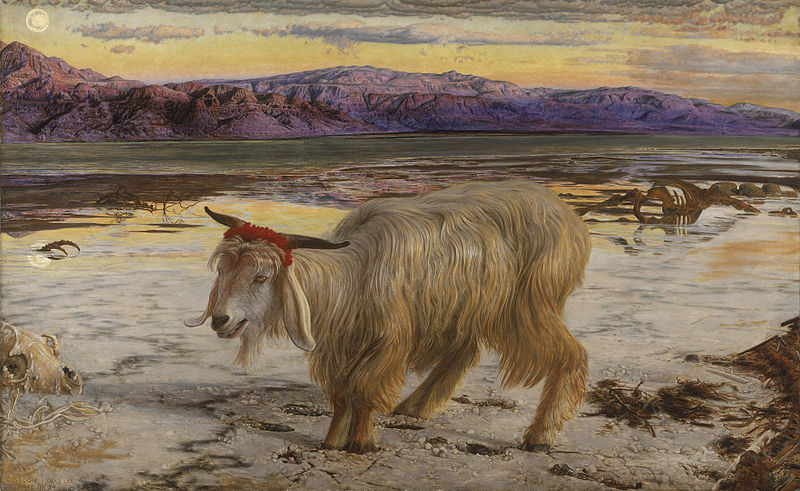
Although Yom Kippur is now over, I have a confession to make. My wife just showed me eScapegoat, the website where you can confess your sins over the virtual priest laying electronic hands on a disturbingly cute animated goat. Even before I owned a computer (or one owned me), and even before I knew of the internet, I used to joke with friends what the technological revolution would mean for religions. Would we eventually go to an ATM for virtual communion? Would the screen glow with the words of the eucharistic liturgy, Rite 1, or would it be more contemporary (Jesus raised the glass and said, “This blood’s for you!”)? Would a physical wafer come through the slot? If so, would it have to have been pre-consecrated? So our bemused musings ran. But our idle thoughts held a touch of prophetic insight, it seems. Can the force of religion come through the keys upon which your fingers rest? The monitor that glows like heaven itself? Whence electronic salvation?

There can be no doubt that religion is a huge topic on the internet. I generally don’t go looking for it, because it will come to me. Religions, by their very nature, spread. They are aggressive memes, wanting desperately to replicate themselves. Our frail human minds want so much to believe that we have found the truth, and once we have, we want to share it with others. Bibles were among the first books off the first printing press. Television soon evolved televangelists. The internet became the home of virtual religion. For some it is reality, nothing virtual about it. Concepts such as grace, however, defy any kind of clear exposé, there’s always shadows in this room. Can it make its way, preveniently, through the wires and waves of the internet?

eScapegoat is lighthearted, but I can’t help but wonder if there isn’t a more serious side to it. Confession on the internet can be cheap. Anonymity (excepting, of course, the NSA) is easily maintained. Your confession, visible to the faith community, is really between you and the Almighty, right? The book of James tells us confession is good for the soul, or something similar. We all know that admitting a mistake has its own cathartic release, but I found confession, in my Anglo-Catholic days, terribly invasive. Surely I knew that I’d made errors, and I knew that I felt badly about them. Did I really have to tell someone else so that I would feel bad about them all over again, reopening wounds that had already begun to heal? Isn’t this the beauty of eScapegoat? You can make a serious confession that others will see anonymously as a joke. Our poor, blinking goat will pay the ultimate price.
800px-William_Holman_Hunt_-_The_Scapegoat


Supernaturally Selected

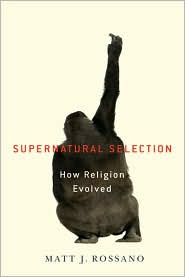
Things are seldom as simple as they seem. Religion, for example, is frequently cast as the villain or the hero of human society, when, in truth, like most human institutions, it is a little of each. I’ve read many theories on the origin of religion, and none has been completely convincing but most contain persuasive aspects while I’m reading them. After having read several books proclaiming the end of religion in the last several months, I just finished Matt J. Rossano’s Supernatural Selection: How Religion Evolved. Many books with a similar goal begin with the suggestion that religion may have had some biological utility for people at one time, but that we’ve outgrown our need for it and we should classify it with other obsolete, arcane concepts that have no further purpose. Rossano suggest that religion grew out of the need for social bonding and that we could not have become human without it.

Basing his ideas on genetics and anthropology, Rossano notes that even with our genetic similarity to chimpanzees there remain striking differences. Mostly they are social in nature. Many of the differences are reflected dimly in our primate cousins, but the human penchant for gathering in groups with ritual behavior to offset overwrought emotions applies only to us. That ritual behavior includes healing rites, something that Rossano suggests might be the earliest, shamanistic, religion. Back in my teaching days I’d been telling students that the earliest evidence for religious behavior dated to the paleolithic period. This is something I’d reasoned from the artifacts found in pre-historic communities. I was happy to find confirmation in a more competent scholar than myself.

While I’ll no doubt revisit some of the fascinating hypotheses of Supernatural Selection over the coming days, one point especially stood out on my initial reading. Religion is a communal phenomenon in what is a largely individualistic society. In other words, religion itself continues to evolve. Even the hermit in his or her cave is only considered religious in comparison with his or her less dedicated, secular compatriots living la vida de fe. Since religion is communal, Rossano suggests, it is impossible to argue someone out of their religion—based on perceived relationships as they are. Indeed, it seems that his hypothesis predicts a behavior we find only too evident when we prepare to line up at the polling booths, but which will immediately fall into the background again once the level is pulled.


WaterFire

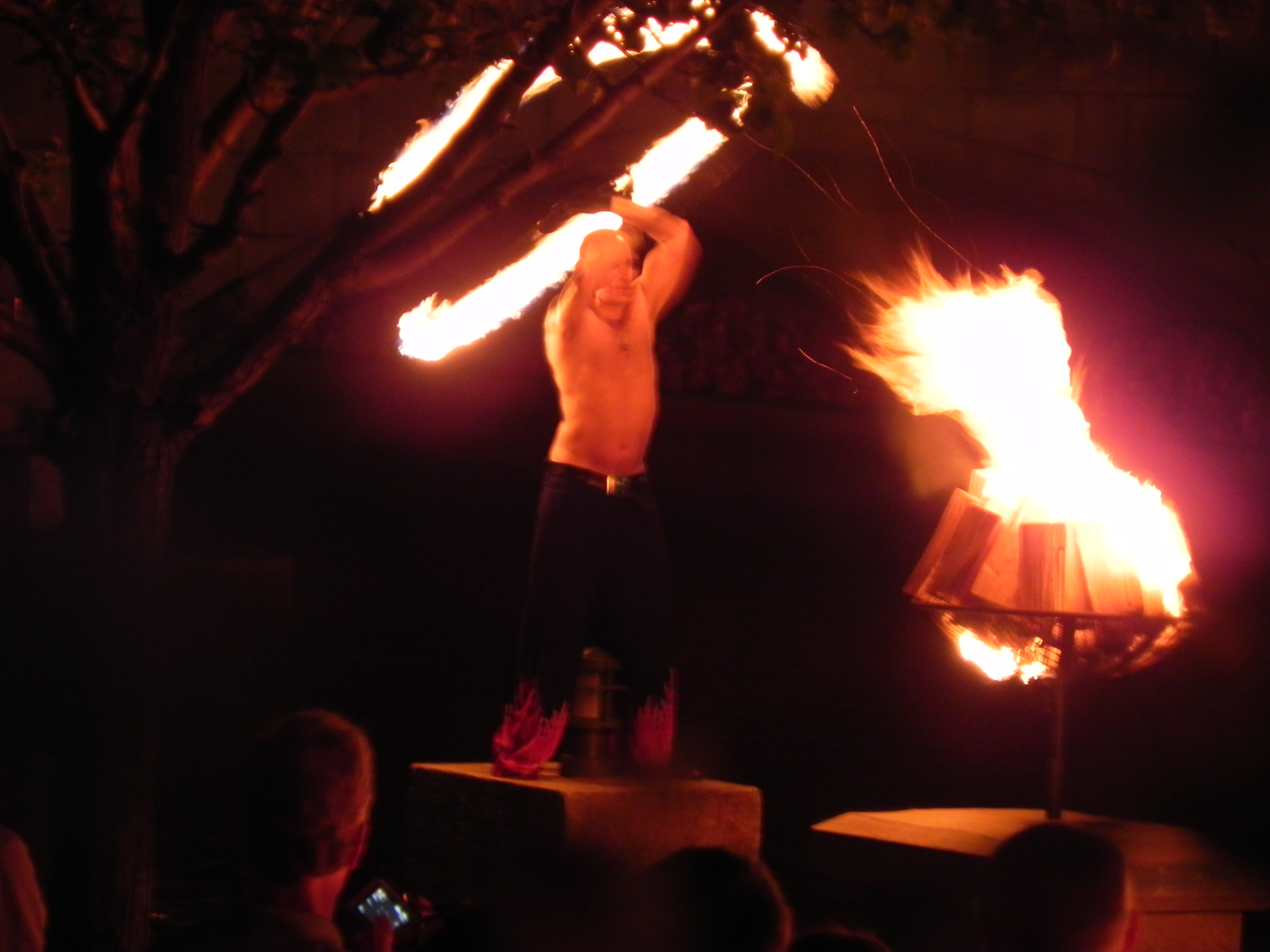
Providence is not always as assured as the divine aid its name suggests. Rhode Island’s capital, like most cities, hosts significant dualities—people who have more than an abundance and those who struggle to get by. There are also those who don’t. In an effort to revitalize the downtown, artists have created WaterFire—an organic sculpture bringing together the pre-Socratic four elements, but focusing on the two encompassed in its name. Great braziers are dot the middle of Providence’s rivers and WaterFire is a new performance art that suggests a religious underpinning. On Saturday, during Brown University’s commencement exercises, WaterFire was performed. Watching fire erupting in the iron braziers as the fire dancer twirled flaming sphere in intricate and dangerous patterns, I felt a primal sense of awe. Indeed, the fire dancer’s motions would be classified as religious by anthropologists in an unfamiliar context.

Religion is generally a response to that which we cannot control. Conscious beings like to think they have some measure of control over their destinies—indeed, people behave that way constantly. It doesn’t take much, however, to demonstrate that our sphere of control is actually miniscule and tenuous. Religions assure us that some cosmic older sibling (whether deity or force or principle) is on our side, watching our backs. Ceremonies propitiate any angry being and bring us back into the graces of elements beyond our control. Is this not the very meaning of the name Providence?

Watching the blazing bonfires tracing the contours of the river, lit by a dancer in time to moving music, WaterFire felt like more than simple performance. Fire is a powerful element, necessary and dangerous to our existence. Water too is crucial, but threatens to overwhelm us as our planet is mostly covered in it. Earth and air often seem the more comfortable elements, often inert and unconsidered. We never confront fire or water in the natural world without giving pause to consider their significance. Whether it is crossing a river or opening an umbrella, water forces itself onto our consciousness. Fire even more so. WaterFire taps into something vital and may just be the real divine guidance that Providence requires at this time.


Crossing Over

The periodic reforms that have swept through the church like so many Massachusetts tornadoes have often whirled around the matter of ceremony. Certainly there have been disputes over obtuse points of esoteric doctrine for which there is no final arbiter, but frequently the rancor involves what the faithful do when they meet together. In keeping with ancient templates, religion is generally a matter of what people do more than of what they believe. I personally had my love of ceremony beaten out of me by its plangent and perpetual repetition at an institution so enamored of it that humans and their needs were viewed as mere obstacles to sacerdotal perfection. Nevertheless, as the school year winds down, ceremony is all around us: graduations, awards dinners, rites of social passage. Last night I attended a Girl Scout bridging ceremony. Bridging is the symbolic crossing of a bridge to indicate a new level of commitment and integration into the larger Girl Scout community.

It's just a bridge.

As I sat staring at the bridge, waiting for the celebration to begin, it occurred to me that this was very much like a religious service. A group of spectators had gathered to watch a ritual unfold—a ritual that involved everyday objects invested with a new significance by the context. The bridge is just a small arch bridge over artificial water; before the ceremony kids run and jump over it with no fear of divine reprisal. Once the correct words are spoken, however, crossing the bridge becomes a solemn act. The ceremony opened with a kind of invocation, a creed (the Girl Scout law), a kind of Scripture reading—complete with exegesis of what that “Scripture” means and a reference to God as creator of all—a sacramental act of transformation, and even a hymn or two. The main difference I felt between this ceremony and most religious events was that the Girl Scouts are far more accepting and affirming than most religious conglomerations. Of course, there is the matter of gender distinction, but what is a church without any exclusivity?

I have great admiration for the Girl Scouts. In the face of a community that continues to act out male supremacy as a matter of God-given right, the Girl Scouts (and other similar organizations) offer a place for young women to assert their sense of belonging. Religion has just as often been used to suppress aspirations as it has been to uplift them. Life is difficult enough without God breathing down our necks. Human institutions that encourage thoughtful regard for those who are different, or underprivileged, or simply overlooked, often fill the gaps that religions callously leave behind. Yes, some religious institutions still display a social conscience, but if we wait for the religious to solve the suffering of the world, it is good to have groups like the Girl Scouts around who actually put their beliefs behind their ceremonies into action.