New Gremlins

I haven’t seen the movie Gremlin in years.  I’m adding it to my Christmas list this year, however.  Probably because I watched Shadow in the Cloud recently.  And although that gremlin wasn’t cute, it led me on a journey of discovery, and that counts for something.  I have to admit, first of all, that I’d never heard of Roald Dahl before a kind family member sent us some of his books when our daughter was young.  We became rather hooked.  His novel The Gremlins was among those we read but there was something I didn’t know (one of trillions of somethings, of course).  And that is that Roald Dahl was probably the reason anyone outside the Air Force knew about gremlins at all.  Dahl was a pilot with the Royal Air Force.  His first children’s book was the aforementioned Gremlins.

Image credit: US Government, public domain, via Wikimedia Commons

I first learned about gremlins from The Twilight Zone.  “Nightmare at 20,000 Feet” came close to giving me literal nightmares.  (And Nope reminds us that there may be things in the atmosphere that we really know nothing about.)  That particular episode was based on a short story by Richard Matheson.  It was also incorporated into the 1983 Twilight Zone movie which I have, unaccountably, never seen.  Of course, I saw Gremlins in a theater back in my college days.  That was before I understood, or really had any interest in holiday horror.  This is one of those instances where the birth of a monster can be traced and its lore can be watched to grow, in real time.

Dahl took something he’d heard about—gremlins weren’t believed to exist by anyone—and made it literal, in the form of a children’s book.  Soon after, other vendors, such as cartoon creators, picked it up.  In the Twilight Zone it began its transition to horror.  Then a regular horror movie was made of them.  All of this has taken place since World War II and there are plenty of people alive who were around at the time.  Shadow in the Cloud was a reboot of a monster generally underused.  There are few times people feel as vulnerable as when they’re flying.  Heck, climbing a tall ladder is enough to give me the willies.  And the movies have shown us that even on the ground we’re not really safe from the monsters of our imagination.  That’s why it seems like a good idea to me to watch Gremlins again.  And to dream of the monsters we invented.

Sweet Morality

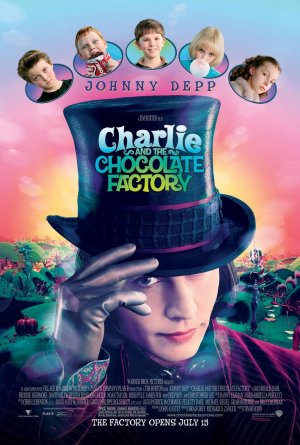
CharlieandtheChocolateFactory When I saw Willy Wonka and the Chocolate Factory as a child, I had never heard of Roald Dahl. Although I enjoyed the movie, it was never a favorite. Like any kid I liked candy, but I’ve seldom been motivated by sweets. I discovered Roald Dahl when my daughter was young, and read for the first time his somewhat more disturbing original version of the story. Tim Burton has a reputation for going back to the roots of beloved childhood characters and revealing their darker sides. When his Charlie and the Chocolate Factory came out in 2005, the appeal went beyond sweets, for this was a modern, if sinister, morality play. While rewatching the movie recently a number of what should’ve been obvious religious motifs suggested themselves. The first came when Charlie Bucket is shown in the main chocolate processing room reaching for a candy apple. Violet Beauregarde steps in and snatches the apple from the tree in a defiantly Evesque move. She later receives her punishment by being transformed into a fruit.

Augustus Gloop receives a strange, chocolatey baptism is what might otherwise be the waters of life. After all, the Oompa-Loompas are shown bowing down in worship to a cocoa bean in a flashback. When Veruca Salt attempts to catch one of Willy Wonka’s nut-sorting squirrels, in a rather disturbing scene reminiscent of Ben, the squirrels pin her down and carry her to the garbage chute. She is carried in classic cruciform style, emphasizing the martyrdom she receives at the hands of her indulgent father. Even Mike Teavee undergoes a kind of resurrection after being atomized and projected into a television.

A friend once told me that the characters in the film represent various deadly sins. Augustus Gloop easily falls into gluttony, and Violet Beauregarde is an emblem of pride. Veruca Salt clearly represents greed, and Mike Teavee is full of wrath. Willy Wonka is part devil and part god in the film, doling out just punishment in a seemingly unfeeling way, while rewarding the few instances of virtue. Deprivation forges virtue in Charlie Bucket demonstrating how clearly the movie is in the realm of a morality play. With its horror film tropes and forays into the truly strange, Charlie and the Chocolate Factory is an example of how morality persists even in the vision of those often considered completely secular. Without it the movie becomes just another excuse to overindulge in sweets.