Nibbles

With a career as prolific as Roger Corman’s was, it’s difficult to keep up.  I knew his horror movies mostly from the sixties and maybe early seventies.  Having stumbled upon Humanoids from the Deep, which he produced rather than directed, I was pointed to Piranha.  I knew about this movie, of course, but never had a reason to watch it.  Well, Corman rabbit holes are easy to tumble down.  Corman was the executive producer of Piranha and since I was already splashed with water-themed horror, well, why not?  As with Humanoids, it has a different feel from movies Corman directed, but some of the trademarks are there.  Piranha has so many shark-sized holes in it it’s not difficult to believe that it was exploiting the popularity of Jaws.  In fact, the movie opens with one of the characters playing a Jaws video game.
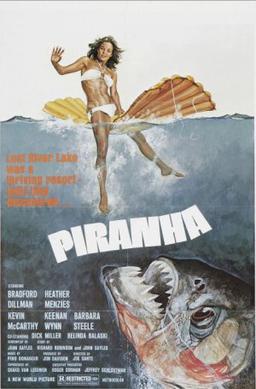
So the government had been weaponizing piranhas to help in Vietnam but when the war ended they kept the program going.  A woman who finds missing persons releases these fish into a Texas mountain stream.  Anyone on the river is in danger and, of course, it flows past a new resort that is having its opening weekend downstream.  The government wants a coverup because the colonel in charge has invested heavily in the new resort.  You get the picture.  Lots of people screaming in the water and a gratuitous use of movie blood and a story that keeps the viewer asking “why?” The film has a way of somehow steering just clear of bad movie territory.  Also, it becomes obvious, that even without appropriate music cues, this is a horror comedy.  I lost track of how many unanswered questions there were within the first fifteen minutes.

Piranha is a sort of fun knockoff from Jaws.  There’s nothing really profound here, although one scene did make way for a little social commentary.  When Maggie (the skiptracer) wants to distract an army guard with her feminine wiles, she wonders if he might be gay.  This was in 1978, well before “don’t ask, don’t tell,” and she asks with a pre-Trumpian nonchalance that it’s downright refreshing.  Otherwise it’s pretty much your typical exploitation film.  The concept has led to a couple of remakes, so watching swimmers getting nibbled to death obviously has some appeal.  The plot is so outlandish that there’s nothing scary here, even though it’s clearly horror.  There’s even a scene with some stop-motion animation of a creature in a subplot that’s simply dropped.  There are worse movies for summer escapism, given that we’re now post-pre-Trump again.

Cut-Rate Black Lagoon

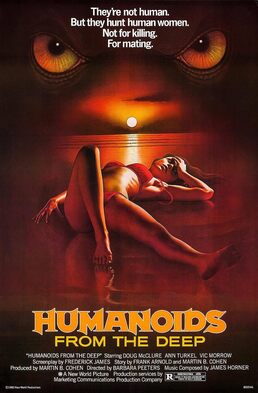
I stumbled upon Humanoids from the Deep while looking for a different film on Tubi.  I had to make a quick decision (don’t ask) and I saw that Humanoids was a Roger Corman movie and figured I knew what I was getting into.  In a sense I was, but B movies can surprise you sometimes.  As the story unfolded my first thought was “this doesn’t look like a Corman movie.”  Indeed, the direction didn’t come from Corman but from Barbara Peeters.  But that wasn’t the end of the story.  What is said story?  Well, it’s a kind of ecological Creature from the Black Lagoon, but with a bit more of a disjointed plot.  A large cannery wants to open in Noyo, California and the local fishermen all like the idea except the American Indians.  Pollution has been driving off the fish and the cannery will make things worse.  From the beginning humanoid creatures have been stalking the town at night.

The creatures start killing the men and raping the women.  The female scientist brought in speculates that a certain hormone intended to grow larger salmon faster had leaked and coelacanths that had been eating the modified salmon became humanoid and felt the need to reproduce with human women.  The creatures were inspired by the Gill Man but have ridiculous tails that give them a kind of Barney vibe.  During a local festival the creatures attack the town en masse and a real melee breaks out, but the creatures are defeated with a combination of high-powered rifles, gasoline on the water set ablaze, and a kitchen knife.  It’s all a bit of a mess.

Apparently Corman felt the movie wasn’t exploitative enough and hired another director to spice it up a bit, having it edited together without the director’s knowledge.  To complicate things, a second, uncredited director had already been involved, so the film has three.  That might help to explain why the story doesn’t really hold together.  As a cheap creature feature it’s not horrible.  It borrows ideas from Alien, Prophecy, and Jaws (and apparently Piranha, which I’ve never seen).   It turns out to be rather nihilistic when it’s all said and done, but the creatures, apart from the tails, aren’t that bad.  There are a couple of legitimately scary moments.  Those of us who watch Corman movies might know to expect some deficiencies, but I was caught off guard by some of the cinematography and even some of the acting.  Not bad for a movie picked with only a few minutes to decide.


X-Rayed

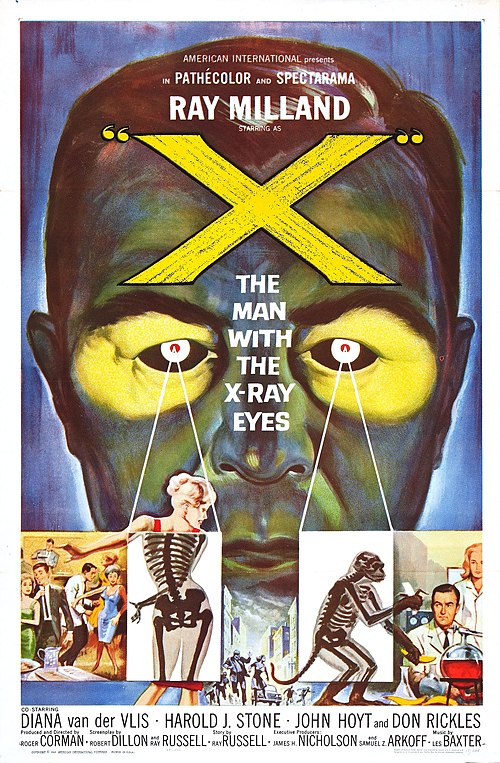
If you’re of a certain age, you’ll remember the comic book ads for x-ray specs.  That’s the idea behind a Roger Corman film that Stephen King thought one of the scariest he’d seen.  X, subtitled The Man with X-Ray Eyes, came out in 1963.  Not to be confused with the X of the modern trilogy, this X follows a Doctor Xavier who develops a formula that allows him to see inside people so that he can accurately diagnose and cure them.  This formula may affect his sanity, however, and he kills a friend who is trying to take the ability from him.  A wanted man, he finds a carnival barker who exploits his gift as a trick.  It was a bit jarring to see Don Rickles in a horror movie, but stranger things have happened.  In the midst of this exploitation, an old friend finds him and drives him to safety.

Then to Las Vegas, where his sight allows him to win unabated.  When the police are called he steals a car and increasingly sees through the fabric of the universe.  He stumbles into a road-side revival where the preacher encourages him to take Matthew 5 literally and he does so as the congregation chants “pluck it out!”  What makes this final scene so arresting, apart from qualifying it for Holy Sequel, is that before the minister tells him to mutilate himself, the doctor says he sees through the darkness to the eye that “sees us all.”  He sees God.  The minister interprets this as the Devil, confusing the most elemental entities that exist one for the other.

The movie has some lighthearted moments, some even apart from Don Rickles.  When the doctor begins to see through everybody’s clothes, it’s presented in a humorous way.  But for the most part, the film is played straight and it manages to raise some serious issues for those who think through the implications.  Our senses evolved to help us survive.  Accessing abilities beyond that is a catalyst for disaster.  Indeed, Dr. Xavier early on notes that he’s approaching godhood because of this newly won ability.  It also means that an individual might know too much.  It seems that at the end he does.  The movie is remarkable even today in several ways.  Technology has made special effects more believable, but the human side of this story remains unaltered.  A doctor wanting to help patients becomes more of a monster than a man, in some respects.  And perhaps the most remarkable aspect is that this is a serious horror film made by Roger Corman for AIP. Scary even to a young Stephen King.


Ending the Cycle

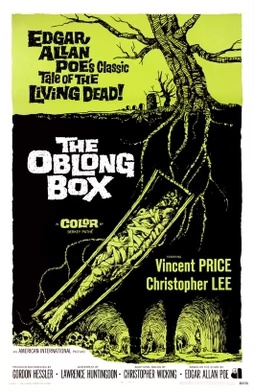
Curious to finish out the “Poe Cycle” of American International Pictures, I looked up The Oblong Box.  The only thing similar to Poe’s tale is the title, as viewers must’ve come to have expected even in 1969.  Poe was the marketing to sell the film, but not much more.  Okay, the theme of premature burial has Poe’s fingerprints all over it, but that’s not part of his story “The Oblong Box.”  Now, as for the movie, it has several subplots and a pretty high body count.  Its ending isn’t really explained, but after starting out as seeming racist, it comes out justifying the actions of the Africans at the beginning.  In the middle it’s a muddle.  Pacing is completely off and some sub-plots, such as the police investigation, are summarily dropped.  Apart from the positive view of Black people, which is important, the film is a confusing criss-cross of unsavory motivations.

The Markham brothers own an Africa plantation and the trampling of a slave by a horse leads to revenge on the part of the slaves.  The scarred brother, Edward, is driven insane and he escapes his brother Julian’s care by being buried alive.  Grave-robbers, however, want him so Christopher Lee can experiment on his corpse.  Edward escapes again and dons a scarlet mask, but his insanity leads him to kill a variety of people, looking for the witch doctor who can cure him.  Meanwhile, an unscrupulous lawyer is cashing in on the brothers’ wealth but ends up being killed by Edward.  There’s a rather pointless bar fight, and, after killing Lee, Edward and Julian finally face off with Edward getting shot but biting his brother before he dies.  The witch doctor raises Edward from the dead, buried in his coffin, and Julian now has his brother’s scarred face (and presumably, his insanity).

The movie was the first to feature both Vincent Price and Lee.  The film had a change of directors, pre-production, and a script that was added to by another writer.  The plot verges on tedious and it’s difficult to feel sympathy for any of the characters, apart from the women, who don’t seem out to hurt anyone.  Price (Julian) also plays a “good guy” until the reveal near the end, but Edward dominates the screen time, all the while wearing a mask.  The “Phantom of the Opera” reveal is shot in the dark, however, and the results are not so grotesque.  And those who’ve read Poe’s story wonder where the ship might be.  This is the only Poe Cycle film not directed by Roger Corman, and he, as well as Poe, are both missed.


Not Plan 9

Dementia 13 is a strange little movie.  It’s Francis Ford Coppola’s directorial debut, and it was produced by Roger Corman and released by American International Pictures.  Like many Corman/AIP movies, it was low budget and quick.  It seems that Corman had some money left over in the budget from a previous movie and he offered Coppola the opportunity to direct a film shot quickly and funded by the leftover funds.  With a script written in three days (and it shows), he set out to film what was intended to be a Psycho knock-off.  The title might give that away, although I’m not sure what the 13 has to do with it, other than being “unlucky.”  Shot in Ireland with mostly American actors, the film is suitably gothic, but the original start to the movie is a red herring.  So what’s it about?

A rich heiress has never recovered from the death of her young daughter, who drowned in the rather sizable pond on the estate.  One of her three sons dies early in the film, setting up a subplot that goes nowhere.  The two remaining sons, unaware of their brother’s death, keep the ritual of the annual acting out the sister’s funeral.  While the widow of the deceased son tries to work her way into the will, she is axe-murdered, bringing this into the horror genre.  The family doctor suspects something’s wrong (although viewers are led to suspect him), and finally solves the crime after another bit character is beheaded.  Part of the problem is the film is too brief to develop the ideas properly.  Released at only 80 minutes, with a 5-minute gimmicky prologue, you really don’t have time to absorb the psychology of the characters.

The influence of Psycho is pretty obvious, the wet woman slowly chopped to death while in the water, is the scariest scene in the movie.  It’s shot in such a way that it’s not obvious that she’s actually being struck until the end of the act (a budget thing, I suspect).  The wealthy widow drops out of the story as the family doctor becomes the self-appointed detective.  Of course, the previous deaths have been undetected, so no actual police come.  In sum, creepy (but not too creepy) Irish castle, siblings working at cross-purposes, a scheming daughter-in-law, and the irruption of the past into the present, along with the black-and-white filming, ofter a quick gothic thrill.  Otherwise, it seems more like homework than an example of foundational horror, but still, it has had inspired a remake, and that’s saying something for a three-day script.


Premature

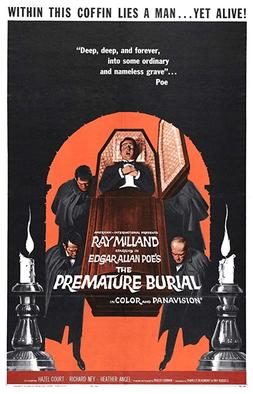
The last, for me (but actually the third), Roger Corman Poe Cycle film is The Premature Burial.  Released the same year as Tales of Terror, it departs from the other Poe films in not starring Vincent Price.  Indeed, this is because it was originally not an American International film, but was later brought into the fold.  This particular story by Poe doesn’t have the superstructure of this film at all.  Indeed, Poe’s tale is spare, beginning with reported events of premature burial and ending with a first-person fictional account.  The movie does have a quote or two from the story, as well as the elaborate preparations that the narrator, in the movie the protagonist Guy Carrell, undertakes to be able to escape his mausoleum.  In the movie Carrell has to be an aristocrat, so as to afford such a fancy contrivance.

Although the screenplay was written by Charles Beaumont, a frequent Twilight Zone contributor, it lacks pacing and contains some improbabilities.  The theme of grave-robbery is also prominent and doesn’t fit well with what actually happens in the plot.  Since the movie is over sixty years old it’s safe to say that it involves a twist ending.  The marriage—missing in Poe—of Emily Gault to Guy is a ruse to get the family fortune by murdering Guy by fright.  Emily exploits his fears of premature burial (his father suffered catalepsy)  to lead to his own premature burial.  The grave-robbers, however, visit Guy that night, not realizing that he was only catatonic.  Guy then takes his revenge, only to be shot by his sister when he attempts to kill an innocent family friend.

Fitting for the Victorian era, Poe used the theme of premature burial in a number of his stories.  “The Premature Burial” is the tale that contains Poe’s famous quote, “The boundaries which divide Life from Death, are at best shadowy and vague.”  This remains true even going on two centuries later.  Accounts of Near Death Experiences (NDEs) complicate our simple binary of life and death.  The movie is, of course, coded as horror and is part of the suggestive string of interpretations that cast Poe as a “horror writer.”  Corman had been growing a reputation as a director of horror (but he, like Poe, worked in other genres) and it was this recasting of Poe into what was developing into a mature cinematic genre that partially solidified the writer’s reputation.  Premature Burial isn’t the best of the series, but I do feel as though I’ve accomplished something by finally having watched all of them.  Or have I?


More Poe

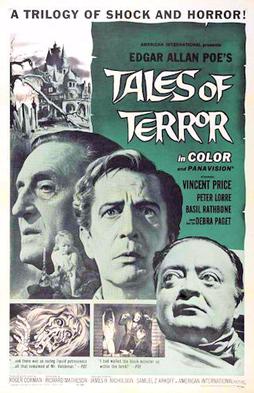
Having admitted to not having seen the entire Roger Corman Poe cycle, I figured I’d better get to work.  I had two movies left to watch and I found Tales of Terror for free on a commercial television streaming service.  As the title indicates, it is an anthology film, bringing together four of Poe’s stories in a three-featurette format.  At the same time, I am trying to catch up on Poe tales that I’ve never read.  More on that to come.  Tales of Terror begins with “Morella,” one of those stories I’ve not read.  There is a danger, of course, in watching a movie first since Corman loved to sensationalize.  I’ll need to wait until I find the time to read “Morella” to know just how much invention there is.  The movie version is an undeserved revenge from beyond the grave story.  Of course it stars Vincent Price.

Although “The Black Cat” gives Price top billing, the story focuses on Peter Lorre’s character, Montresor, borrowed from “The Cask of Amontillado,” with which it’s interlaced (The Cat of Amontillado?).  Montresor is an alcoholic who hates both his wife and cat.  Taking his wife’s money to buy alcohol (something I personally witnessed as a child), he eventually stumbles into a wine tasting convention where he meets Fortunato (Price).  When Fortunato begins an affair with Montresor’s wife it becomes an excuse to wall them both up in the basement.  Lorre plays his Poe characters funny and that makes this segment more a comedy.  Also, there’s a black cat.  The last featurette, “The Facts in the Case of M. Valdemar,” also stars Basil Rathbone.  I haven’t read this story either, so I’m not sure of its fidelity to Poe.  Yet.

The “Poe Cycle” was part of American International Pictures (AIP’s) collaboration with Corman.  Most of the movies were produced quickly and cheaply, although Richard Matheson did write the script for this anthology.  Of course, I hope I haven’t spoiled the two Poe stories I hadn’t read.  I do own an anthology of all of Poe’s fiction, and sometimes it takes movies to make me remove the ponderous tome from my shelf.  (Yes, I’m aware that Poe’s tales are also available for free online, but Poe deserves to be read from an actual book.)  As I’ve mentioned before, I never kept a record of the movies I saw, particularly on television, as a child.  Since the Poe Cycle was still being shown in theaters for part of my youth, I likely missed most (but not all of them) when they were aired on television.  I do remember seeing The Raven decades ago.  At least the internet does allow for a strange kind of resurrection since most of the cycle can be found for free online.


The Cycle

The last of the Roger Corman Poe cycle was The Tomb of Ligeia.  I haven’t seen all eight films in the set, at least I don’t think I have.  A couple don’t sound familiar to me but I didn’t keep track of all the movies I watched growing up.  Although critics were, well, critical of a number of the films, at least three of them weren’t bad.  In that number I would count Ligeia.  The usual problem with making Poe films is that Poe wrote short stories.  Getting them to the length necessary for a feature required padding, sometimes by borrowing against some other Poe tales.  Ligeia isn’t too far off from Poe’s original and although Corman reportedly didn’t want Vincent Price in the star role, because of his age, he pulls off what seems to me a winner.  Atmospheric, and well-acted, the story is a touch slow, but manages to bring in some solid horror themes.

I’ve been pondering Poe as a horror writer lately.  I suspect that the master himself would’ve been surprised, and probably not pleased with the characterization.  Yes, he wrote stories that would become horror hallmarks, but his fiction output included detective stories (a genre he invented), something akin to science fiction, drama, and comedy.  Some of his funny stories retain their humor today.  I suspect that one reason he became remembered as a horror author was H. P. Lovecraft’s adoration of him.  Lovecraft wrote mostly what we consider horror today, although there’s variation there too.  But since Lovecraft saw the horror, so did others.  When Corman began shooting movies he soon fell into the horror trend and, known for that genre, incorporated Poe.  By the end of the sixties, Poe was a horror writer.

What makes The Tomb of Ligeia work is Price’s tormented performance of Verden Fell.  His Byronic character is caught in the realm between death and life.  Unable to free himself from Ligeia, and she, unwilling to renounce her will, they are caught in a belief that a local declares blasphemy while Verden calls it “benediction.”  The theme of resurrection—presented mostly in the form of Egyptian artifacts—is an inherently religious one.  The setting in a ruined abbey—original to Poe—also plays into the sublimated resurrection theme.  Critics didn’t care for the movie, but separating Corman’s Poe cycle out over time allows a viewer to consider each piece separately.  In this light, this appears to be one of the best three.  Of course, I haven’t seen all of them yet.


Not Really Free

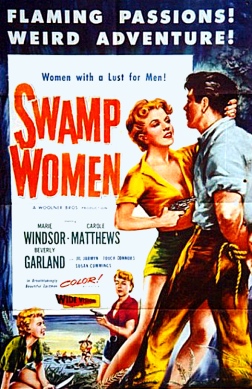
I admit that I’m a cheapskate.  When you grow up poor, that comes naturally.  For some of us the myth of scarcity is less of a fable than it is for others.  Perhaps that’s why I like Roger Corman movies.  Or usually do.  And it’s also the reason that I bought the Classic Features Horror Classics DVD set years ago.  50 movies!  And cheap!  Now, in my defense, I bought this collection before streaming was a thing.  I’d become somewhat addicted to horror movies and renting was pricey and hey, fifty movies!  Of course, they’re public domain.  Some of them are pretty bad.  You can stream most of them for free, but with commercials.  I was in the mood for my fellow cheapskate Roger, so I decided to try Swamp Women (it’s in the collection).  Now, why it was considered horror I don’t know.  It must be pretty difficult to find that many public domain movies in any category.  It was just over an hour and I thought of it as homework.

Three tough-talking cons break out of prison with the help of an undercover cop.  They’re all women, of course.  The cop is there to make sure the stolen diamonds they hid are found.  And to get out alive.  This was a very cheap movie.  The writing is puerile and there are plot holes large enough to row a boat through.  Still, it’s a Corman film.  The only real horror comes from an alligator and a snake—it seems that couldn’t afford more than one of each—and it ends up pretty much as you’ve pegged it will once the endless stock footage of Mardi Gras is over.  What I found interesting, after reading a history of American International Pictures, is that even though co-founder James Nicholson was helping Corman raise money for the film AIP didn’t serve as the production company.  After seeing it, it’s pretty clear why not.

The critics gave this a pretty tough time back in 1956, sometimes noting that it did at least attempt some female psychology.  Really the only psychology on display was who might end up with the one guy they decide to keep as a hostage.  When his girlfriend drowns after trying to steal the only boat, he barely frowns.  I was hoping (I try not to read about movies before watching them) that there might be a swamp monster or something.  I mean, swamps and monsters naturally go together, don’t they?  I guess even those putting together public domain movie collections might be a bit cheap from time to time.  All of us skinflints understand each other, I guess.


Small Things Grow

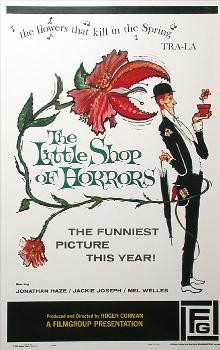
I’ve always been fascinated with origins.  I guess I’m a kid who never grew up.  Now that I’ve turned my attention to movies, I sometimes wonder about the origin of the story.  For example, The Little Shop of Horrors.  I first saw the musical movie version of 1986.  It was cute, and employed horror themes like the Rocky Horror Picture Show from the previous decade.  Then, when Roger Corman died, I read that he’d filmed the story back in 1960.  Curiosity compelled me to watch the original.  Like its remakes, it’s comedy horror, or horror comedy.  But beyond that it’s a literal farce.  Roger Corman was a showman, and that means he tried different things to entertain.  One of them was Little Shop.  The idea of the plot you probably know, but I couldn’t remember the ending as I sat down to view it.  After all, it’s not meant to be taken seriously.

I have to say that the music makes it better in the remake.  The endless malapropisms and burlesque humor are funny, but really in the original they are presented as low comedy.  The Jewish humor was early on I feared might be anti-semitic, although not intended that way.  I empathize with Corman.  It took him nine months to find a company to release the film.  Ironically, it attained cult status after being double-billed as the B movie with Black Sunday, which was a quite serious attempt at horror.  Camp has a way of living on in cult status.  Of course, the early bit part for Jack Nicholson didn’t hurt.  It isn’t bad for a bad movie.

The idea of people-eating plants is a reasonable approach for a horror story.  (I’ve used it myself.)  Plants move very slowly, however, which is one reason that the idea’s hard to accept.  Even The Land Unknown had used the idea three years earlier.  But the seed was planted.  The idea of the film lead to an Off-Broadway show, which led to the more famous movie.  Then it reopened off-Broadway and a reboot was planned (but currently seems to be on ice).  Not bad for a movie based on a desire to reuse a set that was scheduled to be torn down, and then shot in two days.  Classic Corman.  The result was a bad film that is still fun to watch all these years later.  I did miss the musical numbers, however.  When you plant seeds, you never know what might grow.


An Interesting Prize

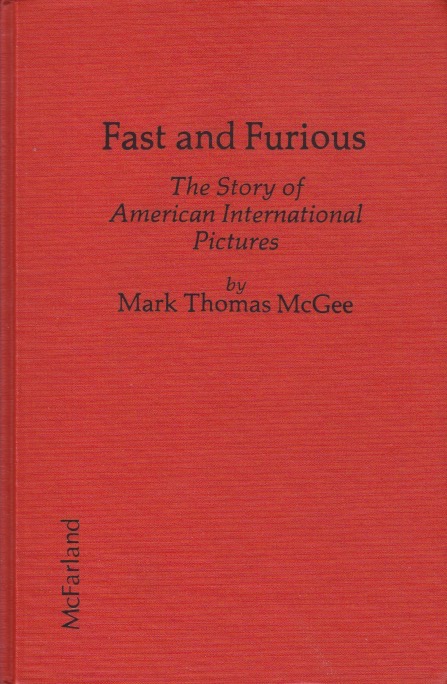
If you’re born without it, you get by any way that you can.  Capital, that is.  Those of us who inherit nothing but active minds don’t stand a chance, really.  Without connections or the cash to draw others in, we tend to be scrappy.  And cheap.  This is probably the reason I’m drawn to characters like Ed Wood, and those who started American International Pictures.  I get the sense that Mark Thomas McGee must be an interesting guy.  After all, he met some of his idols when he was young.  Fast and Furious: The Story of American International Pictures is available in a second edition, I know, but I tend to find first editions fresher.  They say what’s really on an author’s mind.  Besides, used books have their own charm.

Although American International Pictures (AIP) was early on known for fast shooting schedules and cheap effects, it eventually started to earn some mainstream respectability before the company being acquired by Filmways.  Along the way they engaged some famous champions of cheap, such as Roger Corman.  A number of films discussed in this book were part of my childhood.  And as someone who’s always had to live cheaply (I just don’t comprehend finance), I found this an extremely hopeful book.  Some of these folks never became famous in the lifetimes, but they left a legacy.  And that’s a worthy goal.  I suspect that for those of us who can’t break into mainstream publishing, blogging is about building a legacy.  What some of us want, however, is to appear in print.

And I mean in print.  The book is an object.  I bought this one used.  I sometimes find interesting things in used books.  The former owner of this one (a McFarland hardcover!) carefully glued postcards of AIP movie posters to the covers and endsheets.  They didn’t put their name in it, but they (in pencil) ticked off the movies, presumably that they’d seen, from the filmography.  This is a person after my own heart.  I tend not to write in most books anymore, realizing that someday someone will probably sell them and, hey, it’s hard enough to make money in the book business.  But this personalization is something you can’t find in an ebook.  No, a book is meant to be held and loved.  This one clearly was.  As publishers chase more and more after electronic and audio books (the latter of which are also electronic) and learning moves from reading to watching, we’re losing something.  They’re called books, and they bear their own meaning.


The Movie Maker

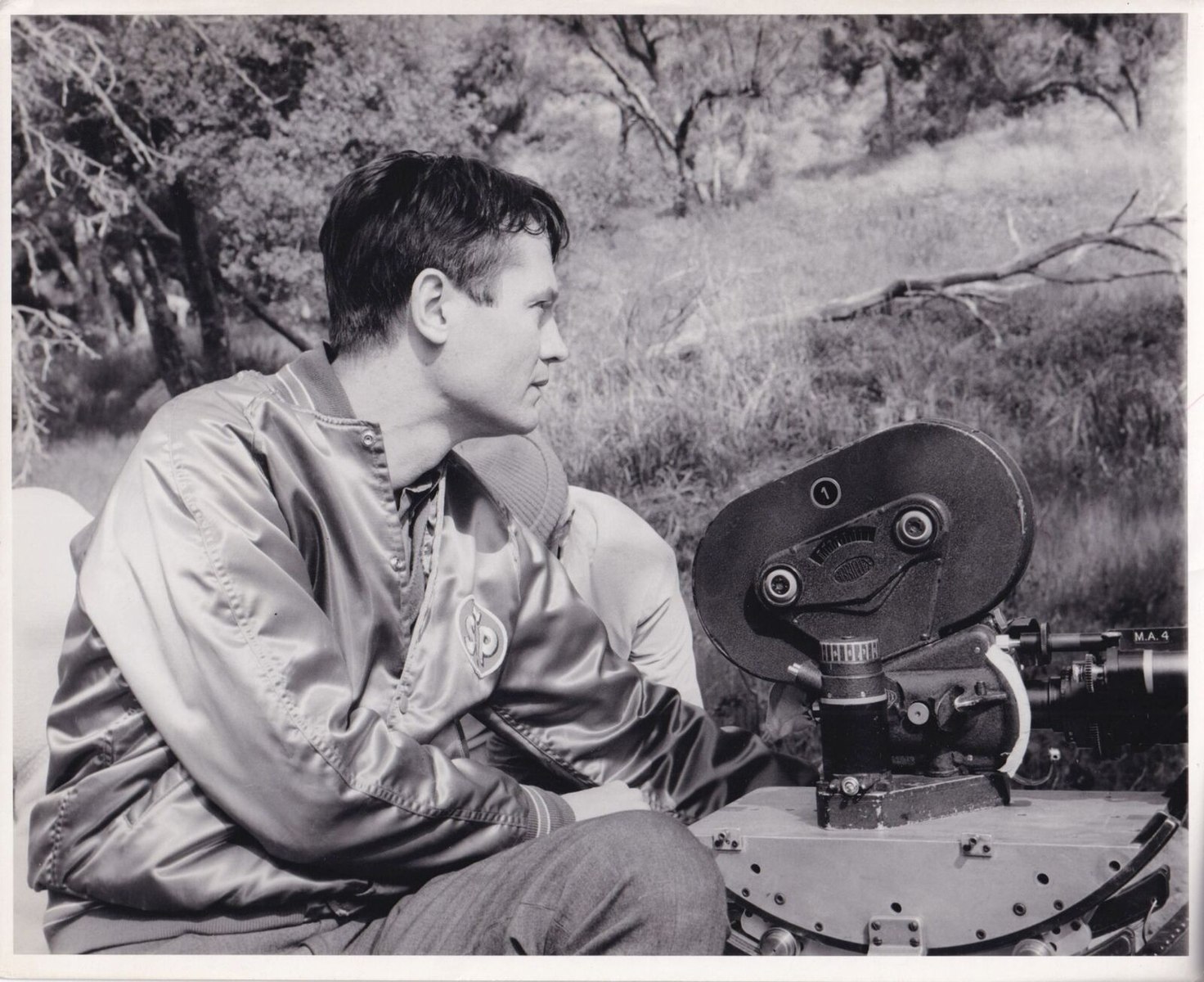
Roger Corman has died.  So passes an era.  I’ve always had an appreciation for the speculative films of the fifties and sixties.  Many of these involved low budgets and content intended to shock.  Or at least excite youngsters.  And Roger Corman was a huge name among directors, producers, and promoters of such schlock.  He entered the realm of horror in 1955 with Day the World Ended.   Attack of the Crab Monsters a couple years later put the focus firmly on monsters.  Producing and directing three or more movies a year, he built a reputation for being cheap and quick, but that didn’t prevent him from creating some good movies.  A film’s producer is the one responsible for overseeing the production.  Often they come up with the ideas of what to film.

Roger Corman, publicity still; public domain via Wikimedia Commons

As the sixties were dawning, Corman produced several films “based on” work by Edgar Allan Poe.  I remember seeing some as a young person and wondering what they had to do with the Poe I’d been reading.  Still, he managed to grace cinema with House of Usher and The Masque of the Red Death.  These are good films, despite limitations.  At the same time, Corman was still producing creature features as well, wracking up an impressive list of nearly 400 produced films.  As an established player in cinema he also took on the role of distributor from time to time.  When The Wicker Man was being ignored in Britain, Corman undertook the role of US distributor, likely saving the movie from total obscurity.

Circling back to Day the World Ended, we’ve become accustomed to believe that some kind of divine or human ending is in the offing.  These ideas get embellished over time, as I suggested in my new piece on Horror Homeroom.  Corman knew that this putative end would get the attention, whether or not there was any truth to it.  Perhaps that was the genius of his work—he knew how to attract attention.  And he wasn’t afraid to do so.  The business of cinema is one of attracting viewers.  Telling stories we want to hear.  We remember reading Poe, and even if the movies differ from the stories he penned, they are nevertheless reminders, reminiscent of what we’ve read.  If there are monsters they are somehow perhaps even more effective for not really being believable.  In short, Corman was a showman.  He made a living doing what he loved.  And he influenced many lives along the way.


Black Bird

Although we prefer typecasting—it’s so much easier!—Edgar Allan Poe had both depth and width as a writer.  He penned funny as well as scary, love poems and detective stories, even something like a scientific treatise.  One thing I’m sure he didn’t anticipate was his name being suborned for cheap horror movies.  Roger Corman is a Hollywood legend—a good example of a guy making it in the film industry on his own terms.  He paired Vincent Price with a number of Poe titles that had little to do with the actual works of the writer.  One that oddly stayed with me since childhood is The Raven.  This was well before I’d read the poem.  It’s funny how very specific things will stick in your mind.  I remembered the strange hat Price wore.  And I remembered—misremembered, actually—Price using a spinning magical device with sparklers.  Misremembered because that was Peter Lorre’s character, not Price.

That was it.  I didn’t remember that Boris Karloff was also in the film.  I was too young (as was he) to recognize Jack Nicholson as well.  Although I watched The Twilight Zone, I didn’t realize the script was by Richard Matheson.  This film was loaded with talent, but it really was goofy.  I recollected Price was a magician, but I didn’t know this was a rather silly battle to become chief magician.  Lorre’s ad libbed lines were surprisingly funny, even after all these years (I was about one when the film came out).  Surprisingly, the movie did well at the box office, despite its taking a sophomoric approach to perhaps Poe’s most serious poem.  

I’d avoided watching it again for all these years because of that sparkler scene.  I’m not sure why that particular moment wedged itself so firmly in my young brain.  It seemed so not Poe that I couldn’t get back to the movie, apparently.  With Price and Lorre camping it up—Karloff was, by all accounts, most professional as an actor—and Nicholson uncharacteristically timid, the cheap special effects, it’s obvious that viewers enjoyed a good laugh at this one.  It’s not true to Poe, of course.  It’s true to Roger Corman, however, a filmmaker who knew how to deliver cheaply and quickly and still earn some money at it.  I’d last seen The Raven about half a century ago.  I may be tempted to watch it again, after having seen it as an adult, but if I wait too long I’ll need to leave that duty to someone who’s read this and who isn’t afraid of sparklers. 


More Water Monsters

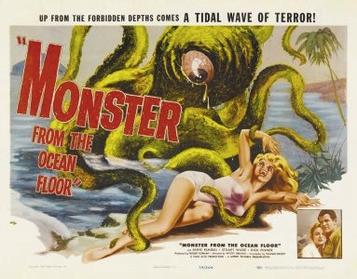
Monster from the Ocean Floor, one gets the sense, wouldn’t have merited a Wikipedia article were it not for the fact that it was the first film Roger Corman produced.  Despite its B-movie quality, there’s quite a lot to like about it.  First of all it has a strong female lead.  Julie Blair is the only gringo in Mexico to believe the locals that there’s a monster just off shore.  Steve Dunning, the scientist, is an avowed skeptic.  The plot is cheesy—the monster is an overgrown amoeba irradiated by the Bikini Island underwater nuclear tests, and it’s killed by getting a submarine in the eye—but there are some very effective cinematographic moments.  When the young boy talking to Julie in the opening turns to stare at the ocean where his father disappeared, the framing and emotion are perfect.

The theme music for the approach of the shark, and then the amoeba, anticipate Jaws by a couple of decades, and I have to wonder if John Williams hadn’t watched Monster from the Ocean Floor.  (I’m sure even cultured people watch the occasional B-movie.)  There’s also an unexpected religion angle.  A series of episodes in the film have a couple of locals trying to kill Julie as a sacrifice to the monster.  Despite the holes in the plot, it’s remarkable that in 1954 there could be dialogue suggesting that the Christian God (“the other god” according to a local woman) isn’t the God that Quetzalcoatl is.  All the same, the sacrifice is based on the folklore that the sacrifice of the “fairest” (Julie is, naturally, blonde) will appease the monster.  Maybe not the most solid theological basis, but still, not bad for a bad movie.

I’ve recently published a piece on Horror Homeroom about women and water monsters.  Having a strong woman in a 1954 film is especially remarkable.  Julie, despite the skepticism of the scientists, takes the initiative to dive right down and see the monster for herself.  It’s only when she comes up with physical proof that the men consider that she may be right (and in danger).  Of course, the men do have to rescue her—you can’t have it all.  Yes, it’s a cheaply made movie with a paper-thin plot but it was beginning to show that a woman could take the reins and with good motives (if nobody else will do something about the monster, she will).  Although she’s the love object of the movie, she’s so much more.  And a submarine in the eye—that’s gotta smart.


Flavor of Childhood

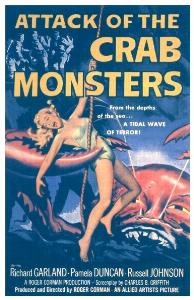
Giant, telepathic crabs whose molecular structure make them impervious to bullets, explosives, and fire, and that know how to use dynamite and who plan to take over the human world?  A group of scientists trapped on an irradiated Pacific island that is slowly sinking into the ocean?  This must be Attack of the Crab Monsters!  I was born during what is generally considered the dearth  period of the American horror industry.  Roger Corman, however, was working hard outside of the studio system to cater to that new demographic—teens with spending money.  Drive-in theaters were big and for about $100,000 you could shoot a double-feature and bring in ten times that much.  If you shoot quickly enough you can produce several of these in a year and not have to worry about the big studios.

It’s been fashionable to laugh Corman off, but he knows how to live the teenage dream.  Monster movies were part of the childhood of many of us during this “dearth.”  Yes, sophisticated frights were yet to come, but these creature features were full of creativity and escapism.  And so many unanswered questions.  How did those giant crabs chop all the radio wires to bits with those indelicate giant claws?  If they could smash through the outside wall of a house, why couldn’t they break through a light-weight door once inside?  And why, knowing that bullets and grenades can’t possibly hurt them, do scientists keep firing away?  What was that oil subplot all about anyway?  And how do you end a film with the lines “He gave his life,” followed up by “I know”?  This is stuff, like Strawberry Quik, I couldn’t get enough of as a kid.

No, this wasn’t intelligent horror—it was often laughable—but it made an impression.  As an adult I can’t recall which of these movies I’ve seen before and I suspect it would take a lifetime to watch all the films Corman directed or produced.  Along with his contemporary indie director/producer William Castle, Corman may be inordinately responsible for my tastes as an adult.  I’ve grown more sophisticated (I hope) in some ways, but I’m at a pay grade where free on Amazon Prime often decides a weekend’s entertainment.  Besides, these movies struggle to top out an hour’s running time.  You can still get a lot done in a day and still have time for a monster crab, giant leech, or wasp woman.  With enough radiation, and imagination, anything can happen.