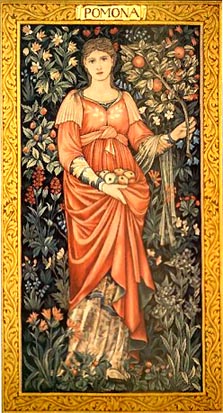
O Pomona!

Ancient goddesses have long been a fascination with me. After writing my Edinburgh dissertation on Asherah, and taking employment at an Anglo-Catholic seminary that venerated the BVM – Blessed Virgin Mary, and not some underwear brand, as I had supposed – I realized that male-dominated religions still recognize the need for the sacred feminine. In my recent post on Halloween, I mentioned the Roman goddess Pomona. Roman religion is generally not treated with the finesse of classical Greek mythology, but it represents an important part of our western heritage. Pomona is an etiological goddess. Etiologies are stories of origins, and like other goddesses of the ancient world Pomona was used to explain the mysterious ways of nature.

The story that best describes Pomona is preserved by Ovid in his Metamorphoses. Pomona is one of the virgin goddesses, specifically the goddess of fruit. She has no known Greek antecedents. The myth involves her devoted chastity and her commitment to ripening fruit, particularly apples (and sometimes pears). Shunning all lovers, she was eventually wooed by Vertumnus, the god of changing seasons. Disguising himself as an old woman, Vertumnus visits Pomona and tells her of the wonders of love and of the attributes of Vertumnus especially. Eventually Vertumnus reveals himself, and Pomona, delighted at what she sees, loves him. Of course, apples ripen and seasons change. Winter is soon to come once the apples fall from the tree. The goddess has been subdued by masculine designs.

So it often is with goddesses. Men recognize the need for the divine feminine, but fear it and attempt to tame it. Pomona, however, survives. One of the memorable objets d’art at Nashotah House, where I sat in that chapel for over a dozen long years, was a frieze of the BVM. More technically, a Madonna and Child. The frieze hung over an altar in a side chapel behind the choir, so most people didn’t spend much time looking at it. Mary, holding Jesus, was surrounded by a frame of fruit rendered in plaster. Apples were prominent among them. There are those who suggest that apples show how Mary overcame the heinous sin of Eve. I believe, however, that the fruits surrounding the virgin demonstrate that Pomona, the virgin goddess who eventually succumbs to the advances of the male deity, still has a place in the patriarchal world of Christendom.

St. Valentine’s Day

In keeping with my holiday series for young people, I present here my lighthearted essay on Valentine’s Day. This holiday was actually the starting point for the book project. My daughter had to do a school paper article on the holiday and had a difficult time finding information on the history of Valentine’s Day that was suitable for children. I starting writing this book at that time since there was nothing on the market. Still isn’t. In any case, here goes —

Hearts and cupids and tasty candy are a long way from the origins of this holiday! To get a grip on St. Valentine’s Day we have to go back to the Romans again. Remember that the Romans took over the known world in the first century B.C.E. Nobody has accused the Romans of having a great sense of humor! Like most empire-builders they had the serious business of looking out for their own best interests in mind.

Before Constantine (if you skipped New Year’s Day, there’s more there) the Romans worshipped lots of gods. Their religion didn’t really have a name, but it had plenty of gods, gods to spare even! So when they conquered the land where Jesus would show up, Judaea (aka “Israel”), they didn’t really need any more gods. There were so many religions around, in fact, that the Romans hated new religions.

One of the favorite Roman sports was killing Christians, because Christianity was a new and illegal religion. By a remarkable coincidence two guys by the name of Valentine were priests in the early days of the church. Although St. Valentine’s Day gets cootie points for some, the name actually means “valiant.” Well, these two Valentines were both traditionally killed on February 14 in the 200s (C.E.). So Valentine’s Day starts with blood and gore!

Read the rest here (under Full Essays).


A Sigh for Cybele

As we fall out of the holiday season into that distinctly chilly and sometimes cheerless February, Cybele comes to mind. Over the past several weeks I have added posts focused on the holidays associated with December and January. In the course of my research for a children’s book on American holidays (not published), I was astonished at how frequently Cybele appeared among the origins of current holiday practices. Having researched ancient Near Eastern mythology long enough to complete a doctorate in the field, and to write a book on an ancient goddess (Asherah), the lack of reference to Cybele in my sources was unexpected. I pushed this question mark to the back of my mind, but as I was reading H. P. Lovecraft’s story “The Rats in the Walls,” I found Cybele once again.

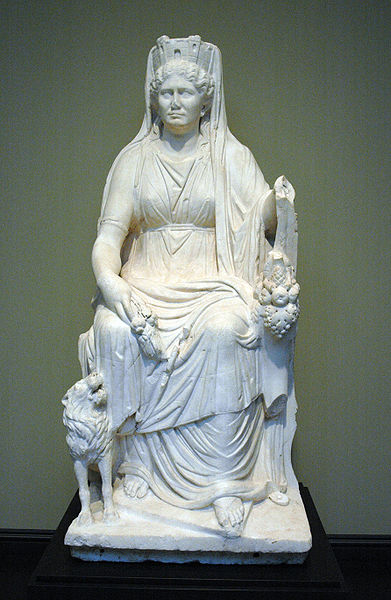
Cybele eventually became a major Roman goddess, although she was never among the Greek Olympians. Her importance shows in her connections with several Roman festivals and practices of antiquity, some of which have survived even to the present. Greco-Roman adherents to Cybele worship considered her to have been of Phrygian origin. Many scholars, however, see in her name and character echoes of a Semitic goddess named after Gebal, or the native name for Byblos in Phoenicia. If so, she is one further piece of the puzzle connecting the classical world with that of the fertile crescent.

Wikipedia Commons Cybele

A standard title for Cybele was Magna Mater, or “great mother.” As such, she was frequently associated with the earth itself, widely considered to have been a primordial female deity in the ancient Near East. In many respects she resembles Asherah, although the two are never explicitly identified. In myths where she is associated with Atys (later Attis), she becomes the spouse of a “dying and rising god.” She is prominent in festivals around mid-March, at the time of the renewal of fertility in the Mediterranean basin. Matronly, stolid, and powerful, Cybele lurks in the background of religious sensibilities. Her association with spring offers something to look forward to as the overly long, yet short, month of February starts to become visible.