Dark Library

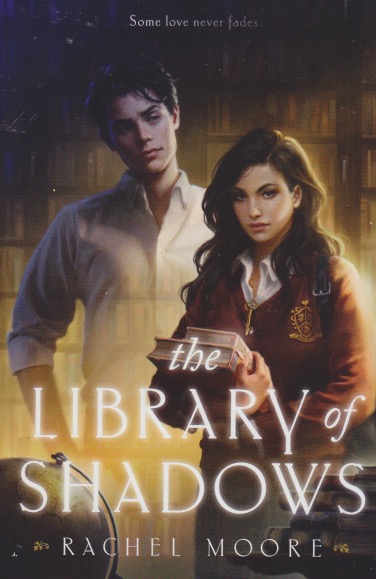
Although it’s booming, I’m not a romance reader.  Not in the modern sense, anyway.  I’m a big fan of the Romantic Movement, which gave us the gothic novel, but the distant descendant of the latter is dark academia.  And dark academia is what brought me to Rachel Moore’s The Library of Shadows.  That, and ghosts.  I’d read somewhere that this novel (probably classified as young adult as well) brought dark academia and ghosts together and indeed it does.  I’m finding dark academia to be quite liberating.  I may no longer be a card-carrying member of Club Academe, but that setting is never far from my mind.  Enough about me.  Here’s the story: Este is a student at Radcliffe Prep, reputed to be the third most haunted school in the country.  She doesn’t come from money, however, since her father, a former Radcliffe Prep student, died prematurely and her mother has gone in search of anything that might remind her of him.

Este, unlike her wealthy cohort, isn’t sure how she fits in.  She doesn’t believe in ghosts.  Until she falls in love with one.  (This isn’t really a spoiler since it’s on the back cover copy and you can infer as much from the cover art.)  The story revolves around how to resolve that tension.  I’m sorry to admit that I’m not sure if “fades” are a traditional kind of ghost or if they were invented for this story, but they are behind the somewhat-horror elements to the tale.  Moore lays out the rules for her ghosts: they can’t walk through walls (so they can be locked out of a room), they tend to be not seen in natural light, but artificial light brings them into view, if they want to be seen.  And those that inhabit the library at Radcliffe, have bodies that can affect the physical world, but they can’t connect with anything living.  The fades are much worse: they kill mortals.

Moore’s story is a romance and a fantasy, but it is fun to read.  As a first book it has the freshness that somehow fades when writers become too jaded with the system.  (As someone who has tried repeatedly to get fiction published, believe me, I know.)  I suspect those looking for serious adult fiction might find it on the light side, but romance does have its attractions.  Since this is for younger readers there’s nothing too explicit here.  Just a story that keeps you interested as the pages turn.  And if romance has ghosts, and fits dark academia, I wouldn’t rule out reading more.

Godic

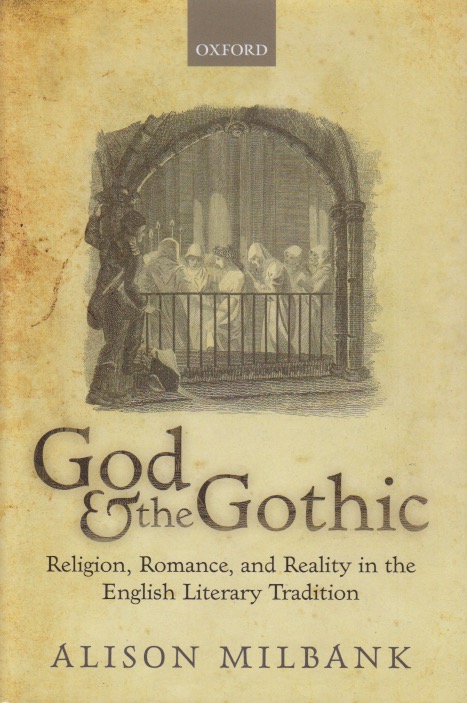
I have tried, in my halting way, to articulate what religion has to do with horror.  Alison Milbank is more experienced than I and it shows in her book God and the Gothic: Religion, Romance, and Reality in the English Literary Tradition.  There can be little doubt that the gothic is the direct ancestor to what became horror in the twentieth century.  In this intriguing study, Milbank explores just how the gothic made extensive use of religion, a sensibility that has carried over into modern horror.  Having taken a good long look at this myself—the fascination was there before Holy Horror and reaches back to my childhood—it is nevertheless affirming to find another student of human fears and fascination regarding the darkness has come to similar conclusions.  I always walk away from books like this with a renewed reading list.

Milbank points out, in the context of the literary world of England, how horror and religion not only cover the same theological ground, but come into direct contact time and again.  She does so by suggesting that Protestantism constantly seeks the lost Catholicism.  In England this came to be embodied in the Church of England, the middle way between Catholic and Protestant.  She covers various aspects of this such as melancholy, the doubling of characters, supernatural creatures, and death.  And more.  This isn’t a quick or light read, but I found myself making many connections I had missed.  Much of this, admittedly, came in books I’ve not read.  One of the problems with interest in the classic gothic is that bookstores don’t cater to selling older books and some of them weren’t successful in their own day, let alone ours.

There is a vindication in finding you’re not alone in a field.  Many of us who work on religion and horror know one another.  We’re a somewhat small, hidden group.  Milbank approaches all of this from the point of view of theology.  Theology is a somewhat distinct practice from religious studies and even from biblical studies.  There is overlap, of course, but theology is generally distinctly Christian in a context like this.  And that fits the living context of the many authors explored in this study.  Many familiar, and a few unfamiliar names appear.  What they have in common, apart from making up the cadre of gothic writers, is that religion influenced their writing and they weren’t shy about noting it.  This book explores the shadows very well and I’ll be revisiting its insights again and again.


Dark Lite

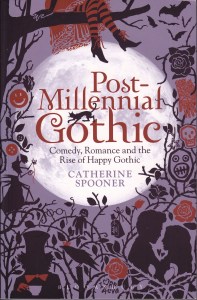
Maybe you’ve noticed it too. While certainly not universal, many forms of Gothic cultural expression (novels, movies, television, etc.) have a playfulness to them. As if taking the genre too seriously might be a misrepresentation. Even Edgar Allan Poe can be caught smirking from time to time. I’ve often wondered about this unusual combination of darkness and light. Catherine Spooner obviously has too. In Post-Millennial Gothic: Comedy, Romance, and the Rise of the Happy Goth she takes on a number of these cultural expressions—both Goth and Gothic—and tries to understand the lighter side that they often present. Sometimes it’s comedy and sometimes it’s irony, but those fascinated by darkness aren’t always as gloomy as they seem.

This book is a real hodgepodge of both British and American explorations of the smiling dismal. It’s a cultural contradiction, maybe, but it certainly feels authentic if you look closely enough. Although Spooner doesn’t discuss it directly, I couldn’t help but think of that great progenitor of the Gothic—the medieval church. Perhaps it was the very real fear of the plague and the nearly constant warfare of the time in Europe, but liturgy, when done right, has a palpable darkness to it. References to ourselves as “miserable sinners” begging God to “have mercy upon us” clearly call to mind some of the deeper elements of the Gothic sensibility. Having attended Anglo-Catholic services for years I came to know many who were compelled by this intensity. A Gothic chasuble is a thing of beauty forever.

Spooner, however, focuses on popular culture. Beginning with the Goth movement of the 1980s, a subculture formed that brought much of this darkness to light. She’s careful to point out that being Goth isn’t the same as being gloomy all the time. It is an expression of creativity, and, as Spooner notes, closely associated with Steampunk. Such things, however, require a recognition on the part of participants that in order to taken seriously, such expressions must become part of daily life. There are risks, however. Even in enlightened cultures we are not yet fully tolerant of those who are different. And really, much of the book is about this—accepting those who are not like ourselves. There is quite a bit going on here that’s beneath the surface. And depth is something the world could use a bit more of. There’s nothing wrong with having some fun while acquiring it, either.