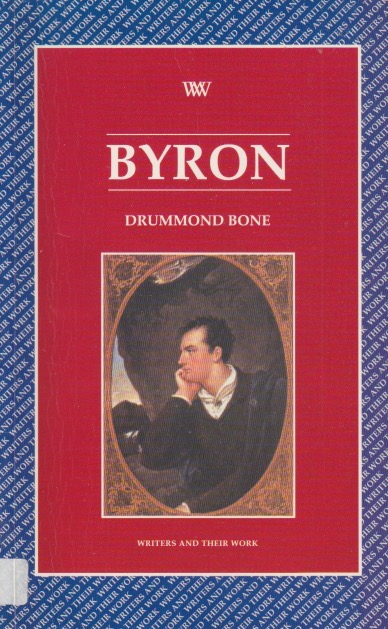
A Different Lord

I just wanted to learn the basic outline of Lord Byron’s life without having to commit to the hundreds of pages most of his biographies boast.  Something brief, but authoritative.  Something for which I could be sure the author was vetted.  I hadn’t read any of the Writers and their Works series before.  It gets good reviews and here was the story of Byron in less than 100 pages!  I was excited to get started.  Then I discovered this is mostly about his poems rather than his life.  It contains 21 pages of biography and 60 of poetic analysis.  I really should’ve checked more reviews.  I’m not really into poetic analysis.  I know that those of us who create tend to think of our creations as extensions of ourselves.  I’ve made 3-D art (kind of like sculpture), I’ve drawn, I’ve painted, I’ve written.  These are parts of me that exist in the world.  But really, I just wanted to know what Byron’s life was like.

Actually, I did learn the answers to some of my questions.  Although a “lord,” he didn’t inherit much wealth.  Indeed, the opposite.  His eventual wealth came from his poetry.  This is nearly an impossible dream these days, of course.  His fame brought the spotlight onto his personal life and politics.  A man who easily “fell in love”—he was a Romantic, after all—he had affairs and his politics weren’t those of the majority.  He left England at the advice of a friend, never to return.  He was friends with Percy Shelley, which is common knowledge.  As he made a home, actually several homes, in Europe, he continued to earn good money for his poems.  He was famous and feared, it seems.  Although the book doesn’t describe it, he gave the world its Byronic hero.

I haven’t read much of Byron’s poetry.  That style of writing has never appealed to me.  The poetic life, however, is of endless interest.  Shelley drowned on a boat trip home after visiting him in Italy, and Byron was present at the cremation.  (And I got yelled at in the New York Public Library for trying to snap a picture of the fragments of Shelley’s skull that were on a special display.  Byron had been there in person, of course.)  A few short years later Byron also died while helping to plan and finance the Greek war for independence.  Still, there is more I’d like to know.  But probably not enough to read a biography of several hundred pages, though.

Human Humanities

The New Yorker, if it didn’t take so much time to read, would be on my magazine list.  I’m primarily a book man, and there’s so little time these days that magazines seem mere ephemera.  However, someone at work pointed me to a story on the end of the English major that was really about the end of the humanities.  It was most disturbing.  Making the case that college students really prefer the humanities, they nevertheless go to STEM because that, and business, are the only place to find jobs.  In a world where work increasingly demands more hours a day, these young people take employment that kills their souls in order to keep their bodies alive.  The “starving artist” is no joke.  Society has deemed humanity unimportant.

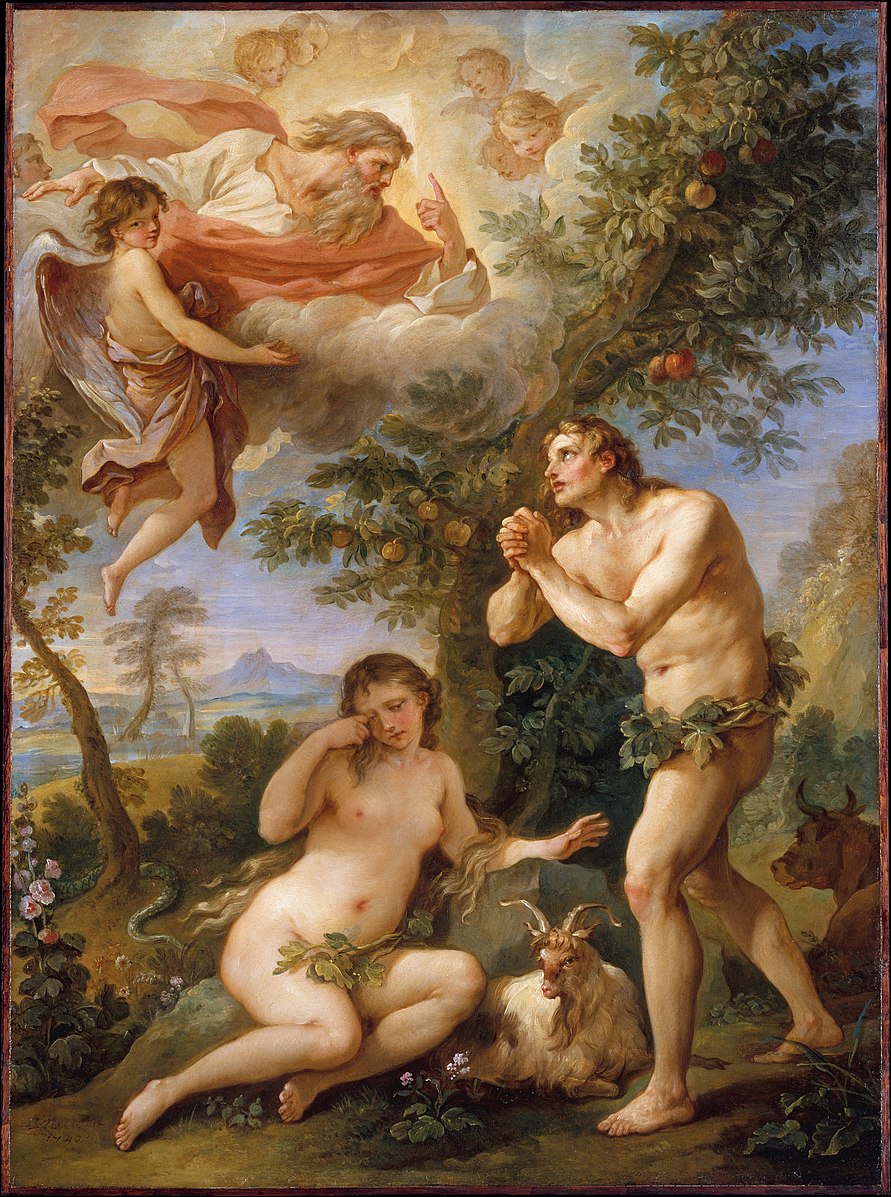
The Rebuke of Adam and Eve, by Charles-Joseph Natoire, Creative Commons CC0 1.0 Universal Public Domain Dedication, via Wikimedia Commons

What happens when we cease to be human?  Artificial intelligence and robots and capitalism.  It’s a cold world where only numbers matter.  I’m not a great one for metrics and “evidence-based” humanities.  No, Romanticism is not dead.  The world where imagination reigns and Adam Smith is not even a shiny shekel in his great-grandfather’s blue eye.  How do I know it was blue?  Imagination.  You see, I’ve written a few novels (unsuccessfully), and I know a few (very few) colleagues who do as well.  Mainly I know that because their novels find publishing houses that know how to get them in the public eye.  I jealously guard those friendships because I’m a Romantic.  I tilt the electronic windmills telling me all of life is statistics and figures.  No, those slowly spinning blades are liable to chop your head off, if you let them.

My friends often express surprise when I reveal that I’m a Romantic.  Books should be evidence enough.  Ideally, work would allow us to bring our gifts to the table—or more accurately, screen.  It would find a way of saying, “be human here because we really mean what we say about diversity and inclusion.”  Instead, evaluations are metrics-based.  The numbers.  The bottom line.  At moments such as these, I throw off my hat and let my thoughts run free.  I daydream about the books I’ve read and those I’ve written.  I imagine life as a place to truly be human.  The humanities are all about understanding what it means to be authentically human.  And let me tell you something—it’s not all about numbers.  In fact, if I had it all to do over again, I think I would be an English major.  With no regrets.


The Romantics

It takes one to know one—or so they used to say.  My current preoccupation has me learning about the Romantics.  This isn’t the same as “romance,” although both words derive from the Old French for “verse narrative.”  Novel, in German, is Roman.  In any case, Sir Walter Scott cordially embraced Washington Irving when the latter arrived unannounced at Abbotsford.  Reading the account in Irving’s own words, it sounds like a bromance, and some modern interpreters—inclined as they are to look for genital contact—have suggested Irving, a lifelong bachelor, might’ve been a homosexual.  Although there’s nothing wrong with that, I do wonder if it misunderstands the language of the Romantics.  To borrow a sentence from Andrew Burstein (more to come anon): “This had to do with intimacy, not sex as we understand it.”

I recently gave a talk about Herman Melville’s spiritual orientation.  I mentioned his close friendship with Nathaniel Hawthorne.  During the discussion period the question of whether they might’ve been lovers was raised.  I’d read this before.  I don’t know what went on in Melville’s bedroom—it’s none of my business—but I think the Romantics were all about intimacy.  We’re now familiar with the genre of bromance.  Guys, usually two, pairing off for pursuits of significance to both of them.  Or two women. I think of all the great same-sex pairings throughout literary history and wonder where we’d be without them.  Since our culture has long demonized sex, our mind is constantly creeping between the sheets.  Who touched whom?  Where and when?  Isn’t intimacy enough any more?  Where’s the Romance?  I’m no prude, but I wonder if we misread sex and the Romantics.

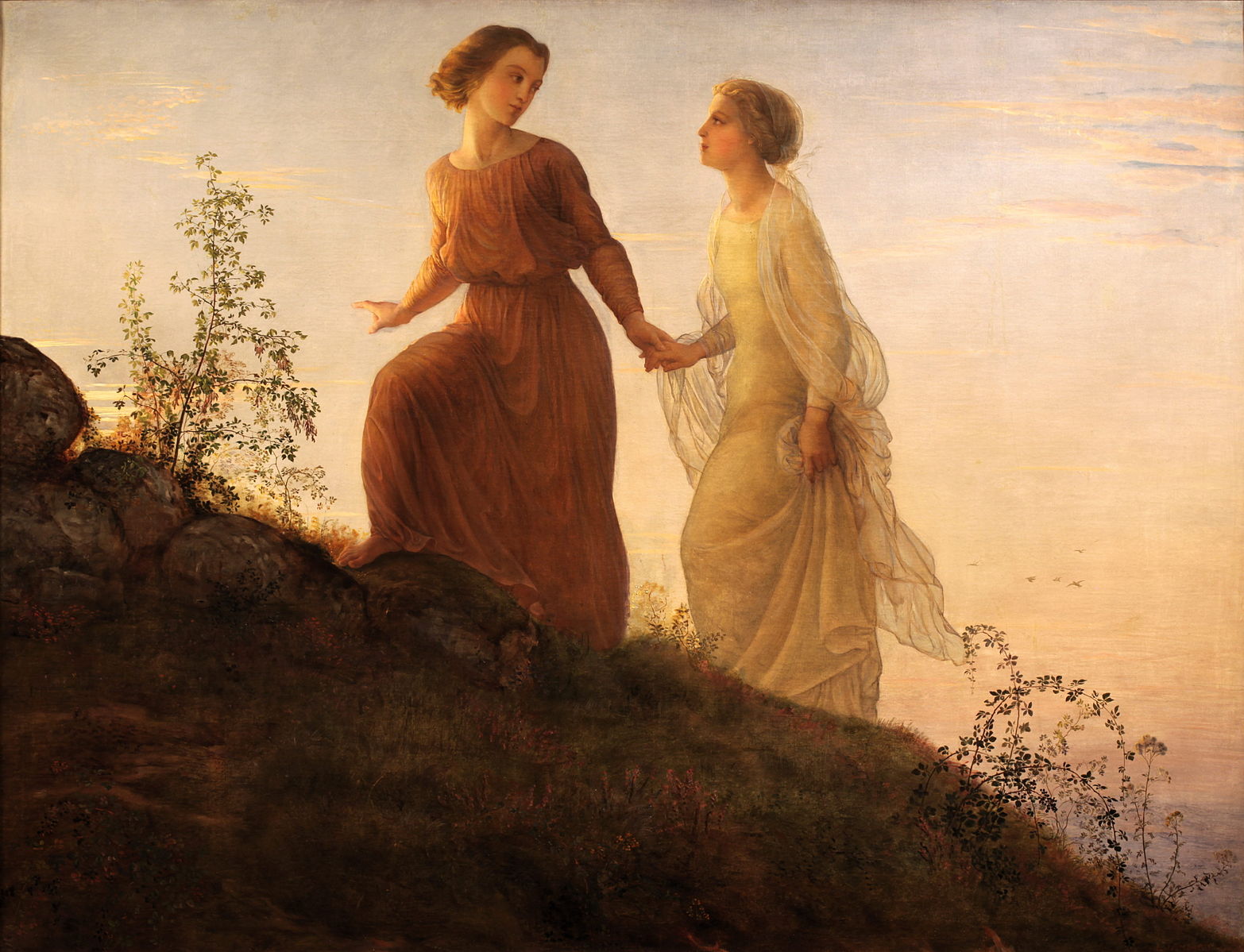
Louis Janmot, Poem of the Soul – On the mountain, public domain (via Wikimedia Commons)

The Romantic Movement produced the culture I taught myself living in a run-down house with no spending money.  I borrowed recordings—actual records—of Beethoven symphonies from the library that I had to listen to with headphones because nobody else wanted to hear that kind of thing.  I read Poe.  I read about Poe.  Gothic, a subset of Romanticism, became my muse.  I had no intimate friends with which to share this.  Not until seminary—that place where such unusual, unspoken things occur.  Of course I was in Boston, the most Romantic of American cities with New Bedford to the south and Salem to the north.  To the east the boundless ocean.  We still read the Romantics.  We still read about them.  I can’t help but think we might misunderstand them.  Yes, Irving and Scott were together “from morning to night,” but thinking back to my own Romantic ideals as a teenager, I suspect they just talked.  Intimately.


Gothic Dreams

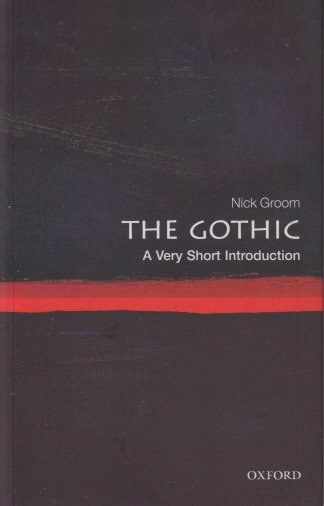
There’s something that compels a large number of people to consume material in the horror genre.  Whether it takes the form of movies, books, or music, it is a genre widely spread.  The gateway to adult likes seems to be in childhood.  As a young person I read about how many adults wanted to “re-live their childhood” and at the time I wondered why.  Now, as an adult of long standing, I think I can begin to see the answer.  In any case, my gateway into appreciating horror was the Gothic.  But what is gothic?  Like many abstract concepts I know it when I see it, but what exactly is it?  I’m not sure Nick Groom has fully answered that in The Gothic: A Very Short Introduction, but then the reason may well be in the “very short” part.  Nevertheless, this is a remarkably broad treatment of the subject in not so many pages.  It also helped me to understand my own fascination a bit better.

Groom begins with the historical Goths.  Like the Celts, they are a people without a prodigious written record, so the imagination takes over.  They valued freedom above all else, and that, it seems to me, is the beating heart of the Gothic.  Recognized through its architecture, especially in notable cathedrals, the incipient Romanticism in the style made its way into works of fiction.  In that realm it is remarkably widespread.  Shakespeare participates in it.  It becomes more fixed in later generations, but it still returns in popular format even today.  At several points in this brief treatment I found myself wondering at the connections.  Gothic is so huge and sprawling that it informs quite a lot of literature that isn’t even categorized with that title.

The story Groom sketches takes the Goths from their Germanic roots to their Anglo-Saxon influence in England.  For English readers, the genre really takes shape in Britain before spreading out into the many forms in which it exists today, including several species of American Gothic.  While the modern mind tends to turn toward the dark and melancholy aspects—and they are clearly there—the underlying theme of freedom comes through.  Thus the separation of ways between “Classical” culture with its rules and strictures and symmetry and the Gothic with its mystery, wonder, and romance.  By the end we’ve passed through Poe and on to modern horror.  And through it all I catch glimpses of what drew me to all this in a childhood of longing for freedom.


Shipmates

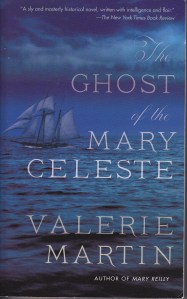
MaryCelesteGhosts have a way of persisting. I’ve had Valerie Martin’s The Ghost of the Mary Celeste on my reading list since I first saw it in hardcover on a bookstore shelf. The Mary Celeste was an actual ship, found with not a soul aboard, lifeboat intact, and no sign of violence, back in the 1870s. To this day no one knows what happened to the crew. Valerie Martin takes this frame and fills it in with a family drawn into Spiritualism, a religion that was just beginning at the time. Spiritualism, which developed in the aftermath of the Fox sisters and the eerie rapping at their upstate New York home, is one of the few religions to be completely at home with ghosts. The faith still exists today, and although Margaret Fox “confessed” to having hoaxed the effects she also retracted her confession, leaving ghost hunters perplexed to this day. These two mysteries, brought together in the moody month of November, make for a compelling novel that urges the reader forward.

Martin also adds the presence of Sir Arthur Conan Doyle to the story. Doyle, an avowed believer in the spiritual realm, also created Sherlock Holmes. As the various characters try to piece together what happened to the Mary Celeste, the ghosts of those lost at sea ambiguously communicate with the living. The world between realms, in this story, is permeable but indistinct. Those lost at sea are, in the narrative, restless. The mood of the novel is unrelentingly moving and thoughtful. Ghosts haunt, but don’t appear. Readers are left to draw their own conclusions.

As today is the fortieth anniversary of the sinking of the Edmund Fitzgerald, it seems appropriate to think about the Mary Celeste. Since Percy Shelley drowned in his own personal boating accident, loss at sea has become one of the hallmarks of Romanticism. Conceived as an answer to the cold, callus industrialism that trailed the scientific revolution, Romanticism suggested that there was an enchantment to nature and that things were not always as they seemed. Prosaically, there’s nothing poetic about dying in a violent shipwreck. That’s what makes the Mary Celeste so compelling. There is no violence here. The sea calls and claims captain and crew as her own. The lack of resolution has led to a very open-ended mystery—the perfect foil to a harsh materialism. Today the Mary Celeste and Edmund Fitzgerald will be sailing my internal seas as the season of spirits and shipwrecks come together in the lengthening nights of November.


Shelley, Byron, Trelawny, and Ahab

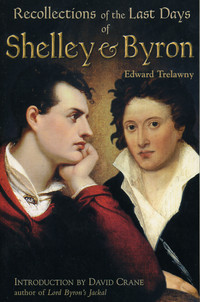
“I took up the word [atheist], as a knight took up a gauntlet, in defiance of injustice. The delusions of Christianity are fatal to genius and originality: they limit thought.” The words come from Percy Bysshe Shelley, according to Edward Trelawny. After visiting the display Shelley’s Ghost at the New York Public Library last week, I was struck by how little I knew of Shelley. I’d read some of his poetry, and had watched the fictional movie Gothic (maybe more times than is really healthy) to get a sense of this candle in the wind, the Romantic poet who died in a shipwreck before reaching 30. Edward Trelawny’s reputation as an historian is somewhat suspect, but he did form friendships with Shelley and Lord Byron and arranged the disposal of their earthly remains. His book, Recollections of the Last Days of Shelley and Byron, while somewhat self-serving, weaves an intriguing account. Among the mementos in the library display are some fragments of Shelley’s skull, taken after his cremation by Trelawny. This erstwhile biographer did prove his mettle by reaching into the pyre and pulling out Shelley’s heart, according to his own account, that eventually returned to Mary Wollstonecraft Shelley, his widow.

Trelawny admired Shelley’s atheism, and even applauded Darwin’s Origin of Species when it appeared. The nineteenth century was setting the stage for a strange Frankenstein’s monster of political and religious backlash against the freedom of the Romantics. Not all of the Romantics, obviously, were atheists, but their works extolled the wonders of nature and a sense of liberty from tyranny that would define them as dreamers and idealists. Lord Byron comes across much less favorably in Trelawny’s account, although their friendship lasted through some difficult times. After the poet’s death, Trelawny claims to have examined his feet, discovering the cause of a lifelong limp. His psychologically astute conclusion is that Byron’s disagreeable personality traits arose from his lifelong anger and anxiety about his birth defect.

Being an ardent admirer of Herman Melville’s Moby-Dick, I have to admit that the elements of anger at the divine for a limp (Captain Ahab forcefully stomps into mind), and the emphasis on ships and shipwrecks (as in Shelley’s death) tie these three literary geniuses together into a knot of suffering and seeking. Religion had consoled many in the nineteenth century, just as it continues to do now in the twenty-first. Among many of those who have endured through their literary works, however, God had slowly disappeared. Not quite as dramatic of a demise as Shelley’s, nor as unforgettable as Captain Ahab’s, but one for which there will be few biographers.