The New Neighbors

Apartment dwellers often ponder new neighbors. If anything gives the lie to being in control of your own destiny, renting your domicile does. Still using the old, aristocratic terms landlord or landlady, we know that we are under someone else’s authority. “As long as you’re under my roof,” my bully of a step-father liked to huff, “you’ll obey my rules.” When you rent, you can’t choose your neighbors. Those who own the property have final say. If they play the stereo too loud (“game” is probably the modern equivalent, but I was born before Pong even came alone) and won’t listen to your plea for a more monastic setting, you throw yourself on the mercy of your lord or lady. We got new neighbors this week. Not just us, but the whole galaxy. Seven new earth-like planets—surely ruled by Trump-like dictators—have been discovered. Let’s hope they’re early to bed, early to rise types.

During the Bush administration I often fantasized about the aliens landing on the White House lawn. I thought, with a president so obviously lacking intelligence, what would our new neighbors think of us? Would they complain to the landlord? You’d think that after that long trip across cold, vast interstellar space they’d maybe have the right to expect to find the brightest and the best in charge, right? Mission accomplished. The sign says so right there. Or to put it in a modern key, “Earth first, Earth first.” If they’ve got their intergalactic television on, I hope it’s switched to a different channel.
15207890820_d855b341e3_z

Contact, the novel by Carl Sagan, suggested the first contact from the aliens would be of Adolf Hitler. Among the first poisoned radiation this planet flung off into space was the fascist propaganda of 1930s Germany. Earthlings, not yet tempered by the Trump brand, were shocked. Surely this is a sign of hostility! Unless, of course, you control both the legislative and executive branches. Then you can just decide not to show up at the town hall and tell everyone you’ve got more important things to do. So, what will our new neighbors think? Do they just want the bodies of their compatriots from Roswell back, or is it a more serious discussion to be held behind closed doors? After all, African slaves were merely chattels in a negotiation between a more powerful culture and unhuman indigenous dullards with nothing better to do. On the spaceship back to their extraterrestrial slave mines, I do hope they have the common decency to keep the music down to a reasonable level.
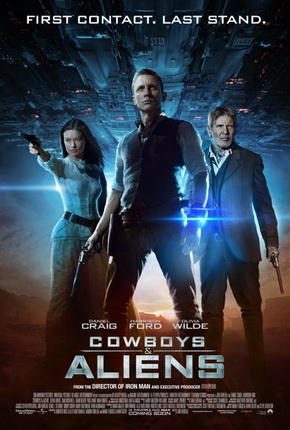
Cowboys and Demons

Cowboys_&_Aliens

Cowboys & Aliens finally came down into my price range. For movies I’d have to view alone, I generally wait until they appear for free on some online movie service or for less then ten dollars at Target. I’ve been waiting for this one since 2011, but my patience paid off. Inspired, so the rumor goes, by the Roswell incident, the film follows the adventures of some old western stereotypes as they encounter the superior power of aliens. The aliens, it seems, are just as materialistic as humans, coming to the old west in an extraterrestrial gold rush. They abduct humans to learn their weaknesses (which really seems superfluous given the technological imbalance between the species) and anger a number of ornery hombres in the process. Then we have an old-fashioned shootout with ray guns versus bows, arrows, and bullets. Human devotion, however, defeats the evolved armor and flying machines of the—well, what are they exactly?

The cowboys scratch their heads, not quite having the consarned concept to categorize these flying machines and their occupants. The local preacher, who is a pretty handy shot, tries to help the confused cowboys, who settle on the term “demons” to describe the extraterrestrials. We forget that in the early part of the last century other galaxies had not yet been discovered, and although we knew of other planets, there was assuredly no way to get there from here. Ugly things that come from the sky are demons. This doesn’t lead to a whole load of speculation—nobody suggests praying to take care of the menace, although the Native Americans resort to a religious ritual to unlock the mystery of where the demonic hoard is hiding. Through her resurrection we discover that Alice is a good alien, planted in the town to stop the invaders from doing to the earth what they did to her planet. And winning the heart of Jake Lonergan (whose very name suggests lone gunman to insiders) along the way.

Since the movie is three years old, I won’t worry about spoilers—if you’re inspired to watch for the first time, however, you might want to do so before finishing this. When Alice figures out how to stop the alien mining operation for good, Jake is left, for the second time, with his woman being killed by demons. Woodrow Dolarhyde, realizing that the outlaw Jake isn’t such a bad guy after all, seeks to console him at his loss. At the end of the movie, in a camera angle that goes from Woodrow to Jake, the focus falls on the cross atop the local mission as Woody says, “She’s in a better place.” All aliens go to heaven. Literally. With echoes of the X-Files, Cowboys & Aliens is sufficient for a dark night where demons and angels are a little too close to tell apart.


Alien Deities

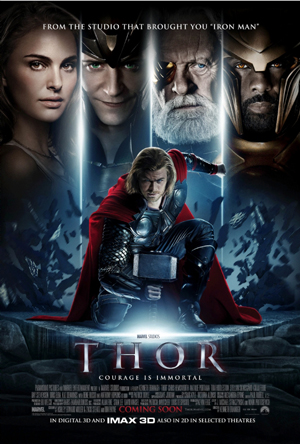
What with The Avengers making such a big pre-summer splash this year and all, I decided to refresh my memory and watch Thor again this weekend. In many ways it is a very impressive movie—very loud in the theater last year, and necessarily quieter in our apartment over the weekend. Often when I see a movie on the big screen I can’t keep track of all that is said or implied, especially when there’s so much action going on. Of course, Thor is an unusual hero in the Marvel Universe, being a god. Being supernatural is not limited to deities in that universe, but the other mutants are the results of science: the Hulk and his gamma rays, Captain America’s experimental treatment, and Iron Man’s good, old-fashioned engineering. They are modified humans. Thor comes from a different place. Upon rewatching the movie, the line about the Norse gods as beings from another dimension worshipped as gods came through loud and clear. Jane Foster comes to believe in the ancient alien hypothesis.

As a solution to the lack of omnipotence on the part of the gods, casting Thor and Loki into the role of aliens serves comic-book universes very well. In reality there are well-meaning and serious people who believe that any entity recognized as a god by human religions might have been a space traveler mistaken for divine. This is an idea I first encountered in Erich von Däniken’s Chariots of the Gods? (Hey, I couldn’t help it—I grew up in the seventies!) The world has enough high strangeness without von Däniken’s hypotheses, but in the case of Thor we have a fictional realm that explains how heroes gain their strength. The same could be postulated, I suppose, for Superman, but then, he never commanded a formal cult in antiquity.

Beyond the theological conundrum, Thor also participates in the nearly universal theme of resurrection. Realizing that his arrogance has led to the troubles of the human race, Thor faces the Destroyer (a creature with origins in the Hebrew Bible and Israelite mythology) and willingly lays down his life. This is generally the prerequisite for resurrection in any effective mythology. Of course, Thor returns and, like any good savior, rescues the world. Setting the story in New Mexico only assists in reasserting the mysterious events at Roswell where, like in the movie, something strange fell from the sky. In this subtext the feds rush in and commandeer the data, for people are not capable of making the correct decision. Yet, they leave the god behind. Marvel Studios has been rightly praised for its mastery of the genre. For those willing to look deeply, even Thor has its social commentary.