Science of Religion

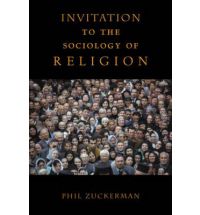
People do strange things when they are together. Phil Zuckerman’s Invitation to the Sociology of Religion (Routledge, 2003) is an informative whistle-stop tour of how social scientists view religion. Back in college sociology classes involved so many stats that it felt like a math class, so I was pleasantly surprised when I could read this treatment without a calculator or graph paper at hand. Sociology, of course, is all about how people behave in groups. Religion, as commonly defined, is a group phenomenon—people are religious together. Nevertheless, the study of religion from a sociological point of view does raise some uncomfortable issues for many people. Chief among them are the facts that religion is generally determined by where and when you were born and by the social forces surrounding you—it is learned, not revealed. Even religions that teach revelation of their divine origins generally don’t expect individuals to receive the religion by revelation, they receive it by social instruction.

Naturally sociology does not attempt to answer the question of where religion ultimately comes from. Religion, however, is something people do, and, unless one happens to have the correct religion (don’t we all?) then everyone else’s religion is made up. Sociologists would tend to see all religions as being human constructs. Zuckerman’s treatment is pithy and punchy and fun to read. As a college student at a confessionally-affiliated institution, our classes were entitled “Christian Sociology.” That is shorthand for sociology with a pre-decided bias. It was not sociology of religion, but sociology by religion. In many respects, reading Zuckerman’s treatment was affirming much that I had already observed, but having it placed in a scientific framework made a world of sense.

In many universities there a basic misunderstanding still reigns; many administrators do not realize that the study of religion is the study of a social or psychological phenomenon. Zuckerman demonstrates once again just how important this study is. It is no understatement to say that the entire “social contract” of the United States was constructed under heavy Christian influence. Zuckerman’s discussion of sexual mores alone should prove that point. We have the outlook we do because of the incredible force Christianity exerted on the developing religion of the western hemisphere beginning with the Roman Empire. Once those viewpoints have been deeply embedded, many, many generations deep, the chances of getting out for an objective evaluation are slim. That’s why we need our sociologists of religion. If more people were aware of what we know about socially defined religious parameters, the more they’d realize we need to pay much more attention to religion than learned doyens of human behavior often do.

Had my Phill

One of the pleasures of the editorial occupation is traveling to campuses to meet potential authors. Having no excuse not to go to Philadelphia, I jumped on a train this morning to spend the day on the campuses of the University of Pennsylvania and Temple University. I’d been to both campuses before, but they are a study in contrasts. Penn is Ivy League, of course, and the students appear confident and self-assured. Temple is a large, public university situated in a neighborhood that doesn’t exactly inspire the same confidence. The students appear happy enough, but of a rather different ethnic blend. I pondered these differences while waiting for a taxi. I hadn’t realized that PHL Taxi stands for “Prefer Hanging Loose”—after three calls and no vehicle, I had to call another company. To try to save Routledge a few pennies, I had opted for the Days Inn in north Philadelphia. A friend told me over lunch that this part of the city is probably not the safest.

In the taxi we drove through neighborhoods that politicians like to pretend do not exist. The sheer degradation of the buildings, sidewalks, and people was sad. The most common type of building, next to houses (many semi-demolished), is churches. Many of the churches bear their names in Spanish; most have heavy metal chain doors emblazoned with crosses. It seems that maybe Van Helsing would go to church in a place like this. The kind of place where a dead body does not astonish, and the people on the street corners look remarkably cheerful, given the circumstances. The Days Inn is in a more open and commercial area, and I don’t think anyone has actually been murdered in this particular room. On Temple’s campus I saw many signs for Occupy Philly.

Those who think everything is just fine with the ultra-wealthy in their heaven while we expect human beings to live like this are worse than naïve. Those who are privileged look on Occupy Philly with a sense of academic curiosity. Those who live next to poverty, hard up against it, see Occupy Philly as a mandate. We can’t keep pretending that everything is okay. If God has a plan for America, why have so many people been left out? People with more churches per block than any affluent neighborhood desires or supports? The movement may be ill-focused and leaderless, but the need is very real. Tomorrow I go back to Temple, back to where the struggle is often life and death and the need is very human. But for this evening, “Now I lay me down to sleep…” I’m sure you know how the rest of it goes.


Jots and Tittles

While busy editing during the course of the day, I ran across this line in a Routledge book entitled What is Religion?: “We live in a pluralist, inter-racialist and multi-faith society and the need to understand one another is greater than ever before. Much misunderstanding arises from racialism and nationalism and could be avoided if people knew more about the beliefs and practices of one another.” Amen, Robert Crawford. I would, however, add a caveat to his statement: even more conflict could be avoided if people knew their own religions. I know many people, especially in the United States, who have no idea what their religion’s official teaching is. I know Presbyterians who have no concept of the official doctrines of this organization they’ve joined. Many Catholics, given the more corporate structure of that church, know the teachings but choose to ignore those that just don’t match the realities of life on earth. In such cases, the question of acceptance of religious teaching is a very relevant point. Can you get to heaven without crossing every “t” or, because it sounds more interesting, observing every jot and tittle? (By the way, “jot” is a stand-in for “yod,” the smallest Hebrew letter, “tittle” roughly translates as “serif” or the fancy little calligraphic flourishes typical of Tanak manuscripts.)

Religious membership devolves into self-declaration, often of a self-perceived version of the religion one favors. The vast majority of people are born into their religions, an immediate red flag that absolute truth claims will necessarily lead to conflict. And it won’t help to try to devise some Uber-religion that includes all the others, since apart from the occasional Universalist or Bahai, nobody buys that other religions are quite as good (or right) as theirs. Even the task of defining what religion is remains beyond the reach of mere mortals. I find Bronislaw Malinowski’s observation apt, that religion grows “out of the conflict between human plans and realities.” We can imagine a much better world than the one that exists. In some such fantasy worlds, religion itself ceases to exist.

Religion never existed in any pure form. It did not descend from the sky in a unified whole. Instead, religions have been cobbled together by people since the Paleolithic era, and we simply don’t have the time, resources, or influence to go back and start it all over again. Religion may be defined as conflict. Conflict between what is and what ought to be. Conflict between right and wrong. Conflict between us and those who believe differently than we believe. Religion brings, as one founder stated, a sword. Religion gets passed down the generations just as surely as the family jewels and deeds. To ask anyone to relinquish such valued property, even for the sake of world peace, is too much to ask. Even getting people to understand what they claim to believe is too much effort. It is much easier to praise whatever lord and pass the inhumane ammunition.


Springing up Moses

“Springsteen’s work and person invite analysis in terms of the biblical themes of exodus and promised land,” so wrote Kate McCarthy in “Deliver Me from Nowhere: Bruce Springsteen and the Myth of the American Promised Land” (conveniently in a Routledge title, God in the Details: American Religion in Popular Culture, second edition, 2011). Having just finished Bruce Feiler’s America’s Prophet (not Routledge), I am attuned to the exodus theme at the moment. Feeling an unaccountable, personal connection to the other Bruce (Springsteen), I have felt the sense of exile in his songs since I was a teenager. I had no idea who Springsteen was when “Born to Run” made it to the charts. Living in a nowhere town at the time (population less than 1000), I felt the burning need for a personal exodus that eventually landed me in the largest city in the country. But still the sense of exile remains.

Lest readers be too confused, it might be politic to point out that the biblical concept of exodus likely had its origins in the Exile. Without rehearsing too much history, the Babylonian Empire, under Nebuchadrezzar, conquered Jerusalem in either 587 or 586 BCE, leading to the deportation of a significant number of Judahites who would become, over a generation, the “Jews.” These people were exiles, forced to live under the watchful eye of a political overlord with whom they shared only the most basic of heritages. Their religions had grown apart over the centuries, and as the Jews began to think back on their homeland, the exodus came to mind. Archaeological evidence for an exodus of biblical proportions (literally) does not exist. Why, then, the story of the exodus? Did not the desire to return home involve crossing the desert, with a divinely appointed leader? One who carried the law (Torah) with him? When Ezra led returnees home in the fifth/fourth century, he had the Torah in hand. Like Moses, he led the people out of bondage under the Persian plan. Exile and exodus are twin children of oppressive regimes.

So, how do ancient desert wanderers come into the orbit of a very damp New Jersey, and in particular, it’s arguably most famous resident? Alienation is home. Very few teenagers don’t understand this. As we attempt to integrate them into adult life, something vital, essential, is left behind. Consider all the long-haired artists of the ‘60’s and ‘70’s who still perform, now shorn to conservative acceptability and sometimes churning out very conventional songs. The fire has gone out. It is difficult to escape exile when you carry it with you. That’s something I think Bruce understands. His look may have changed, but his message has not. America has always been a haven for exiles. Simply because an exile moves into a new setting, however, does not mean that the promised land has been reached. As McCarthy seems to be saying, and as I have often felt, the promised land disappoints. The seeking is what must persist. America may have its Moeses, but it will find, from atop Nebo, that the path is where your feet already are.

Look carefully at your prophets!


Material Whirled

With the moon and Jupiter waltzing slowly so high in the sky, radiating such brilliance early in the morning over this past week, it is understandable how ancient people came to see the gods as material objects. The course of progression seems to have been physical gods to spiritual gods: the earliest deities ate, drank, made love, fought. They were of the same substance as humans, or at least of the same psychological makeup. The Egyptians, Zoroastrians, and Greeks all toyed with ideas of beings of “spirit”—non-corporeal entities that did not participate in our material world, but were able to influence it. In the world but not of it. The tremendous gulf between great goddess and material girl was born. Today that concept is taken for granted, especially in western religions. We are locked into physicality while God is free to come and go.

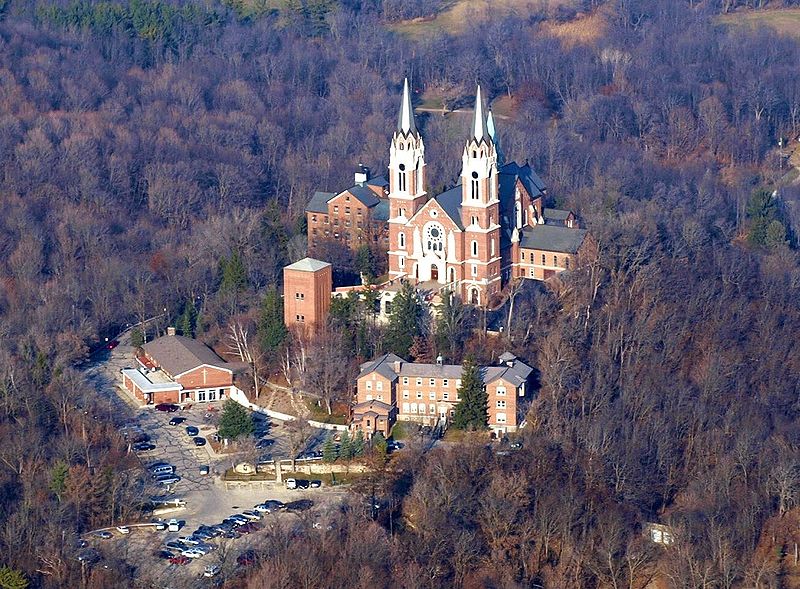
Many religions respond to this by suggesting that we should look beyond the physical to the majesty hidden from biological eyes. And yet, physical creatures that we are, we are drawn back to material means to demonstrate our spirituality. One of the perks of working for a publisher is the constant exposure to new ideas. At Routledge I have been learning about the rising interest in material religion: the manifestation of religion through physical objects and rituals. This aspect of religious life easily devolves into a cheapening of faith into mass-produced, religious knickknacks and kitsch. Some mistake this for the real thing. While living in Wisconsin, my family used to visit the spectacular Holy Hill, the site of a Carmelite monastery atop a large glacial moraine. On a clear day you can see Milwaukee from the church tower. It is a large tourist draw.

No visit to such a shrine would be complete without the obligatory stop at the gift shop. Even the non-believer feels compelled to buy some incredibly tasteless artifact to keep them grounded in reality. Many of the items—giant glow-in-the-dark rosaries, maudlin mini-portraits of the blessed virgin Mary (BVM as the insiders call her, not to be confused with BVD) and the crucified Lord on all manner of crosses, line the walls and shelves. This commercialization is not limited to the Catholic tradition. Evangelical groups realize the importance of branding as well, passing out cheap merchandise (or better, selling it) with Bible verses emblazoned on it. These signs of faith sell themselves, but they blur the sacred distinction between human and divine. Does religion point to a reality behind the physical? This is its claim, but what is the harm in making a bit of cash on the side, just in case?


Do Unto Others

Having just finished my first week as Religion Editor at Routledge, I have learned many things. The lengthy commute into New York City is filled with many lessons along the way and working for a publisher of some distinction is a privilege. My working life began with the work of a common laborer at 14. Conditions weren’t bad although the work was hard—we have laws to protect minors against exploitation. Funnily, after people reach a certain age exploitation is freely allowed, as long as someone benefits from it (not the one doing the labor). Being from a working class family, I gravitated towards dirty jobs. My college career was supported by many long hours in the dishroom, washing the cups and plates sent back by kids whose parents could foot their bill. I didn’t complain—physical work has always been relaxing to me. Mind work is much harder.

The majority of my adult life has been whiled away under the Damoclesian stare of religious institutions or individuals. Christians don’t make good bosses. My years at Nashotah House felt like some combination of Alcatraz and Bedlam. Under the authority of the religious I was taught to quake and fear. After over a dozen years of this, released into an empty academic void, I found a job with a Christian publisher who once again lived to dominate. I try hard to believe it is not inherent in religion itself, but often those who wish to bend others to their whim have some sacred sanction. For a brief respite I had a wonderful experience at the University of Wisconsin Oshkosh. My boss was secular and very caring. The same applied at Rutgers University. When Gorgias Press tired of my efforts, the secular academy came to my rescue.

Routledge once again reinforces that paradigm. For the first time in my professional life I feel that I am truly valued. As a rule, adjuncts are like Kleenex—there when you need them, but disposable after used. The university people were kind but could offer little. Now I am accepted among the secular and the little knowledge I’ve gained over the decades is appreciated. The scars, however, still show. The fear of long years of subservience are not easily dismissed. It is my hope that some day they may become effaced enough that the terrors wielded by the religious might be only nightmares recalled vaguely in the full light of day. If such deliverance comes it will have been because of my non-religious bosses. Such a parable should teach us about what religion has become in this “Christian country.”

No mean city.


Happy Literacy Day!

Having read 25 books so far this year, and working for a publisher, I was chagrined to learn that I had overlooked that today is International Literacy Day. One of the greatest buoys that kept me afloat during my days of unemployment, reading is far more than a pastime. The books I read often become friends—some distant and occasional, others close and intimate. Our identities are—we are—shaped by what we read. Writing is the most important invention that humans have conjured, and we have it to thank that we have come as far as we have. Writing has changed forms from poorly executed scrapes of pictographs on clay to fine, syllabic cuneiform, to our alphabet better suited to paper, and now to electrons dancing about LCD screens. No matter how we encounter it, however, writing defines us. So after a long day of trying to get up to speed at Routledge, I needed to add a note of thanks to whoever invented writing. That forgotten genius truly invented modern humanity.


For the Love of Books

As is so often the case, publication and religion go hand-in-glove. George Routledge was a man with a vision. As a literary man of nineteenth century England, he moved from bookseller to publisher, establishing the well-known London house of Routledge (aka Warne & Routledge, George Routledge & Sons) in 1843. Although his initial successes were literary, among his first publications were the reprinted Bible commentaries of Albert Barnes. By 1854 a branch of Routledge was established in New York where it continues to operate. Acquired by Taylor & Francis in 1998, Routledge still pursues and produces notable academic books in many fields of the humanities and social sciences. The company is a testimony of the strength of vision of a man with a love of books.

I began this blog as a recently unemployed editor at Gorgias Press and part-time lecturer at Rutgers University. Both were jobs involving books and religion, but I am now moving to Routledge as a religion editor. Once again, I will be full-time in the world of books. Regular readers of this blog will know of my sense of loss at the closing of Borders this year. Although I claim no special insight into the way businesses work, the loss of comfortable space surrounded by books is something I felt very deeply. There seems to be a kind of redemption in taking on a position that will once again set me in the role of seeking to produce more books. It is as if the fabric of several loose strands of my life that had unraveled under the trials of the world of higher education have once again rejoined.

While whiling away the happy hours at the 4-H fair last week, I enjoyed strolling through the arts tent. There I noticed that someone in our county has started a creative writing club. This was a hopeful sign; the previous year I had made inquiry into starting such a club myself. When the world seems to have evolved beyond books, those of us who need them must invest the love of writing in our young. Although 4-H is not a religious organization, writing nevertheless has a sacred appeal. Those who feel drawn to the craft know the incredible grip that written expression can exert on a person—seeing your name on the cover of a book is a form of eternal life, metaphorically speaking. As editor I will not be the name on the cover, but I will be the one helping others to attain that immortality. It may not bring Borders back from the dead, but even the very idea of resurrection comes to us in the form of a book. Even so, Routledge is the agent of resurrection in my meandering career.