Spider Thoughts

Spiders know.  Spiders are aware of when they’ve been seen.  I’ve been noticing this for some time now.  You can verify this yourself, but it may take some resolve, depending on your level of arachnophobia.  You walk into a room first thing in the morning and see a spider placidly hanging from its web.  If you intentionally look at it, it knows.  Leave the room for at least ten minutes and then come back.  The spider will be gone.  When you first stare at it, it won’t move.  Nature’s flight, fight, or freeze response has a clear winner here.  Spiders play it cool.  This happened recently on a weekend.  I had my wife verify this for me.  I pointed out the spider (I’d already stared at it) and told her I was doing an experiment.  She’s been married to me for thirty-five years, and such things no longer come as a surprise.

I told her my thesis and suggested we both just get breakfast ready as normal.  The spider didn’t move, even with clatter of bowls and spoons.  When my wife went to take her bowl to the sink several minutes later, the spider had vanished.   (This doesn’t seem to apply to spiders actively descending on a web in front of your face, I’ve noticed.  They’re too busy with their spider thoughts.)  Animals are smarter than we give them credit for being.  Who ranks spiders on their list of smart critters?  But they are.  And I wonder what they think of me.  If a spider crawls on me, I run away.  Like a spider I won’t return to the same place where it happened, at least not for some time.  All of this brings Rupert Sheldrake to mind.

Sheldrake has been summarily wiped off the table by other scientists, in part because he has explored the sense of being stared at.  Materialistic science tells us there can be no such thing since being seen is passive and we have no sense organs to detect it.  We have all, however, had the experience of turning around to find that someone has indeed been staring at us.  As so often happens with materialism, we’re told simply to discard it as fantasy.  But that’s not the way it feels.  So I look at my most recent spider—I know there will always be more—and know that s/he knows they’re being stared at.  When you’re small running may not get you away swiftly enough.  Freezing makes more sense.  Freezing and waiting.  The thing you fear (for a spider it’s me) will generally go away on its own, looking for something more material, I suspect.


For the Dogs

DogsThatKnowYou know that feeling of being dropped into a very strange place?  Sure, it’s disorienting for a while, but once you get used to it, you start to enjoy your surroundings.  Now ask yourself: what if my entire way of looking at life is based on a faulty paradigm?  Many, I suspect, will drop out at that point.  There’s strange, and then there’s going too far.  For those wedded to the idea of finding the truth, however, weirdness is part of the journey.  I just finished reading Rupert Sheldrake’s Dogs That Know When Their Owners Are Coming Home.  Yes, it felt like the room was spinning (actually, I read it on the bus, so that might’ve been true a time or two), but it confirmed something I’ve suspected for many years.  The reigning, mechanistic universe paradigm is wrong.  Please don’t take this as an anti-science statement.  Sheldrake is a bona fide scientist, and I’m an avid reader of science books.  It’s not so much that science is wrong as it is that science doesn’t go far enough.  Ever since the Industrial Revolution—not coincidentally—we’ve been informed that the universe is really a giant machine.  We can figure out how it works using this squishy stuff in our heads that insists we can find Pokemon everywhere we look when it’s not busy solving the riddles of the mulitverse.

Sheldrake, who is given a wide berth by many scientists, states what any of us who grew up with pets knows: they know more than they’re saying.  Admitting up front that much of the evidence is anecdotal, Sheldrake provides empirical studies to demonstrate what folk say.  Dogs do know when their owners are coming home, before they are within sight, hearing, or smelling range.  His study, however, isn’t limited to dogs or to knowing when someone’s coming.  Animals, by virtue of their own minds, have abilities that we do not.  Since they don’t speak our language, we assume they are dumb.  In fact, as this book shows, a great many animals know a great deal more than we do.  The question is, if this is the truth why don’t we hear more about it?

We prefer, it seems, our truth to be qualified.  There’s a lot at stake here.  The reigning paradigm keeps us plugged into this corporate machine we’ve devised.  Our lifestyle cannot subsist without the subordination of animals.  We can’t give them abilities we lack, apart from tastiness.  If the universe isn’t a machine, it might open the door for a broader view of reality.  Maybe it is better to be post-Christian, but religion has proven benefits to humans (and perhaps animals).  Why does religion remain in a mechanistic universe?  Perhaps what we call “souls” are the same as “minds” and perhaps they aren’t the same as brains.  If we really do have minds, it is in our best interest to care for them, develop them, and improve them.  It may seem like a strange world indeed where your dog informs your view of reality.  Read Dogs That Know When Their Owners Are Coming Home, however, and see if you don’t find yourself wagging your tale, just a bit.


Just Passing Through

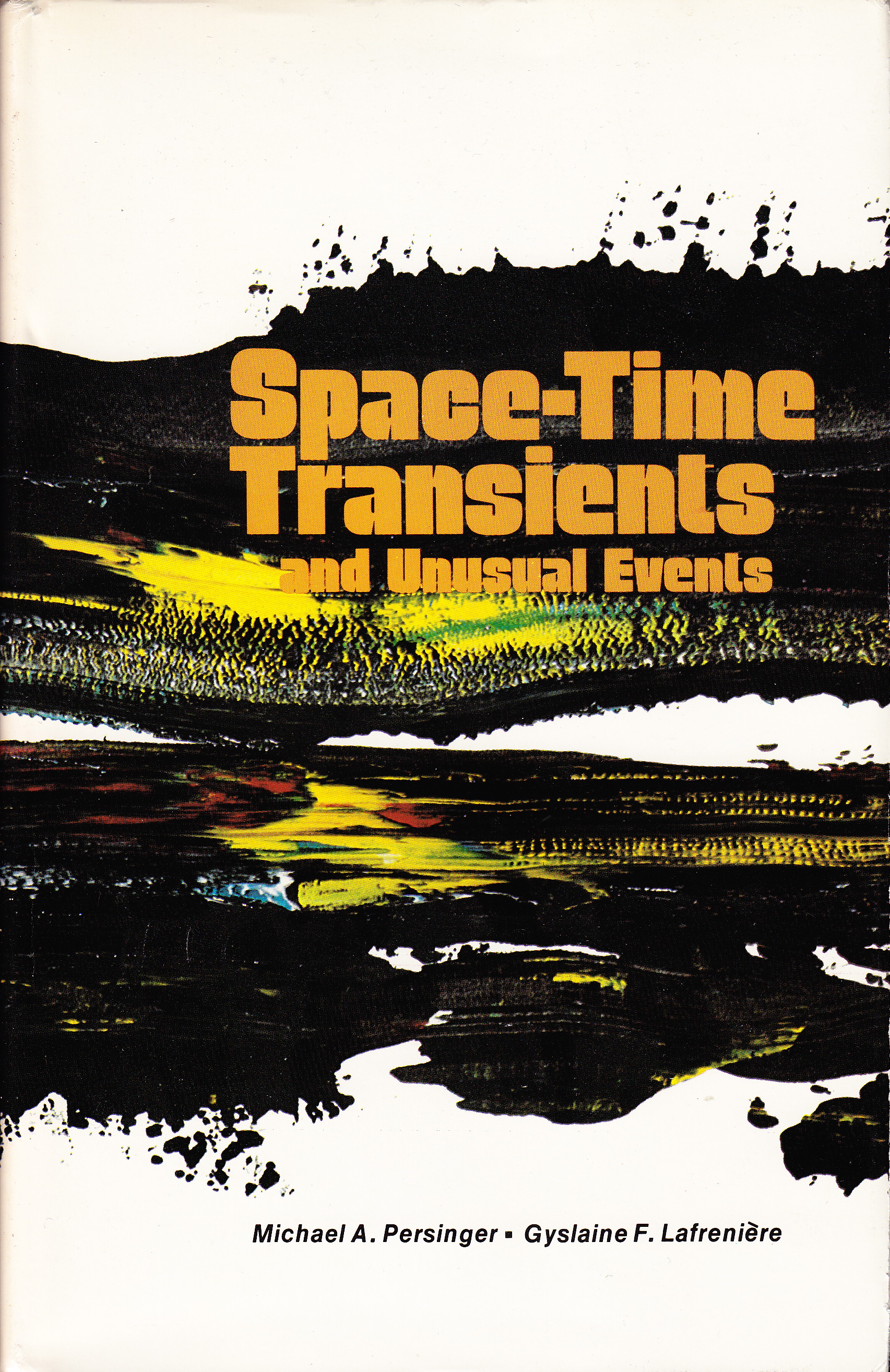
SpaceTimeTransientsMichael Persinger is a curious and rare scientist. Apart from occasionally making it onto Through the Wormhole episodes, he is also known for his somewhat unorthodox willingness to ask unfashionable questions. I just read his book, co-authored with Gyslanine Lafrenière, Space-Time Transients and Unusual Events. What makes Persinger (the lead author here) so unusual is that he is willing to admit that unusual events happen. Most scientific studies begin with the assumption that the uncanny is unreal, and that people who witness the unusual are unbalanced. Most of us, I would venture to say, have noticed that strange things do happen from time to time. Those who read all the way through Space-Time Transients may be surprised to discover that Persinger and Lafrenière offer an empirically-based hypothesis that places many unusual events squarely in the realm of scientific explanation. The acceptance of woo this is not.

For an old religious studies student, such as me, it is refreshing to see scientists at least asking the question rather than sweeping all the unorthodox evidence off the table. Not everyone who has experienced a fall of fish from the sky or a poltergeist in the bedroom is a deluded liar. Strange things do happen. Space-Time Transients, however, asks what seems to me the perfectly logical question: what’s going on here? Yes, some accounts are exaggerated. Others are fabricated. Still others clearly remain. Should we call names or should we try to figure out what is behind all this? One of my favorite unusual events is the coincidence. There may be nothing supernatural at work, but the oddity of the situation leaves us wondering. Shortly after being hired by Routledge, on my way home through a very crowded Times Square, I saw someone crossing Seventh Avenue drop a five-dollar bill. This person was hurrying in the opposite direction from me in the midst of a crowd, and was far enough away that calling out “you’ve dropped some money” would have only caused a feeding frenzy. It was only a fin. The next morning, coming to work over on Third Avenue, I found a five-dollar bill on the pavement. With the exception of pennies, just about all the dropped money in Manhattan is quickly scooped up by the needy. Could this have been the same dropped bill from over twelve hours before, on the other side of the island? Perhaps not. But why a fiver in both cases? Money does not grow on skyscrapers. The story gets even weirder, but you’re not here to read about that.

Scientists who are willing to admit that strange things happen (the names of Rupert Sheldrake and Dean Radin come immediately to mind) often face difficult times being taken seriously. They are, however, asking the big questions. Ironically, it is often the notice of strangeness that leads to advances in science. As one quip has it, science grows not because an observer says “Eureka!” but rather, “that’s strange.” In a world where strangeness is associated with religion, and religion is for the deluded, we have perhaps cut off an obvious avenue for learning about our strange universe. As Persinger and Lafrenière point out, we live in a very small habitation, viewed as a cross section of a planet that is itself not terribly massive, in an infinite yet expanding universe. To think that we’ve figured it all out by now is perhaps the strangest idea of all.


Making Sense

Science is more than meets the eye. Even since I was a child I’ve tried to follow what I can of science without a real microscope or telescope and a doctorate in some incomprehensible subject like chemistry. I guess that’s why I’m a fan of popular science—the kind that is written so a layperson might understand, or at least pretend to. Indeed, one of the complaints from scientists and others alike is that science has become so complex that only a specialist can really understand. I suspect that’s one reason religion continues to thrive; anybody can be an expert in religion, even a scientist. Nevertheless, science is based on empirical observation, now with instruments fine tuned to receive data better than human senses. So I sometimes watch Through the Wormhole to find out what is happening in the realm of pure knowledge. Although simplified to the digestibility level of the laity, Through the Wormhole tries to stay on base with interviews with mainstream scientists who are working at the cutting edge of what’s out there. I recently watched the episode entitled “Is There a Sixth Sense?”

I have no way of knowing what scientists think of such things, but I was glad to see the everyday experience of normal people addressed in this particular episode. Who hasn’t felt that weird pre-cognition from time-to-time, or felt like they were being stared at only to learn that they were? These might be the spooky effects at a distance that so unnerved Einstein, but they are part of human experience. We all go through it, but mainstream science comes up with a convoluted scheme whereby our brains project what actually happened back in memory before it happened so that it just seems like we knew something was about to transpire. Of they point to false positives—how many times did we think something was about to happen and it didn’t? We just don’t remember those. Still, this particular show brings together mainstream physicists and theorists usually considered outsiders, such as Dean Radin and Rupert Sheldrake (strangely omitted from the IMDB cast list). Several smart people, it seems, wonder if we are really all connected.

Mainstream science has grown terrified of metaphysics. The suggestion that anything might be remotely like the world of religion is frightening to those who believe we just need more precise calipers and higher resolution imagery to explain an entirely physical universe. This little universe we carry around in our skulls, however, is attuned to what we might just have to call the “spiritual” or some such moniker, just to differentiate it from the particles that we are told make up everything. Or is it strings? Don’t ask me; I couldn’t tell an up quark from a down quark. Interestingly, one is even called a “charm.” And then there’s the God particle, the Higgs’ boson that briefly reminded the world that Edinburgh is a top-rate university, although, as we all know, there’s no place like Harvard. For the rest of us, however, there’s the everyday business of work to face. And if I try to read a blog while on the clock, I definitely have a sense of being stared at, even when I’m alone in here.

One of the last fearless scientists

One of the last fearless scientists


Sacred Gaze

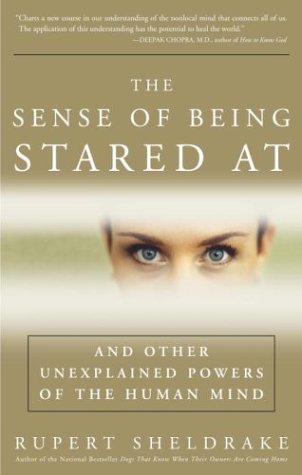
SenseofBeingStaredAt Rupert Sheldrake raises the ire of some of his fellow scientists. Science has increasingly allied itself with a strict kind of materialism, although, as Sheldrake repeatedly points out, evidence for such absolute materialism is lacking. This is not to challenge science, but simply to note that we may not yet have all of the data. The Sense of Being Stared At considers possible scientific explanations for unconventional situations we all experience from time to time. Who hasn’t felt eyes on them and turned around to find somebody looking? A number of other “impossible” scenarios also find their way into this intriguing book. Sheldrake suggests that such phenomena can start to be explained scientifically if we allow that the mind is not the same thing as the brain. Sure beats a Christmas party with B. F. Skinner, where every present is inevitable.

Materialism feels threatened when spooky action at a distance occurs. As Sheldrake points out, however, we are willing enough to accept it if an invisible “field,” one that we can’t even feel, is posited. Take magnetism, for example. Few people doubt that magnetism is a real force. We’ve never actually seen it, but its effects are clearly visible. Taking this as a starting point, Sheldrake suggests that various psi phenomena involve such fields. The scientific studies that have been undertaken on many of these “spooky” scenarios show statistically that chance may be safely ruled out. And, if the experience of many ordinary people counts for anything, even our pets and other animals may possess minds.

Ironically, the mind (with its taint of being associated with religious concepts such as the soul) is one of the most contentious phenomena in science. Many materialists deny its existence, suggesting it is merely some epiphenomenon of our brains’ electro-chemical processes. Yet these scientists still, one presumes, insist on being treated with respect and being paid for their work, although these mere trifles are just odds and sods clinging to the edges of a materialistic abyss. To me, work like that of Rupert Sheldrake is crucial for an honest assessment of the evidence. Maybe not everyone accepts that dogs know when their “owners” are coming home, and maybe Sheldrake’s morphic fields have yet to be confirmed, be it is clear, when all the evidence is considered, these phenomena do actually happen on occasion. Instead of simply dismissing something because it shouldn’t be, or can’t be, according to materialism, why do we find accepting the evidence so frightening? Is it perhaps the fear of being watched?