
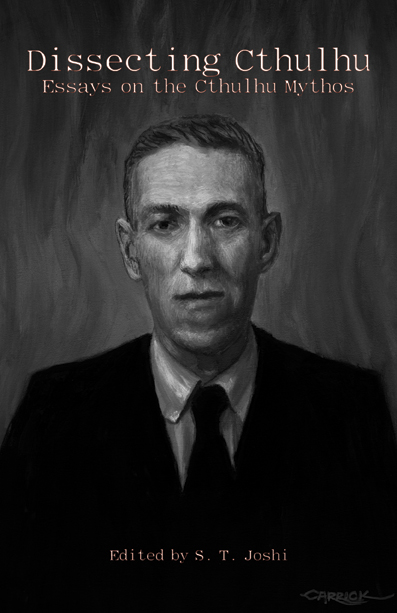
 The word “fan,” an apocopated form of “fanatic,” is a word borrowed from the realm of religion. Most often associated with sports, it can refer to any overly enthusiastic devotee. While I enjoy reading H. P. Lovecraft’s fiction, I think I would stop short of calling myself a fan, but were I to take that step I would have some serious competition. The circle of those truly enamored of Lovecraft have yet to break into the hallowed, or perhaps haunted, halls of the western canon. Fans there are, but not the sort who find regular play in literature classes. Still, as I read S. T. Joshi’s edited collection, Dissecting Cthulhu: Essays on the Cthulhu Mythos, I came to realize just how committed Lovecraft’s fans are.
My fascination with Lovecraft arises from his felicity with gods. Some argue that his gods are aliens, but even Erich von Däniken hasn’t stopped the true believers. Dissecting Cthulhu is a collection of articles from a variety of Lovecraft analysts debating the fine, and sometimes gross, points of the postulated “Cthulhu Mythos.” Cthulhu hardly requires any introduction these days. He has basked in his underwater fame since the internet has made a star of him. The eponymous deity of the alleged cycle, the divinity, or alien, was never really put front and center by his creator. Deities are all the more powerful for being unseen. Here is where Lovecraft the atheist becomes Lovecraft the theologian. By creating gods we tacitly admit their subtle power over our psyches. We may call them aliens or monsters, but compared to us, they’re gods.
After reading Dissecting Cthulhu, however, I’m not sure that I could say much more about him than before. This is often a problem shared by theologians—what more can you say about an entity that won’t sit still long enough to be interviewed? Gods will be gods. The rest of us are humble hermeneuts. There’s no doubt that Lovecraft touched on a deep and abiding current in human experience when he held alienation high as the standard of life on earth. Somehow we resent Cthulhu for not being there, even though his is no octopus’s garden under the sea. Other galaxies were discovered and partially understood for the first time during Lovecraft’s lifetime. Suddenly it felt pretty lonely down here with all that empty space up there. It is better to populate such a large expanse with gods. Not seeing is believing after all.

 Steve A. Wiggins