Have It All

You can’t have it all.  I know, I know.  People are all the time saying, “I want it all.”  But you can’t have it.  This is where my Buddhist side kicks in, I guess.  It’s the constant desire that makes people unhappy.  And you don’t have to take my word for it.  About having it all, I mean.  The Catholic Church backs me up on this.  There are seven sacraments.  If you follow the rules most strictly, no one can receive all seven.  Holy orders and marriage, at least for much of church history, have been mutually exclusive.  As Paul was rattling on about spiritual gifts in one of his letters, he makes the point that nobody gets them all.  And you don’t even get to choose.  

Humans are acquisitive.  It’s probably an evolved trait.  Think of squirrels hoarding more acorns than they can ever eat.  (By the way, squirrels are the real heroes when it comes to planting trees, and they don’t even mean to do it.  It just comes naturally.)   Life gives us what we need for as long as we have time on this earth.  If you’re reading this you’re living proof.  We fear for the future, however.  What if tomorrow something I need goes away?  I’ve lost jobs and I know the desperation that immediately sets in.  So we want to store up more than we need.  But those sacraments.  Those spiritual gifts.  They remind us of something important.  Something a carpenter from Galilee once said.  It’s essentially the same as therapists have told me: be in the moment.  You have what you need right now.  As a coda: tomorrow will take care of itself.

Those of us who can’t stand incompletion (don’t show me a series of books with one missing!  Please don’t.) suffer from this quite a lot.  Here’s where we need to nod to Siddhartha again and take a deep breath.  Center yourself.  When I was a seminarian discovering Roman Catholicism for the first time, really, and that mostly through the Episcopal Church, I wondered about the sacraments and why, if they were things we should strive for, we couldn’t have them all.  By seminary I was pretty sure I wanted the matrimony route.  As my wife can attest, however, I still crave a monastic existence from time to time.  Torn between two sacraments and I’m not even a Catholic.  I guess I’ve known all along that you can’t have it all.  Those who try for it, if they’re lucky, end up under the Bodhi tree.
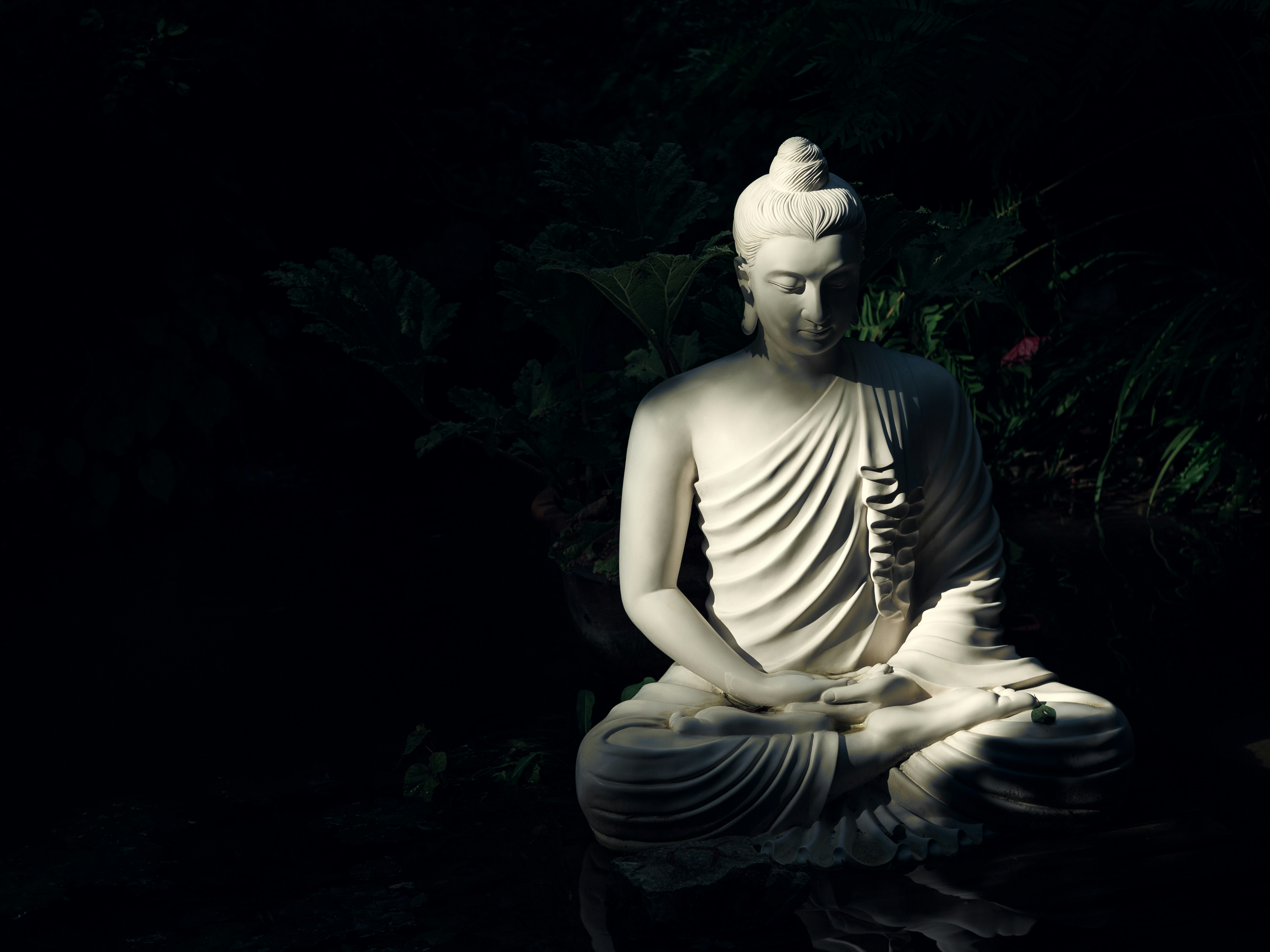
Photo by Mattia Faloretti on Unsplash

Ordinary Sacraments

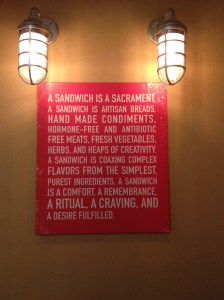
It’s like they knew we were coming. The towns that host AAR/SBL must remember the event after we leave. We make quite an impact around the convention center, and since everyone wears their name tags in public, it’s pretty clear that we’re all related. So when I stepped down into a local sandwich stop on Newbury Street, I saw a sign that could’ve been commissioned just for us. “A sandwich is a sacrament” it began. Going on to list the wholesome ingredients, the sign concluded “A ritual, a craving, a desire fulfilled.” I’d been taught that a sacrament was an “outward and visible sign of an inward and spiritual grace.” Of course, it could be more carnal than that. I’m not a priest, after all.

Food is indeed intimate. With packed restaurants full of religion scholars hungry for more than just sustenance for the mind, the city makes way for what may be a secular sacrament. Those who cook for a living do so in exchange for lucre. Everyone has to contribute something, and while we’re burning our calories debating fine points of theology, or in lexicographal deliberation, someone’s stoking the fires for the lunchtime rush. We hand over our credit cards and don’t stop to think about what we’ve just experienced. We’ve been given the means to convert matter to energy, an energy we’ll expend in purely cerebral consultation. The meeting of the minds. After the outward and visible sign of a sandwich becomes in inward and digested energy. And so the cycle spins on and on.

Large conferences like this bring the blessings of cash flow to local economies. Even in the poorest of times eating out’s a necessity. We’re not, after all, close to home. Time is at a premium with papers peppering each hour of three-and-a-half days, lined up like items on a menu. We select and choose, keeping to our intellectual diets. Or not. It takes plenty of energy to think so much. Some sit in the restaurants and return thanks. Others pay their respects in less visible ways, for this is the world of sacraments. Not ordinary time. What goes into a person, a sage once said, does not defile. Rather, what comes out does. We sit in respectful silence and listen to what emerges from our fellow conventioneers. It’s like being in church, almost. And we all know, deep down, when the talking’s done it’ll be time to eat.


The Bottom Line

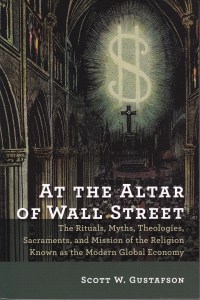
AltarWallStUnderstanding, or even caring about, economics has been one of my abiding weaknesses. I suppose growing up poor, excess money was a foreign concept—at least on a quotidian basis—the possibility of acquiring much of it remote. The poor know their place. Still, I was intrigued by Scott W. Gustafson’s At the Altar of Wall Street: The Rituals, Myths, Theologies, Sacraments, and Mission of the Religion Known as the Modern Global Economy. It has turned out to be one of those very important books that could be world-changing, if enough people read it. The basic idea is simple enough: Economics is a religion. Immediately many people will put the book down. Economics may be the dismal science, but at least it’s a science, right? Not so. Not completely. While economics uses scientific principles (as does theology), it is a belief system based on an underlying myth that has pushed us to the place where the rich are far too rich and we’re convinced that the plight of the poor is simply a reality with which we must live. It’s all based on a myth of barter.

There are places I quibble with Gustafson, but he makes a very compelling case that the Global Economy, through a series of historically discernible steps, has come to be money making money for money’s sake. As he clearly demonstrates, developments in stock trading have made this an enterprise where people are completely left out of the equation and understanding what has happened impossible. As long as money has been made, the Economy is happy. This way of thinking, which is de rigueur for business schools and presidential wannabes, believes with the conviction of an evangelical that as long as money circulates everything will be fine. Those who believe this walk down Fifth Avenue with blinders on.

Step by step Gustafson demonstrates that Economics has all the trappings of any religion: a priesthood, mythology, rites and rituals, and an overarching theology. And this belief structure, like that of many religions, persecutes heretics. Indeed, human sacrifice is an innate part of this religion called Economy. It has sent missionaries out to the far reaches of the world to convert other ways of living to that of the Global Economy. And in this religion, it is safe to say, those who make it to Heaven are remarkably few. This book does offer potential solutions. They are solutions the wealthy and powerful will not like, so they are probably not going to be enacted any time soon, if at all. So while the rest of us are standing in line at the soup kitchen, I would suggest some reading that will make far more sense than you think it might. At the Altar of Wall Street could change the world for the better, if the Economy allows it.