Ezekiel’s Equinox Paradox

Like the great celestial wheels of antique imagination, the seasons continue their wearisome roll across the earth. On a day long marked as a holiday among those more closely attuned to nature than most modern people in developed nations, we face the beginning of autumn. Change is in the air and already the gray skies that have predominated the eastern seaboard over weeks since Irene seem to have winter on their minds. Changes always call to mind how the human mind tends to divide what it sees into categories. The Bible is one place that this tendency is crucial. The whole scheme behind clean and unclean comes down to the need to make discrete that which nature shamelessly blends. When it comes to deity, the party line has always been (at least in the monotheistic religions) that God is like one of us. We can’t imagine human very well without gender, and so God becomes a guy. Notwithstanding protests to the contrary, early religions did take that distinction literally; divinity and masculinity were of a piece.

This fact makes it all the more intriguing when the Bible itself offers a few passages that call this orthodoxy into question. A few verses explore the trope of God as female, but they quickly back away and revert to the male God when taking on more literal terms. Hebraic culture was monistic, not dualistic. God as “spirit” was not really a possibility in the Hebrew Bible. God as a big man fits the picture better. One of the voices that claims dissent is that of Ezekiel. No surprise there—Ezekiel has been analyzed as everything from a dreamer to a dropper. Ezekiel’s understanding of God, however, is deeply imbued with temple imagery. Ezekiel was a priest without a sanctuary, and so his view of God suffered from temple vision. Nevertheless, the strange account of Ezekiel’s vision of Yahweh coming to Babylonia that opens his book demonstrates a startling lack of clarity when it comes to divine gender.

When two people meet, as psychologists have long noted, the first bit of information they attempt to discern is gender. Perhaps it’s the old fight or flight reflex from our reptilian brains, or maybe it is the opportunistic mating behavior that so obviously characterizes our species, but we are very uncomfortable when we can’t make a gender assignment. It is the whole premise behind Saturday Night Live‘s old sketch of “It’s Pat.” When Ezekiel first espies God he describes the deity in terms of glowing metal. But notice that he begins, “And I saw as the colour of amber, as the appearance of fire round about within it, from the appearance of his loins even upward, and from the appearance of his loins even downward, I saw as it were the appearance of fire, and it had brightness round about” (1.27). Beginning at the loins the prophet looks the deity up and down and concludes God is like fire. This image does not long survive the vision, for Ezekiel quickly reverts to masculine imagery for God. Even in the face of evidence that God is not gendered, the faithful must make him so, for the age-old appurtenance of male superiority suffers immeasurably without the camaraderie of God.
O Pomona!

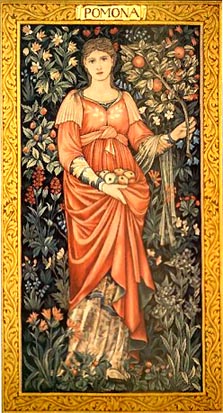
Ancient goddesses have long been a fascination with me. After writing my Edinburgh dissertation on Asherah, and taking employment at an Anglo-Catholic seminary that venerated the BVM – Blessed Virgin Mary, and not some underwear brand, as I had supposed – I realized that male-dominated religions still recognize the need for the sacred feminine. In my recent post on Halloween, I mentioned the Roman goddess Pomona. Roman religion is generally not treated with the finesse of classical Greek mythology, but it represents an important part of our western heritage. Pomona is an etiological goddess. Etiologies are stories of origins, and like other goddesses of the ancient world Pomona was used to explain the mysterious ways of nature.

The story that best describes Pomona is preserved by Ovid in his Metamorphoses. Pomona is one of the virgin goddesses, specifically the goddess of fruit. She has no known Greek antecedents. The myth involves her devoted chastity and her commitment to ripening fruit, particularly apples (and sometimes pears). Shunning all lovers, she was eventually wooed by Vertumnus, the god of changing seasons. Disguising himself as an old woman, Vertumnus visits Pomona and tells her of the wonders of love and of the attributes of Vertumnus especially. Eventually Vertumnus reveals himself, and Pomona, delighted at what she sees, loves him. Of course, apples ripen and seasons change. Winter is soon to come once the apples fall from the tree. The goddess has been subdued by masculine designs.

So it often is with goddesses. Men recognize the need for the divine feminine, but fear it and attempt to tame it. Pomona, however, survives. One of the memorable objets d’art at Nashotah House, where I sat in that chapel for over a dozen long years, was a frieze of the BVM. More technically, a Madonna and Child. The frieze hung over an altar in a side chapel behind the choir, so most people didn’t spend much time looking at it. Mary, holding Jesus, was surrounded by a frame of fruit rendered in plaster. Apples were prominent among them. There are those who suggest that apples show how Mary overcame the heinous sin of Eve. I believe, however, that the fruits surrounding the virgin demonstrate that Pomona, the virgin goddess who eventually succumbs to the advances of the male deity, still has a place in the patriarchal world of Christendom.


Our Mother Who Aren’t in Heaven

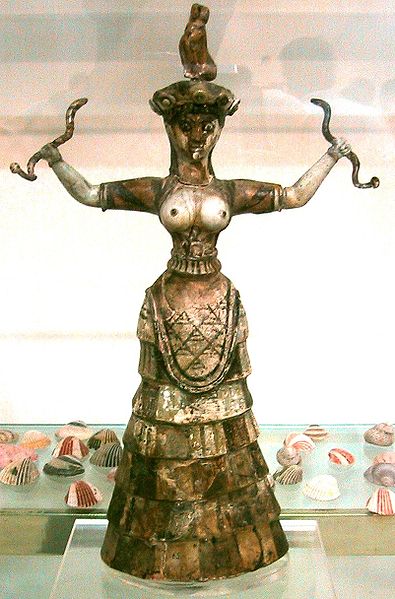
In the course of preparing to teach a course on Classical Mythology, I have been reading up on the Minoan culture of ancient Crete. This fascinating civilization is obviously related to many others in the Ancient Near East, but it has such a distinctive ethos that it always gives me pause. The Minoans had a religion that was apparently dominated by a great mother-goddess. Decades ago astute archaeologists and historians demonstrated that the amorphous “mother goddess” of antiquity was a modern construct rather than an ancient reality, but the evidence still stands that at least the Minoans revered the sacred feminine.

The work of Marija Gimbutas had overstated the case for a matriarchal society in antiquity, but she had touched on a truth sometimes obscured by the patriarchal world of yesteryear — some cultures did venerate the divine mother. Among the cruel ironies of history the name of this goddess has been lost, but images of a secure island with its chthonian female divinities remain. Among the artifacts discovered among the various Philistine sites in the Levant was an inscription, apparently dedicated to Asherah. Asherah is a thoroughly Semitic deity, first appearing in Mesopotamian contexts further to the east. The Philistines, however, likely settled their region after migrating from Crete a few centuries after the collapse of the Minoan culture. Could they have brought with them a remembrance of the divine mother?

I am not convinced by arguments that suggest a polymorphous “mother goddess” reigned in antiquity, as much as I might wish it had been so. What a different world might have emerged if monotheism had been based on a divine mother! Minoan culture appears to have been strong but relatively peaceful. In one of the androcentric twists of history “Cretan” and “Philistine” have come into modern usage as derogatory slurs against good taste and refinement. History demonstrates, however, that apart from foreign biases those hailing from ancient Crete may have developed the superior civilization of antiquity.