Biggest Book

As a bibliophile it’s kind of embarrassing to admit that I’ve only just learned about the world’s largest book.  If you’re like me you’re probably imagining an enormous tome that required acres of trees and fifty-five-gallon drums of ink to print.  But that’s not it at all.  This particular book is located in Mandalay in Myanmar.  If I say it’s a religious text you might be clued in that it represents the Tripitaka, or Pali Canon.  These are Buddhist scriptures.  They are extensive, as scriptures tend to be.  I’m certainly no expert on religions in that part of the world, but it’s clear that the world’s largest book, as a monument, required a massive amount of effort to put together.  Housed at the Kuthodaw Pagoda, the texts were inscribed on stone housed in 729 stupas that are stunningly beautiful.  (Take a look for other photos online—it’s impressive!)
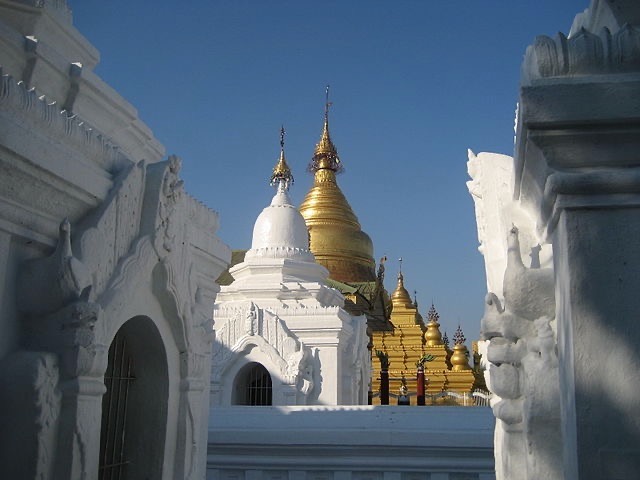
Photo credit: Wagaung at English Wikipedia, published under GNU Free Documentation License

The monument was completed in 1868.  When the British invaded southern Asia, however, there was much looting and damage was inflicted on the shrine.  It was eventually repaired and still stands as the largest book in the world.  It’s no real surprise that this honor would be relegated to a religious text.  Bibles of all sorts become symbols and their symbolic nature often supersedes what’s written inside.  The idea of the sacred book has an unyielding grip on the human psyche, whether we think the book comes from God or an enlightened human being.  Indeed, the sacred itself is an integral part of being human.  When one group wants to dominate another, it often goes for its sacred artifacts.  Cathedrals as bombing targets in the Second World War demonstrate that well enough.  Ironically, we’ve ceased paying much attention to the sacred but we still revere it.

Books represent the best of our civilizing nature.  They’re ways of coming to see the point of view of others.  It really is a privilege to read.  Banning books is, in its own form, a crime against humanity.  Those who ban almost inevitably end up promoting yet more sales of the offending book.  I often see books that make me angry or upset.  My knee-jerk reaction is to want to deface them—this is a human enough response.  But taking time to reflect, I realize that these writers are entitled to their opinions, benighted though they may be.  A civil exchange of ideas is essential to getting along in a world with billions of different opinions.  Every nation should have a monument that shows its love for books.

Waiting for a Miracle

A friend recently sent me a New York Times story about Marianne Williamson’s spiritual background.  Before I say anything more about this I have a confession to make.  I didn’t know who Marianne Williamson was and, consequently, I’ve never read any of her books.  I also didn’t know about her presidential bid, although she seems much more grounded than whatever it is that sits in the Oval Office these days.  In any case, it’s the spiritual background part on which I’d like to focus.  Williamson is apparently a devotee of A Course in Miracles, a book written by Helen Schucman in the 1970s.  According to the NYT article, Schucman penned the book by the dictation of a divine voice.  This aspect seems worthy of further exploration, regardless of politics.

You see, sacred books have a long history of divine dictation.  The Bible makes such claims only obliquely, but clearly there were some who believed that Moses was the recipient of narration from on high.  Mohammed heard a voice saying “Write.”  Centuries later the Book of Mormon was written out at the dictation of Joseph Smith.  The point is that such texts are often believed to have had sacred origins.  I find Schucman’s reluctance to put herself down as the author of A Course in Miracles instructive.  She didn’t believe she wrote it.  Not to devalue any of these sacred texts mentioned, I would nevertheless note that authors often feel that their words come to them.  Maybe academic books don’t count, but when I’m writing fiction, it’s like somebody’s hands are on the wheel, but I’m not sure I’m the one driving (with apologies to Jeff Daniels).

A Course in Miracles has been translated into double-digits languages, something quite rare even among many bestsellers.  What this says to me is that people still crave answers from an authoritative text.  The written word has a power that electronic publication lacks.  Who wants to point to a screen and say, “this is divinely revealed truth”?  Hefting a heavy book, printed on actual paper, has a symbolic power that outweighs that of ebooks.  Probably it’s because the Bible paved the way.  We’re already primed for a sacred text, in physical form.  The longer I study holy books the clearer it becomes that they will unlikely ever cease to be written.  Helen Schucman didn’t have the last word.  As long as people write it’s doubtful anyone ever will.


Hieroglyphs

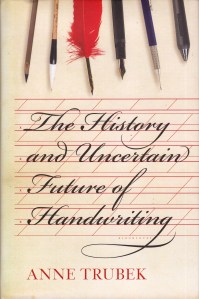
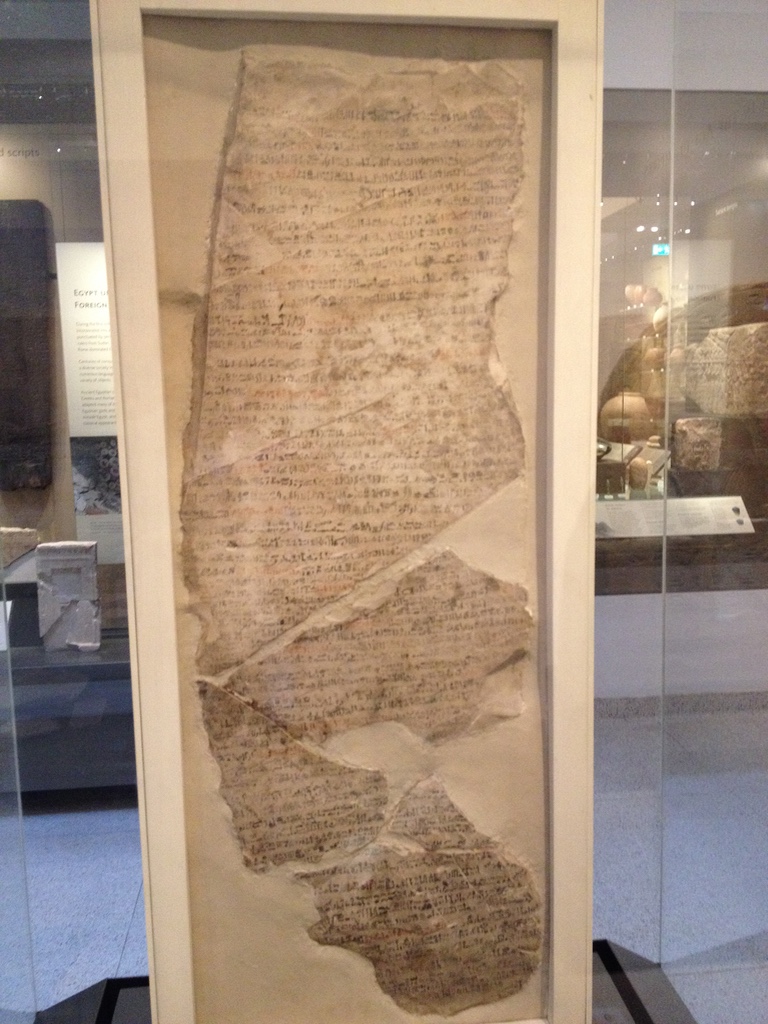
The word “hieroglyph” translates to “sacred writing.” If you’re like me, your first attempts to learn writing were probably not very sacred at all. Tongue pressed to the corner of my mouth, eyes staring fixedly at the paper flat in front of me, my hand going anywhere but where I wanted it to, writing was a burden. I soon grew to love it though, not realizing it was changing my brain even as I was assimilating how to do it. Anne Trubek introduces quite a few new angles to the story in The History and Uncertain Future of Handwriting. She begins at the beginning, cuneiform, not hieroglyphics, and offers a brief sketch of how handwriting developed into the phenomenon we know today. And how it is now becoming something very different than what it once was.

Trubek’s book is full of delightful surprises about the development of scripts and the technologies that attend them. Like most non-specialists in cuneiform suppose, she suggests handwriting is basically anonymous therein. In fact, it’s not. Molding clay into a smartphone-shaped tablet doesn’t seem like technology, but the process of writing took a leap forward when someone figured out how to do this. Those who work with cuneiform can learn to identify handwriting. In the Ugaritic corpus, the tablets “signed” by Ilimilku can be distinguished from those written by others, and not just by his name. Technology has been devised to measure depth and order of stylus strokes in the clay, the angle the stylus was held, and many other seemingly insignificant features. Handwriting was present from the very beginning.

Perhaps what is most striking about Trubek’s study is how religion enters the discussion at almost every stage. Very early on writing was identified as a sacred activity. This continued through the middle ages when monks were those who performed writing as part of their non-secular duties. Even those who piloted penmanship in the modern period often noted that a person’s moral, Christian disposition could be measured by how said person made their letters. Writing, as those who do it for a good while know, becomes a sacred activity. Most world religions have holy books. Many of those books were the reason for an interest in literacy in several cultures. Even a surprising number of secular writers have understood the activity to have spiritual dimensions. Trubek’s book gives bibliophiles plenty to ponder. She doesn’t see the rise of keyboarding as a threat to writing because even in the computer age, individuality comes through. And for those who truly understand hieroglyphs, all writing is sacred.


Receive History

Sacred texts, without readers, are mere artifacts. While so evident as to be trite, this truth lies behind the area of biblical studies called reception history. Perhaps from the earliest days that some books were considered holy, those who studied them wondered primarily what the original author meant. That was, after all, why the texts were preserved as special—they possessed a quality that other writings lacked. Over the centuries this perspective gained nuance and sophistication. (Despite what some secularists say, the study of the Bible can be quite scientific. Some of it is so technical that even specialists have a difficult time following it.) Until last century, however, one aspect remained unchallenged. The goal was to reach what the original author meant. The enterprise of exegesis is geared toward that end. Strip away the reader to get to the writer.

thumb_IMG_2069_1024Meanwhile sacred texts, such as the Bible, continue to develop their own lives in culture. While today’s facile use of the Bible in politics may seem to be something new, the use of Scripture in government is as old as this nation. It easily goes back to European explorations of text, and perhaps even to Asian exegesis before then. Even though the founders of the United States were unquestionably Deists, for the most part, they also were biblically literate. Even the Enlightenment recognized that the Bible held a privileged place in western civilization. Perhaps it was not the only sacred text, but it was a sacred text to many thousands, or millions, or people. Such a pedigree is wasted only with great loss to all. Enter reception history.

In the days of ecclesiastical hegemony, the church, however defined, had the right to interpret Scripture. With the growth of literacy and education the possibility of understanding the Bible spread to any who could read, or had ears to hear. We have only to glance around to see the ramifications of that today. While students may not know who Moses was in the Bible, they can tell you Christian Bale played him in a recent blockbuster. They may not know that Noah was 600 years old when the flood came, but they can tell you he was a troubled, if not somewhat psychotic, devotee of God. At least in popular culture. And that is merely the thinnest veneer of the surface. The idea of sacred texts remains embedded in our worldview. It would seem that if we want to understand ourselves, reception history will unearth vital clues.


Instant Education

Among the “non-essentials” upon which I spend my earnings, books hold the top spot, if not in value, certainly in quantity. Reading is more than a pass-time—it is perhaps the most basic aspect of who I am. I love books. While reading a New Jersey Star-Ledger piece by Allan Hoffman entitled “Learning by the book,” however, an uncomfortable truth dawned on me. Hoffman gently laments that the search for information has gone almost wholly electronic. As a person who currently works in the book industry, I know he’s right. More than that, I know it from my own life. I can’t remember the last time I opened a phone book, other than to retrieve a pressed leaf I’d inserted between its pages for pressing. If some bit of information about a religion or a biblical passage escapes my distracted brain, a few keystrokes work better than shuffling to the shelf, pulling off the reference books, and thumbing through until I find the datum. No, we are all addicted to speed.

Despite the best effort of Google books, much material necessary for research in many subjects remains sequestered in actual books. The problem is, for contemporary knowledge, book production is slow. In my editorial work, and as an erstwhile author, I know that the five years I spend researching and writing a book, the submission time to a publisher, the eventual decision, and then the year or longer production time, all equate to immediate obsolescence. Any non-fiction book is outdated by the internet even before it is shipped from the warehouse. New truths are born at the speed of light while books take years to make. I agree, Mr. Hoffman, we’ve lost something in our idolatry of the instant knowledge. If you need urgent info (What do I do about a snake bite? Where is the nearest Starbucks?) the internet is your up-to-date databank.

I have long known that the study of religions is often the study of texts (most of which are online now). Believing some ancients knew more about the ultimate realities of life than we do, either by dint of divinity or enlightenment, we search the texts about them or by them in hopes of joining them in a knowledge beyond knowing. Now in the age of the internet, new messiahs arise almost daily, proclaiming their truths across the world-wide web of wisdom. I have a feeling there is a dissertation or two in there. Of course, it will take a few years before you’ll see them in print.

IMG_0966