Saint Nick

My wife and I have both noticed it.  December has been much busier than usual, and neither one of us works in retail.  We’re at the age when most people are considering retirement, but are both just settling into our careers.  But this is about December, not about us.  Today is December 6, Saint Nicholas Day to some.  What many people don’t realize is that this used to be “Christmas” for particular sets of folks.  You see, St. Nick was one of the many components of what would become Christmas.  His saint’s day was/is today and it was traditional among some early American communities to pass out gifts today because of the tradition that Nicholas was one of the more generous saints.  While at Nashotah House the rather somber Advent atmosphere was broken this day when the Dean would hand out gold coins.  Well, chocolate coins covered in golden foil, but you get the picture.
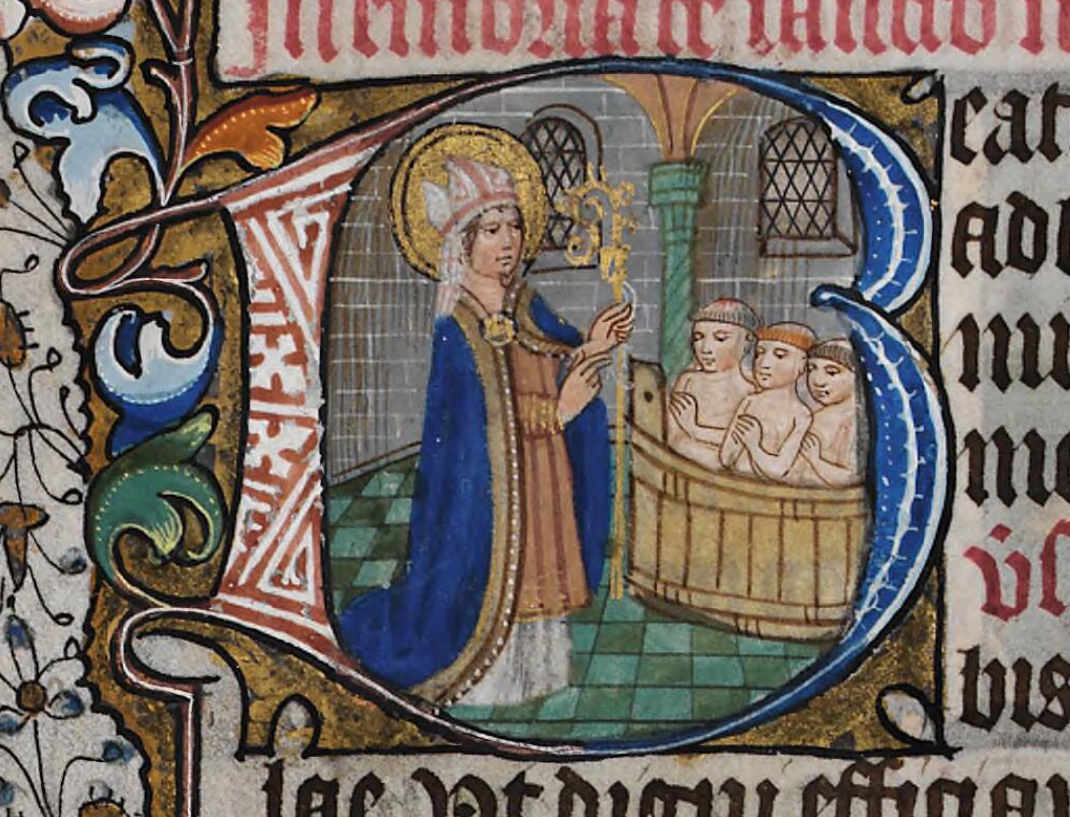
Image credit: National Library of Wales, public domain via Creative Commons CC0 1.0 Universal Public Domain Dedication

In our capitalistic zeal to get Christmas down to just one day off, if that, we’ve targeted the twenty-fifth.  Saint Nicholas was rolled into Santa Claus and we could keep on working nineteen more days.  “Santa” was known by many names—Father Christmas, Christkindl, and Kriss Kringle, among others.  They were expected at different times in December, even as the Catholic Church had decided on this month to be Jesus’ birthday, to counter Roman celebrations of Saturnalia and Kalends (both of which were more than one day, I might add).  December, in other words, should be a festive month.  Instead, it’s become a busy season for squeezing everything in before taking some time off work.  Do we ever sit back and consider how ridiculous such hectic living is?

Don’t get me wrong—I love the Christmas season.  I save up vacation days every year to give myself a mini semester break.  When I’m feeling exhausted with September’s onslaught, if I can cast my eye as far as December I can feel some relief coming.  And I’m not sure why we don’t get offered a few more days in December.  Remote workers can’t always make it to the office holiday party, so maybe December 6 might be a remote worker’s mini Christmas day off?  The weary struggle to make it to the official Christmas could use a little refreshment just about now.  I don’t recall a December ever being this busy on the work front.  For the economy’s sake, hopefully those in retail aren’t finding themselves bored.  One thing that all of us might wish for, however, is a visit from Saint Nicholas.

Jolly Saint Nicholas

StNick

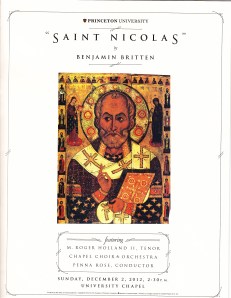
Each December the Princeton University Chapel Choir performs a free holiday concert in the impressive university cathedral (actually, it is a chapel, but given its size I’ll stick with cathedral). This year’s concert was Benjamin Britten’s “Saint Nicholas.” The association of Saint Nicholas with Christmas, not really a major holiday until relatively recent times, was an aspect that developed long after his death in the fourth century. The date of his death, December 6, and his association with the giving of gifts, made him an obvious model for Santa Claus (who still bears his name). Most of the gifts I’ve received from bishops involved losing a livelihood and personal dignity, so it is little wonder that Nicholas is venerated. Few bishops of his generosity exist today.

The stories of Nicholas of Myra, however, are full of mythical accounts that bear less resemblance to history than to legends of old. Eric Crozer’s lyric for Britten’s piece invokes several of these miraculous tales. Saint Nick, it seems, stilled a storm at sea, multiplied food and walked on water like Jesus. The lyric also tells the legend of how he raised three pickled boys from the dead, although I have to admit I couldn’t get my mind off zombies after that. This story seems to owe something to the myth of Tantalus, who, like Nicholas, was from Anatolia. In real life we do know that at the Council of Nicaea Nicholas punched Bishop Arius in the ear for his heresy. Theological discussions are like that sometimes. And I wonder if that might not be the origin of another curiosity of which a friend recently reminded me—Saint Nicholas doesn’t travel alone.

Our modern version of Santa Claus takes its roots mostly from germanic traditions. In that culture the saint is accompanied by a more sinister character who doles out punishment to the naughty. He is known by many names: Krampus, Ruprecht, Schmutzli, Zwarte Piet, or simply the Devil. Instead of using their diabolical fists, they generally carry rods to smack the not-so-nice, kind of the Republican side to the liberal Santa. This dark figure does not appear in Britten’s “Saint Nicholas” where a (mostly) kinder, gentler saint appears. A saint who raised briny boys from the beef barrel also belted another theologian upside the head. Life, even for saints, is full of contradictions.