Scaping By

Failure is a part of life. We don’t like stories about failure, however, unless the protagonist goes out with a memorable bang. So it is that when we fail we start looking for a scapegoat. Now it’s a little too early to tell if Ken Ham’s Ark Encounter can be considered a failure. According to a story on Friendly Atheist, “Ken Ham is Now Blaming Atheists for the Economic Failures of Ark Encounter,” the ark may be loaded with dinosaurs, but not money. People need their myths, yes, but myths that take themselves too seriously often fail to convince. Atheists, even the friendly variety, have always been convenient scapegoats. I wonder how many scapegoat species are in the Ark Encounter.

I don’t know about you, but I’m curious about the Ark Encounter. I don’t want to go because I don’t want them to have any of my money. As I’ve told academic friends who visit—I just can’t see contributing to their cause. Although the Right seems to implode when it reaches power (there are far too many selfish people in the Party, and selfishness leads to easy splintering) one thing that it has is money. Think about it, the extremely wealthy are on their side. If I was given a free pass I might find it worth my while to wend my way back down to Kentucky. Who doesn’t like a spectacle? And I would like to see how they represent scapegoats in their dioramas. Besides, with sea levels rising from “fictional” global warming it might not be a bad idea to get a few tips on how to build an ark, no matter what you believe.

You only fail when you fail to try. That was a phrase a friend used to repeat to me before disappearing from my life. A friend from college once told me that I had to stop admitting my failures if I wanted to move ahead in life. There is a danger in easy appearances of success, however. Failure can be a very noble teacher. There are mornings when I’m walking across Manhattan, passing the homeless in their blankets on the street, and I realize that I would not be where I am were it not for failures. I could hide them, but if I haven’t learned from them they’ll only burst out of the closet again when it gets too full. Is Ken Ham’s Ark Encounter a failure? It’s far too early to tell. One thing we know for sure, however, is that scapegoats will never be an endangered species even if there’s a world-wide flood.

James Tissot,Agnus-Dei: The Scapegoat (Brooklyn Museum via Wikimedia Commons)
Ashes to Ashes

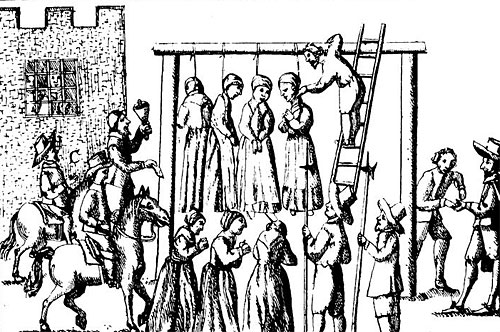
It was just a small blurb in the paper. Down at the bottom of page 17, it could have been easily overlooked. “Alleged witch killed by being set on fire” the small headline stated. And the date was 18 February 2012. This sad incident took place in Nepal. The story notes that “Each year hundreds of women in rural Nepal are abused after being accused of being witches.” Just last week, to the scorn of many, Cologne, Germany reopened the case of Katarina Henot, a woman burned as a witch 385 years ago. Katarina Henot was declared innocent because of the efforts of a priest to raise awareness of the persecution of women around the world. Five days after the story hit the news, Theganidevi Mahato was burned to death in Nepal. Although some called the action in Cologne a publicity stunt, it was anything but. We need to put names on those we continue to allow society to brutalize. Katarina Henot and Theganidevi Mahato, separated by 385 years and many, many miles, both died for the insanity that equates tragedy with women.

How blithely the word “witch-hunt” spills off the tongue. Each time we invoke it, the very phrase trails the ghosts of many thousands of women made to pay the price for society’s paranoia. The answers to why such tragedies occur may never be fully understood, but the events are preventable. The key is education. Even in the most advanced culture in the world, as we like to style ourselves, we heap contempt upon education, claiming that teachers barely work and that professors get paid for doing nothing. We have fallen into the fallacy that one size fits all—not all jobs can be measured by the wicked, black dip-stick of the oil industry, or the quick-cash-and-crash of the stock exchange. Education is a lifelong process, and as the political ridiculousness we constantly hear reminds us, lessons must be endlessly repeated until they sink in. Too many people think it is just easier to burn witches.

Witch-hunts arise when societies are stressed. Scapegoating is one of the most unfortunate legacies religion has left us. Evidence points to the scapegoat as being earlier than the Bible, although it takes its characteristic form there. We hear how the sins of the people were transferred to the goat on a day not so different from Ash Wednesday, to be symbolically born away where the animal would die instead of us. Somehow we’ve come to believe that burning the representative of our neuroses will somehow cure our society. Does it? Has it ever? This day as millions of Christians contemplate their sins and wear ashes on their heads, I suggest that we think of the women whom religion has allowed to become its victims. Whether due to the superstition of a remote village in Nepal or the irrational fear of “civilized” Europe with the blessing of the church, we’ve let scapegoating go too far. And those who’ve been killed are not the nameless females of forgotten times, but are the Katarinas, Theganidevis, Marys, and Rebeccas who were just as human as their neighbors.

What are their names?


What’s Wrong with Eve?

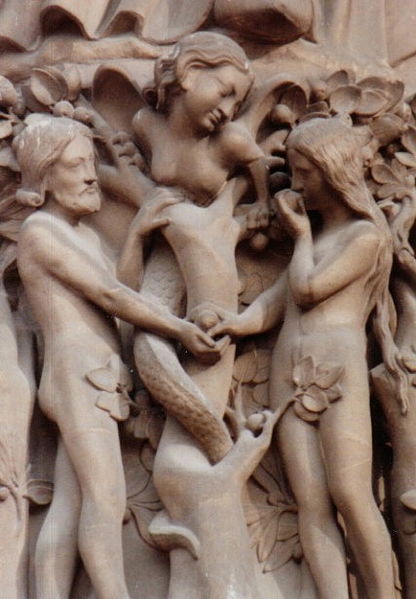
Reading a newspaper film analysis by critic Stephen Witty on film noir, I was intrigued by how he represents the role of the femme fatale. Most produced and directed by men, the classic noir features a dangerous woman. Noting that there are “nice girls” in such movies, Witty states, “they’re not the ones who matter, the ones as essential to the plot as that serpent is to Genesis.” Naturally, this statement evokes the image of Eve, the seductress.

Eve has been much maligned by patriarchal religions. She is a convenient scapegoat for men’s uncontrollable urges, and by making her the gateway to sin itself the male spiritual psyche is unburdened; it is all her fault. It often comes as a surprise that Genesis does not use the word “sin” in the episode in Eden. Interpretations of the tree of knowledge are not universally negative, nor is Eve alone to blame. Scapegoats, however, are much more comfortable than admitting culpability. Religions have stropped this to a high art; the masculine religious establishment can repress the feminine threat with scriptural justification.

Eve is a misunderstood heroine. She is the mother of knowledge. Genesis does not forbid the tree of life; ignorant humanity was free to live forever. Without knowledge. Eve, while perhaps under the duress of temptation, nevertheless took the initiative to find wisdom. And she has been paying the price ever since. Film noir is a reflection of life, as is most art. In a world where men like to think they have the right to rule, the woman who sees a little farther is considered dangerous. All feeble theological attempts to forbid religious leadership to women have Eve to thank for their revisionist hermeneutics.