A Cougar’s Mother

While on a stroll between appointments at Indiana University in Bloomington, I came across a tree with flowers laid underneath and a memorial plaque at its base. I glimpsed the name Mellencamp, and for a fan of rock, it didn’t take much imagination to tie it to John Cougar. Indeed, the memorial is dedicated to his mother, an artist, who died earlier this year. I first came to know of Indiana University because of music. I married a musician who, like myself, had to sacrifice a career doing what she loved in order to “get by.” Although she hadn’t studied at Indiana, my wife knew the reputation of the campus well. At a sunny moment between appointments I sat outside one of the music buildings listening to students practice through the open windows and read about Marilyn Mellencamp. An article in a local paper explains that this week an exhibition of her art is on display in Bloomington. When I read the quote from Waldron Arts Center Gallery Director Julie Roberts that the arts “are viable ways to make a living and they are vital part of being a happy and alive person,” I felt a renewed sense of hope. There are others, it is clear, who see that the arts are called the humanities for a reason. In a culture where only money matters, there is no culture. Think about it.

Since the industrial revolution we’ve been told that the measure of a human is how much money they are able to make. Something profound has been lost since then as great universities cut programs for the arts and humanities while business departments build new facilities. Talk about gaining the world but losing your soul—business cattily replies, “I have no soul.” While John Mellencamp never rivaled the biggest bands for income, his work, particularly Scarecrow, is full of human empathy. I listened to that album over and over in 1985, recounting the farm crisis and the demise of those not driven by corporate greed. And looking at this maple tree I wonder when the last time was that someone honestly mourned the death of a corporate mogul.

It is the mark of a deeply schizophrenic society that we all aspire to what fails to inspire. Our economy is driven by the material—money—and not that which speaks profoundly to what it means to be a human being. We keep the arts alive because the wealthy require something worthwhile upon which to spend their lucre. Is not buying art buying part of another person’s soul? We can’t define souls materially, science must conclude they don’t exist, but every time you say, “I feel happy/fulfilled/satisfied” you belie the facts. Souls may not be material, and they may never be found in laboratories. They are nevertheless part of the human constitution, and I for one, would lay a flower under a tree and know that it is more than just fertilizer for the next growing commodity.

Magic Bibles

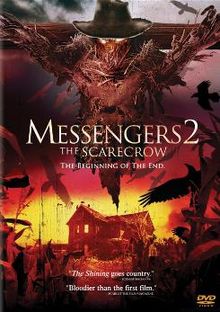
With autumn not far down the road, my mind turns to scary things. Actually, it is that way quite a bit of the time. Nevertheless, movies about farms are often the setting for the creepy—the sense of isolation, the sharp implements farmers use, the rustling of the drying crops in the wind. A couple years back I watched The Messengers. As a horror film it had a number of good scares, but the menace always seemed somewhat restrained. Nothing profound happens, and it is a film fairly easily forgotten. It was a rainy Saturday afternoon and The Messengers 2: the Scarecrow suggested itself to me. I began watching in an ambivalent mood, but when the first scene began with the protagonist (whose name I’ve forgotten) dropping his Bible on the porch chair as he loosens his tie to work on a derelict water pump, I was curious. When his wife arrives home and asks why he left church before it was over, my interest grew. This direct-to-video prequel turned out to be a cut-budget horror flick based squarely on a religious parable.

In a faustian moment of abandon, and at the advice of a jocular neighbor named Jude (Iscariot, anyone?), our hero erects a scarecrow to try to improve his lot (literally). To give credit where it is due, the scarecrow is distinctly disturbing. The scene of John (okay, I looked it up) nailing the scarecrow to the cross is clearly a crucifixion scene, and the blood that will later appear at the foot of the cross bears this out. Before he realizes that the scarecrow is evil, John hears ghostly children singing in his cornfield. The song is “Jesus Loves Me.” There is a strong fertility goddess theme running through the film and when Jude reveals that his wife has a magic book that explains all the benefits of the scarecrow, John decides to cut it down. The scarecrow, predictably, resurrects.

Meanwhile, John’s Christian family thinks he has gone insane. Or worse, backslidden. As he tries to explain to his wife what has happened, John shows her the magic book and she insists “It’s just your old Bible,” and it is. Heathenish occult instruction transubstantiates into Christian scripture. It is tough to tell one sacred writing from another. For cut-rate horror fodder, this is wonderful commentary on religious sensibilities. Although straight-to-video movies are not high art, and will never receive academy award nominations, they do reflect popular religious beliefs. Scholars are now in search of such beliefs in ancient societies since “official religion” almost never reflects what actual hoi polloi think. Lived religion seldom conforms to the intricacies envisioned by religious founders, and yet it is out there on the Internet for all to see. Maybe the messengers in this film are not the crows after all. The point of the parable? Stay true to your Christian upbringing or else the scarecrow will get you.