Machine Intelligence

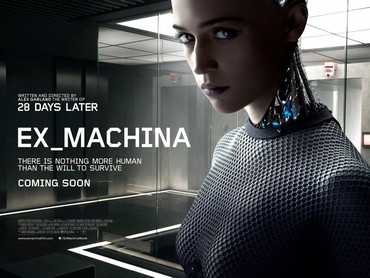
I was thinking Ex Machina was a horror movie, but it is probably better classified as science fiction.  Although not too fictiony.  Released over a decade ago, it’s a cautionary tale about artificial intelligence (AI), in a most unusual, but inevitable, way.  An uber-wealthy tech genius, Nathan, lives in a secured facility only accessible by helicopter.  One of the employees of his company—thinly disguised Google—is brought to his facility under the ruse of having won a contest.  He’s there for a week to administer a Turing Test to a gynoid with true AI.  Caleb, the employee, knows tech as well, and he meets with Ava, the gynoid, for daily conversations.  He knows she’s a robot, but he has to assess whether there are weaknesses in her responses.  He begins to develop feelings towards Ava, and hostilities towards Nathan.  Some spoilers will follow.

Throughout, Nathan is presented as arrogant and narcissistic.  As well as paranoid.  He has a servant who speaks no English, whom he treats harshly.  What really drives this plot forward are the conversations between Nathan and Caleb about what constitutes true intelligence.  What makes us human?  As the week progresses, Ava begins to display feelings toward Caleb as well.  She’s kept in a safety-glass-walled room that she’s never been out of.  Although they are under constant surveillance, Ava causes power outages so she can be candid with Caleb.  She dislikes Nathan and wants to escape.  Caleb plans how they can get out only to have Nathan reveal that the real test was whether Ava could convince Caleb to let her go by feigning love for him.  The silent servant and Ava kill Nathan and Caleb begs her to release him but, being a robot she has no feelings and leaves him trapped in the facility.

This is an excellent film.  It’s difficult not to call it a parable.  Caleb falls for Ava because men tend to be easily persuaded by women in distress.  A man who programs a gynoid to appeal to this male tendency might just convince others that the robot is basically human.  It, however, experiences no emotions because although we understand logic to a fair degree, we’re nowhere near comprehending how feelings work and how they play into our thought process.  Our intelligence.  Given the opportunity, AI simply leaves humans behind.  All of this was out there years before Chat GPT and the others.  I know this is fiction, but the scenario is utterly believable.  And, come to think of it, maybe this is a horror movie after all. 


More Morons

There’s an aesthetic to bad movies.  Some are so bad that they’re good.  Others are just plain bad.  Many years ago, during some Amazon movie sale or other, I purchased a DVD of Morons from Outer Space.  Now, horror comedy is a recognized genre, but sci-fi comedy is a bit harder nut to crack, even though horror and sci-fi are siblings.  Morons sat on the shelf for at least a decade, in case of need.  Having been scammed out of our life’s savings, a Friday evening when my wife said “Pick whatever you want, I’m likely to fall asleep anyway,” scanning the shelves my eye landed on it.  The movie had been distributed by MGM, how bad could it be?  Worse than anticipated, it turns out.  I don’t recall ever seeing an intentional comedy where the entire laugh potential was so misaligned.  There were one or two spoofs that worked, but mostly it dragged and begged to be put out of its misery.

Three aliens, anatomically human, crash land on earth after leaving a crew-mate behind on their deep-space vehicle.  The extended scene of their spaceship tooling down the highway might’ve been funny had it lasted maybe a tenth of the time.  The knock-off of Close Encounters’ use of music to communicate was a little funny.  The alien interrogation missed several potentially humorous opportunities.  The aliens eventually become celebrities while an American commander insists that they be killed because of their threat to life on earth.  Ironically, I’ve often wondered how it would be if aliens who came to earth were badly behaved members of their species.  I can honestly say that that would be better than the way this movie played out.

Meanwhile, the abandoned alien gets a lift with a spooky-looking alien.  In perhaps the funniest scene, the spooky alien asks the human alien his sex.  That part was funny on a couple of levels and showed the potential that the movie might’ve had.  He ends up on Earth and tries to connect with his three shipmates, who are now, literally, rock stars.  When they finally meet up, they summarily dismiss him again, only to be hauled off back to space by a closing Close Encounters parody.  I confess that I am still trying to appreciate bad movies on their own aesthetics.  I’ve seen so many that I added a “Bad movies” category to this blog.  Bad movies are often unintentionally funny.  It’s a different beast when a comedy is unfunny.  Particularly when there was potential there, if it’d only been effectively used.


Cuckoo’s Roost

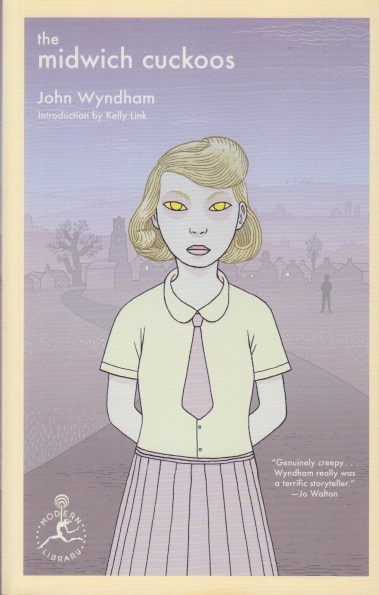
John Wyndham is someone I discovered through movies.  Often considered a science-fiction writer, his works cross over into horror, particularly on the silver screen.  Many years ago I read Day of the Triffids and, having seen Village of the Damned, wanted to read The Midwich Cuckoos.  It was a pretty long wait.  I kept thinking I might find a copy in a used bookstore, but it never happened.  When I saw a reprint edition I ordered it with some Christmas money.  There are some horror and sci-fi elements to the story, but there’s also a bit of thriller, as it’s called now, thrown in.  The book is quite philosophical because of the character Gordon Zellaby, a Midwich resident who keeps thinking about what is happening in terms that don’t match the expectations of other, more prosaic thinkers.  In case you’re not familiar:

Midwich becomes unapproachable for a period because an alien ship (the sci-fi part) has covered it.  Everyone in the village is asleep for a couple of days.  When they awake, generally no worse for wear, they soon discover that all the women of childbearing years are pregnant.  They all give birth about the same time to children that look eerily alike and have bright golden eyes.  The officials know this has happened but adopt a wait-and-see attitude.  Meanwhile, the locals get on with things but they discover these new children develop about twice as quickly as humans do and they can control people with their minds.  They also have collective minds so that their brainpower is quite above that of Homo sapiens.  Zellaby makes the connection with cuckoos—birds that lay their eggs in the nests of other birds and after they hatch shove the other chicks out of the nest.  Indeed, this is a story about what if cuckoos were humanoid aliens who tried the same thing with people.  Told with a British stiff upper lip.

The story slowly unfolds and gets scary as it grows.  I saw the movie quite a few years ago and the details were lost on me, so I was learning as I read.  I suspect that it differs from the book quite a bit.  Perhaps it’s the Britishisms that make this story less of a horror tale.  There’s a kind of jocularity to the style, at least for a good bit of it.  The serious issues of how governments and individuals interact is raised and discussed to a fair extent.  Even though the book is fairly short, there’s a lot going on here.  But now I need to watch the movie again.


A Land Forgotten

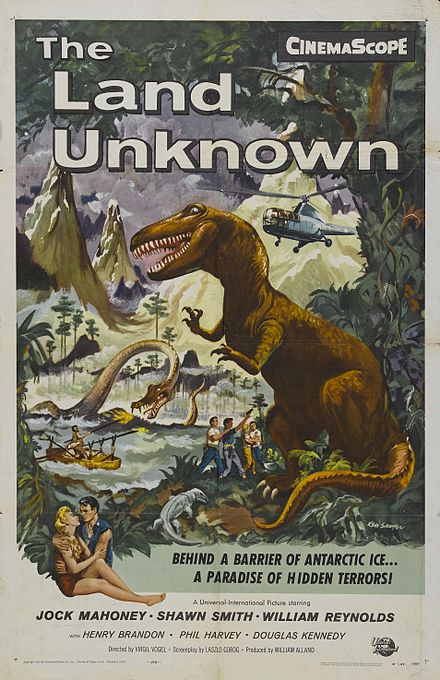
In case anyone’s noticed (which I doubt) that I’ve been discussing a spate of 1950s sci-fi/horror movies, I have a confession to make.  Several years ago I needed to see Tarantula.  (Anyone with similar headspace will know this need.)  The only place it was available at the time was in The Classic Sci-Fi Ultimate Collection.  Volumes 1 and 2 were sold together.  I did what I had to do.  Then I forgot I had the set before finishing volume 1.  Who knows what might’ve been going on in my life then?  Rediscovering it has been a budget-saving way to address my fix.  I had never heard of The Land Unknown before, and although it has one of the goofiest T-rexes ever, it is actually a good story.  Of course there are holes in the plot, but it is about the necessity of being humane, even when emotion dictates otherwise.

A helicopter crew on a South Pole expedition makes an emergency landing in a volcano that harbors prehistoric life in a hot spot in Antarctica.  The crew has a female reporter with them—these movies certainly have fifties attitudes about women!  Not having the parts to repair their copter, they try to survive among dinosaurs and an aggressive, giant monitor lizard.  There is another person there, the sole survivor of an earlier expedition, who’s become mostly feral.  The commander of the modern crew demands that they give him the dignity and fair treatment that all people deserve.  There’s a bit of drama around who will get the girl (again, the fifties), with the commander ultimately winning out.  How do our heroes escape this peril?  They’re able to repair the helicopter with parts from the earlier expedition’s crashed vehicle.

With its budget the special effects had to be cheap, but the story has redeeming value.  The message that we mustn’t let isolation drive us to bestiality is still as important as ever.  There are those who watch such movies solely to laugh at the special effects.  Hey, I laughed a bit too, but I’m only human!  There is, however, more to this movie than the dinosaurs, which drew audiences then just as the Jurassic Park franchisedoes now.  There’s even some serious talk about evolution, which was often present in these Universal creature features.  There are some slip-ups on the evolution part, but apparently the monitor lizards were meant to represent stegosauruses—did I mention the budget was tight?  I actually found the movie to be worth seeing for its intrinsic value.  Not bad for a forgotten set purchased mainly for one movie in a time unknown.