Of Gears and Gods

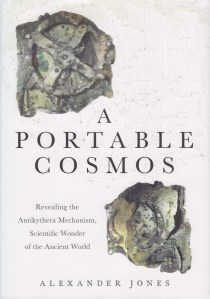
We develop pictures in our minds of the kinds of things that belong together in different eras. Dinosaurs, for example, don’t belong with our own species, no matter how much we may occasionally wish it were so. Horseless carriages don’t populate the seventeenth century and complex machines, we tend to think, didn’t really come about until medieval Europe (and then they were often used for torture). Our view of the world is, of course, one of comfort with the certainties of history. That’s why the Antikythera Mechanism is such a fascinating artifact. A very sophisticated device with gear trains and cranks and dials, it astonishes those who first encounter it in that it was made before the Common Era somewhere in the sway of ancient Greece. It is, in essence, a kind of computer. Long before Joseph met Mary.

Alexander Jones’ A Portable Cosmos: Revealing the Antikythera Mechanism, Scientific Wonder of the Ancient World is a pretty thorough introduction to the device, including the mechanics of how it works as well as how astronomy works. You see, the Antikythera Mechanism was designed to demonstrate the relative motion of the planets, including the sun and moon. For a device in the geocentric world of ancient Greece, that’s pretty remarkable. It predicted eclipses and showed the phases of the moon. It also makes me ponder the fact that most ancient people considered the planets deities. Long before Newton, then, some were recognizing that even the gods could be made to work according to a crank and gears.

Science and religion coexisted peacefully in those days. Although only one such device has been discovered, it’s virtually certain that more existed. Gods and gears both had a place in such a world. Along the centuries, however, the idea grew that if gears worked, we no longer required a deity. Occam’s razor has its uses, to be sure, but it can shave a little too closely from time to time, nicking delicate flesh. The idea that one side only can be right—and since we can see with our eyes that science works—tends to favor the mechanistic universe. There’s no disputing that science makes our lives easier and that its method is self-correcting and generally effective. The hands that cranked that ancient geared device, however, likely belonged to a believer in gods. Such belief didn’t prevent progress, but then some kind of Fundamentalists killed Socrates for his own form of heresy. Perhaps the true answer lies in balance. It may also be the most difficult of principles, scientific or otherwise, to achieve.
Candles vs Demons

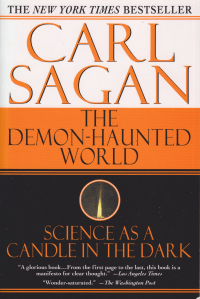
Among scientists who write Carl Sagan has always struck me as one of the more open minded. Dedicated to the scientific method, he nonetheless admits that there are some things scientists don’t know. The last time I was in Ithaca, therefore, I picked up a copy of his tour de force, The Demon-Haunted World: Science as a Candle in the Dark. I wasn’t really sure what to expect—I’ve been researching demons and I supposed they would be addressed in his book, since they feature in the title. Although that is indeed the case, the book is a collection of essays vindicating in various ways the practice and teaching of science. It is quite a scary book. It was also Sagan’s final book published in his lifetime.

Reading this just after Gabriele Amorth’s An Exorcist Explains Demons, noteworthy for its credulousness, The Demon-Haunted World was like whiplash into reality. Back into the realm of observable facts and testable hypotheses, it was indeed like a candle in the dark. Sagan admits that science can’t speak definitively on the supernatural—something that sets him apart from other science writers—but that doesn’t mean we shouldn’t apply scientific thinking anywhere it’s appropriate. And that includes the universe of politics. Published some two decades before the rise of Trump, the book is surprisingly prophetic when it points to the possibility of the rise of fascism in a nation that distrusts science. Indeed, the book shows Sagan clearly worried that an authoritarian, totalitarian government was on the rise. It’s almost preternatural in its accuracy.

The tome is large enough to dissuade a full summary within the word-limits I set for myself on these daily posts, but I can say that this book is necessary now more than ever. Sagan was a celebrity in his lifetime, a “rock star” scientist. Even so he worried about the deplorable state of science understanding among political leaders he met. For many years America has been mired in conservative causes that distrust science implicitly. Another strain that runs throughout this book is the need for education. Not only has America catered to anti-science groups, it has fallen behind much of the rest of the world in science education. Those who claim to make America great again can’t see that their very tactics have made our nation fall behind the rest of the world when it comes to education, across the board. Surely Sagan was right that a good grounding in scientific thinking is the equivalent of lighting a candle. As for the rest of the country it has been getting darker and darker, and our “leaders” have no idea even how to strike a match.


Scientists, Unplugged

Feeling inferior is common among religionists. When cultures list their brightest and best, scientists often top the list and those who specialize in religion are nowhere to be found. This situation gives the lie to the fact that many scientists think about, and are influenced by, religion. That became clear to me in reading Stefan Klein’s We Are All Stardust. Not Klein’s best-known book, this is a collection of interviews with well-known scientists, unplugged. There are many big names in here, such as Richard Dawkins and Jane Goodall, as well as some less familiar on a household level. Klein, himself a Ph.D.-holder in physics, asks them somewhat unconventional questions, with the goal of bringing a more human face to scientists.

When asked directly, scientists admit to thinking quite a bit about religion. Of those interviewed, several are hostile to it while others accept some tenets of one faith system or another. Most of them indicate that either religion or morality plays an important role in society, if not in science itself. The sad part is almost none of them seem to realize that the study of religion can be (and among the university-trained, generally is) scientific. In academia, religious studies is often vaguely tossed in with the humanities, while others would suggest it fits under social sciences—as a sub-discipline of anthropology, for example. Few understand the field, in part because many specialists enter it for initially religious reasons, somehow tainting it.

While I enjoyed the book quite a lot—it was a quick read with plenty of profound ideas—it also had a disturbing undercurrent. The explanation that many of the interviewees gave for why they went into science was “curiosity.” The implication was that those who can’t stop asking questions, and have intelligence, go into science. Again, this feature is true of most academic fields, if they’re understood. Greatly tempted to go into science myself, I simply didn’t have the mathematical faculties to do it. While I took advanced math in high school I wouldn’t have gotten through without my younger brother explaining everything to me. My real concerns lay along the line of ultimates. Learning about Hell at a young age, it made the most sense to me—very curious and scientifically inclined—to avoid going there. To do so, the proper target of my science should be religion. While many scientists in We Are All Stardust are friendly to philosophy, religion is considered a far less worthy subject by not a few. True, religion often behaves badly in public. It doesn’t bring the money into universities that megachurches reap. But unplugged even scientists still think about it.


Personifying Evil

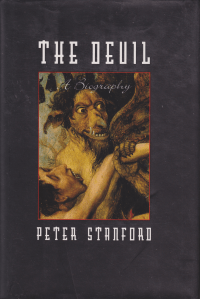
Biographies seldom cover millennia. Even if one were to try to uncover all the scant facts on old Methuselah at 969 years, it would still fall short of four digits. So Peter Stanford’s The Devil: A Biography takes the long view. Even with that lengthy perspective, there’s little that might be known about the prince of darkness. Even with a role in the Good Book his appearances are few and details are lacking. What Stanford does, of course, is outline, more or less, the history of Satan. This is no easy task since few ancient sources focus on trying to provide explanations for exactly who this might be.

As with most books by non-academics (and I don’t mean to sound snobbish here) there are some overstatements. Some of the details aren’t so finely parsed. It’s the big picture the author’s after and he does quite well when it comes to the modern era. Not only is there enormously more material from which to choose, there is also a great deal of literature and even headlines available to harvest. All writers that I’ve encountered on the subject make the point of demonstrating that news of what’s happening in the modern world suggests either the Devil exists or that something (or things) is doing a great job parodying such a character. When seeing evil in the highest reaches of the government it’s not so hard to believe.

The thing about the Devil is that he almost died out. In the nineteenth century when the explanatory value of science was firmly kicking in, and industrialization was making our live both easier and harder, the dark lord went underground. Humans seemed capable of making and claiming their own evil, and even the professionals—the clergy and formal religionists—had admitted Satan was most likely a metaphor gone wild. The birth of Fundamentalism, a movement that became prominent only in the 1920s, necessarily resurrected the Devil. The Bible does mention Lucifer, so he had to be real. Since that day he’s learned a lot. Protean to the extreme, he bears many guises. No longer beholden to a demonic tail, cloven hooves, or a pointy beard, he most often appears clean shaven and wearing expensive business suits. Borrowing a phrase from the Good Book, it’s by his fruits that we know him. Stanford’s biography shows its age a little, but when you’re covering a couple thousand years of speculation, being outdated is only a venial sin.


Sky Mercies

While in a used bookstore recently, I was going over the science titles. I like to read accessible science since I often find it approaches religious ideas in secular terms. Once in a while even the terms of these disparate disciplines coalesce. I spied a volume on the top shelf titled The Mercy of the Sky. The spine showed a purplish cloud-bank, and the very concept set me wondering. We’d just been through a bomb cyclone the day before with wind bellowing through our apartment. Many trees were down and power was out for several people I’d overheard talking that day. I stared at the spine, thinking perhaps this would be a good follow-up to Weathering the Psalms, but as I already had books in my hands, and since I’m not the tallest guy around, it seemed beyond my reach. Of course, after I left I thought more about it.

The previous day’s nor’easter had revived that sense of a storm as divine anger. Strong winds, my wife commented, are generally disturbing. They make it difficult to sleep. It’s hard to feel secure when the heavens are anything but merciful. Although the wind is easily forgotten, it’s among the most easily anthropomorphized of natural phenomena. And it’s ubiquitous. Everything on the surface of the earth is subject to it. Indeed, the atmosphere is larger than the planet itself. Is it any wonder that God has always been conceptualized as in the sky? The quality of the mercy of the sky, we might say, is strained.

Danger comes from the earth below us, the world around us, and the realm above. Like our ancient ancestors staring wonderingly into the sky, it is the last of these that’s most to be feared. The wind can’t been seen, but it can be felt. It cuts us with icy chills, drenches us with dismal rain, even flings us violently about when its anger compresses it into a tight whirl. We can’t control it. Unlike other predators it requires neither sleep to refresh nor light to see. Its rage is blind and it takes no human goodness or evil into account. After a great windstorm, the calm indeed feels like a mercy. Elijah on Mount Sinai stood before a mighty wind, tearing the land apart. It was the still, small voice, however, that captures his imagination. There’s a calm before the storm, but it is the stillness in its wake that most feels like the mercy of the sky.


Science of Unbelief

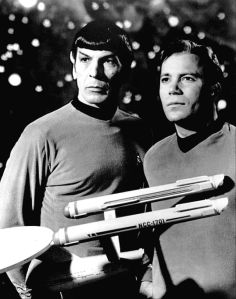
An article a friend sent me from Science Alert back in December recently came to mind. Titled “Thinking About God Might Make You Sweat, Even if You’re Not Religious,” the article by Brittany Cardwell and Jamin Halberstadt discusses how religious ideas are deeply engrained in human psychology. Like people who say they’re not afraid of spiders or snakes, people who don’t believe in the supernatural have made an effort to become this way. For reasons poorly understood, human beings are natural believers. As the article takes pains to state, that doesn’t mean a non-believer isn’t sincere. Thinking, however, doesn’t come only from rationality. Many people hold to the Mr. Spock fallacy—the belief that reasoning can solve anything. We all know from experience that it can’t. The big decisions in life—whom should I marry? What house should I buy? For whom shall I vote?—are often made with the emotions rather than rationally.

Which one’s the captain?

Reason has taught us to be expert deniers. We can learn to overcome our natural aversion to snakes and spiders and we can learn not to believe in God. Sometimes that belief can even be knocked out of us by the silly, unthinking behavior of “true believers.” But deep down it’s still there. Funnily, those who claim that reason alone answers all things are in denial about their own evolution. The human brain is a direct adaptation of the “reptilian brain” with its fight or flight impulses. That viper doesn’t plan to bite your ankle—it’s reacting to fear. Emotions are an integral part of thinking. Crimes of passion are committed by otherwise rational people sometimes. That thing you keep on bumping into in the room is, in fact an elephant. As irrational as that may seem.

The Science Alert article discusses the empirical proof that people fear to dis the Almighty. Were the brain a computer I’d say it was hardwired into us. We’re not wire and circuits, however. We’re messy, organic, evolving stuff that at one time lived beneath the waves. It took a certain amount of lungfish faith to believe we could survive on dry land. As mates approved of such irrational behavior, the trait multiplied and became more common. Today our smart phones and our cubicle window posters tell us there’s no such thing as a deity beyond our own scientific rules. The truth is, however, at some level we don’t really believe it. You can learn not to believe, but you’ll still sweat the big stuff, even in laboratory conditions.


Creating Science

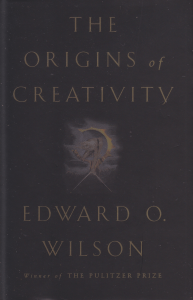
Religion and science. Cats and dogs. We’re used to hearing these two just can’t get along. High profile scientists sometimes denounce religion tout court, and some religionists doubt science’s claims implicitly. Human beings, truth be told, are both rational and spiritual. Often not both at the same time. Edward O. Wilson is a biologist who believes, as expressed in The Origins of Creativity, that the humanities and science are both essential and that the hope of humanity is that both will be embraced. It’s a fine vision—guided by science but aware of the values brought by art, we would live in a world utilizing the best our species has to offer. So, why don’t we?

Apart from the obvious fact that humans are also irrational and non-religious—what else could justify wars?—Wilson has a rather odd answer. The belief in creation myths, he avers, is what leads to much unrest in the world. Not religion per se, but creation myths. Muslims, Christians, and Jews share basically the same creation myth. Their divergences come in other forms. Many don’t much care about the creation myth of their tradition so much as about issues that are based on outdated understandings of humanity. Wilson doesn’t condemn religion per se, which is refreshing, but he does seem to circumscribe it far within its natural boundaries. I suspect his real target is creationism.

In this very insightful little book, another curiosity lurks. Wilson, although he supports the humanities and advocates for them, stresses that they are problematic by being limited to humans. I think I get this, partly. There is much to the world beyond human ability to perceive. Our senses of smell and taste are especially limited. We can’t see as well as an eagle or hear as well as a bat. Incorporating their experiences into the humanities would be way cool, but we would never experience them ourselves. This is terribly speciesist of me to say, I know, but humanities are all about what it means to be, well, human. We are limited. Rationality is limited. We don’t have all the facts, and if history is anything to go by, we never will. Accepting limitations is very human. So is attempting to exceed them. The humanities at their best embrace both. Wilson acknowledges that the study of religion is important, and that our universities let us down by not giving the humanities their due. Science can take us only so far. Creativity is about the most godlike trait we possess.


Heal and Farewell

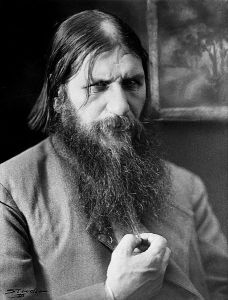
What could Aimee Semple McPherson have in common with the devious Russian monk Rasputin? Apart from being contemporaries for a couple decades, they were both faith healers. Well documented cases exist for both of them, and the medical profession has started to come around to the idea that belief can, and does, heal. The stories of Sister Aimee’s healings, witnessed by thousands, make me fear being thought gullible just for bringing it up. That doesn’t mean it didn’t happen. Cases exist even today where healing inexplicably takes place before scientific eyes. Often it occurs in response to religious stimulus. We may have proof that it happens, but we tend not to believe. This is a curious state of affairs. We trust in reason to the point that it may prevent us from being healed by faith.

Some object, of course, to the theological element. It’s pretty tricky to believe God has healed you if you don’t believe in God. The thing about faith healing, though, is that it seems to work no matter the religion of the person healed. This, it would seem, suggests we should be applying our rational minds to understanding belief. Instead we use it to find new ways to make money or to build smarter weapons to kill one another more efficiently. The more we come to understand the physical world around us, the less we know. As our research institutions take on the shape of the businesses that increasingly fund them, interest in this phenomenon shrinks. Medicine, in all its forms, is big money. Living in central New Jersey you can’t help but notice the palatial campuses of the pharmaceutical companies, nor ignore the mansions on the hill they have built. If only we could believe.

Faith healing was this aspect of her ministry that propelled Sister Aimee to fame. She constantly underplayed it, not wanting to be considered a healer of bodies so much as a healer of souls. Rasputin, of course, had political motives. Both lived—not so long ago—when faith was taken very seriously. Judging from the posturing around the least religious president in decades, whatever faith is left has been sorely effaced. Maybe it’s our minds that have the capacity to heal, but even that well seems to have been drained with the leaky bucket of rhetoric. History can teach us so much, if we’re willing to invest in it. How does faith healing work? I have no idea. Nor, it seems, does anybody else. So it will remain until it becomes commodified.


Augustine’s Secret Sin

I’m curious: what do you think of Augustine? Augustine of Hippo was an odd blend of saint and sinner. I don’t mean “saint” in the sense of being so designated by the Roman Catholic Church, but in the sense of having reputable and progressive ideas. For example, Augustine argued that science, such as it existed in his day, had to be taken into account when understanding Christianity. If the Bible’s account of creation didn’t match what we knew of the world, then literalism had to go—that kind of thing. This was quite liberal for someone in the fourth-to-fifth centuries. He believed in reason, to an extent. The sinner side of the equation goes beyond his Manichean days, however. The sins I’m referring to are his dangerous and long-lasting theological assumptions that’ve helped to hold back civilization throughout history.

It was Augustine, for example, who gave us the idea of original sin being involved in sexual reproduction. The church has always been cagey on why we should reproduce when the second coming is right around the corner, but Augustine declared that from our very conception (which he couldn’t understand scientifically) we were tainted with sin. But that’s not the particular sin to which I’m referring. Augustine also spread the persistent idea that curiosity itself was a sin. Christianity, in his view, was a “need to know” religion, and curiosity about the natural world could lead to uncomfortable answers. He held this in tension with his belief that we should accept what science teaches, but there were many questions, he decided, we simply shouldn’t ask.

Religions have often come to this crux. Science has a strong explanatory track record. Religion is frequently based on old texts, written in an age when science was but an infant. As the power of rationality grew, the role of miracles shrank. Over time the proof of theological structures began to crumble. And since life was all about correct theology, those edifices had to be shored up against the onslaughts of reason. If this sounds hopelessly outdated, I’ll have to confess that many of my students at Nashotah House believed reason was tainted by original sin. Augustine had the answers they believed; somehow rationality had stopped with him. Human curiosity, Augustine felt, was a sin. All questions should’ve ended with his arguments. It’s this kind of theological bravado that gets us into the mess we find ourselves in today. Voting blocs that never question what their religious leader tells them. Never curious enough to ask “Why?” Augustine was a brilliant man, in many respects. He was also a sinner of the highest degree.


Noah’s Phone

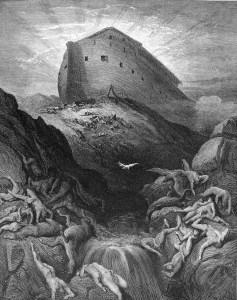
The world-wide flood is a great story. We find it in many cultures, so the idea obviously captured the attention of ancients as well as moderns. What’s strange is that, with the development of human knowledge so many people continue to accept it literally. The only science that can be bent enough to make it work is one where God breaks all the laws of physics and biology to kill everyone, just to make a point. Why bother to make it rain 40 or 150 days? Why not just create the requisite water instantaneously? It would be just as believable. Nevertheless, literalists look for explanations for how this might’ve happened. It’s not to convince God, of course. The goal is to convert unbelievers by showing that the myths of Genesis are literally true.

When I came across a story on Mysterious Universe by Paul Seaburn titled “Academic Claims Noah had Cell Phones, Drones and Nuclear Power,” I was hooked. The academic is a Turkish professor of marine sciences. Using modern technology—rather like the detritus seen scattered in the background of Darren Aronofsky’s recent movie version—he postulates that this could’ve happened. The real issue is why. Not why the flood; the Bible answers that. Why would a scientist feel the need to prove a myth scientifically? Biblical scholars call the flood story an etiology. An etiology is a story to explain the origins of things. That’s its purpose.

Noah’s flood explains why it rains. It also explains why this dome that covers our flat earth doesn’t fill all the way up anymore. It explains why animals are sacrificed and why rainbows occasionally appear to grace the sky after it rains. We also know that the story borrows from an even earlier Mesopotamian myth where the god who causes the flood isn’t even Yahweh. The people of Israel were conquered by the Assyrians and Babylonians and they told flood stories about their gods. The Bible counters with two stories (yes, just like the creation accounts) mixed together in this snow-globe universe of Genesis. Is it easier to believe this or to claim that Noah had access to Verizon, steel manufacturing, Einsteinian physics, remote-control flying machines, and artificial insemination (to help the animals recover)? It’s like when someone suggests natural explanations for the plagues of Egypt. Such special pleading doesn’t prove miracles, but rather it demonstrates that all this could happen without any gods involved. And you’re still going to have to mop up all that water when it’s over. I’m sure it will make for a great story some day.


How Did We Get Here?

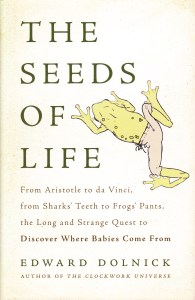
Where do we come from? Leaving aside the puerile snickers of our younger selves, we eventually learn “the facts of life” and get on with it. The funny thing is, conception wasn’t really understood until the late nineteenth century. Obviously people had been reproducing from the very beginning. Chances are they were curious about the matter even then. Scientific investigation was a long way off, however. Edward Dolnick tells the story of the discovery in a wide-ranging, entertaining, and informative way in The Seeds of Life. The subtitle gives an idea of the range and quirkiness of the account: From Aristotle to da Vinci, from Sharks’ Teeth to Frogs’ Pants, the Long and Strange Quest to Discover Where Babies Come From. I used to tell my students that using the Bible for sexual ethics was difficult because biblical writers really didn’t understand what was going on “down there.” I think Dolnick would back me up on that.

Ancient people generally made the connection between sex and babies, of course. What was actually happening, however, wasn’t understood because sex cells require a microscope even to be seen, and that doesn’t make it obvious what they’re doing. Dolnick’s tale looks at advances in various sciences and, perhaps more importantly, the religious constraints under which they operated. The idea of the atheistic scientist is a fairly new one. Up through most of the nineteenth century scientists tended to share the worldview of others that God was assumed and that religious rules applied to such mysteries as life. That’s amply demonstrated in this book. True insight was slowed down considerably by religious presuppositions.

That’s not to say Dolnick blames religion—this book is much too congenial to do any blaming. A number of ideas had to coalesce, however, before it was understood that both women and men contributed to the developing embryo. Medicine was often looked down upon by science, and religion often crossed its arms and stood in the way. Despite all that, careful observation, and putting unexpected things beneath a microscope, finally led to the answer. It was sea urchins who finally yielded up the mystery’s clue. This book will take you some strange places. The individuals described are a curious lot. For the most part they’re also a religious lot. Persistent theorizing and persistent peering through a microscope and a willingness to question convention all had to combine to answer a question as basic and profound as where it is we come from.


Middle Age Demons

One of the consequences of watching horror movies is the interest in the origins of various monsters. Since many such films feature demons, their backgrounds and origin stories have always been a point of curiosity. Time is always an issue and Juanita Feros Ruys obliges that hurried sense by packing a lot of information into her short book Demons in the Middle Ages. Covering the basics in the introduction, she moves on to discuss demons in the desert—the bane of the early monastic, and demons in the monasteries of populous Europe. A chapter on the Scholastics describes how early science was applied to incorporeal beings, and a final chapter on learned magic, i.e., raising demons via magic books, finishes off this brief study.

What is particularly striking here is that the Bible says surprisingly little on the topic. It says, however, just enough to kickstart the Late Antique and Medieval interest in the subject. Vast amounts of speculation were raised in the Middle Ages concerning what exactly demons were and what they were made of and what they could or couldn’t do. Ruys points out the trajectory of the male necromancer giving way to the female witch just as early modernity was getting started. The results, we all know, were horrific. Throughout it is remarkably clear that belief in demons was strong. People took them very seriously—the Bible says they’re there, so there. Belief, as always, has consequences. Beginning with the Scholastics, however, a reasoned understanding of the spiritual world was deeply desired.

Reason and faith aren’t really the strangers they’re often portrayed to be. Medieval monks could be quite clever and scientific in their outlook. Human mental faculties, created, as they believed, by God, were necessarily good. Something I’d never considered, but which Ruys explores, is the belief that God cannot experience emotions. Being an “unmoved mover” meant not experiencing emotion (which, she points out, includes a noun of movement). This also meant that demons, according to some, had no feelings. This is a very cold spiritual world, particularly when it’s put into conflict with the human one. Spiritual, rational beings subjected to emotions, we’re the ones at the mercy of supernatural beings more powerful than us, yet incapable of the warmth we crave. About a millennium and a half of shifting beliefs in demons crowd this tiny book. Although not intended to be especially profound, it gives the reader plenty to ponder. Including why some of us watch horror movies at all when religion can do the trick all by itself.


Science and

Do science and religion have to fight? It’s not evident that they do, but some on each side of this divide like to keep the conflict going. Many religious believers feel threatened by the incredible success of scientific explanations. The gods who used to explain everything are now responsible for so little that it’s easy to feel foolish for believing. It doesn’t help that the most vocal scientists have made religion their personal court jester, adding ridicule to the mix. Krista Tippett’s book of interviews with scientists, Einstein’s God: Conversations about Science and the Human Spirit, is a refreshing counter to this trend. Although it’s a few years old now, the book just landed under my tree, so I started off the new year with it.

A blend of interviews with scientists, quotes from their books, and personal observations, Einstein’s God is a fascinating and quick read. Covering topics from the wonder many scientists feel about their discoveries to medical understandings of how spirit effects healing to the ongoing debates about evolution, this book looks at the big picture. The scientists Tippett interviews, although some are atheists, don’t dismiss religion. In fact, many of them suggest religion in some form is necessary for healthy human living. As scientists they don’t dismiss science either. It’s refreshing to read about how those with scientific bona fides sometimes come to the same conclusions that those of us without the credits have surmised.

Once I began working at age 14, one of my earliest purchases was a subscription to Discover magazine. I was a charter subscriber. I was also a Fundamentalist. Not realizing that science and religion should be squabbling, I read science that could be digested by someone without professional training. Until I felt the tug of the ministry, I had intended to be a scientist. The only professional religionist interviewed in Tippett’s book is John Polkinghorne. A physicist cum priest, Polkinghorne has come to prominence among those involved in the debate between how we know what we know (the fancy term is epistemology). I wondered as I read this how it might differ from the other direction. Some of the interviewees were raised religious—Jewish and Hindu, notably—but none started out as professional religionists who went into science. That, I learned after college, is a much harder transition. Perhaps it says something about the nature of reality that to move into science as a career you must start with the undergrad prereqs if you ever hope to make the switch. Otherwise, those who start out with A’s in high school physics end up watching from the sidelines while others set the terms of the conversation.


Wise Women

At a neighborhood holiday gathering the topic of a local living nativity came up. This year they need some wise men (don’t we all!) and some of the women mentioned that wise men should have beards. As the wearer of an old growth facial forest, I became the subject of a couple of queries—could you be a wise man? I replied that I wasn’t smart enough, but in the back of my mind I was attending the last church nativity play I’d been in. It was at the Church of the Advent, Boston’s high Episcopal establishment. I was cast as a centurion and was directed to deliver my lines woodenly. Being who I am, I did as I was told. I was invited to the cast party on Beacon Hill anyway. It was one of my few brushes with society folk in Boston.

Like many boys raised in church, I’d been cast in such plays before. One of three boys each born just one year apart, I was assigned the role of wise man along with my brothers. Far too young to grow a beard, I wore a costume made by my mother and carried a jar from a science experiment as a gift for baby Jesus. Being poor, we had no gold—or even frankincense or myrrh—lying around. In school we’d done this science project where a solution grew crystals up the inside of an ordinary coffee jar and out over the top. Stain it with food coloring and you have a gift fit for a king. So the illusion went.

The Christmas we celebrate today isn’t based too much on fact, but it is a prime occasion for plays. It’s a dramatic story, although the New Testament has to be bent and twisted to make it all fit into the comprehensive narrative of proselytizing playwrights. The king nobody recognizes being born in a barn. The creator of the universe being rejected by the very world for which he (the baby was always a boy) was responsible. The story is as timeless as Dickens’ Christmas Carol, and it’s enacted thousands of times each year in churches large and small across the country. Is there any reason that, as long as we’re straying into realms of imagination, the wise visitors shouldn’t be female? The ability to grow facial hair has little to do with any kind of intelligence. In fact, we’d be much better off right now with a woman in charge.


Anneliese or Emily?

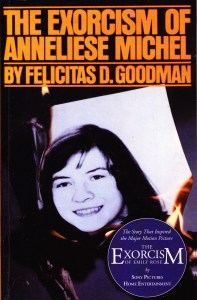
If it weren’t for the movie The Exorcism of Emily Rose, the name of Anneliese Michel would undoubtedly be less recognized than it is. Probably the first exorcism movie since The Exorcist to move the genre in a new direction, Emily Rose was based on the real life case of Anneliese Michel. There were significant differences between film and reality, however. Michel was from Bavaria, and she died at the age of 23 rather than being an American teenager like Emily. The story caught media attention because it was discovered that Michel had died after an extensive, months-long exorcism. Charges were made and the priests and Anneliese’s parents were found guilty of negligent homicide. The movie plays the whole thing out in the courtroom with flashbacks of the possession.

The book which led to the film was The Exorcism of Anneliese Michel, by Felicitas D. Goodman. Goodman, who died in 2005, was a rare academic who wasn’t afraid to address the supernatural. Trained as a linguist, she had years of anthropological fieldwork experience and a medical background. She was also not dismissive of religious experiences. Naturally, this makes her suspect among academics, but her treatment of Michel’s case is both sympathetic and masterful. After narrating events pieced together from court records, diaries, tapes of the exorcism, and information supplied by some of those involved, she offers her own hypothesis of what actually happened. Anneliese Michel was a religious girl caught up in a religious altered state of consciousness that was treated scientifically by drugs. The result was fatal.

Throughout history, and even today, shamanistic persons exist. Whereas in tribal cultures they tend to become prominent, in the “developed world” they are often quite hidden. They experience what Goodman calls religious states of altered consciousness, and are sometimes misdiagnosed as requiring chemical healing. There have been many thoroughly documented cases where such individuals do “impossible” things. The rationalistic world has no place for them, however, for like capitalism, materialism takes no prisoners. Religion is part of who we are. Human beings do have spiritual needs. Such needs can be placated by other means at times, and we can continue to believe that everything in this universe is made of atoms, or super-strings, or quarks. Or we can perhaps admit that theres’s much we do not know. Goodman admits that her solution is an educated guess, but it does put all the pieces together rather nicely. And she doesn’t declare unilaterally whether demons are physical or not. In the case of Anneliese Michel, however, they were undeniably real.