Come Forth

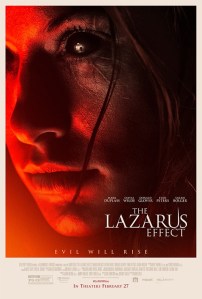
the_lazarus_effect_2015_film_posterHorror movies provide a strange consolation at times such as this. When evil has overtaken democracy, it’s almost like strategy, watching how fictional characters deal with things that are wrong, things that are too close to real life. The Lazarus Effect has been on my watch list since the last sane presidential administration, but need finally dictated that I watch it. The premise is clear from the title—Lazarus is universally known as the dead man who came back to life. A group of medical researchers at a university in California find a way, through direct stimulation of the brain, to bring dead animals back to life. The idea is that they will give surgeons more time to resuscitate critical patients if they can get the formula right so that it works on people. An evil corporation steals their discovery and they have just a few hours to replicate the experiment to prove they are the ones who perfected it. Predictably one of them (Zoe) dies and her fiancé brings her back to life. Mayhem ensues.

Those who’ve seen Pet Sematary will find many similar ideas covered here. Those who come back from the dead are somehow distorted versions of their former selves. Those who do the resurrecting end up dead at the hands of the modern-day Lazaruses. There’s not much unexpected here except that Zoe, a Catholic, ends up in Hell. There’s quite a bit of talk about religion versus science—what really happens when you die. Zoe, despite being a practicing Catholic, has never been forgiven for her childhood sin of setting a fire that killed some neighbors in the apartment building. Religion and horror sharing the screen is something fairly common, but it is seldom as forthright as it is here.

Resurrection—necessarily a religious concept—is a frightening prospect. Horror films have shown many times that this is a miracle that just shouldn’t happen. At least not on this plane. (Those who’ve watched Re-animator know how bad the consequences could be.) Scientists, generally unbelievers in the cinematic world, just can’t accept either an afterlife or death. Using technology to challenge a godless fate, they inevitably end up losing. So it is in The Lazarus Effect. Some biblical scholars have suggested John’s rendition of the story is a kind of biblical horror tale. I mean, Lazarus had been dead four days in the warm climes of the Holy Land. His resurrection seems to have ended up well, however. Then again, there is an inherent difference between science and religion. Neither one, however, is now really in charge.

Build a God

One of the more amusing gifts to find its way under my tree was a Design Your Own Deity magnetic play set. Since I have roughly only this brief holiday break for play in the entire year, I hope to make the most of it. Nevertheless, things like this always suggest something a bit more profound than they were possibly intended to do. The origin of deities is, by its nature, an unresolved question. Partly it’s because regardless of the reality of gods, religions are human constructions. Claims for revelation are frequently made, but the implementation is always our own. We can’t help but think that divinities are motivated by the same kinds of things that people are. I suspect that’s because we make gods in our own image.

img_3116

Historically there are few religions that were admittedly made up. We tend to treat with scorn more recent religions since we’ve become skeptical of a make-your-own deity talking to a person in the post-Enlightenment world. It’s much easier to believe if we say it happened long, long ago. Before we had the reassuring uniformitarianism of science, much could be left to the meddling of deities. Once we had a naturalistic paradigm, the door seemed to have slammed shut on supernatural explanations. Gods, who had been persons, now became symbols and symbols seemed to be less important than the real thing. Hadn’t we been designing our own deities all along? Now don’t we feel silly!

One of the common misconceptions of modernity is that ancient people weren’t very smart. We believe that because they lacked our technology. Looking at the way technology now demands most of my time, I wonder if that’s right. In the light of gadgets, deities have been squeezed out. I’m quite aware that the career choices I’ve made—involved with thinking about gods in some description—are hopelessly outmoded in the technological world. Still, as I look at the political landscape I see that we are still in the process of making our own deities. My play set includes some pretty exotic divinities. One that it seems to be lacking is Mammon. Of course, it’s best not to offend the currently reigning god, even if it is just a symbol.


American Possession

the_exorcism_of_emily_rose

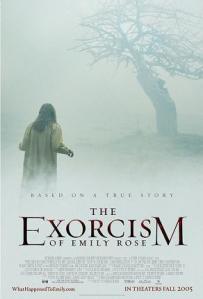
Exorcism seems an especially appropriate trope these days. Embedded evil has to be faced squarely and forced out before it kills its host. I recently rewatched The Exorcism of Emily Rose. This is a most unusual horror film in that the story is born by a courtroom drama over whether the priest overseeing the ritual was responsible for the death of Emily Rose. Famously based on a true story, the movie raises a more basic question than whether it “really happened”—what is the viewpoint through which we view the world? We see from the very beginning that the case is actually a contest between two powerful law firms. Each wants a lawyer that can shred the case of the other. The prosecutors engage Ethan Thomas, a very religious Methodist, against the defense’s Erin Bruner, an agnostic. Believing Emily’s case to be purely medical, Thomas asserts that had she stayed on her medication Emily would’ve remained alive with the prospects of a healthy life. Fearing a complete loss, Bruner takes a risky counter-approach: what is Emily really was possessed?

The obligatory scary scenes are shown, of course. They are flashbacks inserted into the course of the trial, but nevertheless disturbing for all their calm, rational framing. The real question, as the story plays out, is can a supernatural worldview be allowed in a court of law. Ironically, such a worldview is already present when a witness swears on the Bible. This particular movie doesn’t show those scenes, but it would’ve been a fair point for Ms. Bruner to make. Clearly the court can’t decide if demons are real, but it can allow that possibility. It’s a classic case of science versus religion. Nevertheless, both sides make use of science. The anthropologist on the stand is dismissed by the religious Mr. Thomas. He has no time for Catholic, or any other religions’, superstition.

Many strange choices were made for this particular cinematic piece, but the story works nevertheless. Those who believe in spiritual realities are allowed to live them out only to a point. The legal system decides if a religion has gone too far. I couldn’t help but wonder if, in a post-truth world, any clear standard of rationality can possibly hold. But questioning universally accepted truths and subverting them to personal preferences its almost if we’ve actually reached the stage of “all those in favor of general relativity say ‘aye.’” As I say, the film was more timely than anticipated. Demons, after all, often appear in the guise of an angel of light. Especially for those motivated by fear.


Fear of the Artificial

As someone who dedicated four years—particularly long winter nights—to the cause of high school robotics, I found myself knowing quite a bit before I walked into the room. Now let me post a disclaimer here: I’m no techie. I’ve studied the humanities throughout my education and although I’ve been able to engineer a bookshelf or two, and even the occasional project with moving parts, the technical eludes me. I claim absolutely no expertise in it. So where was I going that robotics came to mind? A lecture on Artificial Intelligence. AI. You see, I’ve been a bit concerned about it for some time because I’ve seen what robots can do. A friend recently showed me some episodes of Battle Bots on YouTube (the relative who started this blog for me was doing quite well in the competition last season), and from my own experience watching hours of FIRST robotics competitions, I know enough to be afraid.

What could possibly go wrong? (DARPA photo)

What could possibly go wrong? (DARPA photo)

The lecturer assured us that we had nothing—or next to nothing—to fear. Artificial Intelligence, he assured us, is a misnomer. Machines have no will. No mind. There’s nothing they want. They do as they’re told. You write a program and feed it to your bot and your mechanical friend can do only what it’s told to do. This sounds uncomfortably like slavery to me and although I know I’m projecting, I have to wonder if robots think the same way about it too. No, the lecturer assured us, they do only the tasks assigned. They don’t think at all. Then he said something that made me shiver. That wasn’t his intent. He said something like, “We don’t even know what consciousness is, so how can we replicate it?” That was meant to be reassuring.

I took this idea and flipped it over in my head. Rotated it. Ran it through my own programming. If we don’t know what consciousness is, how can we be sure we haven’t accidentally created it? Herein lies the heart of fear. Scientists have been trying for decades to define, to explain empirically, what consciousness is. We simply don’t know. We all recognize it when we see it in other humans. We’re finally starting to recognize it in animals (long overdue). How do we know that it isn’t a function of complexity? And when does something become complex enough to qualify? I don’t know about you, but videos of swarm robots send me hiding under the bed. Not that it will do me much good. They’ll know where I’m hiding. Maybe I could use some intelligence right now. Even something artificial might help to stop me from shivering.


Daily Bread Plus

I have a confession to make. I’m not a foodie. These days such an admission is tantamount to a venial sin, but the fact is I’m one of those who eats to live, not lives to eat. Still, like many people I’m concerned about whence my food comes. I can’t grow my own and just about all of it comes wrapped in plastic. Thus I found a BBC article my wife sent me to be of great interest: “An uncanny mixture: God, alcohol and even cannabis” by Kait Bolongaro. Focusing on monasteries and their brewing and distilling traditions, Bolongaro uses the foodie angle well. People want to know where their grub comes from, and the current interest in knowing the location of the source plays well into this. European monasteries have long been known for their production of alcohol. Even Jesus drank wine.

I’m no connoisseur of spiritous liquors, but the story is quite interesting. Many people don’t realize that monastic orders, in addition to praying and not having sex, also support themselves through industry. Many make goods to sell. Those in this article make booze. As Bolongaro points out, the fermentation and distillation process is an exacting one. In fact, it is a science. In the case of Chartreuse only three monks know the secret formula. They control the temperatures and conditions remotely, by computer. And I thought Bible Gateway was the only place the religious spent their time.

IMG_2642

Science and religion actually have a very long history of cooperation. Gregor Mendel, whose work gave Darwin’s theory of evolution by natural selection its actual mechanism, was a monk. Other religious have been close observers of nature and processes. There is no commandment against good beer, as many Teutonic brothers would no doubt point out. But to get it right you have to know your chemistry. As the article says, some things can’t be rushed and monastic life lends itself to such slow processes. The rest of us in our secular pursuits rush through life far too fast for religion or science. Contemplation requires “down time.” Time off the clock. The kind of time, we’re told, that simply doesn’t exist any more. The story, after all, appears in BBC Business. I’m no foodie, but I have to confess that the cheese and pretzels purchased from the Amish in Lancaster do tend to taste better than those that come wrapped in plastic. There may be a religion to science after all.


Before and After

Fresh from seminary with a head full of historical-critical theory competing against my immortal soul, I was lost in the Church of the Holy Sepulcher. I’d learned enough in class and in my own reading to know that the association of Jesus’ burial here only dates back to the fourth century. And also that the identification was made by a politician—Helena was the mother of Constantine—and not a archaeologist, or even a theologian (God help us!). The location was, in other words, hearsay. Three hundred years is a long time to keep track of where something happened. I sit on a bus trundling through Weehawken every day and ponder that we don’t really know where Alexander Hamilton was shot. Such are the ravages of time. I was young and, presciently didn’t know if I’d ever return to Israel, so I wanted to make sure at the time. It was holy confusion. Finally an elderly Coptic monk beaconed me into his edicule to touch the stone. He gave me a cheap rosary and asked for a donation.

churchoftheholysepulcher1885

The scene returned to me when a friend sent me a story about the “discovery” of the actual chamber behind the build-up. The report by Fiona MacDonald in Science Alert briefly tells the background to the location and describes the hurried excavation. Still, we have no idea if, as Indiana Jones might say, “They’re digging in the wrong place.” Tradition has nevertheless hallowed the spot. For seventeen-hundred years some people have suggested this is where it all happened, and where many of the liturgical churches agree. Some Protestant groups, attuned to the Bible a bit more than tradition, have suggested The Garden Tomb is the correct location. The years ago when an academic future seemed in store, I stopped by there too, just in case. There were no crowds.

An enormous amount of effort was poured into building and maintaining the Church of the Holy Sepulcher. Crowded with tourists and various orders of clergy, I wondered how anyone might find such an experience spiritual. Territories are marked out between the various denominations seeking legitimacy in stone. Who wouldn’t want to own the spot where it actually happened? Wouldn’t that be the ultimate truth claim? So more money is being spent. More digging is taking place. Science, some believe, might come to the rescue of religion. From my experience, brief though it was, trying to make sense of the Holy Sepulcher, I have my doubts. But what do I know? I’m not even sure if Copts use rosaries.


God’s Meteorologist

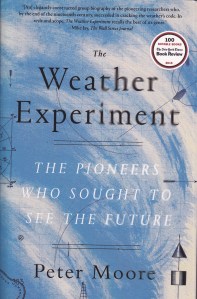
weatherexperiment“To understand the weather is somehow to glimpse the divine.“ I honestly don’t remember writing those words. A friend of my drew them out in a quote last year (perhaps the only time my book has every had such an honor) and they resonate with what a much better known writer has said. The Weather Experiment: The Pioneers Who Sought to See the Future was a book I bought upon first sight. Peter Moore’s story, like the science of the atmosphere, is only a small part of the whole. I glanced through the index for Increase Lapham while still in the bookstore, but despite his absence bought the tome anyway. I’m glad I did. Throughout this account of how meteorology developed in the nineteenth century religion and science are continually at play. As Moore points out, when faced with a violent storm, before any means of grasping the sheer enormity of the atmosphere existed, the only reasonable explanation was God. And it wasn’t just the clergy who believed this. Those we now recognize as scientists thought so too.

There are several key players in the drama of how we’ve come to our current understanding of the weather, but one that surprised me most was Robert FitzRoy. Everyone knows that FitzRoy was captain of the Beagle on Charles Darwin’s voyage that revolutionized science for ever. Some are even aware that FitzRoy, especially after his marriage, because a staunch evangelical Christian, parting ways with Darwin so far as to wave a Bible over his head at a public debate on evolution. I, for one, had no idea that FitzRoy almost singlehandedly invented the weather forecast. And that he did so as a government employee and doing so brought the ridicule of the scientific establishment because predicting was considered the purview of unscientific minds. It was as if the world I recognize had been whirled 180 degrees around by some unseen storm.

Any book on the weather, as I’ve learned, has to include a discussion of global warming. Climate change is real, and it is something we’ve done to our own planet. In a day when statistics can be produced showing that many scientific results are funded by companies with vested interests in the outcome of the experiments—even those at top universities—and we can see just how complex this web of financially motivated truth has become. Science is not pure rationality. It never has been, and it never can be as long as humans are the ones undertaking it. And we are beginning—just beginning—to see that there are some places where the wind blows freely through although those in white coats have assured us the room is sealed. This is a fascinating read and any book that makes me think I had the start of something profound to say is one I’ll buy on impulse any day.


The Whole Truth

In a thoughtful piece on NPR, Adam Frank discusses “Are Scientific Truths Better Than Other Truths?(.)” He describes a Ivy League conference called to discuss this point, and although I get about as much attention as adults give Barney, I’ve been blogging about this topic for years now. If only I had an institution. Or an ivy leaf. But never mind that. The topic’s the thing, and indeed it is long overdue. Science works (at least most of the time) and so we don’t require any convincing on that point. The very title of the article, however, raises the specter of the question: are scientific truths better? There’s a lot of unpacking to do and I haven’t even left home yet. First of all, “truths.” Science provides the best explanation of phenomena that we have, given the data at the moment. Since science is, by definition, falsifiable, it doesn’t provide truths. As much as scientists must begrudgingly admit it, truths are spun out by philosophers and—God help us!—theologians. The scientists who want to give us truths should probably take philosophy 101.

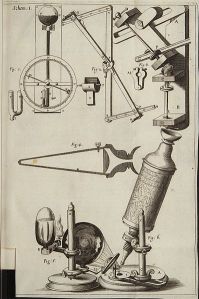
microgaphia_schem_1_instruments

Then there’s that surprisingly difficult adverb “better.” Good, better, best. These are value words. Science cannot assess value. Gold is “worth” more than the lint in my pockets because humans have agreed that it is. Inherently, both substances are made of the same thing: atoms. The lint in my pocket may have more exotic elements than pure gold, but nobody’s going to pay anything for it. Value, as has been endlessly demonstrated, is in the purview of religion, ethics, and philosophy. If you have to you can add the dismal science to the mix, but even that is just a social science. No physicist can tell you if this meal is better than that. It’s a matter of perspective. If I value my beans enough, not even your pâté will tempt me.

I want to stick with this latter word “better” just a little longer. Perhaps because as an underemployed thinker I’m especially sensitive to the subject. In what sense is science “better” than humanities? Show me a scientist who’s never listened to music and I’ll show you a sad individual. When we come home from the lab we still want the creature comforts that people have devised whether through science, culture, or even religion. If you value that weekend, be sure to thank a monotheist. Science tells us no day of the week is any different than any other. In my experience there’s a world of difference between Saturday and Monday. For this inveterate and unrepentant humanities student, that’s the truth.


The Science of Being Human

Not so long ago, when I was still a professor, a colleague told me he had no interest in science. We studied religion, he reasoned, and science had little to add. I was in the midst of a research project at the time. That project was exploring how what we know of evolution (or knew at the time) might inform our understanding of ancient texts. Of course, I was working in relative isolation, noting in my cover letters to universities that my research would benefit from an institution with a cooperative and collegial atmosphere between the sciences and humanities. If you’ve read this blog before, you know how that ended. No cooperative schools ever thought such research was worth sponsoring. After all, there are younger, less expensive specialists out there examining ancient religions in microscopic detail. The rest of the world, of course, wonders why.

This divide, as so eloquently delineated by Marcelo Gleiser in a piece on NPR, is starting to grow narrower. Science is taking us, in many fields, very close to the humanities. And we can’t make sense of some of it without admitting our human limitations. This is what I so admire about Gleiser’s writing—he is a scientist who understands that arrogance has no place in intellectual inquiry. Biology, as I long ago expected, holds one of the keys of this dilemma. Our brains evolved for a specific purpose—to help us survive in a predatory world. They did not evolve into processing systems to comprehend, as one sage put it, life, the universe, and everything. No one brain can hold all that knowledge. Like it or not, that brain in human. And humans need humanities.

Some scholars among the humanities like to claim that science has reached too far. The problem is, any scholar who is a true scholar is also a scientist. We use scientific methods to understand our admittedly speculative, or at least subjective, subject matter. Science isn’t the enemy here. Arrogance is. As Gleiser has stated in other venues, we have to approach the world with humility. We know so very little. Part of that world is that beyond human reach, and part of that world is what humans have done. They’re both part of the larger picture. But humans live on a small planet that we now know is only one of many, many more throughout the visible universe. And we know the visible universe is only part of the story. But we can’t be honest if we forget that the minds trying to understand all this are, no matter how evolved, only human.

dscn6303


News from around the Universe

In the last couple of weeks two large-scale news items caught my attention. One describes how a newly discovered galaxy is made up of mostly dark matter. The other tells how a new fossil find in Greenland may push the origins of life on earth back to 3.7 billion years ago. If you read my blog, you know that I’m a frustrated scientist. I’ve always tried to follow the developments in the field and even considered it as a profession until I ran into the wall of mathematics. Ran into the wall, banged up the car beyond repair, and was barely able to walk away. That’s the breaks in a world where ambition and ability aren’t the same thing. So I have to take my science like baby-food, mashed and strained before it makes its way to my brain. I know I’m not alone in this—the whole field of “humanities” proves that. (Originally science (astronomy) was one of the humanities, but oh how we’ve grown!)

Into the storm

Such frightening things as mathematics aside, these are exciting stories. I’ve been looking around this galaxy quite a bit, and I can believe dark matter outweighs light matter and I’ve never even been off the earth. The story is encouraging because it shows just how much we have yet to learn. Nothing could be more exciting for an erstwhile educator. The opportunity to stretch one’s mind should never be taken lightly. At the same time as dark matter is growing, so is the age of life on earth. I have to admit that I’ve not even been to Greenland, but the idea that life began so soon after the earth formed has cosmic implications. If we were such fast starters, doesn’t that suggest that elsewhere in the universe the same may be true? Ironically, here on earth uniformitarianism is considered a foundation of science. But once you get off earth scientists are reluctant to say the same processes could have happened elsewhere. But what do I know? I’m still trying to figure out trigonometry.

Earthbound I may be. Humble humanities specialist from start to finish. Nevertheless it is an amazing time to be alive. Once we’ve figured out that human brains—products of evolution that they are—aren’t capable of ultimate comprehension, we’ll be able to bask in the light of billions and billions of suns and raise a glass with our cosmic neighbors, made of light matter or dark, and proudly say that we’ve made some real advances at last.


Intelligent Life

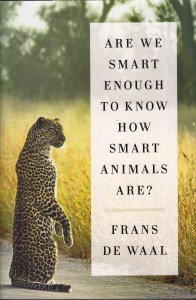
arewesmartPerhaps the most pervasive trait of religion is its ability to construct worldviews. Even when the religion is eventually abandoned, the worldview remains. Most scientists would deny that religion lies behind their perspectives, but in the case of human exceptionalism it remains the most logical cause. I always eagerly await new books by Frans de Waal. Ever since I read his book on empathy and apes, I couldn’t wait for the next one. His latest book, Are We Smart Enough to Know How Smart Animals Are?, although the title is a mouthful, does not disappoint. As I’ve noted before about his works, de Waal is perhaps the most sensible person writing in science today. He considers the evidence and takes his own biases into account. In a competitive world where science money is often doled out to those who can exclude others, de Waal is willing to leave the door open when the evidence demands it.

What is really ironic is that evolution has become the line in the sand between biblical literalists and science. As de Waal points out, the idea that people are different from the animals from which they evolved—in some qualitative way—is an idea based on religion. Many scientists still hold to it in a way that can only be described as, well, religious. This is very strange when evolution works by gradual changes over long periods of time. When did humans gain whatever trait that separates them from “the animals”? When I was a child it was tool use. When that was disproved, it became language. When that was disproved it became consciousness. The latter is the safest since nobody really knows what it is. As de Waal amply demonstrates the Behaviorist school was clearly wrong about animals (including humans). What no Behaviorist wants to admit is that the idea that we alone are conscious comes from the cultural interpretation of the Bible.

Are We Smart Enough to Know How Smart Animals Are? is, like many of de Waal’s books, full of wonderful observations of the ways animals actually behave. They solve problems. They learn from experience. They anticipate the future. In some cases they have been shown to outperform humans on cognitive tasks. And yet we still insist that people are somehow different. Better. Interestingly this is one area where religions and science tend to agree. People are just more important than animals. I wonder if one of the underlying reasons—not addressed by de Waal—is that we have come to depend on a lifestyle that unfairly exploits animals. After all, we eat them, use them for work, and even experiment on them. If we admit that they are intelligent we would need to, yes, rethink all of this. Given what’s happening in the world today, it is perhaps time to admit what we don’t really know.


Finite Gods

Just how many gods are there, anyway? Well, that’s not really a fair question. For one thing, do I mean “real gods” or gods that people believe in? Do I mean “believe in” or made up? Do I mean “made up” or intentionally fabricated? And the nesting questions could go on and on. Over the years in my professional capacity as an erstwhile teacher, I accumulated books listing the deities of various cultures with brief descriptions. I once even argued that using “god/goddess of” (the divine-genitival construct) as a phrase distorted ancient concepts of divinity. The fact is people have believed in many gods in many different ways. As modern scholars of religion we’ve only begun to reach the heavens (or underworld, or anywhere in between, for deities may be found anywhere). This issue comes to mind because a friend recently shared a story from IFL Science about a new Etruscan goddess. The piece by Ben Taub mentions a stone recovered from Poggio Colla, a site in Italy, written in Etruscan. The stone seems to mention a new “fertility cult” goddess. And once again religion and science have met, but not quite kissed each other.

Photo credit: Jastrow (2006), Wikimedia Commons

Photo credit: Jastrow (2006), Wikimedia Commons

Let’s begin with the Etruscans. Before the Romans, Etruscans lived in Italy, giving Tuscany its name. We know very little about them, as their language (Etruscan) is rarely found and imperfectly understood. Some of the classical gods may go back to Etruscan originals, and the Etruscans seem to have known of at least some of the cultures of the ancient Near East, or ancient West Asia. We have no idea how many deities the Etruscans recognized. Polytheism, for all its heathenish exuberance, never had a problem with adding more gods. Interestingly, the “new” goddess mentioned here, Uni, is someone I used to talk about in my Rutgers classes on ancient Near Eastern religion some five-plus years ago. Pardon my crowing—I seldom get to suggest I was ahead of my time.

What really interests me here is that websites that advocate science still take an interest in religion. Although belief is relegated to inferior minds (generally) science does admit, from time to time, that it’s interesting. The study of religion, in at least some schools, is a scientific enterprise. No, we don’t put gods under microscopes (telescopes might be more useful) but we use the same techniques as empirical studies of nature use in order to try to draw some conclusions about religion. Despite the fact that the vast majority of humans on the planet are believers, higher education has consistently under-funded or disbanded departments who apply rational thought to religion. We suppose that someone else can pick it up and study it, coming to useful conclusions without putting in all the homework. Don’t mind me, though. I’m just basking in the light of having known about Uni years before she was discovered.


Simply Beautiful

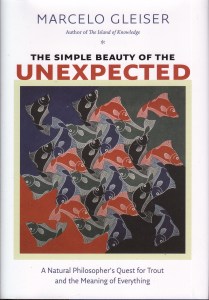
Simple BeautyThe scientific method has been a boon to humanity. Knowing how to sharpen the rational faculties has demonstrated its benefits time and time again. Sometimes, however, overemphasis on rationality contains hidden costs. Humans are not always rational, and sometimes this is a very good thing. Culturally we’re told that reason trumps emotion and that evolution has somehow led us to this. That’s only part of the story. Marcelo Gleiser’s excellent The Simple Beauty of the Unexpected serves as a wonderful corrective to this one-sided view. Although I’ve been trained in rationalistic thinking, my humanities background lacks the credibility of similar training in the sciences. Gleiser, as a physicist, demands respect. As he notes throughout this book, physics asks the hard questions. The only proper response, he rightly declares, is humility. Arrogance in any human endeavor may make for a good story, but it is bad citizenship on this planet.

I have to confess to being one of those poor souls who really doesn’t care about fishing that Gleiser mentions early on in his book. That doesn’t mean that I don’t agree with his outlook and mature thoughts on the subject. Using fly-fishing as a kind of bait, he draws the reader in to consider some deep and meaningful questions about life. Although he describes fishing literally, he clearly has a metaphorical usage in mind as well. Rare is the scientist who will admit that science can’t answer all questions, and moreover, wouldn’t want it to. Showing the limits of rational thought can feel like taking one’s clothes off in front of a crowd for those wedded to empirical evidence. Applied science clearly works very successfully. That’s not the same as having all the answers. Gleiser beautifully illustrates this, acknowledging that the spiritual has a role to play even among the rigorously trained and actually employed of the intelligentsia. This is a very important book.

Admitting that some things happen for which there is no rational explanation, Gleiser advocates for appreciating the wonder rather than trying to force science into situations where its explanatory power fails. This doesn’t happen often—indeed, rarity is what makes the unexpected so wondrous—but when it does happen we need to, like a fisher, accept it as part of the way the art unfolds. In Gleiser’s terms, not every fishing trip is successful. If you always had success, what would be the point in trying? He ventures into the murky waters of religion a time or two, but this is catch-and-release, not for the kill. The Simple Beauty of the Unexpected is an example that includes itself. Those who read it will learn what this means.


Monkey Puzzle

One of the unexpected consequences of Christian theology is the ongoing insistence in science that human beings are qualitatively different from other animals. Actually, it goes back to the Hebrew Bible and the concept of “the image of God.” As the absolute line between human and beast continues to blur (intelligence, tool use, language use—you name it) mainstream teaching has trouble admitting that our special differences aren’t that different. A Washington Post story by Darryl Fears describes how capuchin monkeys have been using tools to extract cashews from their toxic husks for at least 700 years. These monkeys use a two-rock system to get at cashews, which, in their natural state, are inedible. The surprise here is that this makes these monkeys denizens of the Stone Age and capable of teaching complex behavior to their offspring.

Animals watch parents to learn to eat—it might seem to be a simple idea. In reality it’s more complicated than that. As I watched a doe and fawn foraging the other day, it occurred to me that what we call “instinct” is a way of getting around admitting animal intelligence. Why would a newborn (“unconscious”) animal seek to feed, or flee from predators? We call it instinct, but what we really mean is a form of will, a desire to survive. This “will” pervades nature well below the human-animal divide. Plants strive to thrive, and exhibit a “will” to live. By just taking all this for granted and calling it “instinct” we’ve further cut ourselves off from the organic world of which we’re all a part.

Christian culture gave rise to scientific method. No doubt this is an embarrassing scenario for those who believe science should reduce all the wonder of being alive to mathematical equations. Can’t we just pretend that rationality was creeping in from the beginning? Aristotle was going that way wasn’t he? But his work was “lost,” only to be recovered by Muslims who saw the value of such logical thinking and Christians—in an over-simplified history—wanted to catch up. Meanwhile, in the Dark Ages monkeys were using an intricate system to extract tasty nuts from toxic casings without the benefit of any religion at all. The Stone Age, we easily forget, was the first recognizable step on the road to the technological world we inhabit today. And we continue to use an outmoded paradigm to understand our place in that world.

391px-Organ_grinder_with_monkey


For the Dogs

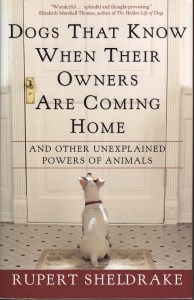
DogsThatKnowYou know that feeling of being dropped into a very strange place?  Sure, it’s disorienting for a while, but once you get used to it, you start to enjoy your surroundings.  Now ask yourself: what if my entire way of looking at life is based on a faulty paradigm?  Many, I suspect, will drop out at that point.  There’s strange, and then there’s going too far.  For those wedded to the idea of finding the truth, however, weirdness is part of the journey.  I just finished reading Rupert Sheldrake’s Dogs That Know When Their Owners Are Coming Home.  Yes, it felt like the room was spinning (actually, I read it on the bus, so that might’ve been true a time or two), but it confirmed something I’ve suspected for many years.  The reigning, mechanistic universe paradigm is wrong.  Please don’t take this as an anti-science statement.  Sheldrake is a bona fide scientist, and I’m an avid reader of science books.  It’s not so much that science is wrong as it is that science doesn’t go far enough.  Ever since the Industrial Revolution—not coincidentally—we’ve been informed that the universe is really a giant machine.  We can figure out how it works using this squishy stuff in our heads that insists we can find Pokemon everywhere we look when it’s not busy solving the riddles of the mulitverse.

Sheldrake, who is given a wide berth by many scientists, states what any of us who grew up with pets knows: they know more than they’re saying.  Admitting up front that much of the evidence is anecdotal, Sheldrake provides empirical studies to demonstrate what folk say.  Dogs do know when their owners are coming home, before they are within sight, hearing, or smelling range.  His study, however, isn’t limited to dogs or to knowing when someone’s coming.  Animals, by virtue of their own minds, have abilities that we do not.  Since they don’t speak our language, we assume they are dumb.  In fact, as this book shows, a great many animals know a great deal more than we do.  The question is, if this is the truth why don’t we hear more about it?

We prefer, it seems, our truth to be qualified.  There’s a lot at stake here.  The reigning paradigm keeps us plugged into this corporate machine we’ve devised.  Our lifestyle cannot subsist without the subordination of animals.  We can’t give them abilities we lack, apart from tastiness.  If the universe isn’t a machine, it might open the door for a broader view of reality.  Maybe it is better to be post-Christian, but religion has proven benefits to humans (and perhaps animals).  Why does religion remain in a mechanistic universe?  Perhaps what we call “souls” are the same as “minds” and perhaps they aren’t the same as brains.  If we really do have minds, it is in our best interest to care for them, develop them, and improve them.  It may seem like a strange world indeed where your dog informs your view of reality.  Read Dogs That Know When Their Owners Are Coming Home, however, and see if you don’t find yourself wagging your tale, just a bit.