Kidnapped by Religion

The title is, unfortunately, not mine. My wife sent me a story on NPR entitled “Humility Is Embedded In Doing Science, But What About Spirituality?” by Barbara J. King. The piece is largely an interview with physicist Marcelo Gleiser about his new book, The Simple Beauty of the Unexpected. Of course, now it’s on my reading list. The interview treads the well-worn path of science versus religion. Science is presented as humble (which I don’t doubt, when in the right hands—or the right minds, rather) while religion is arrogant, claiming to know everything. Gleiser states that spirituality has been “kidnapped by religion” but still has a place in the life of a scientist. I wish there were more of them like Gleiser.

Now, I have to admit my data are limited. I read science books—I have since I was a teenager—but with a layman’s eye. My scientist dreams were dashed against the unyielding rocks of complex mathematics, something evolution cruelly withheld from my gray matter. I wouldn’t have survived high school pre-calc without my younger brother’s help. I’ve nevertheless read the pre-chewed, partly-digested science regurgitated for the formulaically challenged, and find myself, like Glieser, awed at the wonder of it all. Still, I also find many scientists—at least those with the loudest voices—claiming that what they’ve discovered is all there is. There is only matter, and we with our three-pound brains have figured it all out, by the gods, without the gods! We know all that can possibly be known will conform to the system our brains have developed, and there are no gods out there and no spirits in here and that pang you’re feeling in your gut is merely physiological, not spiritual.

I haven’t read The Simple Beauty of the Unexpected, but I have found many scientists walking the same trail I’m on. We are those who are seeking the truth, and who don’t assume the answers. Religion need not be arrogant. At its best, it’s not far from science. As a species, we have developed rationality extremely well (even if we fail to use it). Much of biological existence, however, is emotion, or feeling. That we sometimes leave behind. It participates in reality as much as rationality does. I’m reminded of this every time I hear someone in the business world refer to “soft” skills. What mere humans bring to this rationalistic business of making money. We’re just the squishy stuff that CEOs can’t live without because wealth mean nothing if you can’t compare it to someone else’s. Humility? I agree, Dr. Gleiser, we must maintain a sense of wonder. For those of you who say we’re just a number waiting to be quantified, I would humbly ask for 42, if it’s not already taken.
DSCN0633


Paraleipomenon

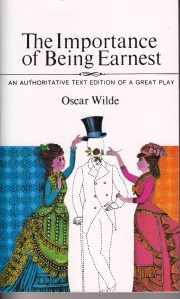
EarnestI suspect, like most people, I missed quite a few classics in school. This was the ’70’s when new and experimental were still the rage. One of the must-reads I missed was Oscar Wilde’s The Importance of Being Earnest. As usual when approaching books like this, I’m delighted at the sheer number of famous lines I’ve repeatedly heard, whispering to myself, “So that’s where that comes from!” as I go. Since I expect you, my cultured reader, have walked on the Wilde side, I need not provide any of these lines here. I won’t even have to go over the plot. The edition I read, however, contained lines and scenes that did not make it into the canonical version. As an erstwhile writer, I know that final versions seldom resemble those that felt so magical at their penning. Cuts must be made. Editors must be satisfied. And so goes the life of the writer.

It was one of these cut lines that caught my eye. With Wilde’s keen wit, the clergy, represented by Dr. Chasuble. (For those liturgically challenged readers, a chasuble is a priestly vestment in the Roman and Anglican traditions.) In an unfortunately stricken scene the minister says, “I am compelled, like most of my brother clergy, to treat scientific subjects from the point of view of sentiment. But that is more impressive I think. Accurate knowledge is out of place in a pulpit. It is secular.” Accurate knowledge is secular. That thought stayed with me long after reading the out-takes and deleted scenes of the play. Those that remain contain priceless comments about the church and the dangers of christenings. This particular gem, from the cutting room floor, would be hilarious were it not so often true. It explains, for example, creationism.

It’s a fair wager that science remains, even today, a subject that flummoxes clergy and laity alike. It is the new revelation, after all. No truth cannot be reduced to numbers. Even my scribbling this post is mere electro-chemical signals jumping synapses like electro-chemical salmon dying to spawn. We’ve simply substituted one clergy for another. When’s the last time a preacher has been cited as an authority on anything? What with televangelists setting the bar (for anything we see on the media is necessarily representative), it stands to reason that no real intelligence lies here. By default we nod toward those who hold the paten and chalice of empirical evidence. As it is now, but never was, and shall be forever, amen. Who’s being earnest now?


The Found World

LostWorldChallenges will make you do funny things. One enjoyable dare has been Modern Mrs. Darcy’s Reading Challenge. With a modest twelve books in twelve months goal, the specific target is to read the types of books laid out. Into one of those categories, for me, fell Michael Crichton’s The Lost World. It’s sad that I feel I need so many disclaimers—I never really outgrew my love of dinosaurs—such escapist literature is indeed a guilty pleasure. Crichton could write a quick read, not bothering to pause for literary hindrances, and this novel fits the bill. It always surprises me when at the end of a traumatic story where friends die (this time ripped apart by reptilian carnivores) that the protagonists escape and never mention the dead. They joke, explain holes in the story, and generally look forward to a better, raptor-free future. There is, however, some food for thought here, among the lucre-grubbing sequel to Jurassic Park.

The first religious element that caught my attention was resurrection. Ian Malcolm rather convincingly died in Jurassic Park (and even an unconvincing death works for most people). In The Lost World he’s suddenly back again, with a barely disguised deus ex machina, and is as diffident as ever. The other former protagonists know better than to return to an island full of dinosaurs. Resurrection is a time-honored literary trope. So much so that it’s sometimes difficult to believe that death is in any way permanent. Well, come to think about it, the dinosaurs too are resurrected. Do reptiles have souls? Crichton’s dinosaurs seem to.

Then, just over halfway through the story, I was stunned. The chapter, or section, called “Gambler’s Ruin” explains how science and religion (or the humanities in general) are really the same. I couldn’t believe that a bestselling novel actually took the point of view that scientific objectivity is just as fraught as post-modern literary theory. There is no way to observe without influencing. When a conscious presence enters the equation, the facts have to counterbalance in return. Many, of course, would disagree in principle. Still, this unexpected bit of profundity stopped me in mid-chomp. Materialism, beguiling as it may be, doesn’t explain Heisenberg or Schrödinger. It takes a resurrected mathematician to do it. No wonder chaos abounds in this world where dinosaurs still rule the earth.


Story of God

Synchronicities come at kinds of synchronaddresses. After I had written a recent post on human sacrifice, I watched the first episode of Morgan Freeman’s The Story of God. My wife actually figured out how to get it without the miracle of the triple play, and we watched the initial installment on death. I’ve stated repeatedly on this blog, as I used to in my lectures, that death is a universal concern of religion. I wasn’t really expecting to learn anything new from the show, but it is a good idea to keep up with what hoi polloi are being told about the field in which I’m supposed to be a specialist. In any case, The Story of God is very much like Through the Wormhole, only from the other side. Science and religion. Religion and science. Like chocolate and peanut butter, two great tastes that taste great together. Really, I mean that.

So after telling us that the Egyptians may have invented the afterlife (although it’s clear they didn’t), the show takes us through other religious expressions: Christian, Hindu, Aztec. The Aztec segment brought up human sacrifice again, in its particularly grisly expression, as a means of thinking about what happens after death. In the light of the article I’d read (see last Sunday’s post) I couldn’t help but think how this was an ideal form of social control. There’s no doubt who’s in power when you’re looking up at your still beating heart, strangely cooled. As I’m pondering that heart, I’m thinking it wasn’t the Egyptians who first had this idea at all.

DSCN6127

Neanderthals, it appears, may have buried their dead. Even if they didn’t other ancient, pre-historic people did. And with grave-goods which, if you think about it, are rather superfluous without any afterlife in which to use them. It stands to reason, even before reason, that as soon as people began to recognize death, they had to be wondering what happened next. It is a bit simplistic to suggest that religion began because of the fear of death. It is also equally simplistic to suggest that death had nothing to do with the beginnings of what we call religion. People have died as long as there have been people. And survivors have carried on after the passing of others. Maybe we are all grown up now, but it seems that we aren’t fully human unless we give some sort of thought to what comes next. Even if the answer is “nothing,” it’s some kind of religious statement, whether intentional or not.


Strange Chemistry

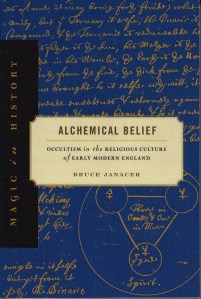
AlchemicalBeliefOne of the many antiquated beliefs that have been left behind over the centuries is alchemy. Today we tend to think that anyone who supposed natural substances could have been transmuted into others must have been naïve at best, or credulous at least. Bruce Janacek’s Alchemical Belief: Occultism in the Religious Culture of Early Modern England sheds light on the wider worldview of the alchemists. Some of them, anyway. Firstly, it is quite clear that many adepts of alchemy were very intelligent people. We easily forget that in addition to rewriting the laws of physics, Sir Isaac Newton practiced alchemy throughout his adult life. There’s something incredibly beguiling about the idea of an underlying unity of materials. Today atomic theory has answered that unity, perhaps a little too well. And that bring up the second important insight in Jancek’s book: alchemists often had an ulterior motive.

Early modern alchemists (think of those emerging from the wake of the Reformation, and you won’t be far wrong) often had a religious motivation for their work. Alchemy isn’t just turning base metals into gold—that’s just its most spectacular claim. Janacek points out that several alchemists were also attempting to prove the legitimacy of Christian theology through their explorations. Concepts as strange as the Trinity, or even the divisions of Christianity itself that were happening in the shadow of Luther, indicated to ordered minds that theological truth must be a unity. That unity, once found in alchemy, would naturally apply to the world of the church. The church, after all, can’t defy the very laws of the universe, can it? These early scientists accepted that there might also be a mystical element involved. Some rejected that aspect, but felt that the basic ideas of alchemy itself were sound.

Like dinosaurs, alchemy pretty much went extinct with the onset of the empirical method. Also like dinosaurs, it survived into the new age, transmuted in form. Alchemy was one of the ancestors of that bane of college students everywhere: chemistry. We tend to forget that astrology laid the groundwork for astronomy and creation (not quite an “ism” in those days) led to the study of biology. Religious ideas underlie much of what led to modern science. Religion, after all, indulges the curiosity of humankind. We are allowed (in the best instances) to let our minds range where they will. Later on theology, or some such device, will rein them in, but until such a time the psyche is free to explore. And build systems. And offer explanations. The alchemy comes when all of this is taken from the hands of natural philosophers and put into the laboratory only. And the rest of us await pronouncements from above of what might be real, or not.


Long Live Life

Horseshoe CrabsShortsighted and arrogant. No, I’m not describing Richard Fortey’s Horseshoe Crabs and Velvet Worms, but rather the collective human race. I love people—I really do. Collectively, however, we sometimes act in the most inexplicable ways. This thought came to me repeatedly while reading Fortey’s book. The subtitle might explain the subject a bit fuller: The Story of the Animals and Plants That Time Has Left Behind. Fortey is a paleontologist who tells the stories, almost biographies, of various creatures that have survived eons with little change. He is quick to point out that all creatures evolve, but in the case of some, evolution has been minimal. Animals, such as his titular examples, and many others (cyanobacteria, tuataras, and, of course, coelacanths, just as a sampling) can sometimes be so well adapted to their environments that they change very little over time. In this book Fortey travels to see the living examples of those creatures he’s studied in fossils, and tells the story of an amazing continuity in a world of constant change.

Some of the species, particularly the plants and microscopic organisms, I’d never heard of before. I also have to admit to being surprised at how many very old life forms still exist. And admittedly, this is only a snippet of a much larger cloth. Throughout, I was pleased to see, Fortey mentions various religions—themselves often throwbacks—but not disparagingly (except the creationists). Noting that some creatures have a Buddhist-like calm, or that the Bible occasionally provides the phrase a naturalist writer seeks, here is an irenic meeting of science and religion that is so much needed. So why did I say “shortsighted and arrogant” at the start of this post?

One of the more disturbing truths revealed, and not just about charismatic megafauna, is that people have often hunted animals to extinction. Fortey suggests it has always been so. Large animals (megafauna) are easy targets and we have repeatedly hunted (and continue to hunt) them to extinction. We destroy habitats and thereby drive species extinct that we haven’t even yet discovered. What could be more arrogant of a single species? Looking back over 4 billion years of evolution should give us some perspective. We’re relative newcomers on this planet, and it isn’t ours to do with as we please. Fortey is gentle, but he does remind us that some of the creatures in this book will likely, no matter how great the catastrophe, long outlive us on the planet. Ours is a brief day in the sun. Shouldn’t we care for our planet rather than pillage it for our own gain? Ask the horseshoe crab. When we understand its language we might be able to begin to call ourselves wise.


Act of Balance

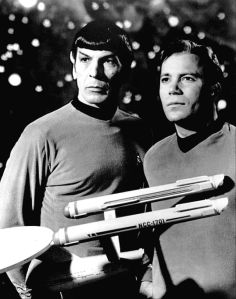
They call it the green-eyed monster. Jealousy. Under its weightier name of envy, it becomes a deadly sin. I often wonder if envy isn’t behind the debate that seems to have atheists and believers in religion talking past one another. Each seems to want, it appears to me, what the other has. Atheism has emerged in this new century as the current brand of intellectualism. Those who rely on reason alone don’t require comforting ideas such as God or salvation to get along in a world that has learnable rules and no magic. On the other hand, as an article by Barbara J. King on NPR points out, some religionists (Alister McGrath, while good for illustrative purposes, may not be the most representative choice) insist that atheists miss out on the meaning of life. Goal-oriented behavior, which we all understand, in a traditional monotheistic context is a divine mandate. We want to get to a better place either here on earth or after we die, and God has given a set of rules to follow to enable us to get there. Along the way, nature veritably drips with the dewy beauty with which God has infused the universe. Those Mr. Spocks among us miss it all, for their non-nonsense approach to reality.

Leonard_Nimoy_William_Shatner_Star_Trek_1968

It’s pretty clear, as I’ve traced it out here, that the believers envy the reputation of solid rationality readily claimed by scientists. We all would like to be able to prove we’re right. Pointing to a law of physics and declaring, “this law can never be broken” carries a satisfaction that is rare in the theological world. Still, I wonder if some atheists aren’t just a little jealous of the teleology of having a goal set by someone else. Heaven and Hell may be passé, but you have to admit that having challenging rules laid out is somewhat invigorating. Doing something because you “should” can infuse a sense of meaning into life. Some people, if they could just do what they wanted, would opt for no more than eating, sleeping, and meeting biological necessities. They sometimes claim religion gives them the motivation to do more. It can make a difference if a deity takes the initiative.

You’ll never, however, be able to prove a religious point empirically. Gravity pulls things downward as surely as sparks fly upward. And we can send a person into space to prove it’s true. No astronauts, as far as we can prove, have ever seen God in space (RIP, Edgar). Reason and emotion, religion and science, thought and action—these things need each other in order for a balanced life. Problems arise, it seems to me, if we take an extreme position. Life is complicated, and simple answers just don’t apply. Perhaps if we allowed for a bit more balance, we might all find life just a bit more satisfying.


Not Your Father’s Demon

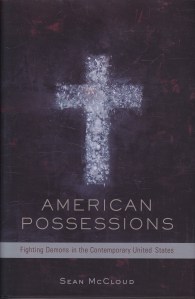
AmericanPossRegan MacNeil is a name that can still send shudders up and down stout spines. Despite advances in CGI and special effects, The Exorcist is consistently rated among the scariest movies of all time. Demon possession, clearly, is a very troubling thing. American Possessions, by Sean McCloud, is not a place to go to find Catholic priests expelling the forces of darkness. Subtitled Fighting Demons in the Contemporary United States, the book, one might suspect, is saying more than it seems to be letting on. This is a book about Third Wave evangelicalism and its demon-fighting manuals. Although the term “Third Wave” may be unfamiliar, the next time you go to a Tea Party you’ll know you’re among them. These born again uber-capitalists believe in a literal demonic world. In fact, demons are so common that Jesus would’ve had a hard time keeping up with their exponential economic growth. These demons are more frightening than those that possessed Regan. The are more akin to a different Reagan.

Especially popular among Pentecostals (the fastest growing form of Christianity) this modern day belief in demons sees them in places Jesus didn’t think to look. Family curses (at places ruled out in the Bible, but still, apparently, possible), addiction, depression, sexual urges—these are all demonic. And once these modern demons are cast out, unlike that of Regan, they can come back. And if they don’t possess you they will oppress you. And they can live in your material goods, your house, and even the land it is built upon. They are everywhere, and they have to be fought against constantly. They also, apparently, vote Republican.

This view of the world, strange as it is to many people with a basic education in science, motivates a large sector of the United States population. Expelling these demons requires a specific view of Christianity—a view that absolutely excludes Catholics. And it is a view that promotes free market economics, blaming the victims of poverty for allowing themselves to be oppressed by demons. Many aspects to this belief system will strike the reader as completely unbelievable, all the more for being so seriously believed. At the same time, we are told, we should pay no attention to religion, at least as educated people. The problem with this is that these true believers vote. And the kingdom they would have come on earth is, in a way they would certainly deny, possessed.


Thinking about Thought

The history of thought can be compared to a slow-moving pendulum. At other times it can be more like a ping-pong game. Acceptability for ideas can take time, but sometimes the perceptions change rapidly. Having been raised in a small town in a Fundamentalist setting, it is difficult to assess where exactly the “status quo” was when I was growing up, but by the time I had reached college it was pretty clear that the challenge science posed to my particular brand of religion was pretty firmly entrenched. Materialism—in the philosophical sense—had obviously gained several champions. B. F. Skinner and his followers applied this template to human beings, and it became fairly common to hear that we were basically automatons. (Ironically, double predestination in the Calvinism I was learning about taught pretty much the same thing.) Today there are even more vocal heralds proclaiming that all that is, is material. If it can’t be measured empirically, it can’t exist. The pendulum, or ping-pong ball, has come to one side of the table, or arc, awaiting rebuttal.

An article in Scientific American from two years ago (my personal pendulum sometimes moves slowly as well) asks the question “Is Consciousness Universal?” The article by Christof Koch describes panpsychism, the theory that anything beyond a certain level of organization is conscious. Koch begins by discussing dogs. Those of us who’ve spent time with dogs know that they are clearly conscious, although a materialist would say they are just as much dumb matter as we are. But panpsychism goes beyond dogs and horses and other “higher” mammals. Anyone who has taken the time to study any animal in depth, particularly those that are obviously mobile and can seek what they wish to find, knows that animals have will, and intension. The loss of meaning only comes with materialism.

Integrated information is the term Koch uses to describe the baseline of consciousness. Of course, this would need to account for more than the merely biological. Computers may be sufficiently complex, but the information they “possess” is not integrated, thus keeping them from being truly conscious. I’m not enough of a scientist to understand all the technicalities, but I do know that something as simple as common sense suggests that consciousness is part of all animals’ experience of life. As some scientists have long realized, feeling, or emotion, is integral to the thought process. Only when we realize that we share this world with a great variety of conscious creatures will we begin to make any progress toward understanding the difference between mind and mindfulness.

DSCN5295


First Stronghold

FIRST Robotics has a way of getting into your blood. Like many people of my generation, I learned about FIRST Robotics through my daughter. Our local high school has a robotics team and, as we quickly learned, the decision to join FIRST is a four-year family commitment. My wife and I were both involved at some level, despite being the world’s least likely engineers. I even served a term as the president of the foundation (responsible for funding the team). We made lasting friendships and grew in the lingo and odd humor that is FIRST. The founder and chief promoter of FIRST, Dean Kamen, is an unapologetic geek and has helped develop what some journalists are calling “the new cool.” Yesterday was launch. If you are a FIRST follower, I don’t have to explain that. In case you’re not, “launch” is the revelation of this year’s game. Teams now have six weeks to plan, design, and build their robots.

IMG_3125

Launch is a big deal. We haven’t been part of the competition for three years now and we still watch the live web-broadcast. The major players (Kamen, and Woodie Flowers) get in character and meet kids from various teams. They give inspirational talks. Dean Kamen told the kids “Don’t get stuck into today.” Technology changes too fast. What you learn in school are tools, because facts are available instantaneously on the internet. Those of us who retain facts are so yesterday that we’ve become the trivial pursuit generation. Any computer, let alone robot, could beat us. Woodie Flowers told the young audience thinking about careers that they must do what machines cannot do, otherwise their jobs will become obsolete. What could be more human than religion? What’s religion got to do with it? This is science and technology!

This year’s competition is FIRST Stronghold. The entire buildup of yesterday’s launch was a takeoff on Monty Python and the Holy Grail. What is this I see before me? History? The Middle Ages were nothing if not religion run wild. This was a world ruled by bishops, popes and nobility. It was a world where no matter who you were, God trumped all. Technology meant that a trebuchet was a pretty sexy device and long distance communication traveled at the speed of a horse or human runner. (Or, I suppose, a trebuchet missile.) Now that the humanities have fallen victim to science, we look back to them for inspiration. It reminds me of John Keating in Dead Poets Society: “And medicine, law, business, engineering, these are noble pursuits and necessary to sustain life. But poetry, beauty, romance, love, these are what we stay alive for.” This hasn’t changed since 1989. Or even 932 for that matter.


Seeing Things

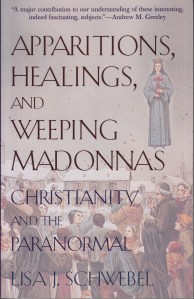
SchwebelWe have to learn to see the world. Traditionally religion and science both had roles to play, but as science grew better at explaining physical causes, many consigned religion to mere superstition. In such a paradigmatic world, Lisa J. Schwebel’s Apparitions, Healings, and Weeping Madonnas is something of an anomaly. Schwebel begins by noting that the Catholic Church has long accepted the reality of psi. As the branch of Christianity with the strongest commitment to furthering science, this itself might seem unusual. We are taught to see the world in a binary way: either this or that, not both. Books such as this challenge that convention, asking us to look at a world that doesn’t always conform to expectations. Parapsychology has made inroads from superstition to science because of testable hypotheses and statistically significant results. What it might mean is up for grabs.

Some claim that Catholicism is credulous. Actually, as Schwebel adequately demonstrates, criteria for declaring even spectacular events as miracles are amazingly high. Merely paranormal events seem common in comparison. In many ways, this is a disorienting book: the supernatural is assumed to exist, but miracles are treated as less common than the everyday supernatural. Those of us raised in a rationalist scholarly world might find the acceptance of that which we’ve learned is impossible just a bit unexpected. No doubt, visions of Mary are reported. Crowds often visit trees or highway underpasses where pareidolia impresses an image on the faithful. Schwebel, however, is discussing visions of another sort, and finds that they may involve the power of suggestion rather than the miraculous.

Faith healing, on the other hand, is something for which empirical evidence exists. Doctors still disagree about whether prayer speeds healing, but there have been many instances of unexpected healings that have occurred, apparently in relation to a person noted for bringing wellness about. Causality, of course, can’t be proven, but many people find themselves believing in a spiritual world after such an encounter. Perhaps that is what is so intriguing about books like this; they make readers uncomfortable in a world that is purely material. Finding a credentialed author who actually believes and has evidence to back her up is a rarity. Challenging conventions is part of the territory in most religions. Schwebel is simply straightforward about it.


The Religion Industry

The American Academy of Religion and Society of Biblical Literature annual meeting can be a heady place. Religionists tend to be “big picture” people, looking at things from the perspective that this is what life is all about. How much bigger can you get? Religion is, after all, a matter of perspective. As quickly becomes clear from glancing across the crowds—there is a literal myriad here—a great diversity exists. Ironically and irenically violence, beyond an occasional rudeness, is absent. There are believers and non-believers and they actually talk to each other civilly. They want to understand, and in an increasingly polarized world understanding religion seems like a very sensible thing to do.

It feels, however, like an industry to me. Religion evolved out of primal fears. Nobody knows for sure where it started, but someplace (or someplaces) along the course of human development, the idea took hold that humans weren’t the final word in terms of power or direction of their own destiny. There is something beyond us. It may be a tao, or it may be a god, or it may be something we haven’t even conceived yet, but there is something larger than us. The scientific paradigm, on the other hand, starts by assuming human superiority, at least in terms of rationality, over the entire universe. Teasing things apart, looking at the smallest units and building up a big picture from there, it all comes down to equations and concepts understandable in empirical terms. If there is a tao, or gods, and if they don’t leave some physical footprint, they must be left outside the frame. Until the religion industry arrives.

Every field of study has its crackpots, but those thousands milling about me as I stand in a booth with knowledge for sale are mostly sincere. The official study of religion takes place in higher education. Its practice is left elsewhere. The Dalai Lama is not here. The Pope is not passing through adoring crowds. Even Mike Huckabee hasn’t put in a guest appearance. We are not always the friends of those who do religion, for this is a complex industry. Our role is to ask how religion works. Beyond that, we try to fit it into a larger picture—one that expands beyond the universe itself. Out to where a mysterious force may lurk. A force that reminds us that human effort, as strenuous as it may be, must acquiesce in the presence of the unknown.

IMG_2612


Make Believer

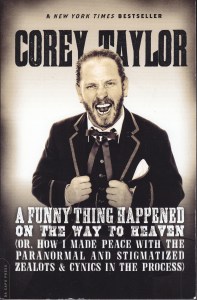
SmthgFunnyMy brother is way cooler than I ever hope to be. While I was busy learning all a tween and teen could about the Bible, he was listening to Lou Reed and David Bowie and Black Sabbath. Since the “door” between our rooms was only a curtain, I heard the forbidden sounds and, despite myself, had to admit that I liked what I heard. In fact, I once gave a lecture on Christian influence in secular rock music, and found many students staring at me in surprise for knowing so much about such debased music. In any case, when my brother recommends a book I know it will always be an adventure. Thus I came to read Corey Taylor’s A Funny Thing Happened on the Way to Heaven: (Or, How I Made Peace with the Paranormal and Stigmatized Zealots & Cynics in the Process). I didn’t want to admit to my brother that I’d never heard of Corey Taylor and that I couldn’t identify a Slipknot song even on Spotify, but the book sounded interesting, blending as it does bad-boy attitude with ghost hunting. November seemed a perfect time to read it. It could lead to some street cred on the bus.

It is difficult to distrust people like Taylor who write with absolutely no pretension (I’m a working-class kid, too). You know that what you’re getting is the real deal. It is also clear that like my brother and many rockers, Taylor is of above-average intelligence. Being smart can sometimes feel like a curse, and Taylor lashes out in several ways during the course of his narrative. He finds it odd to be an atheist who believes in, and has personally experienced, ghosts. I’m not sure that he would find it comforting to know that such a position is not at all as rare as he seems to think it is. Science deals with neither gods nor ghosts, and the average person is left to their own devices to decide who might speak with authority on such issues. Where are we supposed to look when scientists refuse to address such things? Personal experience is a powerful influence.

As with most books by opinionated, brash extroverts, it is difficult not to find yourself liking the writer. Trust may be too strong a word, but I do believe that Taylor writes without guile. After all, people have experienced ghosts for as long back as we’re aware. Why should it be any different for a celebrity? Is Taylor’s house haunted? (Or, more accurately are his houses haunted.) That’s a question no one can answer with certainty. Ghosts are beyond our realm of knowledge. Although plumbers can use scientific instruments, until actual scientists try to explain the immaterial we will be left to choose whom to believe. A metal singer can know just as much as a priest. Or even more, depending on the context.


Northern Ghosts

It is the time of year when respectable publications can, in a half-serious way, address the unconventional. The New York Times, for example, recently ran a story on ghost hunting in Norway. Andrew Higgins points out that Norway, among the most secular nations in the world, has come under the spell of ghosts. In a country where church attendance and religious belief seem to be endangered, there is a growing belief that people might somehow survive this mortal coil. Since such a story has to come off as bemused, we don’t get any indication that people have good reason for believing in ghosts—as one of the officials in the story says, they represent something that isn’t “generally accepted as existing at all.” But I wonder if that’s true. Scientifically, in our heads, there just doesn’t seem to be any room in this godless world for ghosts. Skeptics ask questions like “why do they wear clothes?” or “how can a soul remain behind if we have no souls?” Who told you that you have no souls?

Even with the constant materialist discourse of only physical reality, some ghosts cases have been very well documented. So have some hoaxes. People have the spirit of being tricksters, and that doesn’t always help when it comes to understanding the unseen. The point that the article is making, however, is that ghosts seem to be filling a need that the church hasn’t. Church has long been understood as being trapped in the past—concerned with issues deemed irrelevant by people who are just trying to get by in the world. I’ve heard hundreds of sermons in my life and remember less than ten. What is it that we’re trying to do?

Eugène_Delacroix._The_Phantom_on_the_Terrace,_Hamlet

I don’t know if ghosts exist. Many days I’m not sure what reality is, because if it is simply crawling out of a warm bed into a cold apartment before 4 a.m. so that I can go to work, I’m not sure this isn’t some kind of afterlife already. And maybe not the best kind. I know that as soon as people began to record their thoughts in writing, ghosts have been assumed to exist. Despite Ghost Hunters and other popularizers, vague traces are caught by enough people that we can legitimately wonder about the narrative we’ve been fed that says if it can’t be measured it can’t exist. There isn’t a nation in the world where people don’t see ghosts of some kind. Why should Norway be any different? And we wouldn’t even be asking this question if Halloween didn’t provide us with a buffer that makes forbidden topics chic.


Supernatural Quest

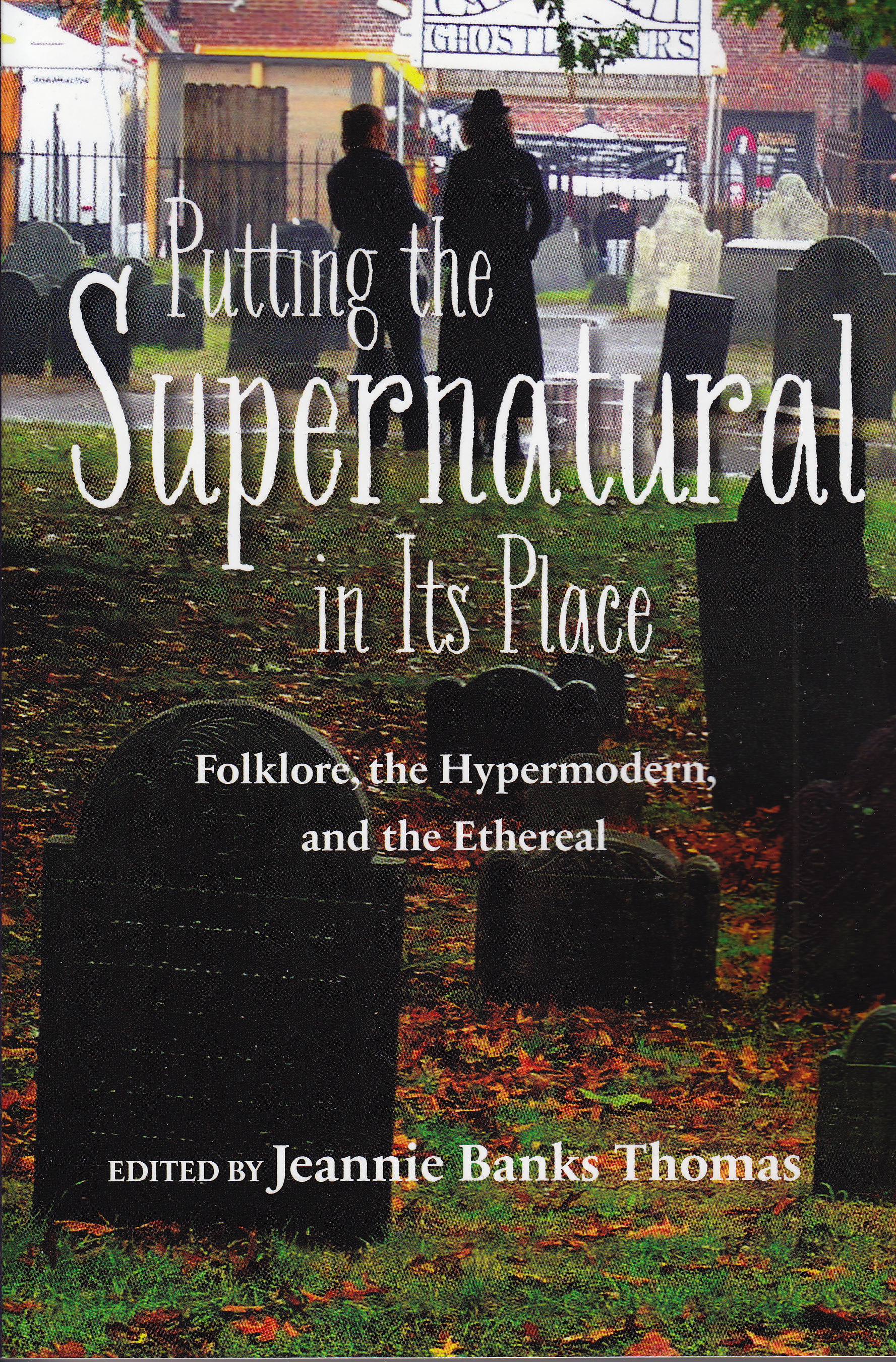
SupernaturalTwo things we’re told about the supernatural: one, it doesn’t exist and two, it can’t be studied. Of course the vast majority of people in the world don’t buy into number one and hardly care about number two. Both, it seems to me, could be wrong. As Jeannie Banks Thomas says in her introduction to Putting the Supernatural in Its Place: Folklore, the Hypermodern, and the Ethereal, belief in the supernatural is not declining. In fact, the more we’re told by cocksure scientists that all of reality is quantifiable and material, the more we become aware of the many exceptions to the rules. Of course, “supernatural” may be a misnomer. It could be that anything sloughed off into that category is simply not understood well enough to be empirically studied. Thinking back over the history of science I find it ironic that the very system that had to convince people that something couldn’t be seen (many gases) could be deadly. Now if it can’t be seen it can’t exist. We certainly don’t want any deities hanging out around here.

But back to the book. Putting the Supernatural in Its Place is a folkloric study of place. The contributors to the volume look at popular beliefs, some serious, some not, that accrue around certain places. As I’ve often stated on this blog, we are aware as humans that some places are fraught with meaning. Scientifically we know this shouldn’t be true, but we feel it when we approach any space of significance. The contributors to Thomas’ book look to some very interesting places: New Orleans, Salem, St. Ann’s Retreat, Lily Dale, Japan, and even movies and the internet. If any of these places aren’t familiar to you, it’s worth picking up a copy of this accessible book to learn more. Supporting folklore is a very good thing. Folklore, after all, is the wisdom of the people.

The places in this book are rumored to be haunted by ghosts, witches, zombies, vampires, and even fairies. Folklorists, of course, don’t try to prove that beliefs are true. Like any academic they study and analyze. The main form of exploration for the non-academic is the legend quest. Many of us have gone legend questing from time to time. A place where something happened is said to have a certain feel or manifestation, so we go to see what it’s all about. If such trips are given religious sanction we call them pilgrimages. We want to see. But more than that, we want to experience something that the past has left behind. In the part of the year when each night grows longer than the last, my thoughts turn to what is usually termed “the supernatural.” And I, for one, am glad to have able guides along the way to make the simple voyage into a quest.