
It’s funny what sticks in your head. As a ten-year-old 2020 seemed impossibly far in the future. And it was very wet. Not because of global warming, but because of a Saturday-morning cartoon called Sealab 2020. Suffering from thalassophobia, the idea of living under the ocean was both intriguing and terrifying to me. I recall that these underwater scientists had “aqua-gum” that they could chew so they’d be able to breathe and talk when not in the giant domes of the lab itself. While checking out the series online, I was surprised to learn it only had 13 episodes and lasted but three months. I’ve been thinking about it for over 40 years now, silently waiting to see if we would have such places as the deadline drew near.
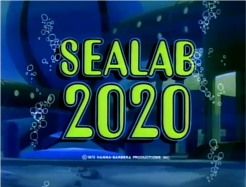
This image is protected under copyright by the owner. It is reproduced here under the fair use doctrine, in low resolution. From Wikimedia Commons.
Instead in 2020 we have a record low of scientific projects being supported by a science-denying government. Ironically the sea levels are rising because of global warming. We haven’t done our homework and we’re pouting that things aren’t turning out the way we wanted them to. Ours is no longer an evidence-based reality, but one where a tweet of “fake news” is all we need to make the truth a lie. And as the water laps our ankles my thalassophobia starts to kick in. The thing about Sealab is that they had kids there too. Kid scientists. Even more ironically, Richard Nixon was president. His downfall was Watergate—coincidental?—and now we have a president caught red-handed (very Red-handed, even) in crimes while in office and Nixon’s beginning to look like a saint. When did the water get up to my knees?
They wore wetsuits and swim fins quite a lot in the show. Moving under water looked so natural—unlike my flailing when I attempted to swim. It was all about not being able to breathe, in my case. They showed us all kinds of strange animals under the water in Sealab 2020. Animals that we could drive to extinction, it seems, if they got in the way of unbridled greed. I have to admit that I’m a bit disappointed that Sealab misled me. We were heading for an optimistic future back then, even with Nixon justifying the Vietnam War and spying on his political opponents. People were still able to look forward four decades ago, in hopes of a better future. For all these years I’ve been awaiting 2020 only to find the world back behind where it was in 1972.
 Steve A. Wiggins