Machine Intelligence

I was thinking Ex Machina was a horror movie, but it is probably better classified as science fiction.  Although not too fictiony.  Released over a decade ago, it’s a cautionary tale about artificial intelligence (AI), in a most unusual, but inevitable, way.  An uber-wealthy tech genius, Nathan, lives in a secured facility only accessible by helicopter.  One of the employees of his company—thinly disguised Google—is brought to his facility under the ruse of having won a contest.  He’s there for a week to administer a Turing Test to a gynoid with true AI.  Caleb, the employee, knows tech as well, and he meets with Ava, the gynoid, for daily conversations.  He knows she’s a robot, but he has to assess whether there are weaknesses in her responses.  He begins to develop feelings towards Ava, and hostilities towards Nathan.  Some spoilers will follow.

Throughout, Nathan is presented as arrogant and narcissistic.  As well as paranoid.  He has a servant who speaks no English, whom he treats harshly.  What really drives this plot forward are the conversations between Nathan and Caleb about what constitutes true intelligence.  What makes us human?  As the week progresses, Ava begins to display feelings toward Caleb as well.  She’s kept in a safety-glass-walled room that she’s never been out of.  Although they are under constant surveillance, Ava causes power outages so she can be candid with Caleb.  She dislikes Nathan and wants to escape.  Caleb plans how they can get out only to have Nathan reveal that the real test was whether Ava could convince Caleb to let her go by feigning love for him.  The silent servant and Ava kill Nathan and Caleb begs her to release him but, being a robot she has no feelings and leaves him trapped in the facility.

This is an excellent film.  It’s difficult not to call it a parable.  Caleb falls for Ava because men tend to be easily persuaded by women in distress.  A man who programs a gynoid to appeal to this male tendency might just convince others that the robot is basically human.  It, however, experiences no emotions because although we understand logic to a fair degree, we’re nowhere near comprehending how feelings work and how they play into our thought process.  Our intelligence.  Given the opportunity, AI simply leaves humans behind.  All of this was out there years before Chat GPT and the others.  I know this is fiction, but the scenario is utterly believable.  And, come to think of it, maybe this is a horror movie after all. 


More Morons

There’s an aesthetic to bad movies.  Some are so bad that they’re good.  Others are just plain bad.  Many years ago, during some Amazon movie sale or other, I purchased a DVD of Morons from Outer Space.  Now, horror comedy is a recognized genre, but sci-fi comedy is a bit harder nut to crack, even though horror and sci-fi are siblings.  Morons sat on the shelf for at least a decade, in case of need.  Having been scammed out of our life’s savings, a Friday evening when my wife said “Pick whatever you want, I’m likely to fall asleep anyway,” scanning the shelves my eye landed on it.  The movie had been distributed by MGM, how bad could it be?  Worse than anticipated, it turns out.  I don’t recall ever seeing an intentional comedy where the entire laugh potential was so misaligned.  There were one or two spoofs that worked, but mostly it dragged and begged to be put out of its misery.

Three aliens, anatomically human, crash land on earth after leaving a crew-mate behind on their deep-space vehicle.  The extended scene of their spaceship tooling down the highway might’ve been funny had it lasted maybe a tenth of the time.  The knock-off of Close Encounters’ use of music to communicate was a little funny.  The alien interrogation missed several potentially humorous opportunities.  The aliens eventually become celebrities while an American commander insists that they be killed because of their threat to life on earth.  Ironically, I’ve often wondered how it would be if aliens who came to earth were badly behaved members of their species.  I can honestly say that that would be better than the way this movie played out.

Meanwhile, the abandoned alien gets a lift with a spooky-looking alien.  In perhaps the funniest scene, the spooky alien asks the human alien his sex.  That part was funny on a couple of levels and showed the potential that the movie might’ve had.  He ends up on Earth and tries to connect with his three shipmates, who are now, literally, rock stars.  When they finally meet up, they summarily dismiss him again, only to be hauled off back to space by a closing Close Encounters parody.  I confess that I am still trying to appreciate bad movies on their own aesthetics.  I’ve seen so many that I added a “Bad movies” category to this blog.  Bad movies are often unintentionally funny.  It’s a different beast when a comedy is unfunny.  Particularly when there was potential there, if it’d only been effectively used.


Reptile Puppet

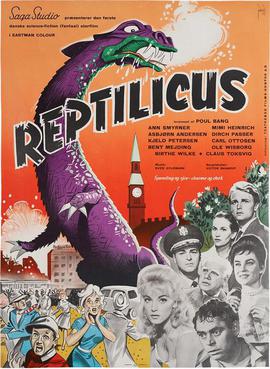
I read about Reptilicus, but I can’t remember where.  A monster movie shot simultaneously in English and Danish in 1960, with two different directors, it was universally panned.  Some times you just have to see a bad movie.  This one qualifies.  I actually laughed out loud a time or two.  The idea behind the story holds promise: some animals can regenerate lost limbs, or even entire bodies from a severed piece.  What if a giant reptile could do the same?  The film’s problem is in the execution.  So, a team drilling for copper above the arctic circle—they’re sweating and working with their sleeves rolled up in a temperate forest—hits a frozen animal in the permafrost under the tundra.  Taken to an aquarium in Copenhagen, the animal’s tail is kept frozen until someone leaves the door open overnight.  When it thaws it begins to regenerate.

Once fully formed—and nobody could see this coming—it breaks out and terrorizes Denmark.  There are some scenes thrown in to show off Copenhagen, and the film makes liberal use of stock footage from military exercises.  The dialogue, poorly written, is delivered with wooden earnestness by actors who struggle to be convincing in their roles.  The monster, Reptilicus, is so obviously a puppet that it could scare no-one.  But it’s a monster movie!  Those of us who grew up on such fare sometimes feel a need to go back to the well.  To appreciate a bad movie, I always approach it with a certain hopefulness.  Here I am, over six decades later, watching the film.  If that can happen, perhaps someone will see that publishing my novels isn’t the worst you could do?  It makes for a crooked kind of logic.  

The main thing Reptilicus has going for it is its near indestructibility and its ability to regenerate.  How is it finally destroyed?  We’re not shown.  In one scene the general asks the head scientist, something like, “If we can knock it out, you can kill it?”  Receiving an affirmative answer, they drug the monster and send the scientist off to do his work (after he’s suffered a heart attack).  I’ve read novels where it seems pretty clear that the author was unsure how the resolution actually goes—I’ve painted myself into that corner a time or two, so I know how it feels.  If you’ve got a budget and backers, however, you have to deliver something.  The movie performed reasonably well at the box office, which shows just how indestructible some monsters can be.


Horror Adjacent

We have the basic facts, but still, it takes a good bit of imagination.  We simply don’t know what the life of Mary Shelley was like, as experienced by the woman herself.  The movie Mary Shelley isn’t a horror film but it’s horror adjacent.  How could a movie about the woman who invented Frankenstein be anything but?  The handling of Haifaa al-Mansour’s film is generally as a drama, or a romance.  The story takes the angle that it was her stormy relationship with both Percy Shelley and her own father that led Mary to express her feelings of abandonment in her novel.  And while we have to acknowledge the liberties all movie-makers take, it does seem interested in keeping fairly near the known details of Mary Shelley’s life.  Although other women were also writing then, it was still a “man’s world” she tried to break into.

I confess that one of my reasons for wanting to see this film was that Ken Russell’s Gothic had a powerful impact on my younger mind.  That movie, which is over-the-top, being the first I’d seen telling the tale, had become canonical in my mind.  I know the dangers of literalism, and I wanted to see someone else’s take on the story.  Al-Mansour’s treatment takes a female perspective to the narrative.  It seems that Percy Shelley and Lord Byron were both advocates of what might now be termed a playboy lifestyle, and that Mary, daughter of forward thinking Mary Wollstonecraft and William Godwin, was fairly liberal herself.  Although Percy Shelley, like Lord Byron, was quite famous in his time, that didn’t always equate to financial solvency.  I could relate to parts of that quite well—full of creative ideas and shy on cash flow.

Mary Shelley didn’t rock the critics, but many felt it was a thoughtful treatment.  It is dark and gothic, but with no real monsters.  It did explain a bit of inside baseball about Ken Russell’s film.  Both movies make use of Henry Fuseli’s painting The Nightmare to explore the famous meeting of Byron and the Shelleys that led to the writing of Frankenstein.  Indeed, Gothic makes a good deal of it.  Mary Shelley explains that Mary’s mother, Mary Wollstonecraft, had an affair with Fuseli.  I was unaware of that connection.  Something was clearly circulating among the Romantics, many of whom knew each other and, in their own ways, became formative of culture centuries down the road.  And although many critics weren’t impressed, I think it’s about time that a woman’s point of view was brought to Mary Shelley’s life in a world not kind to women.  Even if a woman gave the world one of the most influential books of the nineteenth century.


Cuckoo’s Roost

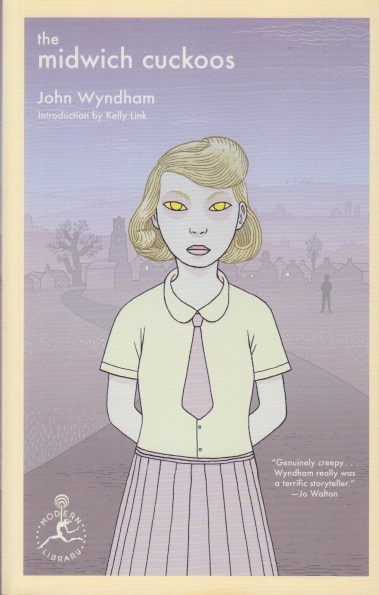
John Wyndham is someone I discovered through movies.  Often considered a science-fiction writer, his works cross over into horror, particularly on the silver screen.  Many years ago I read Day of the Triffids and, having seen Village of the Damned, wanted to read The Midwich Cuckoos.  It was a pretty long wait.  I kept thinking I might find a copy in a used bookstore, but it never happened.  When I saw a reprint edition I ordered it with some Christmas money.  There are some horror and sci-fi elements to the story, but there’s also a bit of thriller, as it’s called now, thrown in.  The book is quite philosophical because of the character Gordon Zellaby, a Midwich resident who keeps thinking about what is happening in terms that don’t match the expectations of other, more prosaic thinkers.  In case you’re not familiar:

Midwich becomes unapproachable for a period because an alien ship (the sci-fi part) has covered it.  Everyone in the village is asleep for a couple of days.  When they awake, generally no worse for wear, they soon discover that all the women of childbearing years are pregnant.  They all give birth about the same time to children that look eerily alike and have bright golden eyes.  The officials know this has happened but adopt a wait-and-see attitude.  Meanwhile, the locals get on with things but they discover these new children develop about twice as quickly as humans do and they can control people with their minds.  They also have collective minds so that their brainpower is quite above that of Homo sapiens.  Zellaby makes the connection with cuckoos—birds that lay their eggs in the nests of other birds and after they hatch shove the other chicks out of the nest.  Indeed, this is a story about what if cuckoos were humanoid aliens who tried the same thing with people.  Told with a British stiff upper lip.

The story slowly unfolds and gets scary as it grows.  I saw the movie quite a few years ago and the details were lost on me, so I was learning as I read.  I suspect that it differs from the book quite a bit.  Perhaps it’s the Britishisms that make this story less of a horror tale.  There’s a kind of jocularity to the style, at least for a good bit of it.  The serious issues of how governments and individuals interact is raised and discussed to a fair extent.  Even though the book is fairly short, there’s a lot going on here.  But now I need to watch the movie again.


The Next Phase

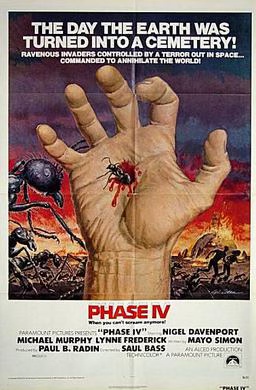
Sometimes I get things backwards.  You have to understand that in the pre-internet era finding information was somewhat dicey.  Those of us from small towns had limited resources.  The movies I saw were on television, with a rare trip to the theater being a treat.  Books, on the other hand, could be had for a quarter or less at Goodwill.  There I found the sci-fi horror Phase IV by journeyman writer Barry N. Malzberg.  I knew there was a movie, which I hadn’t seen, and I assumed it was based on this novel.  Actually, the book was a novelization of the movie.  But it’s more complex than that.  The movie was based on an H. G. Wells story, screen-written by Mayo Simon, then novelized. That novelization made a real impression on me as a kid and I knew that I would eventually have to see the movie.

Some scenes from the novel were still alive to me before watching the film.  It occurs to me that maybe you don’t know what it’s about.  Intelligent ants.  Some cosmic event boosts ant intelligence and two scientists are sent to Arizona to sort it out.  A local family ignores an evacuation order, and when one of the scientists destroys the oddly geometric anthills, a war is on.  (I remembered the destroying the anthill scene.)  The war is both of might and wits.  Meanwhile the family is attacked—I remembered the scene of the ants eating the horse—with only a young woman surviving.  She’s found by the scientists after the first pesticide is released.  The ants attack, intelligently, the research station.  We never do see the expected ants popping out of Dr. Hubbs’ infected arm, but it’s clear by the end that the ants have won and we’re living in Phase IV.

A few observations: this is a scary movie, even if seventies’ fare.  The sci-fi elements dampen the horror down a bit, but it is still scary.  And it also references religion.  I watched the movie a few weeks after seeing The Night of the Hunter for the first time.  What does a Depression-era serial-killing preacher have to do with ants?  The hymn, “Leaning on the Everlasting Arms.”  Now, there’s a project out there for someone inspired by (if such a thing exists) Holy Horror.  Is there a discernible pattern of how hymns are used in horror?  I suspect there is.  That hymn is used so differently in these two movies that I’m convinced something deeper is going on.  If you’re interested, the idea’s free for the taking.  I’ve just spelled out two of the movies for you.


Hiding Kirk

I recently saw—don’t ask where—a U.S. Space Force officer dressed in camouflage.  How fitting for a Trump-era agency.  I should think a Space Force uniform should be all black, maybe with little white dots on it.  Rather like my black lawn furniture that got in the way when I was cleaning my paint sprayer full of white paint.  I often wonder about our love affair with feeling safe.  Perhaps my own phobias have reached such a level that they’ve cancelled each other out.  If I was trying to hide in space, I think I’d try to look small, and dress in black.  Camouflage, which is based on colors found down here, probably wouldn’t do so well for the other planets of our solar system.  Or even the moon, for that matter.  And I personally think I might trust the aliens not to have earth-like issues.  After all, we think it’s okay to let machines think for us.

I grew up quite the sci-fi fan.  I read lots of books in that genre and enjoyed science fiction movies almost as much as my beloved monsters.  I used to watch that show, UFO in the 1970s.  The one with the interceptors with a huge missile on their noses.  I wasn’t really worried about aliens trying to invade.  Perhaps these days I think it might be better than the tedium of daily existence in the 9-2-5 world.  In any case, if we must have a Space Force, ought they not dress for the job?  I’m pretty sure I’ve got some tin foil in the kitchen with which to construct my hat.  Let’s look the part—that’s all I’m saying.

Photo credit: NASA

While all this is going on speculation has been growing about water on Mars.  There’s a good chance we may find it.  (We can always hope that if Elon Musk makes it to the red planet that he will take Donald Trump with him.)  If we are looking for invaders, though, we probably have to go further afield.  That’s alright, dynamic duo, we’ll get along without you.  Perhaps in the interim someone will realize that, dressed in earth green camouflage, our Space Force will surely stand out against the surface of Mars, or wherever they might go.   Unless it’s a planet very much like earth.  That houses intelligent life.  Maybe the beings there feel safe, knowing that their space force—for surely they will have one—is dressed in black.  Or at least, their life really is intelligent.


Them Apples

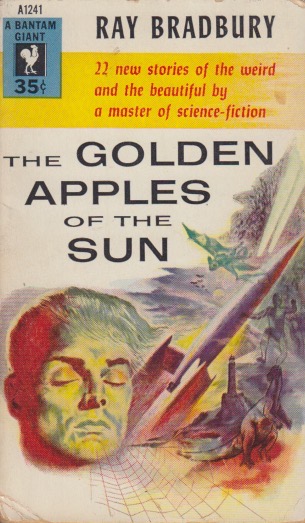
Although I’ve had this book as long as I can remember, I’d never read it.  Not the whole way through, until now.  As I kid I read Ray Bradbury when I could.  I’m sure I read a story or two in Golden Apples of the Sun, but I didn’t approach the entire collection.  I was drawn in at this late age by “The Fog Horn.”  This is the story that lay behind The Beast from 20,000 Fathoms, that classic of Harryhausen, the other Ray.  It’s been years since I’ve seen the movie, but the story was on my mind and I kept going.  Some of Bradbury ages well, while other stories, not so much.  The designation of his tales also changes over time.  As Stephen King says in Danse Macabre, Bradbury didn’t so much write science fiction (as the cover of this edition declares), even if the people occasionally get into rockets.

I realized as I read just how much my early writing style was influenced by Bradbury.  My stories were vignettes like these, not as accomplished, of course, but without lots of violence.  And with horror elements.  But it kept coming back to me how Bradbury’s characters, even the time-traveling ones, are stuck in the button-down forties and fifties.  I naturally overlooked this as a child but all these decades later and the strict binaries of, for example, men’s and women’s worlds, comes through on every page.  When women are the main characters, they’re usually not very flatteringly drawn.  The same goes for caricatures of races, although Bradbury is sympathetic he also uses stereotypes.  And many of the stories in this collection are just about everyday events, not a speculative element in sight.  Maybe I did try to read it through as a kid, but lost interest.

Writers struggle against irrelevance.  Those who look to the future sometimes get it right but often don’t.  And some reflect a present that we’d rather not acknowledge.  Of course, when I’m writing fiction I tend not to think in these terms.  The story simply takes you over and you can’t help being a refugee from the year in which you were born.  This is especially evident when Bradbury casts a rosy lens back toward childhood years.  As a child myself I had no idea that Bradbury was a time traveler from the twenties and thirties.  His childhood was nearly over by the time my mother was born.  It was a different world.  Some of his stories managed to transcend time and its for those that I keep reading him.


Truthful Fiction

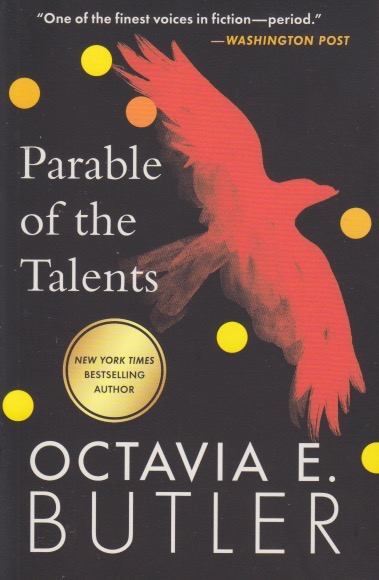
Octavia E. Butler is a name I’ve known for some time.  Various people, most of whom I don’t know, had recommended her books, particularly Parable of the Talents.  It turns out to have been one of the scariest novels I’ve ever read.  It’s not horror—it’s science fiction.  It’s scary because it’s just too plausible.  The first inkling I had that something was amiss was when I read how Andrew Steele Jarret ran for president to “make America great again.”  Jarret pretends to be Christian to get the vote and America suffers terribly when he’s elected.  I flipped back to the copyright page.  1998.  I read on anyway.  It’s not too often you find a sci-fi book about someone starting a religion.  And named after a biblical story, as well.  I was doing fine until Jarret’s supporters destroyed Olamina’s peaceful community and enslaved the survivors.

It’s all just too plausible.  Of course, there’s a lot going on here.  Butler was an African-American whose ancestors had been slaves.  The religions presented in the book are a bit too black-and-white, but the followers of Christian America behave like many followers of Trump.  Butler saw this two decades before it happened.  The slavery part of the book was difficult to read.  There was so much pathos here, so much deep memory.  Although Olamina is a flawed character, she is a visionary with the best interest of the human race at heart.  This dystopia is perhaps a little too close to reality.  Those who recommend the book say that it’s hopeful, so I kept on reading.  And yes, there is a hopeful ending.  Getting to it left me floored.

Religion defines us.  In the growing materialism—false, as anyone who feels deeply knows—the idea that a story could be built around religion seems unlikely.  Butler has done that, and done it in spades.  I was surprised to learn that she’d studied at the Clarion Workshop, not far from where I grew up.  Being from an uneducated family I never heard of the Workshop until I was an adult.  And besides, it left Clarion, Pennsylvania for Michigan before I even got to high school.  Still, it gives me a sense of connection with a woman who saw more than many did.  Although Parable of the Sower is earlier, I’m not sure that I have it in me to pick it up.  At least not right away.  I’m still trembling a bit from Butler’s second parable.


Could Have Understood Differently

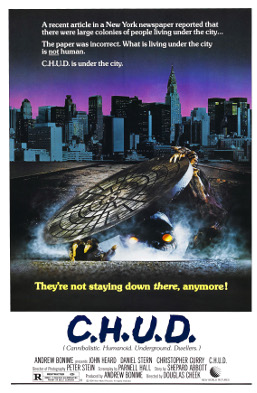
A lesson many authors need to learn (and I include myself here) is that titles matter.  Cutesy, clever titles may work for well-known writers, but something that describes your book, or movie, is essential.  And avoid acronyms.  I avoided watching C.H.U.D. for years, put off by the title.  I’d read a few books where it was discussed, but finally decided it was something I should see.  If you’re as put off by acronyms as I am, C.H.U.D. has a double meaning.  Initially Cannibalistic Humanoid Underground Dwellers, but more importantly, Contamination Hazard Urban Disposal.  I suppose that’s a bit of a spoiler, but since the movie’s been out since 1984 I’ll let it stand.  Although largely panned, I think C.H.U.D.’s a perfectly serviceable monster movie and despite what the critics say, it has a larger message.

Set in a gritty New York City, the film focuses on the homeless who live underground.  Although it’s not preachy about it, the underlying message is that these are people too.  Until, of course, the contamination hazard mutates some of them into C.H.U.D.  Then they start looking for human victims.  In a city the size of New York, they don’t have much trouble finding them either.  A government cover-up is behind all the mayhem.  Nuclear and other hazardous waste is a very real problem, and none of us really knows what happens to it.  With much of government boiling down to political theater, I’ll take my chances watching movies and wondering.  The good guys in this movie are those who actually care about the homeless.  They are a rather unsympathetic photographer and his wife, a police captain with a missing wife, and a guy who runs a soup kitchen.  They learn something isn’t right beneath the streets but can’t get the authorities to admit it.

This isn’t a great movie—there are gaps in the plot all over the place—but it’s not a horrible movie either.  Sympathetic portrayals of the poor are, in my experience, rare.  These are people who’ve organized themselves into a society that’s come under threat because of those who dwell in the light.  Some classify C.H.U.D. as science fiction,  but that’s a very loose use of the term.  It’s actually a low-budget horror film with a bit of heart.  Unfortunately the title obscures that this is a little gem of a monster movie.  I really had little idea of what it was about when I started streaming, but ninety minutes later I was glad I’d done so.  And I went down to the basement afterwards, you know, just to check.


Who’s Knocking?

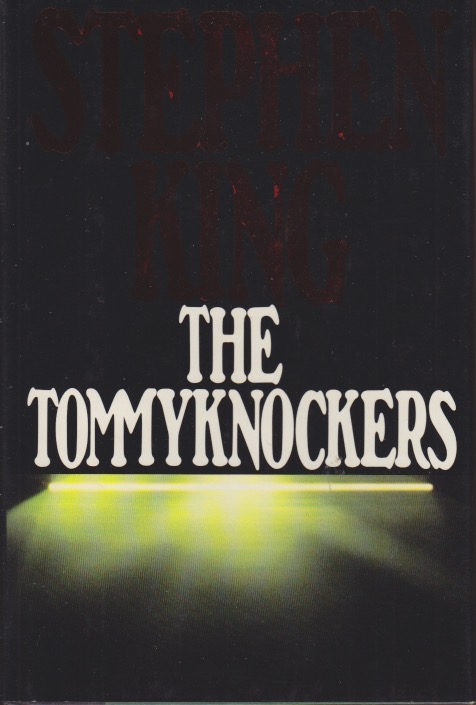
I’m by no means alone in enjoying Stephen King novels.  I’ve read a fair number over the years.  I was put on alert for The Tommyknockers by a scholar who pointed out some of the religious elements in it—again, not rare in King’s oeuvre—but I’d never heard of it before that.  I’m not really a good fan boy, I guess.  In any case, I saw a copy with the shiny copper of King’s name worn off at a library book sale for a buck.  It sat on my shelf for many months because, well, it’s long.  I finally pulled it down in October only to discover that it wasn’t my favorite King story.  For one thing, it’s simply too long.  For another, the characters aren’t the easiest to cotton onto.  If you’ve not read this one and you plan to, a spoiler of two might slip out but I’ll do my best not to ruin the ending.

I think horror when I think King, although I know it’s unfair to typecast authors like that.  Tommyknockers is more King’s hand at science fiction.  Well, at least it has a space theme, which is generally a cue for sci-fi in my book.  Bobbi Anderson discovers a buried flying saucer on her Maine property.  With the help of an alcoholic friend (Jim Gardener) she begins to excavate it.  The saucer, which has been buried for millions of years, is reactivated by their interaction with it and soon the entire town of Haven, except those with a lot of metal in their bodies—like Jim, are under its power.  They invent advanced gadgets (and weapons) using power from the ship and standard batteries.  They begin physically transforming into something less than human.  Jim, mostly immune, tries to help Bobbi out but he, along with a fairly extensive cast of disposable characters, are powerless to stop things.

Like most King novels, it’s well written.  Like some of his other material, it’s over-written.  Having had my own written work chopped down  (and, let’s face it, I’m now an editor), I see places where cuts could be made.  As with any long book, however, I’m left feeling a bit lonely now that characters I’ve read about nightly for many weeks are gone.  Even though I really had a difficult time evoking much empathy for them, hey, they’re people too.  Or so it seems.  Such is the magic of fiction.  Besides, there are bits of the old King horror still present in the book.  I know it won’t ever be my favorite King novel, but it won’t stop me from reading another, when I have the time.  Hopefully the next one will be a few pages shorter.


Employment Opportunities

It’s important to be reminded that stories can also be told by what’s not said.  Non-narrative fiction can be a little tricky to follow, but often contains admirable aphorisms.  Such as “I believe in the future.  I think you need to imagine a future and then live in it.“  This is from Olga Ravn’s The Employees: A Workplace Novel of the 22nd Century.  One of the many things driving me insane at the moment is where I found out about this book.  I know I ran across a recommendation somewhere and I can’t recall the place.  It would be helpful to know since I wonder what it was about the description that convinced me I had to read it.  In any case, there will likely be spoilers below since it’s difficult to describe the book without them.  I’ll start off by saying it’s classified as science fiction, but it’s not your typical 1950s kind.

The story’s told via a series of employee statements to the company that owns a space freighter.  The ship has a mixed crew of humans and humanoids—androids that aren’t easily distinguished from biological humans.  They discover some mysterious, perhaps organic, objects on a new planet and the humanoids begin to request, or even demand, equal treatment.  The outlooks from the two perspectives, human and non-human, are quite different, but they argue that fair treatment is only, well, fair.  The situation gets out of hand and the company, as such entities often do, decides on the economical solution of killing everyone aboard the ship but preserving the exotic objects.  Though generally described as “comic,” I picked up on the seriousness of the issues of prejudice and inequality.  The quote above is from the very last statement from the ship.

Ravn has established a reputation as a poet and that shows through in this novel.  The quote above is an example.  According to the article about her on Wikipedia, she graduated from the Danish School for Authors.  That made me wonder why we don’t have such things.  This isn’t the same as an MFA program.  Indeed, the nordic countries seem to have abandoned their viking ways for literature.  There’s a deep wisdom in this.  Costs of living are high in such places, but so are happiness levels.  What’s not to like about a school option where budding poets and novelists can become acquainted with one another and imagine a better world?  Writers sometimes give us challenging stories but the reason, I believe, is that we can learn from them, view a better future, and live it.


Many Days

Science fiction.  I used to consume it by the bookful, and even now I occasionally turn back to it.  Having read Doris Piserchia’s A Billion Days of Earth, I do have a confession to make.  I don’t know why I read it.  Literally.  As I’ve indicated many times before, I keep a reading wishlist.  It’s comprised of books that others recommend and things that catch my eye.  Every now and again a used book sale will bring something unexpected into the mix, but overall, I rely on my list.  I can’t remember who recommended A Billion Days of Earth, or why.  The cover is striking in that 1970s sci-fi way, and it took me back to the actual seventies when I was reading sci-fi quite a bit.  Some of that cover art still mesmerizes me.  So, about the book…

I didn’t know what to expect and received what I was expecting.  This is a philosophically heavy novel that, in the style of some other seventies fiction I read, was a bit difficult to follow.  The main idea (and there will be spoilers) is that Sheen, a silvery, shape-shifting being, emerges a billion days along.  Evolution has taken multiple tracks with animals such as dogs and rats becoming essentially what humans are today (or were in the seventies) and humans evolving into what the other animals call gods.  Sheen slithers about the world taking the egos from all creatures, kind of assimilating them.  A rat person and a dog person resist the relinquishing of their egos while the world around them begins to collapse.  The “gods” refuse to help.  Then, at the end, the gods board their spaceship, and released by Sheen, leave for another planet.

Although I was confused most of the way through, the book leaves a lot to exegete.  This is definitely a retelling of Genesis 1–3.  Sheen offers people (and animals) paradise in exchange for their egos.  Nearly everyone, except those who think (a small number) accepts this offer.  Even the gods are tempted.  We’ve got the snake (Sheen), the expulsion from paradise, and the gods who separate themselves from humanity.  But still, I’m sure there’s something more that I missed.  There are subplots for Rik (rat man) and Jak (dog man) and the rich Filly family that seem to evade conclusion or resolution.  Or maybe once the gods are gone there’s nothing more to say.  This seventies classic left me thinking.  And wondering who it was that recommended it to me.


Dinosaur Planet

Time, as the crew of the Odyssey finds out, can cast things in a different light.  Admittedly I watched Planet of the Dinosaurs because it was free on Amazon Prime and I was having trouble keeping awake on a weekend afternoon.  It’s the kind of bad movie I’d’ve loved as a kid, and if I’m honest, I still do.  Although it was released in 1977 (it’s hard to believe Star Wars was the same year) the award-winning (!) stop-motion dinosaurs are so unbelievable that it hardly seems possible that the film’s budget was almost all spent on them.  It certainly didn’t go to pay a writer because the dialogue is about the cheesiest I recall ever hearing.  Jurassic Park was still a decade and a half away, after which no stop-motion dinosaur would ever be credible again.

Still, bad movies aren’t all bad.  In fact, there’s an aesthetic to them.  For me the real draw, as with an Ed Wood movie, is that these directors were struggling against an inadequate budget.  This isn’t in the Spielberg league.  And you can only afford so much.  The idea is akin to that of Planet of the Apes—which benefitted not only by a better budget but by a script by Rod Serling.  A planet similar to earth but caught in a different time.  And it’s a chance to explore what it would’ve meant for people and dinosaurs to coexist, which, despite some ark hawkers, never happened.  If it had we probably wouldn’t be here to make bad movies about it.

Our set of nine castaways manage to survive with only four eaten by dinosaurs.  And when these stop-motion reptiles aren’t on screen, the people are filmed walking, inanely talking, or thinking that a stockade of sticks and twine will keep out nine metric tons of Tyrannosaurus Rex.  There’s an attempt at social commentary when the vice-president of the company funding the mission realizes that he’s not the boss among castaways.  Where there’s no money, the balance of power shifts.  Of course, he gets impaled by a Centrosaurus.  At the end, the five survivors have settled down, built a house, and started having children.  They look pretty good for having survived on dinosaur meat and berries.  It helps that the corporate VP isn’t around.  I watch movies like this because, like James Shea, I’m on a tight budget.  And Amazon Prime often dictates what I watch when I’m having trouble keeping my eyes open. 


Annihilated

For a long time I resisted seeing it.  Partially I wasn’t sure if it was any good and partially—mainly—it was because of spoilers.  Annihilation came out in 2018, just as I was reading Jeff VanderMeer’s novel upon which the movie was based.  I will always remember this because I worked in a cubicle where I couldn’t see my fellow workers and the woman in the next cube was a bit of a chatterbox.  She and one of her coworkers had seen the movie and began discussing, somewhat loudly, what’d happened.  I was in the middle of the book at the time and didn’t want any spoilers.  I’d never actually met the woman in the next cube and I couldn’t go over and tell her to stop talking about the film because one of the reasons we watch movies is to talk to one another about them.  (Mostly I do this online.)

Enough time has passed, and a different woman at work, remotely, suggested I see it.  I don’t know why the movie did so poorly at the box office.  The director, Alex Garland, has said he didn’t reread the book as he was making the film because he wanted it to be impressions of the novel rather than strictly based on it.  Even as I watched, I recalled some of what I read back in 2018.  I’ll try to limit spoilers here, but if I’m talking too loudly you can just click away (and, hopefully, come back after you’ve seen it.)  It begins when a mysterious “shimmer” appears after a meteorite strike in Florida.  Those who enter the shimmer never come out.  A team of women scientists are sent in, wondering if gender might make a difference.  One of them, Lena, volunteers because her husband did make it out and almost immediately went into a coma.

A sci-fi horror movie, I wonder if it underperformed at the box office because it stars women.  The tension builds between them as they try to figure out what’s going on within the shimmer.  Species have mutated rapidly and the predatory animals are pretty frightening.  The threat, as in VanderMeer’s novel, is ecological.  The ending, I’ll say, is quite different from the book because it was intentionally written as a trilogy and the director wanted to resolve the tension in a single film before reading the other two (which I still haven’t done).  The end result is thoughtful and tense.  The acting is good and the effects are stunning.  I’d class it with Arrival as an intellectual exploration of what it means to be part of a universe we barely begin to understand.  And kudos for having women lead the way.