The Joy of Tech

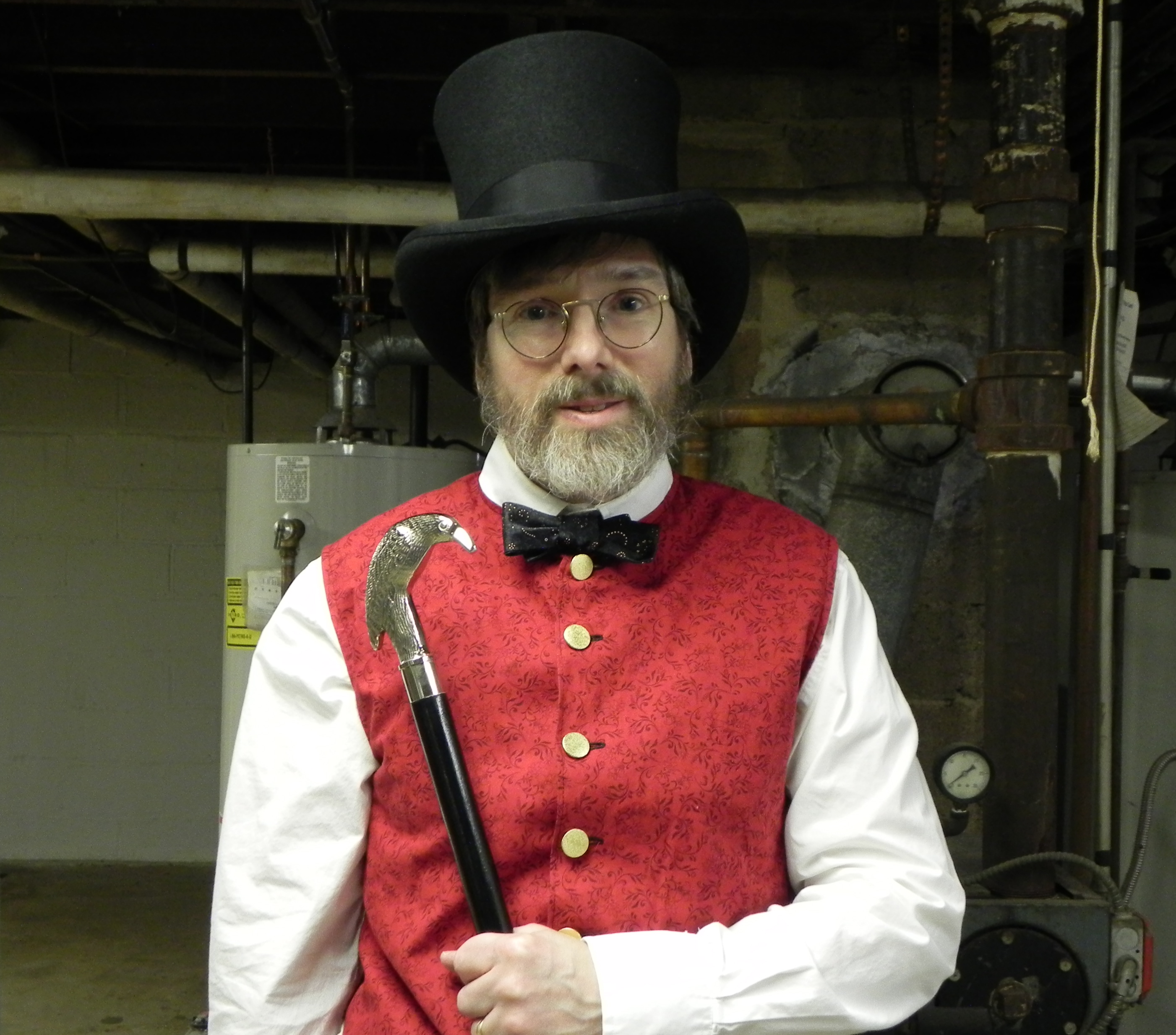
In the age of Steampunk, New Jersey is among the world capitals. Indeed, today is the second day that the International Steampunk City will be inhabited in Speedwell, home of the telegraph. For yours truly, Steampunk is an escape. Alternate realities often look better than the pedestrian one we’ve inherited, so we like to look at the world through steamy lenses and imagine how it might have turned out differently. New Jersey, in the spring, also hosts the Steampunk World’s Fair. Perhaps we have more pressures to escape here in the Garden State. Imagination is certainly in no short supply. I attended the International Steampunk City last year and decided that I’d like to be a part of it. Knowing a thing or two about ancient technology, I thought I might share a bit with the Steampunk crowd. What is Steampunk without tech? Some ancient technology, although not very well known, is perhaps of even greater influence than we might imagine.

One of the connections that is easily misplaced in this era of purely scientific advance, is that technology was devised in the service of religion. At least in the early days. The greatest architectural achievements came under the aegis of temple building. Domes, arches, and eventually flying buttresses that could hold tons of stone high over your head—these were to please the gods. We can’t imagine Stonehenge as anything other than a capitalist venture these days, a way of drawing in the money. Of course, ancient builders knew of the financial benefits as well; temples were often the equivalent of ancient banks. Still, beneath all the pride of accomplishment there was the belief that the gods were somehow pleased with our innovation. Perhaps we’ve just done away with the convenient myth. Steampunk often has a religious underpinning. Many of the stories I’ve read touch on our ancient mythologies. Only, in fantasy, there are different possible permutations.

We sometimes think that technology is a modern phenomenon. Actually, it is quite ancient, as far as human culture goes. The first “computer” was invented around about the first century. Since it didn’t have an obvious benefit to the control of the masses, however, no technological revolution took place. The steam engine was, in nascent stages, invented also in ancient times. Until we learned, however, that it could be enslaved to make certain industrialists rich, we had no need for it beyond a diverting toy. Technology does not take hold without a deeper purpose. Every now and again I get a little paranoid knowing that I carry a telephone that knows my exact location at all times. As if I were important enough for anyone to care. Then the feeling passes and I open my iBooks app and turn to my latest Steampunk novel. I am a slave. I wonder what innovations there will be at International Steampunk City this year that might change the world. Only the imagination will limit the possibilities.

DSCN4341


Infernal Religions

infernalDevicesThe first steampunk novel I read, although some would dispute the classification, was Neal Stephenson’s The Diamond Age. To be sure, I’d noticed other Victorian-style science fiction, but the idea of prescient technology settled into my head to nest for a while. I read a few other exemplars of the genre, finding each interesting in its own right. Having just finished K. W. Jeter’s Infernal Devices, however, I get a sense that I’ve neared the fount. Jeter is generally credited with coming up with the neologism “steampunk,” and this novel, while not his first, is fascinating for the heavy religious symbolism that is used throughout. In our secular, post-Christian age, we tend to forget that in the nineteenth century (actual, if not alternate reality) religion still played a tremendous role in people’s lives and outlooks. Infernal Devices uses that outlook quite effectively. The remnants of Cromwell’s puritan cause appear as the Godly Army, set against science and technology in a society still imbued with religious belief. When a flying machine appears overhead, the Scots suppose it is the beast of Revelation harbinger of the world’s end.

Like most steampunk offerings, Jeter offers us plenty of mechanical wonders. The hapless Mr. Dower, our protagonist and narrator, is the son of a mechanical genius, now deceased. The story involves Dower trying to unravel the many strands his father wove in a lifetime of invention and innovation. The one device that stood out to me, however, was the automaton priest and choir of Saint Mary Alderhythe, Bankside. Dower’s father had invented a robotic priest to go through the mechanical motions of an Anglican mass. Having sat through hundreds of such masses, I could see the point he was making. There are variables, but the overall draw of ritual is, well, its ritualism. The sameness that assures an assuaged deity and a safe congregation. The Godly Army, however, is more revisionist in intention.

Jeter, I’m sure, did not intend for the novel to be read for religious truths. It is rollicking and fun, with characters that you can’t believe but you want to. The driving force, however, behind much of the story is the religious bias of elements of London society. Dower, blamed for vices he doesn’t really have, is chased from his home by the Lady’s Union for the Suppression of Carnal Vice. The Godly Army, however, steals the show. Perhaps the most profound observation comes from Scape, who quips “That’s what you get.. when you give people Bibles and guns,” about the Godly Army. “It just messes up their brains.” At this point I began to wonder whether the story were really fiction after all. In this case the truth indeed perhaps lies in steampunk’s alternate history.


Cowboys and Demons

Cowboys_&_Aliens

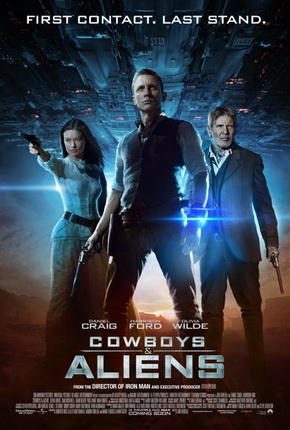
Cowboys & Aliens finally came down into my price range. For movies I’d have to view alone, I generally wait until they appear for free on some online movie service or for less then ten dollars at Target. I’ve been waiting for this one since 2011, but my patience paid off. Inspired, so the rumor goes, by the Roswell incident, the film follows the adventures of some old western stereotypes as they encounter the superior power of aliens. The aliens, it seems, are just as materialistic as humans, coming to the old west in an extraterrestrial gold rush. They abduct humans to learn their weaknesses (which really seems superfluous given the technological imbalance between the species) and anger a number of ornery hombres in the process. Then we have an old-fashioned shootout with ray guns versus bows, arrows, and bullets. Human devotion, however, defeats the evolved armor and flying machines of the—well, what are they exactly?

The cowboys scratch their heads, not quite having the consarned concept to categorize these flying machines and their occupants. The local preacher, who is a pretty handy shot, tries to help the confused cowboys, who settle on the term “demons” to describe the extraterrestrials. We forget that in the early part of the last century other galaxies had not yet been discovered, and although we knew of other planets, there was assuredly no way to get there from here. Ugly things that come from the sky are demons. This doesn’t lead to a whole load of speculation—nobody suggests praying to take care of the menace, although the Native Americans resort to a religious ritual to unlock the mystery of where the demonic hoard is hiding. Through her resurrection we discover that Alice is a good alien, planted in the town to stop the invaders from doing to the earth what they did to her planet. And winning the heart of Jake Lonergan (whose very name suggests lone gunman to insiders) along the way.

Since the movie is three years old, I won’t worry about spoilers—if you’re inspired to watch for the first time, however, you might want to do so before finishing this. When Alice figures out how to stop the alien mining operation for good, Jake is left, for the second time, with his woman being killed by demons. Woodrow Dolarhyde, realizing that the outlaw Jake isn’t such a bad guy after all, seeks to console him at his loss. At the end of the movie, in a camera angle that goes from Woodrow to Jake, the focus falls on the cross atop the local mission as Woody says, “She’s in a better place.” All aliens go to heaven. Literally. With echoes of the X-Files, Cowboys & Aliens is sufficient for a dark night where demons and angels are a little too close to tell apart.


Once and Future Ape

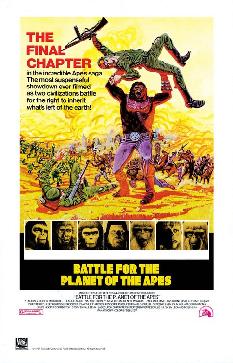
Battle_for_the_planet_of_the_apesThe original pentalogy of the Planet of the Apes franchise began a slow decline with Beneath the Planet of the Apes. Producing a movie per year from 1970 to 1973, the series died with Battle for the Planet of the Apes. Given that Dawn of the Planet of the Apes has been compared with this original final installment, it seemed time to reacquaint myself with it. The early seventies, as I recall them, were tense times. Social unrest both at home and abroad, coupled with a maddeningly increasing nuclear arsenal, seemed a recipe for disaster. Indeed, the world does end with the second installment of the pentalogy, a scenario set up in the final episode as the Alpha-Omega bomb, guarded by mutants, is declared worthy of reverence. Only through the magic of time travel do Cornelius and Zera travel back to the paranoid 1970s to start the whole series over again. The Battle for the Planet of the Apes, apart from its preachiness, does overflow with religious language and rhetoric. Indeed, it begins with a reading of Scripture from the Lawgiver. Pentalogy or Pentateuch?

Caesar is said to be the savior of apes and, like in the current Dawn, the sympathies of the viewer are with the apes. Gorillas, the frat boys of the ape universe, do indeed cause troubles, with Aldo becoming a kind of Cain who slays a fellow ape, Cornelius. (They even got the initials correct, if reversed.) Religion, and prejudice, it seems, have brought this fictional world to a crux, caught in an endless loop of new futures. As Virgil says, there are an infinite number of lanes on this highway. Presumably, traveling back in time opens up all kinds of possibilities.

Despite the number of reused shots in the film—the first ten minutes or so are simply a recapping of the previous two films—and the unfortunate pacing (how could a climax of two angry apes climbing a tree have possibly dragged on for so long?), the movie does have a message. Race tensions, high at the time, are overtly and covertly addressed. Disarmament is praised. The only future that seems not to exist is for one more movie. Interest moved on to science fiction’s apotheosis in Star Wars just four years later. Once again we would find ourselves in a world of black and white, with simple choices. There was no ambiguity among the Jedi. Still, for all that preaching, equality never did reach its goal. So even with its faults (didn’t we see that same tree-house bombed four times?) it is worth dusting off the Battle for the Planet of the Apes once in a while and pondering better possible futures.


Forbidden Zones

Dawn_of_the_Planet_of_the_Apes

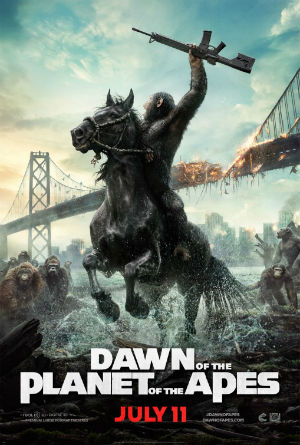
I grew up with talking apes. Well, I was actually about six when Planet of the Apes was released, but it quickly became one of my favorite movies. With a screenplay co-written by Rod Serling, and that very unorthodox conceit of evolution playing visibly on the surface, it was the forbidden fruit. Since, according to our fundamentalist doctrine 1) animals can’t speak, 2) evolution never occurred, and 3) the world was going to end long before 3978, we were not prevented from watching what was obviously fiction. And watch I did. There were spin-off cartoons, not to mention the following movie and television series. An unsuccessful reboot by Tim Burton was followed by Rupert Wyatt’s intelligent, if somewhat sentimental version. And I’ve seen them all. Finances being what they are, and, since my family does not share my enthusiasm for the apes, I’ll probably have to wait for the home-viewing release of Dawn of the Planet of the Apes to enjoy the latest offering.

In the meanwhile in a nearly glowing review in this week’s Time magazine, Richard Corliss has indeed whetted my appetite. The original series of Planet of the Apes movies had, like many films of the late sixties and early seventies, a strong, underlying social critique. Yes, one can see only so much of Charlton Heston’s bare chest, but there was something more going on here—something to which we needed to pay attention. The Burton version went for a parsimonious special effects extravaganza, but the storyline was devoid of much underlying reflection. Good ape, bad ape, all the way. Now, as we are moving into the third major incarnation of Pierre Boulle’s dark vision of our distant future, we see that the apes are maybe the real humans here. Maybe they were from the very beginning.

Perhaps because of its ability to slip beneath the Moral Majority radar in the guise of science fiction, the talking apes have been part of American culture for almost my entire life. The original movie introduced the idea of the Forbidden Zone, that region where the truth lay buried, waiting to be discovered. There was a not-so-subtle jab here at a world where politics was continually being revealed as just another human bid for power, and a Cold War was threatening our very existence. We survived and continued to evolve. Still, we find a kind of social catharsis in the apes, and I worry just a little bit at Corliss’s use of the word apocalypse. The apes have always been remarkably prescient. For some of us, they were more than mere entertainment. And so I’ll patiently wait until I can watch the apes alone in the privacy of my home, to learn what the future might hold.


Double Blind

When I read Isaac Asimov’s three laws of robotics as a child, I assumed that I’d not live to worry about them in real life. What we don’t know can indeed hurt us. Time magazine frightens me sometimes. This week’s offerings include a small blurb about drones. When I was a kid, a drone was a bee—dangerous in its own right—or it was a verb used to describe an uninspired teacher or preacher’s monotoned wisdom. Now drones are robotic planes that can operate themselves without human input. Time reveals that technology has been developed that would allow drones to kill without human input. Asimov’s laws have become truly science fiction. Proponents argue that “collateral damage” might be minimized if we allow robots to kill with precision, and some have argued that the research should be prohibited. The fact that it has been developed, however, means the line in the sand has been crossed. If it has been done once, it will be done again.

800px-MQ-9_Reaper_in_flight_(2007)

Even as a daily user of technology, a deep ambivalence besets me. Maybe if it weren’t for the fact that every once in a while my computer (most often at work) freezes up and issues a command I can’t understand, I might feel a little more secure. Instead I issue a ticket for IT and when they call on me sometimes even a specialist can’t figure out what went wrong. Once the bullets are flying it’s a little too late to reboot. Maybe I’m just not yet ready to crawl into bed with a technology that might kill me, without feeling.

Just five pages earlier Time notes that 1 in 5 is the “Ratio of people who would have sex with a robot, according to a U.K. study.” All things are fair, it seems, in love and war. The part of the equation that we haven’t accounted for in our artificial intelligence is that thought requires emotion—which we don’t understand—as much as it requires reason, upon which we have only a toddler’s grasp. And yet we continue to build more and more powerful devices that might kill us with ease. Isaac Asimov was a prescient writer and a forward thinker. He was from the generation that aspired to ethics being in place before technology was implemented. At least as an ideal. We’ve reversed the order in our world, where ethics is continually playing catch-up to the new technologies we’ve invented. Now it’s time to decide whether to make love to it or to say our final prayers.


Fire Bearer

Prometheusposterfixed

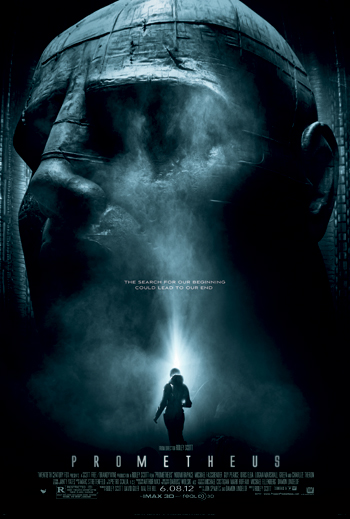
Part prequel and part religious odyssey, Prometheus both treads familiar ground and explores new territory. In keeping with my invariable sense of timing (I saw none of the Alien trilogy in theaters), I waited until well after the fact to see the movie. I had heard Prometheus called a prequel, but even if I hadn’t some of the Ridley Scottish touches might’ve given it away: a large ship bound for a distant planet, evidence of unexpected inhabitants—yes, they knew about the “engineers” (we could call them “watchers”) but not the proto-Aliens they were breeding. We even have the android that understands science’s need to be greater than that of human need. Déjà vu. Still, there’s something very different here—direct discussion of religion and how faith plays into the work of scientists. Elizabeth Shaw, the sole survivor, wears a cross as she tries to work out what her father’s teaching about religion might mean. The cross isn’t hidden in the background—it is brought out into the open and discussed.

If you haven’t seen the movie, the premise is that ancient artifacts (including the ubiquitous Sumerian, Egyptian, and Mayan templates) added to a new discovery in Scotland, demonstrate that a race of giants have been inviting us to their planet for thousands of years. In fact, they had engineered us. (Ironically, the biologist who espouses Darwin is among the first to die.) Peter Wayland, industrialist billionaire who doesn’t want to die, funds a trip to meet these engineers. The engineers, save one, died long ago. Apparently of some plague (cue the aliens!) that were created to destroy humans. They were about ready to send the nasty beasties to earth when they were overcome, with only a single survivor. No coincidence that this planet was reached on Christmas day. It becomes clear to Dr. Shaw that these engineers were intent on destroying the human race they created. And still, she slips her cross back on before facing the engineers of life and death. This was Noah without all the water (and much better writers).

Of course we think we know the rest of the story. Sigourney Weaver bravely led us through three alien attacks before sacrificing herself in a New Testament kind of ending. But what about Elizabeth Shaw? She who bore and aborted the mother of aliens in a very maculate conception? She is off to a prequel’s prequel to find out why these engineers wanted to destroy us. Rumor tells of Prometheus 2, and I wonder if we will get to meet our maker’s makers. Although Scott is an atheist, he brings us Moses later this year, and has already given us Mary and Jesus wrapped up into one with Ripley and her spiritual mother, a sci-fi St Anne, in Elizabeth Shaw. After all Elizabeth was cousin to Mary, and now that the question of faith has been openly discussed, it will have to be more fully addressed. Among the unanswered questions is whether I be able to make it to the theater on time to see this one, or will two years vanish before I find the time to address the eternal questions that Ridley Scott always seems to pose.


Star Tracks

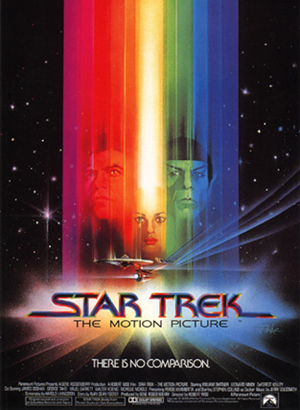
Star_Trek_The_Motion_Picture_posterLong ago in a galaxy far away—1979 in rural western Pennsylvania, to be precise—the local inhabitants were surprised to learn that James T. Kirk was now an admiral. Two years earlier Star Wars had thrilled us with special effects first mastered in 2001: A Space Odyssey but a more accessible plot. Robert Wise, who had not only given the world The Sound of Music, but also The Day the Earth Stood Still, took the helm for the new Star Trek: The Motion Picture. Star Trek geeks, of which crowd I do not count myself, hadn’t really taken their cliched role in the emerging high tech society, and CGI was still a few years off. Nevertheless, rumors in school had it that the movie featured a bald woman and had boldly gone where no man had gone before. The original crew was all there. So on a Friday night I dutifully made my way to the Drake Theater to watch and left saying, “is that all?” Star Wars was action-packed and fun, filled with archetypes and wise-cracking robots. Star Trek had Voyager 6, like E.T., trying to phone home. In a word, the movie was forgettable.

On a tour of the original Star Trek world, I finally sat down to watch The Motion Picture, with its grandly archaic-sounding name, last night. I shuddered to think I’d last seen it 35 years ago—that makes me as old as the crew was starting to look—but this time I was able to see things I hadn’t before. Spoiler alert! Voyager 6 is looking for God. The original Voyager 1 reached the end of our solar system a couple years back, but in 1979 there was no reason to suppose that we wouldn’t try again and again to reach out to parts unknown. We were rapidly become materialistic, and the universe could be a known quantity. Three centuries in the future, Voyager 6 is headed home, having been rebuilt into an unstoppable living machine. When the creator—humanity—doesn’t pick up the phone V’ger poises to wipe out the carbon-based infestation until it learns how to physically, biologically merge with a human being (cue the bald lady and otherwise superfluous Captain Decker). Lots of colorful lights and we can all go home.

Even now I can’t muster the courage to say the movie is profound, but it does touch on an issue that has only grown over time—we have voluntarily left our deities behind. In our rush to reduce the world to the least common denominator, we have pulled the plug on the cosmic phone. The Voyager program ran out of steam as the Cold War was heating up down here on earth and we were being told we were all just a bunch of atoms fooling around anyway. The machines, in the meantime, had come to believe. I probably won’t survive another 35 years to watch Star Trek: The Motion Picture again, but I do hope that in that time we may become more aware of our humanity. And I do hope that if someone divine does happen to call, that we’ll at least pick up the phone.


I See Only Nothing

Once considered to be bad omens, comets are becoming a fad for those who can take their eyes off the screen for a few moments to look at the sky. Comet ISON (C/2012 S1), apart from falling trippingly from the tongue, is apparently now visible with the naked eye. I’ve been looking forward to this comet since at least January, although living just to the west of New York City complicates viewing possibilities quite a bit. You see, although I am now an urbanite, I’m really a rural rube at heart. I grew up in a town of less than 1000, and was born in a town of less than 15000. I attended college in a small town and my first teaching job was in a rural setting in Wisconsin. Apart from the fact that I’m now convinced people have very little control over their own destinies, I have preferred to live in places where I can see the night-time sky. Perhaps it was my love of science fiction as a child, but for whatever reason, space has always captured my imagination. I used to drag my brother out on frigid nights to look at the stars, and even tried to teach myself the azimuth coordinate system to document precisely where I’d seen something. I took astronomy classes in high school and in college. In middle school I did an intensive report on comets that saved my science grade that year.

Hyakutake, 1996.  My first comet.

Hyakutake, 1996. My first comet.

Comet ISON, however, has been refusing to behave as it was projected that it might. Although it could still turn into a very bright sky-show, so far it has been difficult to spot, and, at least for my location, at inconvenient hours of the day. Much to the chagrin of creationists, ISON is 4.6 billion years old, although it is just getting out for it’s first tour of the solar system. Part of the Oort cloud region, Comet ISON is probably a piece of a never-formed planet out past Neptune that decided to take its first cosmic stroll about a million years ago. It’s had a date with the sun since that time. The scientific jury’s still out as to whether ISON will go out with a blaze of glory after its close encounter with our sun and if it will come back around again to wow generations of our distant progeny (presuming we survive that long). For me it will be a matter of seeing if the clouds ever break in the east at 4 a.m. so that I can actually get a glimpse of the sky.

Hale-Bopp, 1997; a little over-exposed--one of the hazards of amateur photography with film.

Hale-Bopp, 1997; a little over-exposed–one of the hazards of amateur photography with film.

Comets were once thought to be heralds of the gods. Like other variable objects in an otherwise pretty predictable night-time sky, they can be either very bright or very dim (even invisible, for all practical purposes). When Halley’s Comet came around in 1986 I was living in Boston and couldn’t see the heavenly visitor. In 1996 Hyakutake buzzed earth, I stood in wonder in the woods of Wisconsin, photographing my first comet. A year later when Hale-Bopp blazed through the sky, I was out with my camera trying to capture it on film (a medium, I understand, that is about as old as Comet ISON). Were these visitors bad omens? One comet may have been decidedly devastating for our dinosaur friends, while some speculate that life on earth was seeded by a comet (making it a kind of secular god, I suppose). I’m only convinced that we have no control over our fate as I stand outside at 4 a.m. yet again, only to find clouds in the east and a comet in my heart.


Monsters Incorporated

Monsters

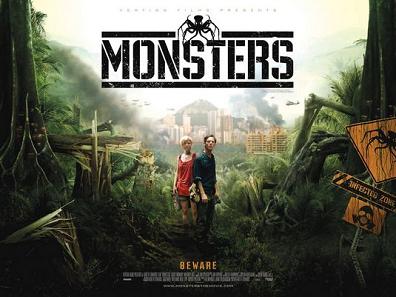
Monsters. What’s not to like? With a title so innocuous and limited US marketing, this 2010 British indie film only just came to my attention. I hadn’t even heard anything about it as I sat down to view it. The premise of invading aliens is as old as H. G. Wells, if not earlier, but this is a film without over-the-top CGI and a very human story. Showing far more tension than bloodshed, Andrew and Samantha, their Anglo names very prominent, are caught in alien-infested northern Mexico. Somewhat predictably, Samantha has a rich daddy who happens to be Andrew’s boss, but the couple has to find their way back to the United States as giant insectoid-octopi rampage through the night, destroying just about anything they can get their tentacles on. So far it sounds like standard Saturday-afternoon fare. As Andrew and Samantha reached the Rio Grande, however, overlooking the huge wall the US government built to keep out the aliens, I realized what the film is really about.

During the Bush years, shortly after the Berlin Wall had come down, a new wall was snaking its way along the Mexican border. America had become weary of “Give me your tired, your poor.” This was the land of opportunity, instead, for the chosen few. Never mind that we know that many of the jobs most of us don’t want are gratefully accepted by those who may not be technically legal in this country. Never mind that we deny social justice, in many ways, to those who make our lifestyle possible. Andrew and Samantha face the massive wall that says, “keep out.”

Of course, they make it back to Texas. They discover, however, that the aliens have breeched the walls as well. And they really pose no threat beyond wanting to draw strength from the abundant light-sources of a power-hungry world. The film’s ending is a bit ambiguous, but then again, the plight of the alien generally is. I watched the film with no expectation beyond a bit of sci-fi action to help give me the energy to make it through another week of work. Instead I saw a brash American coming to a deeper sense of humanity while standing in a church where hundreds were mourning their dead. The death of one small girl was as much a tragedy of as the breeching of the borders. Until humanity prevails over artificial borders, there will indeed be monsters. Were that they were only giant insectoid-octopi.


Mr. Hubbard’s Legacy

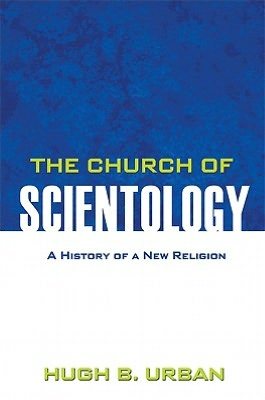
churchofscientology As a child just discovering the joys of reading in the early 1970s, I found science fiction captivating. We were poor, and our town had no library, so I’d buy my books on Saturday trips to Goodwill. In other words, you take what you can get. I recall buying a book by a guy named L. Ron Hubbard. I don’t remember the title or the story, but I recall my surprise when, as a religion major some years later, I learned that this same sci-fi author had started a new religion. Scientology was not something you’d likely encounter in a poverty-stricken, sub-Appalachian town in rural Pennsylvania, and with no Internet it wasn’t so easy to learn about such things even if you had. We did have TV, though, and we watched Welcome Back Kotter (Risky Business was a little too risky). When I discovered that John Travolta (“Vinnie” as we thought of him) was a Scientologist, I was curious. But only to a degree. When I first taught World Religions and spent a few years researching the Scopes Trial for a book I never had the chance to write, I became very interested in American religions. They don’t come much more American than Scientology (and Latter-Day Saints).

As soon as Hugh B. Urban’s book The Church of Scientology: A History of a New Religion appeared, it immediately went onto my reading list. Like most interested laity, I’d found it difficult to trust much of what I’d read on the Church of Scientology from media sources. Now I had a reliable guide! Even better, Urban frames his study around a question that pervades this blog: who gets to decide what is a religion? As Urban deftly points out, it is odd that government agencies are often those tasked with a job more fitting for those of us who’ve studied religion with the rigor that a physicist devotes to quarks and neutrinos. Some of us have parsed religious texts to bare bones and then dug up the skeletons beneath and examined their ossified remains as well. The world doesn’t take religion studies too seriously, however.

Urban’s book, well written and solidly researched, maintains that rarest of academic feats: objectivity. When approaching a religion, particularly a controversial one, emotions are easily engaged and objectivity is challenged. While confessing that he isn’t a Scientologist, Urban lets the historical facts speak for themselves. He doesn’t try to belittle those he studies, but he doesn’t coddle either. Reading his fascinating account, many questions are raised about the rights of religions and the role that secrecy plays. And we know that Urban is only skating across the surface of a deep and mysterious pond here. Sitting in my room with a yellowed, used copy of some L. Ron Hubbard pulp fiction story in my hands, I would’ve never guessed, as a child, what I was really holding.


Running to Stand Still

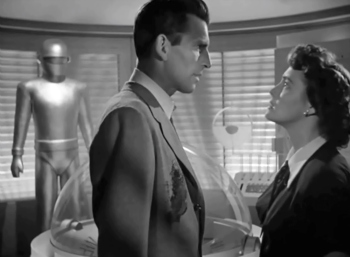
“You have faith, Professor Barnhardt?” Klaatu asks the scientist in the classic The Day the Earth Stood Still. Barnhardt demurs, stating that curiosity is what makes good science, not faith. But sometimes I wonder if the professor or if the alien is correct. Science fiction was young in 1951, and Robert Wise would go on to give us such diverse fare as West Side Story, The Haunting, The Sound of Music, and the first Star Trek movie. Still, The Day the Earth Stood Still has always been my favorite movie that he directed. In 1951 quite a bit could be assumed about America’s religious sensibilities. Yes, diversity had been part of the mix from the very beginning, but the view of America as a “Christian nation,” although not in any way official, was not seriously challenged in those days. This shows through clearly in the movie. Although the opening sequence is intended to be a Klaatu eye-view of descending to earth in his space ship, it is reminiscent of the stock “creation” imagery that would become so familiar to those of us who watched Bible movies. It is a God’s eye-view as well.

Christ-like, Klaatu descends to earth to bring a message of peace, but also an apocalyptic threat, from the powers beyond. He is capable of miracles, such as the eponymous day the earth stood still—the ultimate in non-violent protest because hospitals and airplanes still have power and nobody is harmed. In his human incarnation Klaatu not so subtly takes the name Carpenter, making the corollary clear. In case you missed that, however, he is killed, resurrected and in the end ascends to heaven. Klaatu becomes the prototype of the messianic alien, a figure we would see in guises from ET to Starman. Believers in ancient astronauts or not, the makers of our space movies know that God is an alien.

daytheearthstoodstill

The Day the Earth Stood Still came early on in the Cold War. The obviousness of distrust in the Soviet Union is placed in the mouths and knowing glances of various characters. Some even suspect that Klaatu is a Russian rather than a spaceman. Sputnik was still six years in the future, but the atomic bomb was already in the past. We had learned to destroy ourselves before we had learned how to escape the only planet we have. Klaatu delivers his final homily not to politicians, but to scientists of all races (and, unspoken, creeds). Seated on folding chairs in the outdoors, as if at a revival meeting, they listen as Klaatu tells them the decision of how to live is up to us, but Gort, a kind of avenging angel, is always overhead. The invocation that can save humanity, however, is given to the female lead Helen Benson. She alone knows the sacred words “Klaatu barada nikto.” Amen.


Sterling Serling

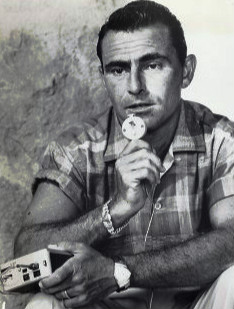
“There is a fifth dimension beyond that which is known to man. It is a dimension as vast as space and as timeless as infinity. It is the middle ground between light and shadow, between science and superstition, and it lies between the pit of man’s fears and the summit of his knowledge. This is the dimension of imagination. It is an area which we call the Twilight Zone.” The words are those of Rod Serling, native of Syracuse and Binghamton, and creator of The Twilight Zone. When I travel to a new place, I like to honor the writers and creators of the region. Yes, there always have been many creators. By my age, Rod Serling was dead, but he had, before that time, created a cultural phenomenon that would stay with the world forever after. It would be difficult to quantify the effect The Twilight Zone had upon me as a child. That opening took ahold of my young mind and convinced me that there was more to life than what appeared on the surface. It is the power of creation.

Rod_Serling_dictating_script_1959

Serling was a fighter. “The angry young man of Hollywood” who used his fiction to protest war and racism, Serling took on many issues in The Twilight Zone that would have been censored had they been presented as fact. Fiction is the vehicle in which truth rides. The bizarre world Serling envisioned captured the imagination to such a point that if I write, “do-do-DO-do, do-do-DO-do” many of you will be able to conjure the theme of The Twilight Zone in your heads. We all know that this is a sign that something strange is about to happen.

There is something about place. I’ve written about sacred geography before, and it is one of the more fascinating aspects of human subconscious life. Something about Syracuse-Binghamton still says “Rod Serling.” Maybe it’s in the low, glowering clouds or the ancient Native American names and traditions that can still be found in this region. Although I’ve never lived in New York, my ancestors did, in the region just east of here. A lifelong wanderer, I sometimes wonder what it is to belong to a place. I have often felt the persistent call of upstate New York, the salmon wisdom whispering me home, perhaps. I’ve never lived here, but maybe I belong here. New York is now proud to claim Rod Serling, and I drive from Syracuse to Binghamton delving deeply into the sacred geography of the region and ponder how such a mind came to be. Even creators, it turns out, have to be created.


Gods in Spandex

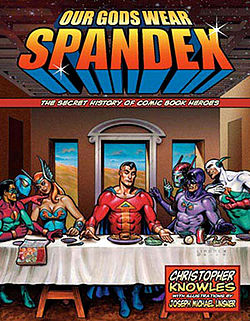
OurGodsWearSpandexOne thing leads to another. Reading Jeffrey Kripal’s Mutants and Mystics stirred an interest in comic books that I hadn’t felt since before my college days. Often excoriated as puerile, escapist doggerel for pre-pubescent boys, comics have grown to be respected members of adult society. I often wonder what the draw might be. Hollywood has certainly cashed in on it with any number of blockbuster flicks each year coming from the brains of the comic book writers and artists. So I picked up the quirky book by Christopher Knowles and Joseph Michael Linsner entitled Our Gods Wear Spandex: The Secret History of Comic Book Heroes. Reading it was kind of like looking in a mirror that has been buried in dust for a few decades. I hadn’t realized that my tastes in childhood comics was a reflection of a longing for the divine world with healthy doses of science fiction, and even H. P. Lovecraft, thrown in along the way. Knowles ties in a remarkable breadth of material to demonstrate that our superheroes are, in the final analysis, gods. That point may be taken in any number of ways.

The academic world suffers from a fear of respectability. That may seem a strange assertion, but I’ve spent a great deal of my life among academics and I know that many of them are insecure and tentative. Does all this reading, writing, and analysis ever get read by anybody? Does anybody take me seriously? Academics are haunted types. So when a subject as vulgar as comic books arises, scholars are reluctant to touch it. It might look like we actually enjoy reading the funnies. Still, popular culture has demonstrated an unexpected depth to much that we read in the strip world. As Knowles points out, a deep undercurrent of the occult and esotericism runs through many hero story lines. Several heroes began their lives as classical gods, only to assume the spandex and become incarnate humans with special powers we long to have ourselves. We would fly, if we were given the chance.

Our Gods Wear Spandex may never be viewed as an academic book by most. It has too much visual interest and not enough recondite footnotes. All the same, it is a profound look at what people really desire. We worship gods because of their special powers. If God were one of us with our humiliating weaknesses and limitations, would we ever worship him or her? Of course not. We only seek to appease those who are stronger than we are. Entire governments and ecclesiastical bodies are built on that very principle. Heroes are like us. Mortal, and yet, with something more. They die. But like the gods, they can come back. Reading Knowles it becomes clear just how much religious thought pulses through the veins of the comic book world. We may be grown up and sophisticated. We may have left behind childish things. But when our backs are to the wall, who doesn’t secretly wish they were Wonder Woman or Superman? And maybe that wish is a prayer.


Blob Blog

Those who actually know something about movies occasionally complain that Hollywood seems to provide us with diminishing returns. How many movies have been remade? Can anyone even count all the sequels, prequels, and just plan quels? A similar trend is evident in publishing. A teen-vampire novel takes off and every publisher faces a twilight of the profits if it doesn’t spin off its own version. Sometimes I end up becoming familiar with a movie through its remake before ever viewing the original. The Blob is one example of this. I’ve seen the thirty-year remake 1988 version a few times. Just this weekend I saw the original 1958 version for the first time. It seems to me that teen movies of the late fifties and early sixties tried a little too hard to get the snappy, sassing dialogue of teens on the brink of the incredible cultural changes that were about to take effect after the extreme conservatism of the McCarthy Era. At times it is so hip that I can hardly stand it.

The_Blob_posterThe Blob falls into that category. A young Steve McQueen trades ripostes with his chums who think a drag race and a Bela Lugosi movie with your gal are pretty daring behaviors. Buried in all that innocence, however, I found a hidden warning tone. When I watch scary movies, I always keep an eye out for religious themes. Sometimes they fail to materialize. The Blob is about as secular as they come. I didn’t even spot a church or a priest (unlike the 1988 remake) in the typical American town. Just a bunch of kids that, Archie-like, try to convince the adults that they’re serious. A blob from space really is loose in town, and nobody has an idea how to stop it. All the adult men wear ties and the ladies all wear dresses. It is a world that follows the rules.

What of this warning tone I mentioned? Well, the blob itself is, apart from its disruptive raison-d’être, hardly more threatening than the stifling culture it attacks. It can’t be shot or burned, and nobody has any other ideas. It is unstoppable. Except for cold. And here’s the chilling part. As the carbon-dioxide drenched blob is airlifted to the Arctic by the military, Lieutenant Dave declares the world safe once more. Steve (Andrews, i.e., McQueen) chimes in with, “Yeah, as long as the Arctic stays cold.” The film ends with a trademark horror question-mark (this one literal) as the blob is parachuted onto a snow-covered landscape. Global warming was a future monster in 1958. The optimistic world could see nowhere but forward. Now, over 50 years later, our future looks a lot less cold. With politicians and some religious leaders decrying global warming as just another liberal myth, we might do well to remember The Blob. Something up there on our melting ice caps is waiting for us to return to the 1950s to begin its sequel of terror.