Mythology in Cinema and Belief

My snow day activities yesterday would not have been complete without the viewing of a classic science fiction film for relief from my Mythology course prep. Still having mythology on the brain, I selected Dr. Cyclops, a 1940s movie that presages many of the concerns evident in the more famous members of the genre over the next decade. There were, even before the atomic bomb, clear concerns with radioactivity and its control by unstable elements of society. The fact that Dr. Thorkel is stereotypically Germanic would certainly resonate with audiences of the day. Given the title I focused on the classical elements and they eventually came through. As the radioactivity shrunk the cast, with the exception of Dr. Cyclops (Thorkel), Odysseus’ plight in the cave of Polyphemus emerged clearly. The doctor is symbolically blinded by the hiding and breaking of his glasses, and the shrunken prisoners escape like Odysseus’ crew. In one scene where the rival Dr. Bullfinch (surely no accident) addresses the much larger Thorkel the writers make it clear for the viewers that Bullfinch is really Ulysses (Odysseus).

Odysseus and Polyphemus

Presumably filmgoers in 1940 were still required to have read the classics in school so that such references would have been obvious from the start. Less obvious to viewers then and now is the fact that ancient mythology was a form of religion. Over the past week or so I’ve been participating in an exchange on Sabio Lantz’s blog, Triangulations, on the topic of metaphorical versus literal truth. I maintain that mythology reflects truth as perceived by ancient believers, whether they “believed” in an actual pantheon on Mount Olympus or not. Myths are intended to convey truth – although ancient religions were more often about correct practice rather than correct belief. Placating angry gods was the job of the priesthood, not the average citizen.

The question unanswered is when religion shifted from correct practice to correct belief. Correct belief can only truly apply in a monotheistic context – if there are many gods there are potentially many beliefs. With one god, one personality, the potential for believing incorrectly infiltrates a religion that is primarily concerned with keeping the many gods satisfied. So perhaps what Dr. Cyclops sees through his one good lens is a metaphor for seeking a single truth rather than the many. In the film, before he meets his demise in the radium mine, Dr. Thorkel is the only character with the stature of a god.

Noah in the Underworld

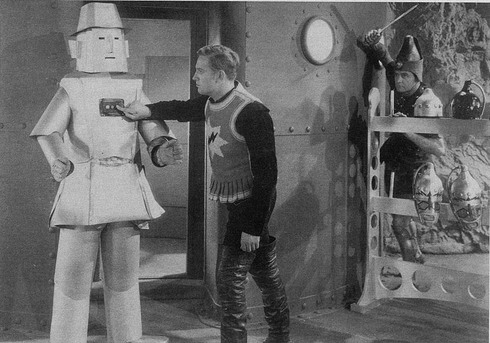
I recently was subjected to the 1940 sci-fi/western film Radio Ranch (a compilation of the series Phantom Empire). This happy-go-lucky story with Gene Autry in his first starring role is a romp through the unbelievable in just about any sense of the word. Based on the premise that there is an underground world called Murania, the film pits Autry against evil scientists who want to get a “bushel load” of radium from Murania, the “Thunder Riders,” or national guard of Murania, and indeed, against his corporate sponsors who will cancel his contract if he ever fails to get to Radio Ranch by 2 p.m. for his singing broadcast! This creative approach to early science fiction will be reincarnated more successfully in The Mole People, a movie that I wrote about a few weeks back.

The connections between the two films do not stop at an underground world with humanoids wearing Egyptian costumes (there is an unmistakable uraeus on the helmet of Argo in Radio Ranch), but go as far as the associations with the Flood Myth. I pointed out the flood connections in my post on The Mole People, and it was startling to note that Radio Ranch begins (and ends) with Gene Autry singing “Uncle Noah’s Ark.” That coincidence is, in itself, barely worth noticing. When the evil scientists invade Radio Ranch, however, they are shown an artifact from the Thunder Riders (whose thunder-producing horses are, admittedly, pretty cool) and they immediately identify it as an “antediluvian” idol. At this point it became clear how deeply embedded the biblical flood story has been in our culture, and how freely it was used in early science fiction films.

At a guest lecture in the Middle East Studies Program at Rutgers on Friday, I mentioned that the flood story goes all the way back to Sumer, making it among the earliest religious stories in the world. Several students had difficulty with this and began asking, “but when was Noah actually alive?” These college students, well educated in science, engineering, or political science, can’t get beyond the biblical literalism they were raised with. It is no wonder that America is falling behind much of the world in science education: we haven’t moved beyond Gene Autry’s overly cheerful belief in a deluge that never occurred.


Prophets in Disguise

Yesterday I decided to take a break from austerity and take my family to see Avatar. Not just on the big screen (a rare enough treat), but in 3-D Imax format. In my zeal I had forgotten about my debilitating congenital problem with motion sickness. I have had trouble since I was a child sitting in the backseat, or riding backward on a train, or even turning my head around too fast. Once I was talked into riding a county fair ride by some high school friends and found myself still getting nauseous two weeks later. I have learned to live with this embarrassing problem, but sometimes I forget that the mere suggestion of motion will send me over the edge. I managed the first twenty minutes of the movie before having to close my eyes and bow my head for the rest of it. It is an interesting experience to listen to a movie. Following the basic plot wasn’t too hard, at least when I wasn’t thinking about all the talk of great special effects and the money I’d spent to see them.

Like most science-fiction movies, Avatar makes substantial use of biblical and mythological themes. The planet is named Pandora, after the “Greek Eve,” and I could hear traces of the hero quest throughout. When the indigenous people were introduced, however, my ears pricked up (as I understand those of the characters do). The Na’vi, it turns out, share the name of the prophets of the Bible. The Hebrew title for prophet is nb’, pronounced the same as the movie characters. I thought about this as I wondered what was going on during the action sequences that I could not see. Those who guard the traditional ways are the prophets, silenced by the grinding machinery of modernization.

Even avatars have their origins in religion. The first I had heard of avatars in science fiction was in Neal Stephenson’s Snow Crash. The idea felt so fresh then that I had to remind myself that Hinduism had given the world avatars as earthly manifestations of deities centuries ago. Placing oneself in another form ultimately stimulates the question of which is the true self, the ultimate reality. It is an inherently religious question.

The morning after, the room is still swaying about me, I can’t scroll down on the computer screen, and I am asking the questions of reality again. It cheers me that Avatar is doing so well at the box office. Any movie, even if unseen, that causes the viewer to question a frequently painful reality is worth the price of admission.

Another blue avatar


Compassion Divine

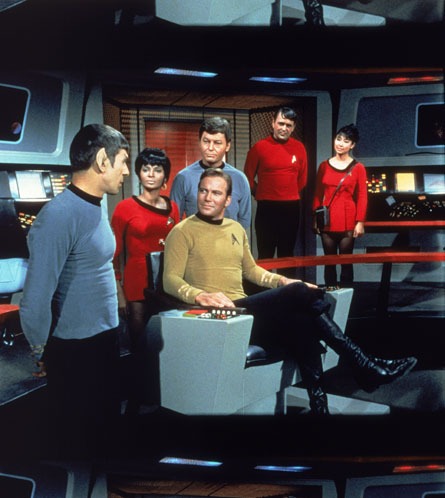
A very generous relative graced this holiday season with the gift of the first season of Star Trek, the original television series. I am not now, nor have I ever been, a “trekkie.” I did, however, enjoy the show as a child and have come to appreciate it even more as an adult. I can’t cite episode and scene like a trekkie can, and a surprise FBI raid would not turn up any pointy Spock ears or a model phaser (although my wife’s cell-phone looks like a sophisticated communicator). As a child the show appealed to my love of science fiction, and as an adult the morality play aspect of the original series fascinates me. Yesterday we watched an early episode where a crew member has his mind boosted by a trip beyond the edge of the galaxy (a la Forbidden Planet). As this character becomes more and more omniscient and powerful, he refers to himself as a god. Captain Kirk, in his attempt to stop his old friend calls out that gods are marked by compassion rather than strength.

I have been rereading Homer’s Iliad in preparation for a course on mythology. Quite apart from the fact that Star Trek borrowed heavily from classical mythological themes, one of the features I have especially picked up on in this reading has been the appeals to the compassion of the gods. As Diomedes, Odysseus, and Ajax (and finally Achilles) battle Hector and Paris both sides call out for the kindness of Zeus, appealing to his compassion (as well as to his baser instincts). Reflecting the ancient perception of the world, Zeus’ responses are fickle.

Biologists have been probing the origins of human sympathies ever since Darwin. Creationists used to argue that compassion, altogether lacking in the animal world, could not have evolved naturally. Many recent studies, however, have demonstrated a naturalistic base for our altruism and compassion. These traits are certainly displayed in a number of animal species, particularly mammals. The ancient Egyptians believed animals to be superior to humans in many respects, lacking our weaknesses and being more adept at survival. It seems that they were right and some of the nobler human traits evolved from our animal milieu. If so, what is divinity beyond the gospel according to Star Trek — compassion to those in need by those who find themselves in positions of power?


Incredible Shrinking Saturdays

As a kid Saturday afternoon was devoted to the science fiction repertoire offered to B-movie connoisseurs on commercial television. There were only about a dozen channels in those days and one of the local Pittsburgh stations had the demographic of teenage boys’ viewing habits down to a science. Now that people tell me I’m grown up, although they won’t give me a full-time job, the temptation is there to let the television do the thinking for me. Actually, I only allow myself to watch TV on the weekends; it never gets turned on until Friday night. The rest of the time is spent getting ready for classes or looking for jobs.

Anyway, yesterday I decided to watch I movie I first saw as a tween (“kid” as they were called in those days), The Incredible Shrinking Man. The Christmas tree was set up and decorated and the snowstorm scheduled to bury the East Coast was doing its job quite well. So I settled in to remember old times. I’ve mentioned before the mild social criticism of 1950s sci-fi, and seeing this film as an adult yielded the same results. When Scott Carey realizes he’s shrinking, the doctors figure out that he had been exposed to radiation — a perennial plot device in Cold War movies — and the various creatures of the natural world become deadly threats. His cat, and, of course, the basement spider, both try to kill him.

Then, as the realization dawns that he will eventually shrink down to nothingness, Carey reflects how the infinite and infinitesimal are the “ends of a circle.” And in a movie where the divine is not previously invoked, he ends his relentless deflation by narrating, “To God there is no zero. I still exist.” When technology (medical science) and human help (his wife stays with him until he is the size of a cockroach, and only leaves when she believes the cat ate him) fail, the 1950s audience falls back on God. Theologians call this thinking “God of the gaps,” where God, the ultimate deus ex machina, is used to explain what human reason can’t yet figure out. It is still prevalent in Fundamentalism and most forms of contemporary Christianity. If belief in God relies on having unexplained phenomena, the question of who is shrinking becomes challenging indeed.