
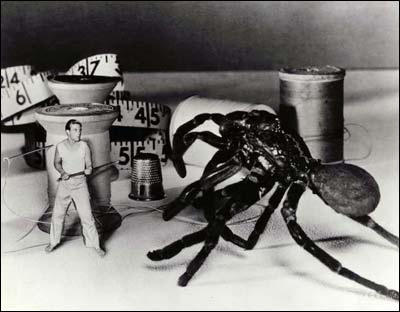
As a kid Saturday afternoon was devoted to the science fiction repertoire offered to B-movie connoisseurs on commercial television. There were only about a dozen channels in those days and one of the local Pittsburgh stations had the demographic of teenage boys’ viewing habits down to a science. Now that people tell me I’m grown up, although they won’t give me a full-time job, the temptation is there to let the television do the thinking for me. Actually, I only allow myself to watch TV on the weekends; it never gets turned on until Friday night. The rest of the time is spent getting ready for classes or looking for jobs.
Anyway, yesterday I decided to watch I movie I first saw as a tween (“kid” as they were called in those days), The Incredible Shrinking Man. The Christmas tree was set up and decorated and the snowstorm scheduled to bury the East Coast was doing its job quite well. So I settled in to remember old times. I’ve mentioned before the mild social criticism of 1950s sci-fi, and seeing this film as an adult yielded the same results. When Scott Carey realizes he’s shrinking, the doctors figure out that he had been exposed to radiation — a perennial plot device in Cold War movies — and the various creatures of the natural world become deadly threats. His cat, and, of course, the basement spider, both try to kill him.
Then, as the realization dawns that he will eventually shrink down to nothingness, Carey reflects how the infinite and infinitesimal are the “ends of a circle.” And in a movie where the divine is not previously invoked, he ends his relentless deflation by narrating, “To God there is no zero. I still exist.” When technology (medical science) and human help (his wife stays with him until he is the size of a cockroach, and only leaves when she believes the cat ate him) fail, the 1950s audience falls back on God. Theologians call this thinking “God of the gaps,” where God, the ultimate deus ex machina, is used to explain what human reason can’t yet figure out. It is still prevalent in Fundamentalism and most forms of contemporary Christianity. If belief in God relies on having unexplained phenomena, the question of who is shrinking becomes challenging indeed.
 Steve A. Wiggins