Louder

Scream is one of my old movies.  I saw it several years ago but the details had grown hazy so I dusted off the DVD to give it another go round.  I’m glad I did.  This Wes Craven classic was one of the first horror movies to rock the critics because it parodies so many other horror films while remaining a scary plot line.  And it’s intelligent.  I liked it so much that I’d watched Scream 2 as well, and the two had jumbled up in my mind.  In case you’re still in a Halloween mood, here’s the basic premise (I won’t spoil the ending): the opening sequence is so well-known that I’m tempted to skip it, but it sets the scene remarkably well.  A teenage girl home alone answers the phone to find a stranger on the line.  This stranger is watching her as he calls, eventually breaking into her house.  Using horror movie clichés, the ghost-faced intruder catches and kills her.
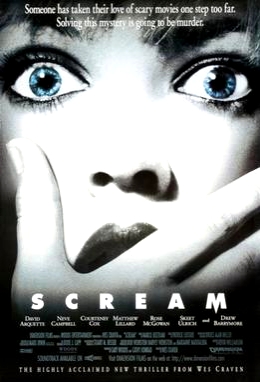
After that, Sidney Prescott is having trouble getting over her mother’s murder the previous year.  The recent murder triggers her.  When her father has to leave town on business, she decides to stay with a friend.  Ghostface attacks her, leading to the arrest of her boyfriend, who shows up after the slasher attack.  Along with her friends, of which the guys are all horror movie fans, she plays out various scenarios of who the killer might, or “should” be, according to the rules of the genre.  This is very effectively done, keeping the first-time viewer guessing who the killer might be.  When school is suspended because of the killings, the kids have a massive party (of course).  The killer’s there, however, for the most part following the rules.  But the instructions are subverted, making for a wild ride.

Clever and satirical, the movie strikes the right tone.  One thing I noticed the first time was that Ghostface is a little too fast for a psychotic killer.  He runs.  He’s also quite vulnerable, but then again, he’s not a supernatural villain.  After seeing Scream again, I realized that there are still some classics that I’ve missed.  One reason is that I’m not really a slasher fan.  Throughout the movie they avoid using the word “horror,” preferring “scary movie”—the original title for the film.  Scary Movie was picked up by a horror parody that I watched shortly after seeing Scream for the first time.  In many ways Scary Movie is a parody of a parody.  Horror is endlessly self-referential, of course.  And sometime an old movie is just what you need.


Out There

While Amazon Prime includes a few A-list horror movies, those that it does I’ve already watched.  Since I can’t afford to pay for this habit, I watch what’s free.  That brought me to the horror comedy There’s Nothing out There.  Written and directed by a twenty-year-old guy, it’s kind of what you might expect.  Its main claim to fame, apart from being a low-budget monster flick, is that it anticipates Wes Craven’s classic Scream.   The latter is famous for being so self-aware.  One of the characters keeps telling the others what happens in horror films and, of course, those things happen.  Although There’s Nothing out There is silly, one of the characters does exactly that.  In the funniest moment in the movie he looks directly at the camera and says “It’s a distinct possibility” in response to one of the girls asking “So you’re saying we’re in a movie?”  Craven didn’t borrow that, but then, Scream is a landmark.

So what’s it about?  There are seven young people who head to a cabin in the woods.  Actually, it’s a regular house, and quite a nice one at that.  The three couples are there for sex but the single guy (Mike) is the horror expert and gets on everyone’s nerves.  He’s right, of course, that there is a monster on the loose.  A slimy green thing with a huge mouth full of pointy teeth, has fallen from space into the neighborhood and it slimes the guys, digesting them, and tries to mate with thee girls.  And if it shoots lasers into your eyes you become its servant, helping out with its mission.  The kids are picked off, of course, with Mike surviving along with one of the couples.  Before they can stop the monster a plumber also gets eaten.

Horror comedy is a strange genre.  It tends to work because there are elements of humor in much of horror.  It’s not all blood and gore—the best examples use that sparingly, in any case.  And horror comedy doesn’t really frighten since it’s pretty clear that it’s being played for laughs.  Sometimes such movies venture into the bad realm—there’s a reason some movies are free on Amazon Prime—but at times they actually have quite a bit to offer.  There’s nothing scary about There’s Nothing out There.  It’s the kind of movie that tends to grow into a cult classic over the years, however.  And while it’s not A-list material, it’s still worth watching for free.


A Scream or Two

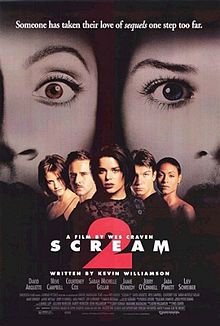
Scream2A few weeks back, for my weekend fix, I watched Scream. I hadn’t seen the movie when it came out in 1996, but having seen so many references to Ghost Face I felt I was missing out on something. I was disappointed, however, at the relative lack of religious imagery or dialogue in the film. Such motifs are so common in horror films that I’ve come to depend on them. In fact, there was nothing supernatural in the movie at all. This weekend I decided to follow it up with the sequel that many claim is better than the original, Scream 2. It is the same self-aware exposé of horror gimmicks and tropes, providing several clever frights along the way. But this time there was more religion. Not that it was overt or central, but it was clearly there. My thesis was bolstered a little bit since the storyline felt the need to come back and pick up what was mostly lacking from the first film.

Sidney draws first blood in the sequel by comparing a sorority to a religion. Not much, but a start. We find out that Sid has taken up drama in college, where she has been cast in the role of Cassandra, the prophet of Troy cursed with never being believed, although always being right. In the truly disturbing scene from the play we’re shown, Zeus himself comes down and points a godly finger at the frightened girl. The real religious imagery, however, comes toward the end of the movie when Derek is tied up, cruciform style, by his frat brothers for giving away his letters. He plays the role of the sacrificial lamb as Sid comes face-to-face with the Ghost Face duo, and when his dead body is lifted up on the stage prop, the camera angle reveals either an angel or an ascending deity, arms spread out as if on a cross. Life has been laid down for life, a distinctly religious theme.

What would horror be without resurrection? The villain always comes back from the dead, having easy access to that which is denied the regular mortal. This factor alone suggests that most horror films are transmuted religious fulfillment wishes. We live in a time when religion seems to have lost its transcendent power, and yet we long for resurrection. Horror movies tell us it is available, but at a very steep price. Perhaps it is an unintentional motif, but it is a pattern that occurs so often that it feels integral to the very conception of the scary movie. That which we long for the most is the most terrifying. Horror films aren’t for everyone, but their popularity shows, on some level, that our society hasn’t given up on religion just yet. Scream 2, the resurrection of a wry, witty, and somewhat gory original, brings fear and religion together once more. Religion, like the horror villain, never really goes away.