Demons and Gremlins

Gremlins have an ancient pedigree, whether they know it or not.  Credited with airplane problems during the Second World War, these meddlers in technology had an older cousin in the demon named Titivilus.  Titivilus was a demon said to be responsible for errors in the works of scribes.  Long before the printing press hit Europe, manuscripts were copied by hand, of course.  Anyone who works with Bibles, for example, knows that no ancient manuscript exists without errors.  But scribes copied more than Bibles, and anyone who has tried to copy an entire manuscript knows that errors always creep in.  (When I was a college student I tried to get my local church back home to set up a Bible-copying station so that when hungry parishioners were leaving the service they might stop and copy a verse.  This was to show how errors appeared in biblical texts.  The experiment took place but results were disappointing—full of errors but we didn’t get past the early chapters of Genesis).

However that may be, having a demon to blame for things going wrong proved to be mighty handy.  The tradition lasted well into modern times.  In the days of manual typesetting the young printers’ apprentices were called “printer’s devils.”  Demons were blamed for spilled cases—capital letters were kept in the upper case, and minuscules in the lower case—and other mishaps.  It may be a stretch, but such a demon interfering with humans trying to accomplish something important, led to ideas such as gremlins.  Most of us, I suspect, don’t like to confess that we’re sometimes clumsy or sleepy and make errors.  One of my notebooks is all crinkly because I knocked a nearly full water bottle over onto it while trying to catch a bug in my office.  ’Twas no demon, just haste making waste, as it does.

The idea of someone not human to blame is compelling.  All the more so because sometimes we are the legitimate victims of circumstance.  Life offers many opportunities to wander, unknowingly, into situations that might not turn out so well.  We don’t have minds well equipped to see the entire picture.  Even if we could the universe, we’re told, is infinite.  Who doesn’t make mistakes because of limited knowledge?  And sometimes those mistakes can eat up years of your life.  Doesn’t it seem more likely that a demon or gremlin lurks behind an all-too-human error in a judgmental world?  I’m sure that, for most people, if we knew better we wouldn’t have done it.  So we invent our demons.  We sometimes even give them names, and thus Titivilus was born.
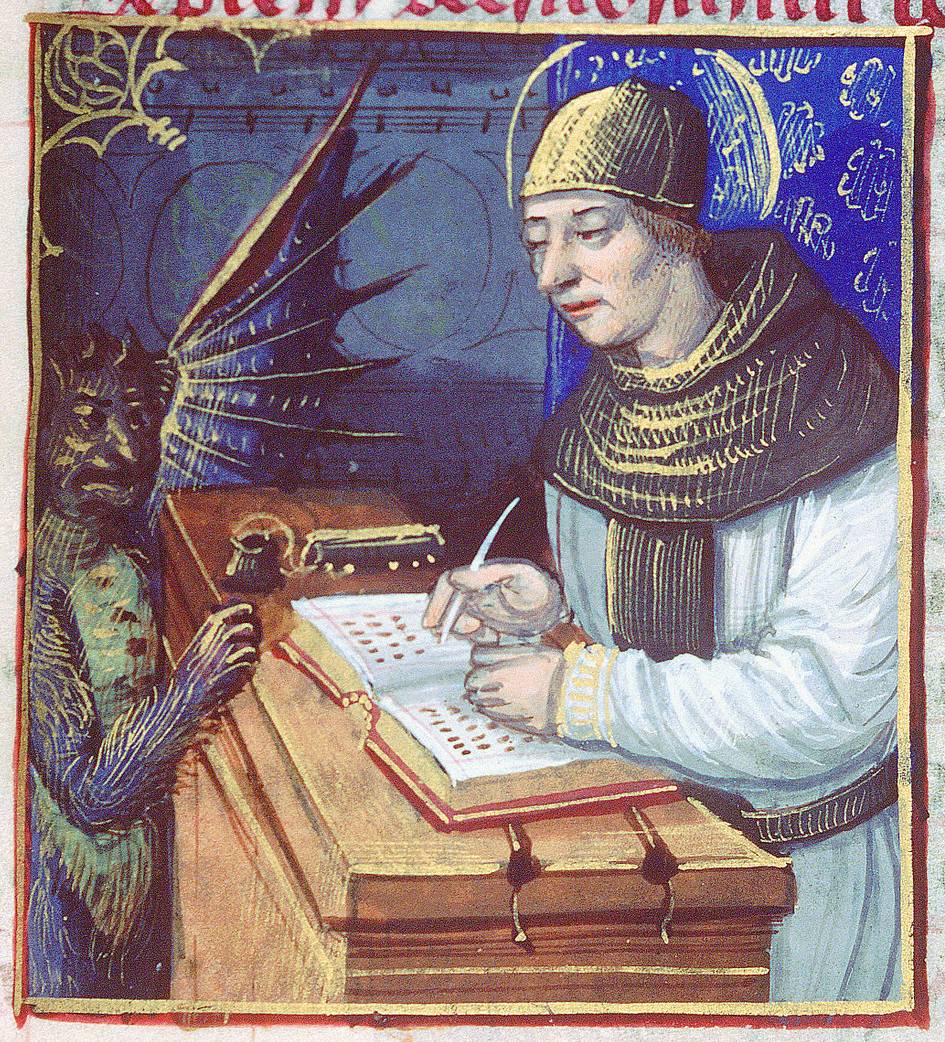
Image credit: artist unknown, public domain via Wikimedia Commons

Doodle Dandy

Deep in the stacks of the New College library at Edinburgh University, I came upon a book in the open shelves with a date of 1611. Once the staff had been notified, this book, which had simply aged in place over the centuries, was quickly moved to special collections. It is the dilemma of many a writer that books seldom see the light of library reading lamps. This episode came to mind as a friend shared an interesting story about doodles. Historian Erik Kwakkel has one of the most enjoyable jobs in history (seems appropriate). His research takes him to old books, and by “old” I mean handwritten, to look for pen trials—how pens were tried out before serious writing began. A lot may be learned from not just the words, but how they were formed. A different friend I knew was working on the forensic study of the order of stylus strokes in cuneiform writing. It was completely fascinating. With the right tools, you can find out in just what order strokes were made in clay, their depth, and a host of other information such as the right- or left-handedness of the scribe. Writing reveals the writer. In any case, Kwakkel has a great excuse for looking at doodles.

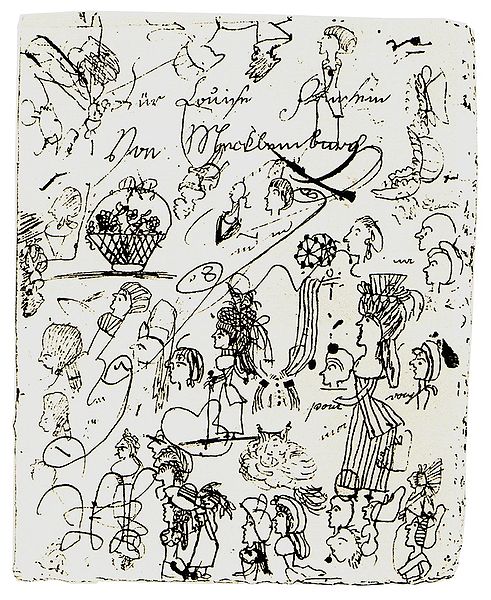
491px-Luise_KritzelzeichnungOne point in this fun story, however, struck a serious note with me. Scribes were, in final copy, expected to be completely anonymous. Their labor was to go unremarked through history. We owe them some of our greatest treasures, and in a bizarre back-formation, modern scholars give these anonymous scriveners names such as “the tremulous hand of Worcester,” in a vain attempt to recover them. In rare instances we are given the names of scribes. Some may have been creators as well. Most will remain forever nameless. Those who love books may be excluded from them by their very love.

There once was a joke that went around that asked “what do you call a writer who actually has a job?” The answer? “An editor.” In the old days, anyway. Now you can earn university degrees in publishing and editors very quickly vanish into the background, like the ninjas of literacy. Like those ancient scribes who, perhaps bored by the rote task of copying out somebody else’s words, left little doodles behind in the margins as their own attempt at immortality. In many ways this blog is my chance to offer a few doodles to the world. I used to be (and still hope to be) a content producer, but now I understand that content has no room for doodles. The serious business of publishing is all about showcasing the author whose ideas are worth spreading. Oh, there’s a subtext here, all right. A palimpsest, one might say. However, like the anonymous doodlers of history, many of us scribble away awaiting future discovery, long after our names are irrecoverable.