Sea Wonders

There’s a hole in the bottom of the sea, if we are to believe childhood songs. News reports this past week, however, have suggested that just the opposite applies to the Sea of Galilee. According to Science on NBC, a huge stone structure, larger than Stonehenge, rests at the bottom of the lake over which Jesus reputedly walked at the height of a storm. To the untrained eye, this stone pile looks like just that—a stone pile. The problem is that there is no natural source for the mound, and it seems highly unlikely that it was built under the water. This astonishing find is only one of the many underwater structures known that seem to defy conventional chronologies and logical behaviors. If this gigantic cairn was built on land, the means remain a problem. It is one thing to climb a conventional pyramid, complete with ramps and sledges, and quite another to mount a mound of apparently random stones to drop another on top. Perhaps it was built under water after all, like one of those tantalizing toys where you try to land your penny in the cup at the bottom of a tank of water.
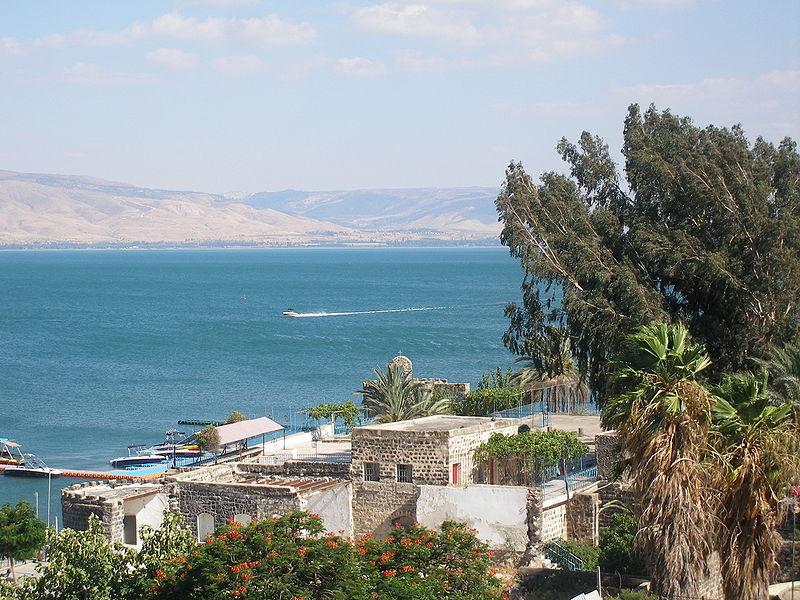
Pacman's Sea of Galilee from Wikimedia

Pacman’s Sea of Galilee from Wikimedia

Ancient monuments are one of the great fascinations of antiquity. When no rational explanation is forthcoming, a religious one will be declared. Without written records, we know nothing of the real purpose of Stonehenge or Avebury, let alone Galilee-henge. With the pyramids of Egypt we have a better set of data, and we can feel justified calling them religious structures. But why were ancient people building massive rock mounds in what was to become the Sea of Galilee? The place has irrevocable religious associations to the modern mind. Did it possess such connections in the deep pre-Israelite period as well? The false mountain of Silbury Hill, not far from Stonehenge, comes to mind. People are mountain makers.

Cairns have been among the most persistent of human monuments, but what makes this new finding of interest is its location. Baptized in the very lake that holds the headwaters of River Jordan, the mysterious mound has already claimed its sanctity. Who built it, why and when, will take backseat to the fact of its holy location. Archaeologists will eventually dive and probe and will declare an anthropologically sound explanation for this newly found, artificial, miniature mountain. Mountains and gods go together, however, as readily as offering plates and churches. Whatever this newly discovered structure may turn out to be, it will always be a religious site for those who believe.


The Skinny on Kansas

Perhaps it was just a slow news day, but Monday the Associated Press ran a story about a year-old skinny-dipping episode involving Kevin Yoder, US Representative from Kansas, and, by extension, Jesus.  Given that I’ve just posted on the skinny-dipping priest in A Room with a View, this seemed an apt place to consider what is being shown to the public. First of all, Yoder did not go au naturel in the swimming hole behind his house. The incident took place last August in the Sea of Galilee, the very body of water Jesus putatively walked upon.  Here’s the rub: with or without a boat, because of the association of Jesus of Nazareth with the Sea of Galilee, many people consider it a holy site. Even an Israeli police spokesman seemed a little put off by the mental image that, even if a year old, is a bit disturbing.  (The thought of any politician undressed is a bit jarring to the puritan imagination of the United States, and, one imagines, in many cases it is a reasonable phobia.) Yoder was reportedly in Israel for a trip funded by the American Israel Education Foundation. They were traveling to discuss international relationships, apparently.

As much fun as it is to catch a big player with his (less often her) pants down, I do wonder at the fuss. During my time in Israel—granted, many years ago and fully clothed except when in the shower—I noticed that American standards were not completely in force. A stroll down the beach in Natanya would easily prove my point. We like to hold our public officials to a higher standard that the average citizen, and given what they take from the system, rightfully so. Nevertheless, I wonder what harm is really done by a bit of juvenile fun. Obviously I wasn’t there, and I don’t have the context with which to judge such behavior accurately.  The Israeli police representative stated that public nudity is forbidden at the Sea of Galilee, so I suppose the legality of the act was an issue. American sexual mores, in addition to having been tempered by Victorian attitudes, are largely based on religious prejudices. The Bible is not shy on nudity, however, and people in the early Christian centuries participated in that world.  According to the Gospels, Saint Peter went fishing naked on that very same lake.  Progress obviously involves putting a cover on it.

Ironically, in trying to explain himself, Yoder said that the jump in the lake was spontaneous, a moment of joie de vivre, “just to have the experience.” He conceded that the Sea of Galilee is a special place.  And, he avers, drunk diving was not involved in the incident. No matter your level of tolerance, the emerging picture is an odd one. A group of government officials, one of them naked, standing around the Sea of Galilee at night.  A 30-something from Kansas jumps in for 10 seconds and it seems as if a storm arose over the feted Sea of Galilee just like New Testament times. One wonders how well our government represents the puritanical interests of their constituency.  Kansas, as we all know, is immune from evolution and provides a home for Fred Phelps and company. And it’s also a land-locked state. If you want to run around naked, and you’re a public official, it looks like you—like Dorothy—have to get out of Kansas.  Even then you might find yourself rocking the boat. Let’s just hope that if Peter’s inside he has the sense to pull on at least the girdle of righteousness before company comes.