Delicate Matters of Faith

Friday’s New Jersey Star-Ledger ran an op-ed piece by Phyllis Zagano entitled “Teaching how, not what, to think.” The essay concerns a tale of two professors, one at the University of Illinois and one at Seton Hall. Both have come under fire for teaching on the issue of gay marriage, one from, one against, a Catholic viewpoint. Zagano’s point of view, evident from her title, is that professors should teach students how to think, but not what to think.

This is one of the most difficult aspects of teaching religious studies. I am in my eighteenth year of teaching in the field. In that time I have taught at both religious and secular schools and, in both settings, presented the material objectively. There are those in both settings who complain. Students at Nashotah House frequently wanted me to bend the Bible to fit conservative Anglo-Catholic teaching. Under immense logical pressure to accept what reason told them of the world, they wanted an authoritative book to back them up in a pre-decided outlook. A theological ace of spades to trump the uncomfortable conclusions of rationality. At the University of Wisconsin Oshkosh and at Rutgers University students frequently want to know my religious outlook so that they might know how to categorize what they are learning: is it sanctioned or is it anathematized? We need to know who you are so we can evaluate your authority in such delicate matters as faith.

I frequently ponder the issues raised by Zagano. I know of no other field of study where the stakes are so high, with the possible exception of political science. Religion is an all-encompassing phenomenon. All of life must conform to religious teaching, often with eternal consequences. It therefore makes an enormous difference what you are being taught. Like Zagano, I try to teach students to think for themselves. Both at the seminary and university I refused to reveal my personal outlook on the issues; I try to kick-start the thinking process. I have paid the price for this in the past, but it is a non-negotiable component of education. If the truth is uncomfortable, it is always possible to let someone else do the thinking for you.
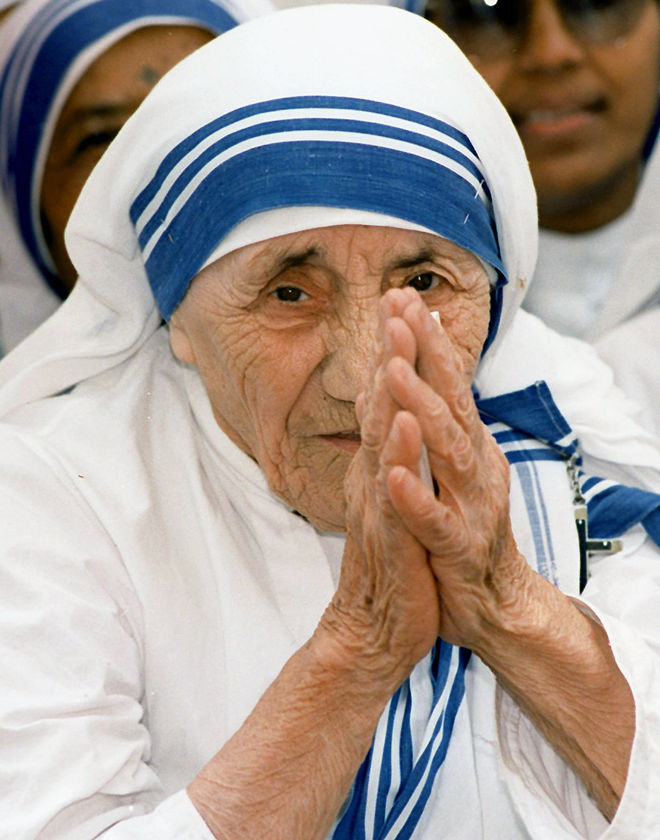

Dissing Mother T.

I pity the fool who challenges a powerful religion. Compelling religion. Tall towers. Tears of regret. The Empire State Building has a famous tower light show. Depending on the occasion, diverse wavelengths of light splash off the iconic skyscraper, and those who have the scorecard can see what’s important. In a city like New York there are countless occasions – holidays, Yankees and Mets games, significant birthdays. New York also houses a significant Catholic population. So it was not a popular decision on the part of the owner of the building to turn down a request to light up the town in honor of Mother Teresa’s centenary. I’m sure it was uttered with the purest of intentions, but the words of Bill Donohue, the president of the Catholic League, made me shiver just a little: “His [the owner’s] decision to double down at this juncture – in the face of massive support for our request – is something he will regret for the rest of his life” (according to the New York Daily News).

Mother Teresa, to many, is the epitome of Christian charity and selflessness. Devoted to helping the poorest members of a cruel world, she lived a life that many religious leaders could stand to emulate. On the front page of the same newspaper carrying this human interest story was the headline of how Seton Hall’s finalist for university president withdrew from the search after requesting a $300 K salary for the job. He is a priest, after all. Beg pardon, a Monsignor. And a professor of Christian ethics. I pity the fool who takes ethics seriously.

Somewhere between a 300,000 dollar salary and abject poverty, many religious believers are boggled by the mixed messages broadcast by their leaders. Most people in western religions are trying hard to avoid hell, complying with the traditions and new demands made by the spiritual CEOs. In a seminary setting someone once said to me that if Mother Teresa had advocated for responsible parenting (that great lumbering demon of birth control) perhaps the roots of the great poverty she daily redressed in Calcutta might have begun to dissipate. But the word from on high had been uttered and was immutable. She would not live to see her name up in lights. From what I’ve read about her, I have a strong feeling that Mother T. is just as happy to stay out of the limelight. I pity the fool who doesn’t understand.

A picture is worth $300,000