
Seven, styled Se7en, shades more toward the thriller end of the stick than horror. The two are very closely related, of course, but as a gritty cop drama, the main horror element is the gore. And the serial killer. Indeed, it’s often compared to The Silence of the Lambs, a card-carrying horror club member. My main complaint is that much of the movie is shot so dark that you can’t see what’s going on. The unnamed city is about as cheerless as Bladerunner, and even when people aren’t being stalked by the serial killer they’re being murdered anyway. So this dark setting brings together two detectives, one retiring (played by Morgan Freeman) and one with anger issues (Brad Pitt) set to take over. The two are only supposed to overlap seven days, but the seven in the title refers also to the seven deadly sins.
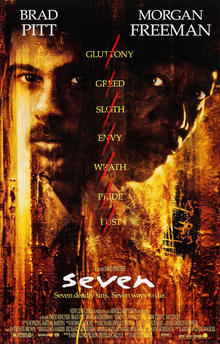
A literate cop drama—Freeman knows his literature (Milton, Chaucer, Dante, and even Thomas Aquinas)—it is a step above the standard crime drama. The fact that Freeman spends his nights in the library may be the reason some people consider this dark academia. The academic part is otherwise absent. In any case, it is Freeman who recognizes that victims are being killed for their embrace of one of the seven deadly sins. An obese man is fed to death, a greedy lawyer has to cut off a pound of his own flesh (in a hat-tip to Shakespeare). When Freeman’s character tells Pitt’s that it’s from the Merchant of Venice, the later says “I’ve never seen it.” Not read it, but watched it. It’s Freeman who recognizes the endgame that the serial killer is playing and tries to warn Pitt. But Pitt’s wrath is also a deadly sin.
The seven deadly sins aren’t biblical. They emerge in early Christianity, taking shape through such writers as Tertullian, Evagrius, and Pope Gregory I. They have remained in Catholicism as pride, greed, wrath, envy, lust, gluttony, and sloth (which sounds like the profile of some narcissists in the news). They’ve been used in proper horror films as well as in thrillers, giving a convenient number of infractions to pursue. Seven is one of those films that has become more highly regarded over time. One might say that a prophet is without honor in their own time. In any case, the movie is gripping and sad and a bit bloody. It doesn’t unfold exactly as you might expect. And no matter its genre, it can leave you thinking.
 Steve A. Wiggins