In God We Lust

One of the entrenched ironies of human mentality is that reason will not suffice to change religious views. Many studies have repeated demonstrated that faith is impervious to logic, and this has appeared with Ektachrome clarity in the case of Warren Jeffs. Rev. Jeffs, the leader of the Fundamentalist Church of Jesus Christ of Latter-Day Saints, has painted himself into a mental corner that makes the logic of legal proceedings appear as slapping the idiot. Logic and faith do not connect. Any Christian who has read the letter to the Hebrews should know that. Nevertheless, Rev. Jeffs, having illogically dismissed his team of lawyers, has been attempting a divine defense to justify his alleged sexual abuse of minors. He remained silent during his opening statement, despite judicial advice that such a tactic might harm his case. Breaking silence yesterday with a nearly hour-long sermon, faith responded to logic and was found wanting.

Society at large fails to consider that studies of religion have been carried out from multiple angles over many decades. We have erudite studies of the philosophy of religion, the psychology of religion, the anthropology of religion, and the sociology of religion. They all point to the human origins of this phenomenon, often demonstrating that a basic disconnect remains when religious belief is brought into the harsh light of logic. Neurologists and biologists have explored the utility of religion as a survival tactic, and evolution seems to have blessed it. Yet trial lawyers, judges, law enforcement officials, and politicians—often themselves religious individuals—are charged with apprehending and convicting others who simply take their religion to extremes. Religions make untenable demands on adherents. God has a poor record of turning up in the courtroom. His divine statements are absent from the stenographer’s tape.

Not knowing the details, it is difficult to find much sympathy for Rev. Jeffs, should he be found guilty. Yet at the same time, his interpretation of religion differs only in a matter of degree from other religious sexual ordinances. Is it normal for a clergyman to live a lifetime of enforced celibacy? Although signing on the dotted line may indicate a tacit agreement with church policy, what young man can clearly anticipate the pressures of decades fighting biology and psychology? Yet the practice is perfectly legal. Until the nearly inevitable inappropriate results squirm out. Public rancor runs high, as it should, against child molesters. The children are innocent victims. The perpetrators, however, believe themselves to be following divine dictates. It would seem that much suffering would be ended if God would go on the record here, so that we might have solid evidence with which to judge the case. If it please the court.
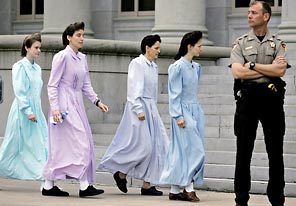
Photo credit: Tony Gutierrez, AP, from The Seattle Times



Sex and Violence in Ancient Pompeii

The earthquakes and tsunami that have devastated northern Japan have me thinking about natural disasters. Currently in New York City there is a display of artifacts from Pompeii, an exhibit I have not yet had a chance to visit. The parallelism of the two tragedies, however, has not escaped me. Pompeii’s destruction by Mount Vesuvius in 79 of the Common Era and its subsequent rediscovery and excavation are the stuff of legend. An unsuspecting city in the shadow of a sleepy volcano, at the pinnicle of its civilization, suddenly snuffed out. Forgotten for centuries, and eventually rediscovered. But rediscovery led to embarrassing revelations.

How will you be remembered?

Some of the first artifacts recovered from Pompeii were the erotic frescos that adorned many of the buried structures. Further, such images as super-sized phalli and other cultic implements of questionable morality led to reburial of some of the material because of more recent sensibilities. We judge ancient and extinct societies on the basis of modern predispositions on decency and propriety without considering that it is our view that is the innovation. Even a cursory read through the Holy Bible will reveal many stories where sexuality plays a prominent role. This suggests that biblical writers, like most people of antiquity, were less shy of sexuality than their post-Victorian heirs.

Natural disasters have a way of stopping time. Not just in the sense of speeding up the rotation of the earth by another 1.6 microseconds either. Surveying the wreckage of what we believed was a stable status quo, priorities are suddenly shifted. Compassion, rescue, and survival outweigh the petty differences of just the night before. Disasters are snapshots of the human condition. As the hot ash settled on Pompeii, lovers clasped in their final moments, never imagining that some two millennia further on that more modern, civilized tourists would be embarrassed by so human a response. Disasters are harsh teachers, but we may learn in the face of an unfeeling nature that we are all humans after all.


Which Way is Up?

In an article full of rare academic tropes and staid paronomasia, MSNBC announced yesterday, through LiveScience, that what appears to be an ancient “sex toy” has been found in Sweden. The object, of uncertain utility, is made of antler and dates to the Mesolithic era in that region. What has surprised the archaeologists is that the artifact apparently represents a male, rather than the more usual female, image. Two common ambiguities of antiquity come together in such a find: the sacredness with which the ancients seems to have held reproduction, and the fact that the way you look at an artifact is certain to express interpretations in line with the assessor’s.

Scholars of religion have long had to roll their eyes as archaeologists, particularly in Israel and “biblical” regions, unearth artifacts of uncertain function. Not knowing what this item might be, it is common for a find to be labeled as “religious.” This is perhaps a larger issue in “biblical” regions since so many archaeologist, particularly the influential ones of late last century, began their careers as biblical scholars or potential clergy. In the days when academic career mobility still actually existed, they could easily make the jump to archaeology, caring all their biblical baggage with them. Efforts to bolster the historicity of the Bible provide a special impetus to see objects as religious. Their actual function remains lost to history.

Even scholars see what they wish to see. It is a form of pareidolia, the finding of significance in what might otherwise be random noise. Is the Stone Age Swedish antler really a phallus or not? It is unlikely that the answer will ever be known. The context is ambiguous and the object itself is open to interpretation. Modern humans, with our own issues about sexuality, are inclined to snap suggestive objects right into that pattern. Even the specialists admit that maybe it is an object to knap flint, a common use of bone and antler material in ancient times. Or maybe it was intended as a thank you to the gods. Its interpretation may depend on which way you look at it.

Ambiguous artifacts abound


Sects in the City

Newsweek ran a story a few days back asking an obvious question: with all the scandal surrounding an exclusively male Catholic priesthood, why not invite women into the leadership mix? The story, by Lisa Miller, makes the point that sexual scandals have continued to deepen and widen only to be treated lightly by a hierarchy that insists sex is only for procreation. Sex between men and women, that is. If an exchange is made between males, particularly if one is under-aged, well, no souls are going to be derived from that! Although Miller’s plea easily wins on the basis of reason, when power is so deeply entrenched reason is likely to be tied to the stake and set ablaze. No, the church has made up its mind, and well, darn the torpedoes!

The church seldom embraces scientific advance without an approval period. The sexual scandal is no different. Everything that has been learned about sexuality over the last couple of centuries suggests that it’s not just for reproduction any more. Nor has it ever been. At least not in primates (both religious and mammalian). Religious organizations often test their strength by seeing just how far into the lives of subscribers they can reach. What they can control they will. The problem with sex is that it is very hard to control. It can be hidden, castigated, descried, and shamed, but it will not go away. Sexuality is hardwired into all creatures that reproduce that way. No, this is actually about power and privilege. Unchecked power and privilege inexorably lead to abuse. We expect that for the corporate world, excuse it even. Yet we hold the church to a higher standard.

Thine is the power and the glory

It is difficult for an institution raised from infancy with the assurance that God loves it best to outgrow this fantasy. Most people never examine their religion too closely — the edifice is built upon the premise that the leaders know more than the laity. Simply believe what you are told to believe. Yet no religion can lay claim to authenticity without subjecting itself to critical examination. This is the nightmare the Catholic Church now faces: two millennia of posturing and assuring believers that everything is fine are coming unraveled. And ironically the instigator is sex; that common denominator for any species with a backbone, and even some without.


Sex and Violence in Ancient Peru

MSNBC ran a fascinating article yesterday that strangely validated this blog. The Quai Branly museum in Paris is opening a display of Mochica artifacts from ancient Peru. Although I am no expert on ancient Peruvian religion, I do recognize the obvious connection that I have introduced here a time or two: the connection between sexuality and religion. The article states that (but does not show) artifacts of an explicitly sexual nature are among those recovered from the Mochica civilization. Bringing violence (in the form of human sacrifice) and sexuality together, the ancient Moche were just as religious as medieval (and later) monotheistic faiths that assert their right to control sexuality and dole out violence.

The MSNBC article makes clear that the sexual, sometimes violent, images are not representations of everyday life, but religious rituals associated with the death of dignitaries. Emma Vandore, the author of the article, notes that the images demonstrate the social control Mochica religion had on its people. She is clearly right. Religions, while often in the position of providing “theological” rationales for their decisions, are actually forms of social control. Individual salvation aside, your clergy want control over your life.

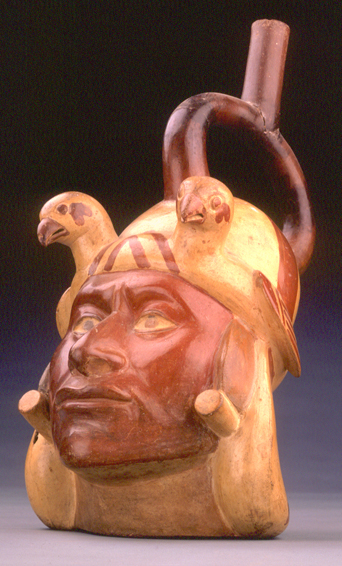
Tame Mochica pottery from Wikipedia Commons

Because religion is so large and so mysterious, the populace often simply complies. The Mochica artifacts, some of which are reported to be disturbing, justify this interpretation. Even an image search on the web will reveal how graphically cruel religious representations of Hell are; much more compelling in scariness than are feeble attempts in alluring one into an idyllic representation of Heaven. (Heaven is often shown as a garden, and as a sufferer of hay fever, I imagine myself sneezing through paradise.) It is no coincidence that organized religion appears on the historical scene on the coat-tails of civilization itself. The Moche were straightforward about what modern civilization would prefer to hide: religion is more about control than it is about belief.


Sects Sells

Once again the headlines tell the story of a child molested by a “celibate” priest now suing the church as an adult. That money dropped in the collection plate goes to cover the cost of sin. The disclosures continue to find the light of day not only in the Catholic Church, but across the religious organizational spectrum. It is an extremely unfortunate situation, but I can’t help wonder if religions are naturally susceptible to sexual expression.

Sexuality and religion go back a very long way. I have suggested elsewhere on this blog that some of the earliest evidence for religion, all the way back to the Paleolithic era, is sexual in nature. One of the blatant aspects of our own cultural conditioning is that we can no longer see the connection. We inhabit a post-Victorian world, a world that strenuously repressed sexuality and removed it from the sphere of human discourse. One of my favorite examples of this is when the standard classical Hebrew-English dictionary (Brown-Driver-Briggs, for those of you who need to know!) makes reference to sexual activity in the Bible (and it is abundant), the editors delicately slip from English to Latin, so as not to offend the sensibilities of clerics and other gentleman-scholars reading the entry. This antipathy to the human condition can be traced even further back to the Greeks who felt that the physical body was much more base than the spiritual, or intellectual aspect. Sexuality was a source of embarrassment and perhaps even shame.

I’m not a psychologist, but it is pretty clear what occurs when strong feelings and drives are repressed for a long time. The early Christians who believed Jesus’ second coming to be imminent did not wish to be caught in flagrante delicto. Sexuality was to be avoided since time was short. When this became formalized and priests, probably very decent people overall, were forced to relinquish their sexuality, it was assumed that it would simply evaporate into the ether and harm no one. We have known for decades that this is naively wishful thinking. As the margarine commercial used to say, “it’s not nice to fool Mother Nature!”

What's Mother Nature hiding?

Ancient sects were not sexually depraved. Stephanie Budin (The Myth of Sacred Prostitution in Antiquity, Cambridge, 2008) has done a good job showing that the case for sacred prostitution in the ancient world has been grossly overblown. Nevertheless, sexuality had a natural place in ancient religions. Any number of nervously giggling teenagers who’ve just discovered the Song of Songs in the Bible know that! The problem arises when our religious culture refuses to acknowledge the obvious. We bottle it up and try to keep it hidden, but when it finally appears the price tag is very steep indeed.


Sex and the Single God

In my Ancient Near Eastern Religions class we have been discussing Egypt. Students have been giving their deity reports and have been shuffling their feet in an embarrassed way when they have to discuss some of the gods’ various sexual activities. I have to assure them that this is not “dirty talk” or pornography — it is simply a pre-Victorian way of looking at the world. Understanding of the mechanics of conception and fertilization, involving, as they do, microscopic gametes, has only fairly recently emerged. Ancient people knew that sex led to kids, but they didn’t know how. When you can’t explain it, pass it along to the gods and forget about it!

Ancient Egypt is often where this disjunction appears most clearly. Various gods in a constellation of creation myths (Atum, Ptah, with others probably standing in line) onanistically generated the matter that makes up either other gods who reproduce sexually or the very stuff of the universe itself. This explanation of the world was not profane or vulgar; indeed, it was the very sacred act that brought all of this into existence.

When we look judgmentally on earlier religions we are condemning our own ancestors. It has become abundantly clear in recent years that ancient religions freely borrowed from each other and developed their own distinctive traditions without wholesale rejection of the earlier cultures they knew. It has even been suggested the Psalm 8 might reflect this very form of creation as an echo in the Hebrew Bible! So instead of looking nervously at our feet, or trying to find a big stone to throw at the heathen while our eyes are down there, it is best to recall that religions grow out of unions and parturitions of other religions. Unless they are created single-handedly — and this is what originates the concern in the first place.

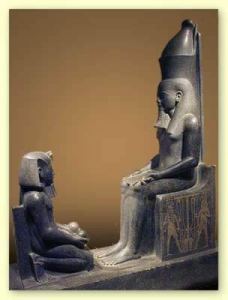
Atum teaches Horemheb the facts of life

Atum teaches Horemheb the facts of life