
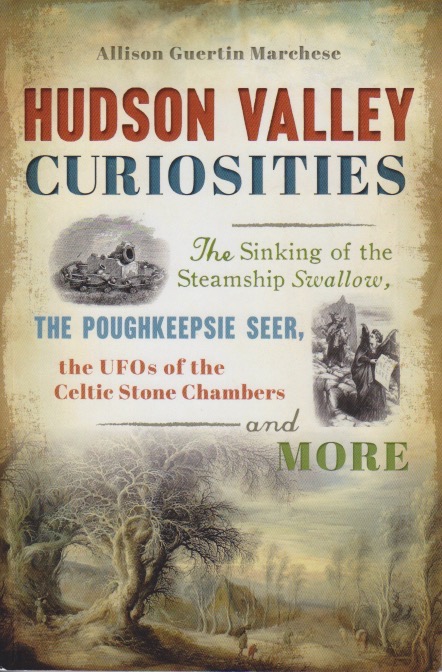
Another of my guilty pleasure reading categories is local history, written by locals. As a genre these books may not always go back to primary sources, and they may get a fact or two wrong, but still they’re endlessly fascinating and I always learn something (which is the point of reading, after all). I enjoyed Allison Guertin Marchese’s rambles along the Hudson Valley. I’d encountered some of these tidbits before, but most of them were new to me and show just how interesting a place this particular river valley is. Living in a strange world is so much more beguiling than a prosaic, predictable place. Still, you’ve got to accept that anything can happen. Unlike many such books, Hudson Valley Curiosities does not focus on paranormal, although ghosts and UFOs turn up a time or two.
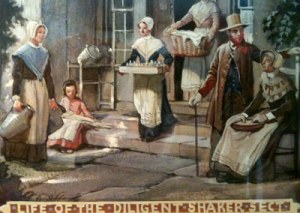
Since this region is about 145 miles from end to end, the book divides it into lower, middle, and upper regions and gives about equal time to each. The curiosities range from mastodons to prohibition busters, from shipwrecks to Shakers. I’d never made the connection with the Shakers and the Hudson Valley before. While the Shaking Quakers had their origins in England, they eventually migrated to the New World, settling in the northern end of the Hudson Valley. The book points out that they were noted inventors, living by their own means as they did, they came up with their own solutions to problems. Another aspect of these curios is the number of them that involved women who took on the cause of women’s rights. The first female candidate for President of the United States, Victoria Woodhull, is discussed, as is Deborah Sampson, the woman who dressed as a man to fight in the Revolutionary War.
Marchese provides a helpful bibliography as well. As someone trained in historical method, I like to go back to the sources. Of course, that means assessing both publisher and author, and taking into account what passed for facts at the time. History is an endlessly fascinating enterprise. Many historians, however, leave out the controversial or questionable materials that a local historian is inclined to leave in. That’s what makes books like this such a guilty pleasure. Who doesn’t like to look behind the curtain now and again and see what’s happening out of the public eye? And it’s helpful to keep in mind that by far the most of history takes place far from the headlines. That’s where real life happens, no matter how strange. And it’s a guilty pleasure to read about it from a local who finds, gathers, and preserves the stories.
 Steve A. Wiggins