Scholars and Villains

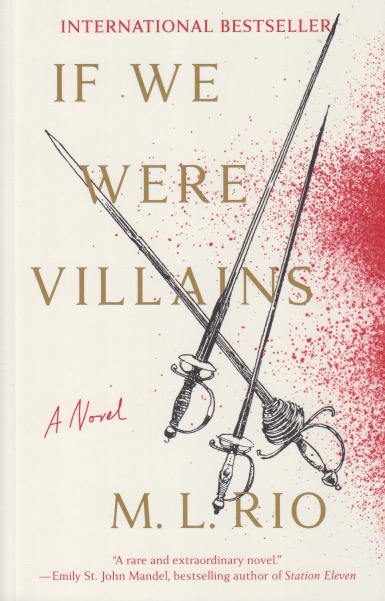
Having read M. L. Rio’s novella Graveyard Shift, I turned to her debut novel, If We Were Villains.  It must be a heady feeling having your first novel become a bestseller, but reading it confirms why.  Rio came to my attention because of dark academia.  This novel is written as realism, so there’s really no speculative material.  At least not directly.  It’s the story of seven friends at the Dellecher Classical Conservatory.  They are the fourth-year students majoring in acting and they are essentially a Shakespearean troupe.  Dellecher only puts on Shakespeare plays, so much of the story is built on the Bard.  There may be some plot give-aways below, and I think this is a book you might want to read—so be advised.  I’ve continued to read Shakespeare beyond high school, mostly sticking to his better-known plays, so this was enjoyable to me.

The crisis begins when the largest and strongest member of the troupe—the leading man—becomes offended by not getting assigned the role he feels entitled to.  He begins acting out against his classmates, bullying them onstage so they can’t call out his bad behavior.  To make things more interesting, one of the troupe is his girlfriend and another of the women is his cousin.  Since they all value what they do so much, and it’s their last year, nobody wants to challenge him.  Until it gets out of hand.  Although Dellecher is exclusive, there’s quite a lot of partying that takes place.  Drinking and drugs seem freely available.  One night when the leading man is drunk, he takes out his hostility on his troupe-mates but is found nearly dead in the lake by dawn’s first light.  And then things start to spiral.

Dark academia is a genre that explores the dark part of higher education (and sometimes secondary education).  I think that most people, even if they enjoyed college (as I did) saw there were tenebrous aspects to it.  This particular genre focuses on those negatives, but not to the exclusion of the very real draw of continued learning.  Since college is when many people receive their first taste of independence, and what passes for adulthood, many emotions come to the fore.  Love, jealousy, fear, and passion among them.  These are powerful motivators and much of our lives are spent learning to control them so that we can live together as a productive society.  This novel, like much dark academia, lingers in those places where unresolved emotions and unchecked bullying collide.  All with a Shakespearean touch.  Classic.

Tracing Writers

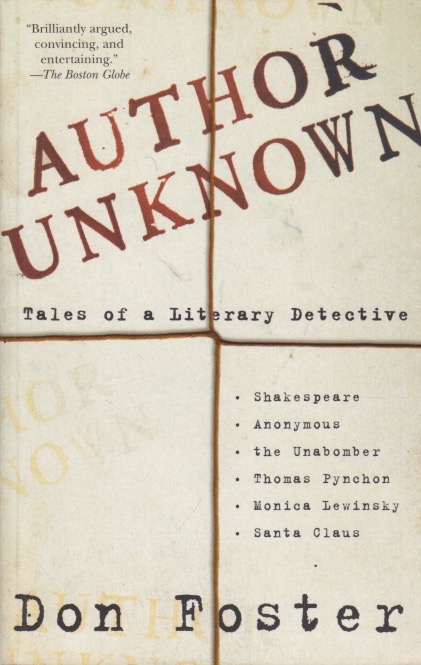
Ratiocination.  Detection.  There’s something compelling about that clear, crystalline logic that leads to solid conclusions.  I was floored by Don Foster’s Author Unknown: Tales of a Literary Detective.  I found the book by following up a reference to “A Visit from St. Nicholas,” aka “’Twas the Night before Christmas.”  Like most Americans I credited the poem to Clement Clarke Moore, but he did not, in fact, write it.  If you trust anyone with literary detection, it should be Don Foster.  Although this cleverly written book is not an apologia for the author’s personal accomplishments, it nevertheless builds trust in his methods and his sense.  It begins as he discovers an unacknowledged text was written by Shakespeare.  The evidence is carefully laid out, and is convincing.  Then others began to ask him to “prove” who wrote other pieces.  It’s quite a ride.

While Foster takes great care not to claim the ideas as his own, he’s nevertheless drawn into the case of the Unabomber, and Monica Lewinsky, and Thomas Pynchon.  His methods of ratiocination demonstrate repeatedly what he explains in his excellent introduction—our writing is every bit as indicative as our DNA.  With an adequate writing sample size, a piece with an unknown or disputed author can, with a great degree of probability, be attributed to the correct author.  You don’t even need to know of the cases to find the outcomes fascinating.  And those who disagree, being human, are simply not convinced by his conclusions.  They’ve already made up their minds.  In this regard the case of Wanda Tinasky (I’d never heard of her) is utterly compelling.

The Santa Claus chapter, the final one in the book, is a real pay-off.  Henry Livingston Jr., of Poughkeepsie, wrote the famous poem that defined Santa Claus as we know him.  Considering Christmas’ importance in our capitalistic society, this attribution is an important one.  Clement Clarke Moore was a very wealthy professor of Bible at the newly formed General Seminary.  Foster demonstrates probable cause in his claiming, and keeping alive, the mythology that he wrote the famous poem.  The way that this chapter is laid out and presented is especially witty.  Those interested in getting at the truth behind who wrote what will find this a page-turner.  Although he wasn’t seeking out the attention that came (most of us, as academics, are surprised when anyone show any interest at all in what we write) Foster has given the world a real gift in this book.  It reminded me once again why research is the most intriguing thing on earth.  And learning can be like reading a good mystery.


Though This Be Madness

Shakespeare could turn a phrase, alright.  Along with the Bible he’s one of the two most unwittingly quoted sources in the English language.  But he liked to borrow ideas.  Writers have always done this, and it came home to me again watching Robert Egger’s The Northman.  My wife and I intended to see it in the theater two years ago—life gets too busy even to get out to a movie, it seems.  So we had to settle for Amazon Prime.  In any case, I don’t read about films in advance and I avoid trailers when possible.  I couldn’t help hearing, however, that it was a viking revenge story.  Still, it wasn’t until my wife said, “Isn’t this like Hamlet?” that I made the connection—Amleth.  Hamlet.  Scandinavian. Danish.  Okay, so The Northman is based on the legend of Amleth which is the direct basis for Shakespeare’s Hamlet.

Like all of Egger’s feature films so far this one is meticulously researched and very moody.  More than once it made me glad that we live in a civilized society, such as it is.  Those of us who were the runts of our family litters know that bigger kids often get their way by dint of physical intimidation.  The vikings—and this was a good representation of a berserker—took what they wanted because they could.  But Amleth couldn’t have what he really wanted.  He witnessed, as a child, his uncle murder his father, the king.  Said uncle takes the throne and the queen and Amleth vows revenge, but what can a young boy do?  Then as an adult, he’s told by a seer that he made a promise so the viking heads home to exact revenge.

The Northman really isn’t a standard horror movie, although Egger’s previous two films fall into the genre fairly handily.  His next project is Nosferatu, after all.  And The Northman isn’t a retelling of HamletHamlet was a retelling of Amleth, and this is another retelling.  Those who’ve been following Egger’s rise know that his films are intelligent and melancholy and literate.  They also have a way of disturbing that peaceful acquiescence that comes after viewing a less thoughtful movie.  It would probably have made even more of an impact had we been able to get to it in a theater.  If it weren’t for Shakespeare most of us probably wouldn’t know the story of Amleth, but Norse mythology has a way of remaining relevant, despite the fact that we tend to credit the ideas to others.  Just check the name of the day of the week and see if that’s right.


Here Before

Déjà vu can be quite disorienting. Déjà vu can be quite disorienting. One of the categories for my 2018 reading challenge is a book you can read in a day. Maybe it’s just me, or creeping middle age, but books seem to be getting fatter these days. Despite the amount of time I spend reading, I’m slow at it and it’s a real struggle to find something I can actually finish on a three-hour bus ride. That’s why I thought of a play. Plays are meant to be performed in one sitting, so you should, in theory, be able to read one in a few hours. My first thought was Shakespeare, but the books of Shakespeare you can find these days all have added pages of commentary and interpretative material and the books seem to have put on weight since the Bard’s day.

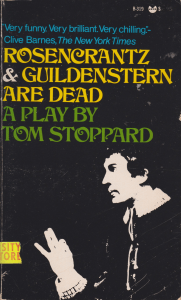
So I settled on Rosencrantz and Guildenstern Are Dead by Tom Stoppard. My wife had a used copy from college days and I’d been wanting to read it for some years. Here was my excuse. Then the bus ride began. Starting Act One I was sure I had read this before. It wasn’t just an inkling, like déjà vu often is, but an overpowering sensation. Of course I could tell what was going to happen—I’ve read Hamlet a time or two—but it was more than that. The sense that I had not long ago read this very sequence of words was nothing shy of overpowering. Uncanny even. As I moved into the latter part of the act, the feeling went away. This was new territory after all.

Consciousness is mysterious. Even with all our instruments and equations and theories, we still don’t know what it is. Materialists insist it must be simply a function of the brain, but that’s certainly not what it feels like. One of the hazards of reading a lot in middle age is that some things do start to blend together in your gray matter. Research, for example, means reading many books on the same subject with repeated ideas common among them. For fiction, however, we often hold a higher standard. Uniqueness and creativity are highly valued, even if the play you’re writing is a riff off the old Bard. In the end, I was able to finish the play in a day’s reading on the bus. Staring out the window after I’d finished, I was thinking how déjà vu can be quite disorienting.


Read Until Ragnarok

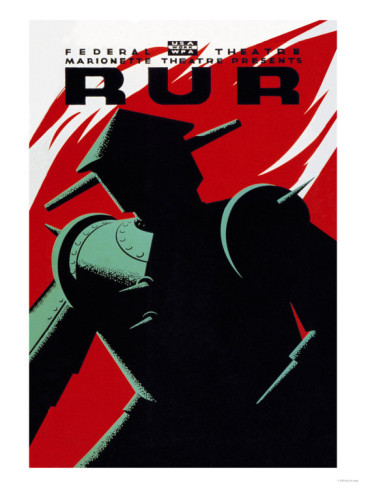
Wpa-marionette-theater-presents-rur“The play’s the thing. Wherein I’ll catch the conscience of the king,” quoth Hamlet. Shortly after the Velvet Revolution, my wife and I were shown about Prague by a friend who’d grown up in Communist ruled Czechoslovakia. As we watched the changing of the guard, he told us how Václav Havel, the final president of Czechoslovakia, had been a playwright and appreciated the need for pageantry in such civil ceremonies. I remember being impressed with what this playwright had accomplished while America had just survived being ruled by a lackluster comedic actor whose major contribution had been the myth of trickle-down economics. Havel was at one point selected as ranking high among the world’s top hundred intellectuals. Somehow Bedtime for Bonzo just didn’t seem to be worth bragging over.

Within another year or two, Czechoslovakia would dissolve, but the world would remain impressed by the Czech playwright. Karel Čapek was another Czech author and playwright of considerable import. Čapek, “public enemy number two” of the invading Nazis, died before the National Socialists could reach him. His brother died in Bergen-Belsen. Čapek is the author of the play R.U.R., or Rossum’s Universal Robots. Indeed, he coined the term “robot,” around which this play revolves. Over the holidays I finally had a chance to read R.U.R., and I was immediately struck by how prominent the meme of God appeared, and also how prescient Čapek was. Like his contemporary Franz Kafka, Čapek had an unsullied vision of human propensities. Not having seen a production of R.U.R., or knowing how it would play out, I was nearly buried under the layers of meaning that such a brief piece could convey. Harry Domin, the general manager of R.U.R., supplies the world with robots for the easement of human labor. These robots eventually acquire souls, through human tampering, but also rely on humans for their reproduction. All of humanity, save a sole survivor kept alive to make new robots, is destroyed. Alquist, the last man alive, realizes when one robot will lay down its life for its mate, they have become a new Adam and Eve, and humanity’s existence is truly at an end.

Although I’ve read about robots since I was a child, I didn’t know about R.U.R. until my daughter joined her high school robotics club. Robots have, in many ways, dominated my life since. Although Čapek’s play is funny in parts, it is dystopian and profoundly troubling. Our robots have evolved since the period of World War I, just after which the play was written, but our moral sensibilities have not kept pace. Helena, the eventual wife of Domin, feels that robots should be given a soul. At first they feel no pain, mental or physical. Once they acquire these, however, they begin their inexorable march to the elimination of humankind. Reading of how technocrats believe that our true function is now to service the robots who do much of our work today, while unemployment just won’t release its grip on the flesh, my thoughts go back to Karel Čapek, Václav Havel, and William Shakespeare. The playwrights create, but the actors just ape.


Co-opting Hecate

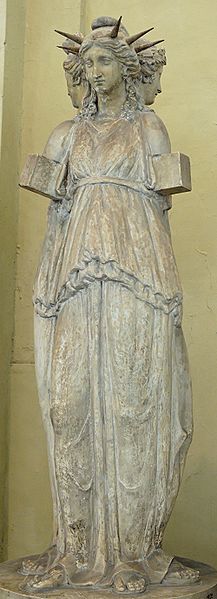
Students in my mythology class had to research and write about a deity from the ancient world. I was pleased that one of them chose Hecate, a misunderstood goddess of obscure origins. Hecate overlaps with other deities in her spheres of influence and her many roles, a sign that she was an early goddess adopted into the Greek pantheon at a stage before Artemis, Selene, and Persephone took over her connections with the moon and underworld. She was a guardian of crossroads, a task later attributed to Hermes – a god who also became a psychopomp. Hecate was left to languish in Hades where she became associated with gloom and magic and baleful spells.

What the Hecate?

It is likely the latter developments that have brought Hecate into the status of patron goddess of many Wiccans. She is chthonian – a right jolly old Goth – and she takes on a bad-girl image that would not have been recognized by the ancient Greeks. Even Shakespeare contributed to her witchy-woman image when he associated her with the weird sisters in Macbeth. Revitalized as a symbol of feminine power, Hecate enjoys such popularity today that it is difficult to find reliable information on the goddess.

I find it instructive that ancient goddesses are so embellished to make them tasteful to modern explorers. Perhaps because of the persistent patriarchality of ancient society, we have been deprived of deep knowledge of the goddesses. For those who originally worshiped them, however, the goddesses needed no blandishments. They were the personification of divine power manifested through the feminine. Ancients believed that all people were touched by supernatural forces, no matter what their gender. In a brash demonization of the powerful feminine, Hecate has become the goddess of witches and seekers after a female image that simply never existed. Why not accept goddesses for who they were – constant reminders that life is not possible without the divine feminine?