Big Bites

Although Jaws takes place on or near the fourth of July, it’s not holiday horror.  Holiday horror draws its source of fear from the day, and although Mayor Vaughn—like many politicians—insists holiday income is more important than a few lives lost, the fear derives from the shark.  I can’t remember when I first saw Jaws.  It couldn’t have been during its initial theatrical release (I was too young), I do know that I read the book first.  I wasn’t expecting Hooper (then my favorite character) to survive.  I was also surprised when I heard people starting to refer to Jaws as horror.  When I first saw it, whenever that was, I wouldn’t have called it horror—it’s just a movie about a shark.  Since thriller and horror bleed into each other I’m more open to the designation now.  Besides, animal attack horror is its own well-established category these days.  Jaws, half-a-century old this year, is experiencing a comeback but the shark never left.
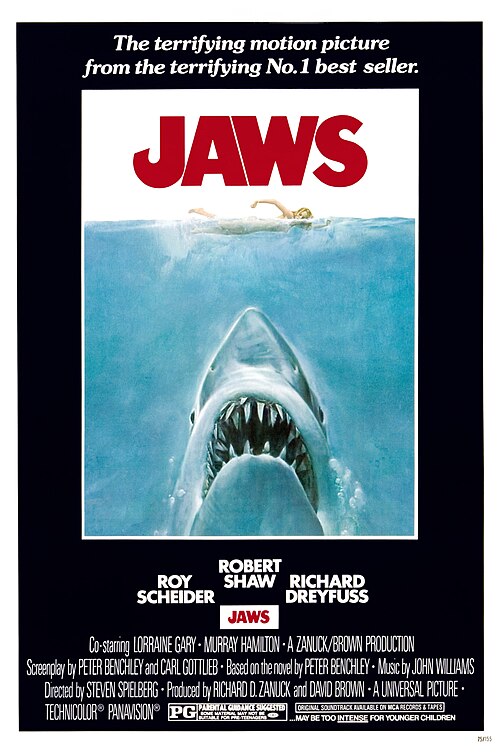
JAWS, 1975

My wife surprised me by suggesting we watch it last weekend.  We’d seen it together on television many years ago.  A number of analyses have been appearing in the media, highlighting the importance of the movie, and I noticed a few things watching it again.  Probably the most obvious shift, for me, was finding Quint the most engaging character.  I don’t know how many times I’ve read Melville’s Moby-Dick, but it’s been at least two times since seeing Jaws the last time.  The connection was much clearer with this viewing.  Quint is after sharks because of their attacks on crewmen of USS Indianapolis in World War II.  Quint was a survivor but his life’s mission is revenge on sharks.  So much so that he smashes the radio to prevent Brody from radioing in an SOS.

So here was a confluence.  I watch horror movies.  My favorite novel is Moby-DickJaws falls somewhere between the two.  The mainstream success of the latter may have been an early contributing factor to the grudging admission that horror can be good cinema.  Just in the past two or three years standard media outlets have been valorizing some horror and in this summer’s movie season, eyes have turned back to Amity and its local Captain Ahab and great white.  The great white shark, mainly feared because of this movie, is considered a vulnerable species.  As with Moby Dick, I felt sorry for the animal, watching the movie.  Both seem to have revenge on their minds as well, whether it’s a holiday or not.


Jonahado

SharknadoSome movies are so bad that they become classics. Some are just plain bad. The jury in my head is still out on Sharknado. The story, obviously tongue-in-cheek, is so far-fetched as to be pretentious, and anyone who knows something about either sharks or tornadoes, or both, will likely find credibility waning from the first scene. For those sensible among my readers, who’ve not seen the movie, the title gives it all away. A global-warming-induced hurricane hurries toward Santa Monica with its forever young sun-worshippers. The hurricane floods the California coast, bringing sharks to the city streets. As our protagonists drive around somewhat pointlessly, the sharks attack their car, eventually eating everyone who’s not family. At one point the family tries to buy rations at a liquor store, only to have the news announce that this is the apocalypse. The store owner scowls that it’s the government, not God, that’s bringing this upon them. Then the waterspouts appear, morphing into tornadoes carrying sharks, still hungrily chomping at everything as they fly through the air.

Ironically a biblical theme comes about with the swallowing of Nova. As she falls from a helicopter (don’t ask), a great white shark snaps her up in mid-air, and since she’s about the only character you can care about, the movie seems to have reached its nadir. As the tornadoes dissipate and the sharks coming raining down, the eponymously named Fin is swallowed whole by a huge great white, while still holding his chainsaw. We already know that this latter-day Jonah will make his way back out, and we are supposed to be surprised that this is the very same shark that holds the reborn Nova, who admits her real name is Jenny Lynn. Like Neo in The Matrix, she is the convert to a new faith, this time in the family of Fin, whose only fault, it seems, is that he cares too much for others.

While a made-for-television B movie (although C or D might be more appropriate), Sharknado demonstrates the popular conception of the apocalypse. Not that it will involve flying sharks and destructive wind-storms, but that the end of the world is somehow inevitable. We have convinced ourselves that its a matter of when, not if, the world will meet its demise. Global warming, clearly our fault, is blamed by the movie (as is the government), but the story is that the flimsy culture we’ve constructed is subject to utter ruin by a hurricane and maritime predators. Or I could be reading far too much into this. Religious tropes may be picked and chosen at will. And when things really go wrong, like accidentally switching on Sharknado, we have a ready arsenal of religious ideas at hand to blame. And the apocalypse may be the least of our worries.


Sharks and Apostles

There are sharks in the water. For the third day in a week, some New Jersey beaches have restricted access to the ocean because of sharks. As a particularly hot July trundles along, this is not really welcome news. Also yesterday, the Vatican codified revisions to its clergy sexual abuse crisis. According to an Associated Press article in the New Jersey Star-Ledger, women’s ordination groups are angry because sexual abuse and the ordination of women are classed together as crimes against the church.

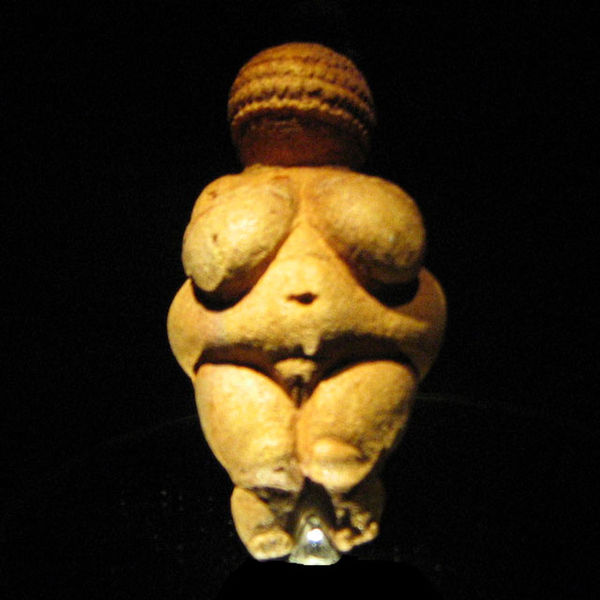
Venus of Willendorf

Even before civilization began, it seems, religion and sexual dimorphism were tied together. Beginning back 35,000 years ago Paleolithic humans carved female figurines. In a hunter-gatherer society where struggle for survival was the best paying job available, the execution of such objets d’art in a brutish, hostile environment reveals religious sensitivities. Stone Age humans knew something that organized Christianity forgot within its first century: sexuality is never far from religion. The Bible itself, particularly the Christian Scriptures, emphasize that celibacy is a putative gift, not something that can be learned or forced on someone. In typical Roman fashion, however, the church quickly mandated celibacy as the norm and ruled that women were the source of evil.

Nothing could be further from the indications of both Paleolithic remains and scientific thinking. Women, long the source of spirituality, were now cast aside in an arrogant aberration of earlier practice. Largely based on the angry writings of one man, the church decided that men alone should determine the eternal fates of others. Masculine men who knew self-control and who could turn off millennia of evolutionary pressures by a sheer act of will. Centuries later, and the Vatican with its own Pontifical Academy of Sciences, the church still can’t get beyond basic reproduction and sexuality issues. I would go to the beach to try to think this one out, but there are sharks in the water.