Le Fanu Fans

Sheridan Le Fanu is sometimes called “the Irish Poe.”  He was a contemporary of Poe but his name doesn’t bear the same cultural cachet.  He wrote a number of stories that are classified as “horror” in today’s genre settings, and one of the most famous is Carmilla, known as the lesbian vampire story.  Le Fanu didn’t use that terminology himself, that I know of, but Carmilla is a vampire and she does have fondness for other females.  I’ve watched a few lesbian vampire movies (I mentioned Theresa & Allison recently), since they give a distinctive taste to the lore.  I don’t generally research the free movies I watch beforehand, so when I saw The Carmilla Movie, I figured it was likely based on Le Fanu (it is) but I didn’t realize that it was a follow-up to a web series with the same characters.  Nevertheless, it’s a pretty good story.
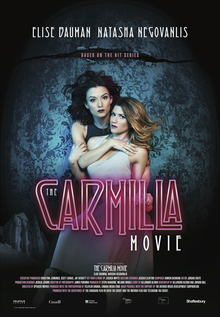
Set in the modern day, with a cast of young people doing things for a living that weren’t options when I was growing up (internet content provider, starting a paranormal investigation business—I was laughed out of school for admitting I was interested in this stuff before the X-Files made it mainstream), the film updates Le Fanu’s story.   Carmilla has become human and has a girlfriend.  But then Carm starts to revert to vampire status.  (Fortunately there’s soy-based blood for her to drink—did I mention this is comedy horror?)  Although this is comedy horror, it’s not a silly story.  There are plenty of humorous asides, but you still feel for the characters and want them to overcome the evil they face.  Here that evil is a past that has to be rectified.

I found The Carmilla Movie to be intelligent and fun.  There are some genuine horror elements to it, and I suspect that being familiar with the web series might help answer a few head-scratchers for us non-initiated.  In general it seems that such independent films as this serve to raise the bar on movies as a whole.  The flip side is, however, that you can’t easily tell if a movie is a studio release or a television movie, or even a web movie without doing some research ahead of time.  Amazon Prime—my go to service—doesn’t distinguish them.  All I know is that if a movie is one I have on my watch list, I’m going to have to pay for it.  Carmilla was free and worth the time to watch.  And it’s good to see Le Fanu getting some deserved air time.

Victorian Nightmares

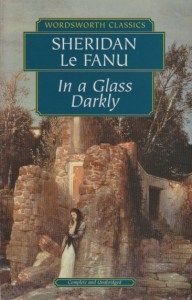
J. Sheridan Le Fanu isn’t exactly a household name, but as a writer from the same era (and perhaps same cloth) as Poe, he was known for his gothic imagination.  Since he was Irish his work never really took off in America as some other writers’ did, and he’s certainly not likely to be found on bookstore shelves because there’s not great demand.  I have a fondness for gothic literature and Le Fanu’s name had been on my list for some time.  At a used bookstore I found one of his books, and as I was checking out the clerk said “I was just checking in another of his books,” so I bought that one too.  (When you’re paying just two dollars a pop for books, it feels like virtue.)  The latter turned out to be In a Glass Darkly, which apart from its biblical title, contains five stories loosely linked by a narrative framework.  Poe wrote that short stories should be read in one sitting, but these tale venture into novelette territory, with some requiring considerable time to finish.

That having been said, the experience was enjoyable enough.  Each story is quite different and they range from the vampire classic “Camilla” to a foiled murder mystery and a canonical ghost story or two.  While better known across the Atlantic, several of Le Fanu’s stories have been translated to film, and he was regarded as one of the best ghost story writers of his era.  Perhaps because modern readers have been subjected to much more subtle foreshadowing, some of the tales are predictable to those on the lookout for twist endings.  The Room in the Dragon Volant, for example, suggests that the mysterious lady at the masquerade is indeed the narrator’s adulteress love interest, although the final twist is nicely wrought.

Probably the most well-known of the stories in the collection is “Camilla,” the account of what’s regarded today as a lesbian vampire.  The tale is well-crafted, but the credulity of the narrator is almost unbelievable as the pieces fall together and the puzzle picture still isn’t seen.  Nevertheless, it’s a creepy account that has captured the imagination of filmmakers through the years.  It took me long enough to finish the book that the earlier stories had faded by the time I’d reached the end, but the fault lies with me, not the author.  As a gothic fix each of the narratives serves quite well.  My other Le Fanu purchase was a much larger book, so it will take some time to achieve that goal.  In the meantime, I’ll look forward to discovering more Victorian nightmares as autumn wends its way forward.