Return to the House

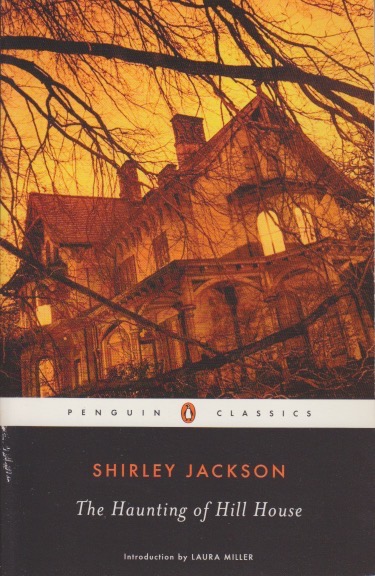
I’ve read Shirley Jackson’s The Haunting of Hill House before.  It might’ve been before I started this blog, or it might’ve been before I started writing about the books I’d read.  Either way, when I search for a post on it, I don’t find one.  This is a classic novel in the genre, but I found it rather sad both times I’ve read it.  Eleanor is such a compelling, abused and discarded character.  But in case you’re unfamiliar with this psychological horror story, here are the basics: Hill House is haunted.  A professor, Dr. John Montague, somewhat hapless, decides to gather a couple of sensitives to try to investigate the hauntings.  He plans to write a book about it.  The two women he invites, Eleanor and Theodora, both had some psychic or Fortean experiences.  The owner of Hill House insists that a member of the family be present, so Luke, a carefree young man, joins them.

The house “manifests” in various ways, but the occurrences while they’re there, center on Eleanor.  Eleanor lives with her domineering sister after having been a caregiver for her dominating mother.  She’s never been able to develop her own self, and she desperately wants to be accepted.  She’ll lie to make that happen, but not maliciously.  In fact, she’s quite childlike.  While the half-hearted investigation takes place, the others begin to suspect Eleanor may be behind the events, or some of them.  Then John’s insufferable wife arrives with her pretentious friend.  Eleanor acts out, doing a foolhardy stunt that leads the others to dismiss her from the house.  The story is creepy, but, like Mary Shelley’s Frankenstein, more like sad.

I decided to re-read it as autumn began to be felt in the air, and I had read a couple other of Jackson’s novels that I remembered better because they were more recent in my experience.  Quite often this story is compared to Henry James’ The Turn of the Screw, another ambiguous ghost story involving a young lady who wants to be accepted.  These characters are compelling in a  Poeseque kind of way.  Critics complained of my using Poe’s observations in Nightmares with the Bible, but these stories, by a woman and a man, are further exhibits in the case.  They add a poignancy to the events because even as we’ve made some progress in women’s rights we still have a long way to go.  No one doubts that Jackson’s writing is laced with metaphors.  None of her characters can be considered “normal.”  And yet, it’s the house that brings it all out.  It’s a story worth pondering again.

Haunted Life

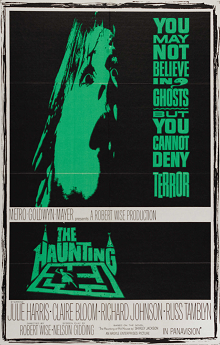
It’s funny what a difference that a few years can make.  I can’t seem to recall from where I sourced my movies in the noughties.  Streaming was extremely tenuous in our Somerville apartment—the plan didn’t include the required speed for it.  Like in the old days when it took twenty minutes to upload a photograph through dial-up.  In any case, I know I’ve watched The Haunting before.  I know it was in Somerville, but having watched it again I have to wonder if my mind is playing tricks on me.  I read Shirley Jackson’s The Haunting of Hill House there, and I saw the movie.  But how?  It’s all about mind games, but the mind games are played on a woman who has an abusive family, one that damages her psychologically.  Escape is important to her, even if it is to a haunted house.

I think the last time I watched this I was looking for something that might scare me.  That phase was one of thinking not much frightened me—but this movie is scary.  Even with its “G” rating, its lack of blood and gore, and black-and-white filming.  It scares.  One thing I’ve noticed when reading about these older movies after I watch them is that many improve with time.  Shirley Jackson was known during her life but you become a classic writer only AD—after death.  The Haunting has aged well.  I suspect it has something to do with Robert Wise, the director.  What must the psychology of a man be who directed The Sound of Music, The Day the Earth Stood Still, and The Haunting?  The latter is all about psychology.

Movies that make you think are those, I believe, that may become classics.  And perhaps there’s a bit of Eleanor inside all of us.  Wanting to be noticed but eschewing publicity.  Needing someone to love us, but pushing away those who try.  Children in bad environments learn unorthodox, and often unhealthy, coping techniques.  Eleanor has difficulty accepting that John is married when she thinks she’s finally found a place that accepts her for who she is.  Even if it’s a haunted house.  Especially if it’s a haunted house.  As a child I’d no doubt have found the movie boring.  There is, however, much for adults to absorb.  And, I expect, I’ll need to go back and read the novel again.  One of the reasons for watching horror is that the viewer is seeking something.  It’s not just thrills.  I didn’t write about the movie the last time I saw it so I don’t recollect when it was.  Or even how.  My thoughts now, however, are that I should’ve paid closer attention the first time.


One Another

Like much of the other information that I’ve managed to pick up in these six decades of wandering the planet, my knowledge of horror is self-taught.  In truth, I’m an eclectic reader—my various, periodic obsessions generally stem from books I’m writing.  For my unwinding time, however, horror stories seem to do the trick.  Nobody I know in person reads horror, so my recommendations are generally the results of other books I read.  That’s how I found Thomas Tryon’s The Other.  Although I’d only learned of it recently, it has been a classic in the field for many decades.  After having read it, I can see why.  And unlike many fiction works with an afterword, this edition has one worth reading.  Maybe you’re unfamiliar with the novel?  If so, in brief, it’s about twins.  It’s about twins.

Identical twins.  Holland and Niles Perry were born over the cusp of midnight, giving them different birthdays while still being the same age.  Unlike stereotypical identical twins, however, Holland is evil and Niles is good.  As the novel unfolds it contains some twists that, if like me you haven’t heard the story, really do work.  They live in a small town in Connecticut with their widowed mother, older sister and brother-in-law, maternal grandmother, and a couple of domestics.  An aunt and uncle, along with a cousin, settle in.  (It’s a large house.)  Family dynamics are strange and the locals grow increasingly impatient with Holland’s antics.  The Perry family is, however, long established and well respected.

Doesn’t sound very scary, does it?  That’s the genius of the work.  It’s a slow burn but when the fuse reaches the powder it leaves you trembling.  Nobody taught me how to find and read horror.  I’m still pretty much a novice and it seems that novels these days tend to have weight problems.  I was glad to find The Other wasn’t excessively long.  It shows that literary horror is possible as well.  Like Shirley Jackson, Tryon received acclaim for his work.  (And like Jackson, his novel doesn’t balloon out to over four hundred pages—something of a rarity these days.)  I guess I’m just a bit surprised it took so long for me to find out about this one.  I don’t want to give any spoilers because this is a beautifully constructed novel and knowing what happens might deter other readers.  I wouldn’t want to do such a disservice to a book I wish I’d known about when I was younger.


The Gift

Each day, each hour is a gift.  With my mother’s passing two months ago, I’ve been struck by the sheer number of colleagues that have died this year.  Not all of them older than me.  I wrote some months back about Michael S. Heiser, a blogging buddy from days past.  An email about a potential author just yesterday sent me back to the Society of Biblical Literature necrology.  This author had died unexpectedly the day before.  Glancing over the top of the list, I saw that three people with whom I’d worked died in November.  This was quite a shock since two of them were younger than me and the other not much older.  The thing about professors is that you kind of expect them to grow old.  To be old.  Life is a gift, and it’s sometimes easy to forget that.

Both tenacious and tenuous, life is a mystery.  Perhaps it’s perverse, but this makes Shirley Jackson’s “The Lottery” seem like a metaphor.  In fact, those of us who read and watch horror generally do so with a purpose, consciously or not.  It helps us face difficult things.  Five colleagues in one year sounds like a lot.  Someone in my family, younger than me, had six funerals to attend this year.  Life can feel difficult at such times.  Horror can be a coping mechanism.  At least for some of us.  It can be profoundly hopeful.  The meaning of life can be elusive, which is why, the existentialists conclude, we must make our own.  Existence precedes essence, as they say.

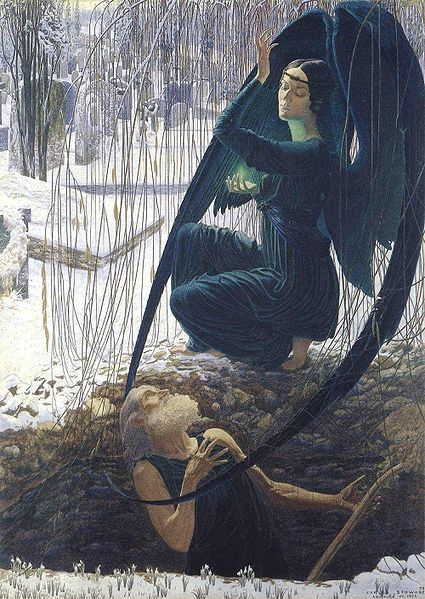
Carlos Schwabe, Death of the Undertaker; Wikimedia Commons

Other than profession, one of the few things these five fallen colleagues had in common was my perspective on them.  I don’t think they knew each other.  Had I not been an editor I likely wouldn’t have known three of them at all.  We live in a web of interconnection.  And I don’t mean the world-wide web (does anyone even use that term any more?).  Lives are gifts and gifts cross paths with other gifts.  Such information, all at once, can be difficult to process.  It makes me wonder why we allow wars.  Why we don’t think of consequences before we vote autocrats to power.  Instead, if we focus on that ephemeral gift we have, and how we might share it with others, appreciation rather than hatred grows.  To this lonely existentialist who watches horror for meaning, that just makes sense.


The Time Is Nigh

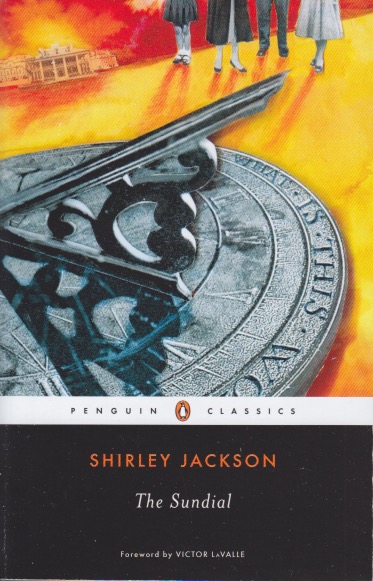
Although I have many authors I like to read, I haven’t fully explored the oeuvre of many.  I’m an eclectic reader and I’m also often limited by bookstores as to what I pick up.  I’ve read Shirley Jackson’s two biggest successes, The Haunting of Hill House and We Have Always Lived in the Castle, as well as her famous short story, “The Lottery.”  I knew she had written much else, but I couldn’t really tell you what.  When I go into a small, independent bookstore I hate to leave with nothing, and seeing Jackson’s The Sundial on the shelf, I decided to give it a try.  In some ways it was quite a departure from her usual style in that it is openly humorous.  Nevertheless, it’s clear that this is the same thinker who gave us the Castle.

Plotwise, the story is about anticipating the end of the world.  The Halloran family lives in a large mansion on the money made by the original patriarch,  but is beset by interpersonal issues.  A wealthy family, there are at least three contenders for control of the fortune.  When one of the family members has a premonition about the end of the world, they come to believe it and prepare for the event with personality quirks becoming more and more pronounced as they realize the only people that are going to be left to judge them will be themselves.  Various guests stop by and the matriarch decides on who might stay, and survive, and who must go.  A group of twelve, including two domestics, is finally settled upon.

As with all Jackson novels, there are layers here.  Things to think about.  One of the funny scenarios involves the goodhearted maid—perhaps the most innocent of all the survivors—revealing to a local villager what’s about to happen.  Not believing her, he refers her to a group of religious believers that have come to a similar conclusion.  This leads to a meeting between the matriarch of the Halloran family and the leaders of the religious group.  Not surprisingly, it turns out that their versions of the end of all things are different, and Mrs. Halloran turns them away since she can’t relinquish her secular beliefs about the matter.  As the time grows closer, the reader is drawn in by the conviction of those in the house.  Their isolation and reflections on life with no other people beyond themselves grows in intensity.  After putting the book down a sense of doom lingers.  And that, it seems, is what Shirley Jackson is very capable of doing, even if in a comedic gothic setting.


Better Places

I have to confess that I’d never heard of Ottessa Moshfegh before.  Shame on me, I know.  As a wannabe writer, I feel compelled to know other writers’ names.  Hang in literary circles.  Etc.  The good news is, however, that I found Homesick for Another World in an indie bookstore.  I’d gone in for something else that they didn’t have, but I don’t like walking out with nothing, especially when it’s a small store.  Besides, I trust the taste of most independent store owners. 

I can’t remember the last time I read a book of short stories all the way through.  As with most writers some work appeals to you more than others.  In my mind the first and last stories stick the firmest.  The latter, “A Better Place,” is haunting, almost Shirley Jacksonesque.  Others make you uncomfortable in your own skin.  This is a rare talent.

Finding a writer who, using simple words and expressions, takes you to another place is a rare gift.  The short story (the only kind of fiction I’ve actually published) is a versatile and engaging form of literature.  Books collecting them are often good for picking up when you have a little time and putting down for a while again.  I felt compelled to go through this whole work, being drawn into the weird and somehow familiar worlds of characters who seem to have no purpose, no goals.  It’s almost as refreshing as Kafka or Camus.  To be a writer who requires only one name to evoke a genre must be glorious.  These stories are strange without recourse to the supernatural, and they defy easy genre assignment.  (This makes publishers crazy.)

There’s an earnestness and a longing in this collection.  A kind of nihilistic spiritualism.  A wanting with no particular object in mind.  I read a lot of fiction, some of it very good.  The kind that leaves you a little stunned and questioning what reality is.  This is that kind of book.  Had I not gone into that indie shop that Saturday morning I never would have found it.  I certainly didn’t know to look for Ottessa Moshfegh.  Here again I’m reminded of the value of the bookstore experience.  The ability to browse without clicking or scrolling feels like a luxury to me now.  I may have to pay more than Amazon’s competitive pricing, but then this is like a finder’s fee for being in the real world.  Even if the book makes you question that reality when you’re done.


Ghostly Thoughts

Ghosts tend to be on my mind in the autumn.  Paul Tremblay’s A Head Full of Ghosts, however, has been on my reading list for quite some time.  As a novel about possession, it has some scary moments, but it’s difficult to compete against The Exorcist in that regard.  Tremblay handles the topic with an ambiguity worthy of Shirley Jackson, however, and there are a few clear nods to her work here.  At the risk of giving out spoilers (you have been warned!) although it’s pretty clear by the end that much of the demonic was a cry for attention, the family member behind the tragedy is clearly left obscure.  We find out whodunit, but we’re left unsure as to the real reason behind it.

For fear of giving away too much (although my Goodreads assessment might be guilty of this), I’d like to consider something that I address in Nightmares with the Bible.  Demonic possession is largely coded as a feminine phenomenon.  The reasons for this are likely complex, but they are clearly related to the idea behind witch hunts and fear of women’s power in “a man’s world.”  Possession narratives, while they predated William Peter Blatty, became an essential part of the revived interest in demons brought on by The Exorcist.  Tremblay’s story is clearly aware of this, as he has his characters citing both fiction and non-fictional treatments of the topic.  Since researching the subject on my own, I’ve been wondering if anyone else has been able to handle it as deftly as Blatty did, and although Tremblay has two girls under threat, the question of whether it’s real or not tends to outweigh the pathos of believing Marjorie really has a demon.

In the end, it seems as if her father might be the real source of the family’s haunting.  An unemployed man looking for a way to support his family, he turns to religion.  This scenario is all-too-real to life.  And religion gives us not only a rationale for demons, but also a solution in the form of procedures and proper responses.  There are priests here—the males who alone can deliver the females—but whereas Blatty clearly made them the target of a demon that was pretty obviously real, Tremblay doesn’t play that card.  The priests come and go, and deliverance takes a form not expected for such a narrative.  A Head Full of Ghosts raises lots of questions and, like all good fiction, leaves us pondering at the end.  There’s still time to read it this coming fall.


Personal Gothic

As I continue work on Nightmares with the Bible, I am reminded just how influential Edgar Allan Poe has been in my life.  It’s not that I read Poe every day, but it’s more that his stories have stayed with me since childhood.  For an English term paper in high school, the last one I recall writing, I selected Poe as the subject.  Something of the sadness of his life made me feel as though we were kindred spirits, although I could never meet him, and never let him know that he would have had a friend if he had been born a maybe a century and a half later, and if possible, in Franklin, Pennsylvania.  If his fondness for drink came with him, he would likely have met my father in such circumstances.

Even today I feel a kind of fiercely protective interest in Poe, as if his poems and stories had been written exclusively for me.  Seeing a handwritten fine copy of “The Raven” on display in the Morgan Library and Museum brought tears to my eyes.  Like Poe, I strive to make a living as a writer, but unlike Poe, I cop out.  I’m too afraid of losing everything.  Jobs necessarily interfere with writing, and some jobs actively discourage it.  Nevertheless, I still feel the shudder when I think about the first time I read many of his stories.  This was, I suspect, what fed my young interest in horror.  It wasn’t the blood and gore of the slasher film, it was the quiet, sad, disturbing atmosphere of Poe.  It has been recaptured by few, in my experience maybe only by Shirley Jackson.

Those who write are connection seekers.  Writing is a way of testing to see if we alone see the world in our own way.  Will others respond?  Poe somehow, mainly after his own lifetime, touched a responsive chord with many.  His work is now very widely known.  His visage appears on everything from bandages to socks.  His stories and poems are endlessly retold, adapted, and parodied.  When I read Poe I hear someone speaking from a life of hard knocks.  His response was to strike back, through his writing.  The life story written by one of his relatives suggests that he wasn’t as gloomy and tortured as he is generally portrayed.  Perhaps not.  Nevertheless, those of us who find gothic literature somehow redemptive know, once we close the cover, who it is we should thank.


A Writer’s Life

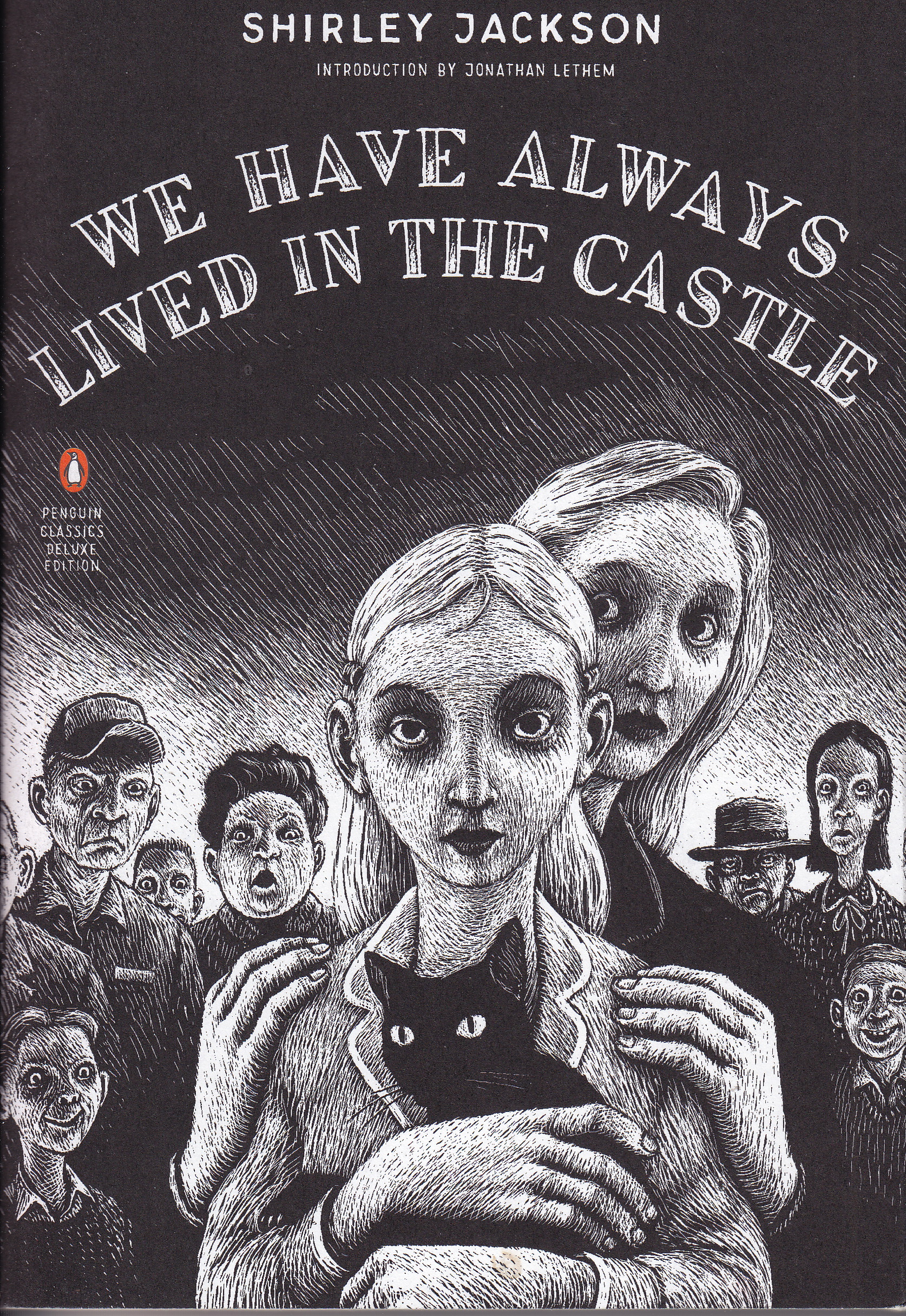
WeHaveAlwaysLivedSometimes, an experienced editor once told me, the author’s life is just as important as the book she’s written. I can’t pretend to know much about Shirley Jackson, beyond that she wrote compelling fiction and that her name is barely recognized today. Best known for her short story “The Lottery” and her novel The Haunting of Hill House, she didn’t match the output of more prolific writers and therefore, in a world driven by capitalism, didn’t receive much notice. Her work is difficult to classify. Not exactly horror, it is nevertheless unsettling by implication. There’s something wrong beneath the surface. Jackson apparently suffered neuroses for much of her adult life, and her ability to translate angst into literature has gathered her a following among fans of ghost stories. I just finished reading her last novel, We Have Always Lived in the Castle, a funny, quirky, and serious story about two young women who live alone and who, one suspects, are thought to be witches by the local population.

This little novel is difficult to lay aside for long. The characters of Constance and Merricat are too compelling to leave alone for any length of time. The fact that they are pariahs makes the reader want to ensure that they are safe as they remain carefully inside the home they’ve always known. Even though you know one of them murdered her family, you want them to be happy and secure, perhaps because the whole town is against them. I wouldn’t presume to say what Jackson meant by this story, but to me it seems a clear description of xenophobia by a woman who felt she was never accepted. Women being persecuted in New England always brings witch trials to mind. Although we don’t know why one of the girls killed her family, it is easy for the mind to fill in the blanks.

Although Jackson died prematurely, her work has influenced novelists such as Stephen King and Neil Gaiman. Uncompromising in her outlook, she allows her characters access to those strange places of the human mind where many of us wander from time to time. Merricat, for example, practices that sympathetic magic that we all, if we’re honest, admit that we attempt every now and again. Hoping in magic doesn’t make one a witch any more than prayer makes one a priest. We Have Always Lived in the Castle, although as old as I am, reflects a world in which reality can’t be pinned down. Assumptions are made and challenged. Protectors turn out to be exploiters, and the only ghosts are very human characters hated by the community in which they live. Still this is an uncanny tale, haunted by a reality that women still face in even the most progressive countries. Listening to their voices, even if from beyond the grave, may demonstrate just how much a writer’s life might mean.


Christian Horrorshow

Books & Culture is the review organ of Christianity Today. Christianity Today is the evangelical answer to the more liberal Christian Century. Working in publishing, particularly in the field of religion, it is important to keep an eye on what the popular magazines are saying about our books. Well, neither is as popular as it used to be, but still. I’ll grown used to Books & Culture taking a rather wholesome reaction to books that challenge worldviews. In fact, it’s not unusual to find a fairly mild tome castigated as somewhat insidious. Negative reviews tend to sell books as well as positive reviews. Sometimes better.

I was a bit surprised to see a two-page spread in a recent edition of Books & Culture focusing on horror stories. Horror and evangelical generally don’t play well together. Well, maybe I should temper that a little bit. The first article was actually on Shirley Jackson, best known for her excellently moody The Haunting of Hill House. That particular book has spawned or inspired at least five scary movies, two of them versions of the book itself. I have to confess that this is the only Shirley Jackson novel I’ve read. The article, somewhat strangely for an evangelical magazine, had made me want to explore some of her other offerings. Horror doesn’t have to be splatter to be effective.

DSCN0216

The second review in this issue was for an Oxford anthology called Horror Stories. The reviewer, Victor LeValle, also comes out with a positive review of the collection. All of this makes me wonder if I missed something growing up as a conservative Christian who felt distinctively unsavory because his love of monsters and the macabre. I can’t remember ever not liking mild horror stories. They manage to evoke parts of my psyche that most other literature bypasses. I discovered Poe at an early age. That’s not to say that I like being afraid. Fear is not what I’m seeking here. It is a kind of strange redemption. In college many of my evangelical friends couldn’t understand my fascination. “Why don’t you watch something more uplifting?” I’d be asked. I was as surprised as anyone when one of my very few Grove City dates agreed to see Nightmare on Elm Street with me. Not even Shirley Jackson could’ve seen that one coming. I wonder how she’d respond to being written up as an evangelical inspiration?