Hallowed Halls

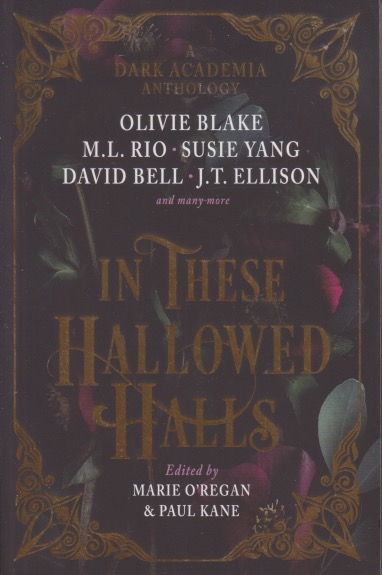
Every time I read a short story collection I tell myself I should do so more often.  Knowing that you’re only committing yourself for maybe thirty or forty minutes at a time is one way to incorporate more reading into a life that’s incredibly busy.  I read In These Hallowed Halls, edited by Marie O’Regan and Paul Kane, because, as its subtitle declares, it’s A Dark Academia Anthology.  As with nonfiction anthologies, it is a mixed bag.  The stories are all well written and all were enjoyable to read.  They also display some of the breadth of dark academia.  Most of the stories are literary (as a genre), others dip into science fiction and horror.  Dark academia doesn’t specify whether a book (or story) will be speculative or not.  As someone who writes short fiction, it seems that some of my tales might wag that way.

In any case, discussing a collection is tricky because there is such variety.  Some of the stories stayed with me beyond reading the next, which could be quite different.  Others I have to go back to remind myself what happened.  These days it can take several weeks to finish a book and a lot can happen in real life in that time span.  The stories that stay with me the most have obsessive narrators, or characters who are obsessed.  This kind of story, I know from experience, is difficult to get published.  Many of us who write, I suspect, do get obsessed.  An idea latches on and won’t let go.  Of course, most of us also have jobs that force the jaws open and drop us down in the world of the ordinary again.

Another thread that runs through many of these stories is how students struggle for money.  That’s true to life.  Thinking back to both college and seminary, there were times in both settings that I was working two part-time jobs as well as being a full-time student.  And living like, well, a student.  That experience, except for the truly privileged, is fairly common and our writers here recognize, and perhaps remember, that.  The other unavoidable theme when writing about young people in college is, shall we say, hooking up.  For many of us, college is that period in life when, thinking of our futures, and following our hormones, we start looking for love.  (I know, high schoolers do that too, but college has a way of focusing your energies.)  All of that swirling around the darkness that sometimes falls over our tender years makes this dark academia collection worth reading cover to cover.

Oblong Box

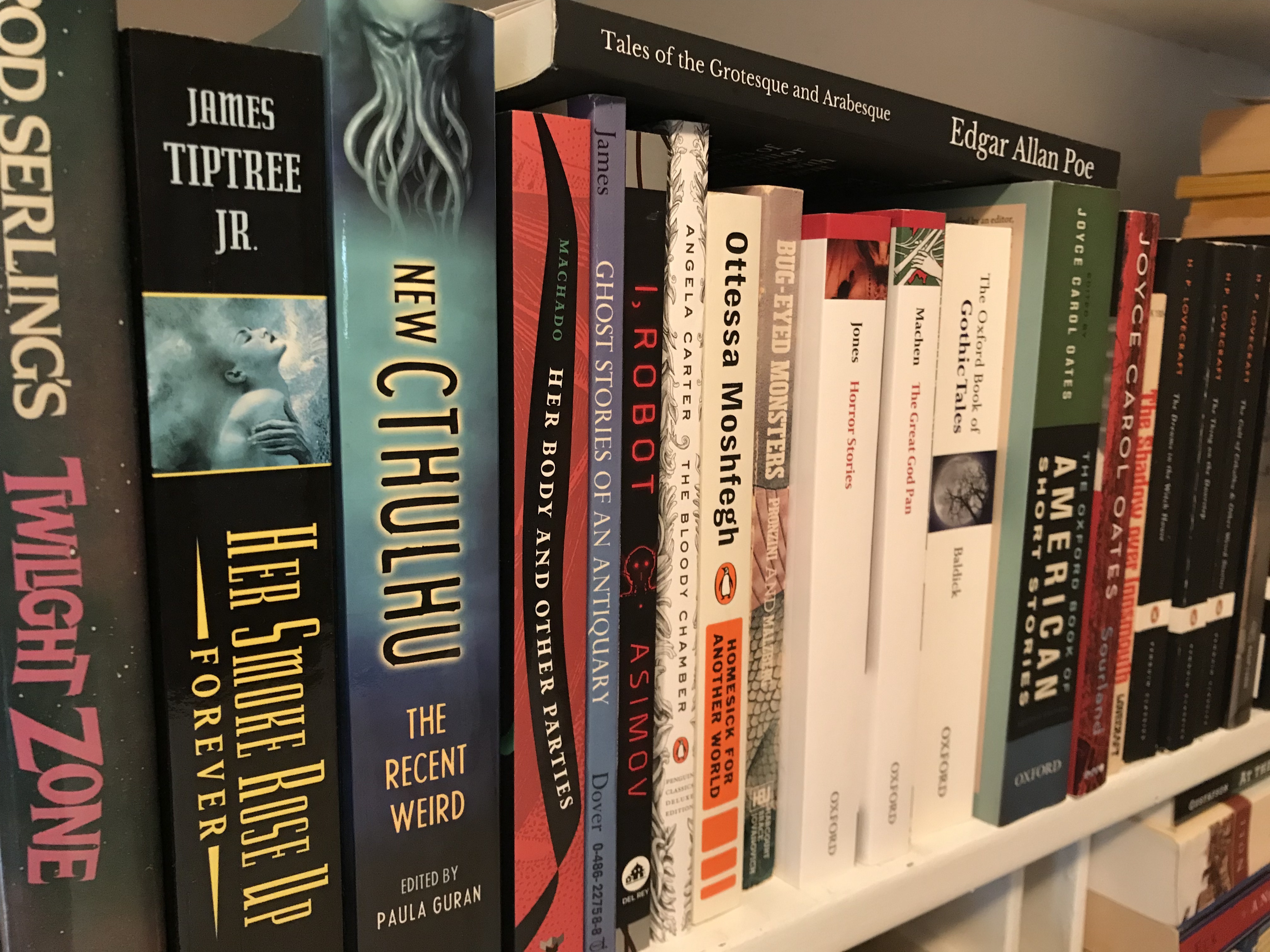
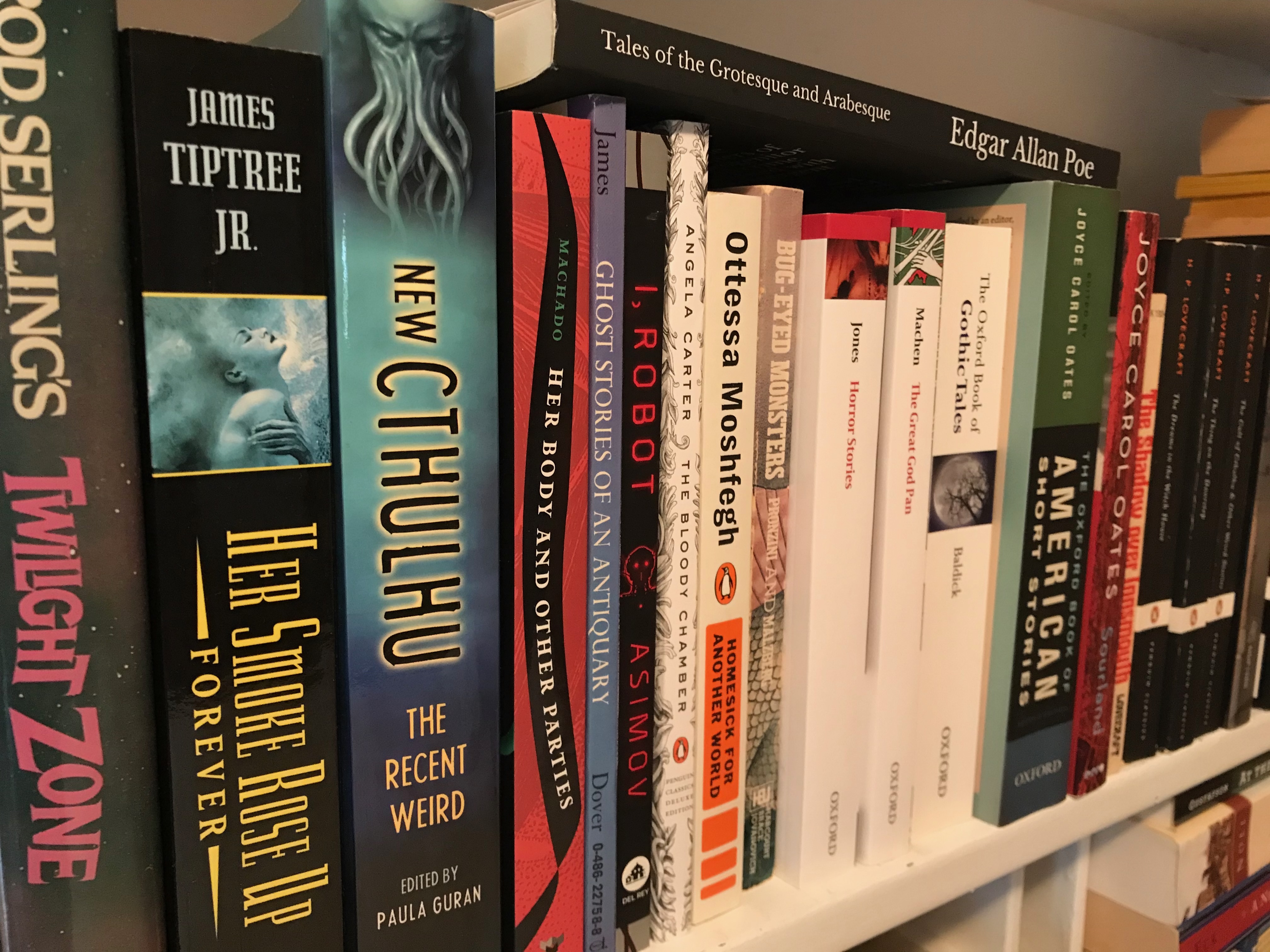
When Borders was closing—a sad day in the annals of American readers—things were marked down.  On one venture to a remaining store somewhere in New Jersey, where the checkout line snaked like one of those around a Times Square theater before the doors open, I picked up Edgar Allan Poe Complete Tales and Poems.  Poe has, of course, been in the public domain for many decades so anybody can publish his works.  I did attempt to sit down and read through this behemoth that contains 73 short stories, but stumbled at “Hans Pfaall,” the first.  This story is really a novelette, in today’s measure, coming in at nearly 19,000 words.  (It took Tales of the Grotesque and Arabesque to get me through it.)  So I’ve been content to dip into it now and again to read one of Poe’s stories.  In print. When the mood hits.

I read “The Oblong Box” in preparation for watching the movie.  I had never encountered this story before, and I prefer to read the base before attempting the latter adaptations (particularly by AIP).  The problem with reading Poe from this remove—in the light of his reputation—is that even the title tells us the box is a coffin.  How it is to be used in Poe’s tale may be unknown at first.  Here Poe divides his characteristic obsessiveness between the narrator and Mr. Wyatt, his temperamental artist friend who is newly married.  Wyatt, the owner of said oblong box, takes it on a voyage by boat from Charleston to New York.  The narrator obsesses over what might be in the box, being kept in a cramped stateroom rather than in the hold.  A storm leads to a shipwreck and rather than be rescued, Wyatt binds himself to the box and leaps into the ocean.  I won’t put the reveal here, but you get the idea. Today the title gives away Poe’s original twist.

There are still many of Poe’s stories that I haven’t read.  I’ve had enough of a head start, however, that I may eventually make it through those he published.  I’m aware that some of them may be funny, and some are tales of ratiocination.  Some may be completely unexpected.  Like many writers, Poe’s reputation is based on certain of his most well-known tales.  But also like most writers, his interest ranged fairly widely.  And he had that sense of “what if” that tends to drive those of us who write in a similar vein.  But these days we know that if we see an oblong box we’ll already have a pretty good idea of what’s inside.

Photo by Tom Oates, 2013; This file is licensed under the Creative Commons Attribution 3.0 Unported license. Attribution: Nabokov at English Wikipedia

Short Story

I often reflect on how little I know.  No matter how much I read there is more to be read.  Works worthy of time but sacrificed to circumstance.  I was recently reading a short story by Poe that I’d never read before.  As others have noted, Poe was a prolific author of a great deal of forms—poems, a novel, letters, a scientific treatise, literary criticism, and, of course, his stories.  I came to know his stories through cheap collections available in my small town, mostly not along the lines of those Poe himself selected.  Indeed, editions of his own chosen works, such as Tales of the Grotesque and Arabesque, before the advent of internet-based publishing, were difficult to come by.  Original editions cost many thousands of dollars.  Poe isn’t alone in this category—short stories are an unusual genre.

I know from personal experience that finding a publisher for a collection of such stories is nearly as difficult as finding a publisher for poetry.  Publishers are looking for money, of course, and like Poe, all writers produce stories that interest some but not others.  The novel is safer, and even today’s amazing writers have to find success as novelists before publishers will offer volumes of their short stories.  Tis a pity, really.  I have many volumes of short stories on my shelves, including some of Poe’s, but for some reason publishers tend to cram such volumes so full that they become unwieldy.  Intimidating almost.  It leads to that feeling of existential dread that I felt approaching War and Peace—would I indeed survive to finish it?  (I did, but that is such a Poe-like question I had to employ it.)

The short story is an important literary form that is singularly difficult to publish.  I have managed to find homes for about thirty such pieces, but many more have failed to move even just  the internet critics.  Those that have been published have brought no income at all.  In Poe’s day, an author attempting to make a living could not afford to give away their life’s blood.  Indeed, Poe’s older contemporary Washington Irving struggled with pirated copies of his works being sold overseas (he spent a great deal of time in Europe).  Like Poe, Irving excelled in the short story, or sketch.  We’re often at the mercy of editors who select the stories for us, making them available.  I suspect there’s much that we miss by not stepping outside their personal tastes regarding what to include.  Or, just as importantly, exclude.  Some day, perhaps, I will have read all of Poe’s short stories.  Until then, I’ll find them when necessary.


Them Apples

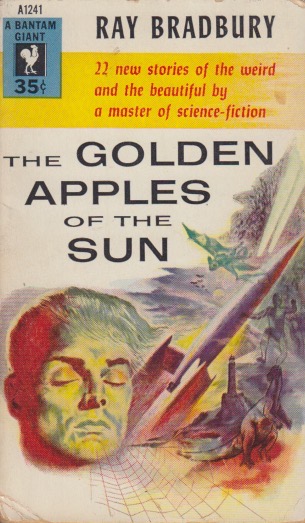
Although I’ve had this book as long as I can remember, I’d never read it.  Not the whole way through, until now.  As I kid I read Ray Bradbury when I could.  I’m sure I read a story or two in Golden Apples of the Sun, but I didn’t approach the entire collection.  I was drawn in at this late age by “The Fog Horn.”  This is the story that lay behind The Beast from 20,000 Fathoms, that classic of Harryhausen, the other Ray.  It’s been years since I’ve seen the movie, but the story was on my mind and I kept going.  Some of Bradbury ages well, while other stories, not so much.  The designation of his tales also changes over time.  As Stephen King says in Danse Macabre, Bradbury didn’t so much write science fiction (as the cover of this edition declares), even if the people occasionally get into rockets.

I realized as I read just how much my early writing style was influenced by Bradbury.  My stories were vignettes like these, not as accomplished, of course, but without lots of violence.  And with horror elements.  But it kept coming back to me how Bradbury’s characters, even the time-traveling ones, are stuck in the button-down forties and fifties.  I naturally overlooked this as a child but all these decades later and the strict binaries of, for example, men’s and women’s worlds, comes through on every page.  When women are the main characters, they’re usually not very flatteringly drawn.  The same goes for caricatures of races, although Bradbury is sympathetic he also uses stereotypes.  And many of the stories in this collection are just about everyday events, not a speculative element in sight.  Maybe I did try to read it through as a kid, but lost interest.

Writers struggle against irrelevance.  Those who look to the future sometimes get it right but often don’t.  And some reflect a present that we’d rather not acknowledge.  Of course, when I’m writing fiction I tend not to think in these terms.  The story simply takes you over and you can’t help being a refugee from the year in which you were born.  This is especially evident when Bradbury casts a rosy lens back toward childhood years.  As a child myself I had no idea that Bradbury was a time traveler from the twenties and thirties.  His childhood was nearly over by the time my mother was born.  It was a different world.  Some of his stories managed to transcend time and its for those that I keep reading him.


The Paw

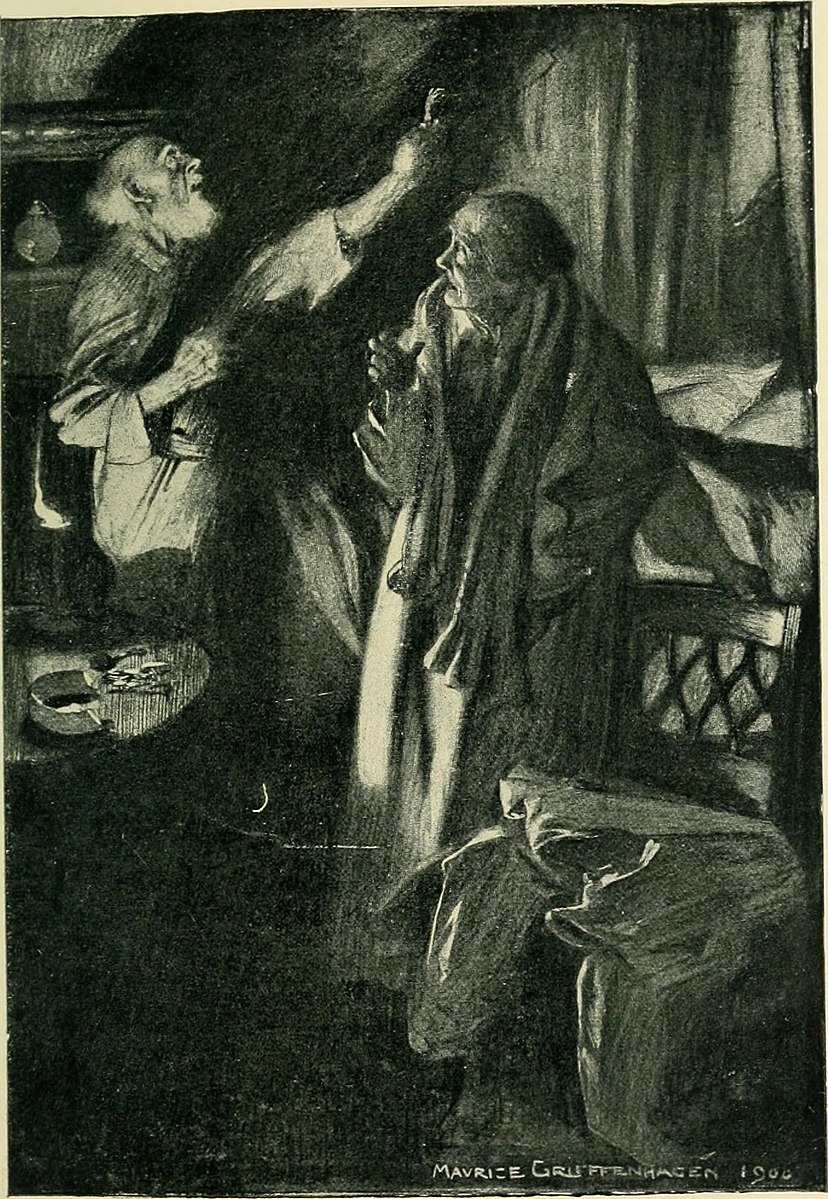
Okay, in the spirit of my epiphany that commenting may apply to short stories as well as to collections, I thought I’d muse on W. W. Jacobs’ “The Monkey’s Paw.”  Somewhat like Washington Irving, as a writer Jacobs was known primarily for this story.  Like “The Legend of Sleepy Hollow,” this tale has taken on a life of its own.  I recently read it for the first time, and I wasn’t exactly sure how it would end.  I knew the basic premise: somebody ends up with an exotic monkey paw that grants wishes, but the wishes, as is often the case, turn out poorly.  There’s a kind of morality to such stories, of course.  People shouldn’t rely on wishes for their happiness and any windfall has its consequences.  What makes this a horror story isn’t the magic, however.  It’s what we expect to see because of it.

Image credit: Maurice Greiffenhagen illustration from The Lady of the Barge, 1902; public domain via Wikimedia Commons.

If you haven’t read the tale yourself, it goes roughly like this: an older couple and their working age son have a guest stop by their hovel of a London home.  The guest served in the British Army in India and it was there that he acquired the eponymous paw.  He sadly tells his friend that no good can come of it and they should destroy it (they snatch it from the fire when the friend tosses it there).  Of course, they don’t really believe it will work.  The son suggests they wish for 200 pounds, to pay off their house.  He then leaves for work.  Later a stranger stops by to tell them that their son has been killed in an accident at the factory.  Denying responsibility, they nevertheless offer 200 pounds to help with the hardship.  The grief stricken mother then insists they wish their son would come back.

This is prime real estate for horror, of course.  The son had been badly mangled in the machinery at the factory.  I won’t spoil the third wish, and besides, you’ve probably read it before.  The story has been retold countless times, with changed settings but always the same message—be careful what you wish for.  Jacobs was able to make a living from his writing.  This is increasingly a rarity today, of course.  Nevertheless some eight decades after his death, outside the circle of literature scholars, he’s known for one short story.  Prior to reading it I couldn’t have even told you who wrote it.  This isn’t a bad way to make a mark on the world.  Those of us who write often put much of ourselves into our stories, and to have even one of them remembered would be an honor indeed.


Whole Books

One of the many peculiarities of my thought process is that I’ve tried to discuss only “whole pieces” on this blog.  In other words, as a “consumer” of media, my self-imposed limit has been discussing only whole books rather than a single short story.  Or the entire run of a television series rather than an individual episode.  The startling contradiction occurred to me that my latest book is an extended study of a single short story.  You see, Washington Irving was no novelist.  As America’s first famous writer, his fiction came in the form of short stories—sketches, he called them—and so to write a book on Sleepy Hollow meant focusing on a short story.  I love to read short stories.  I’ve always waited to talk about them here after finishing the book I found them in.  Maybe it’s time to discuss stories, or individual episodes here as well.

“The Legend of Sleepy Hollow,” many people are surprised to learn, is not a novel.  It’s often presented that way in telinematic adaptations.  The story, published as part of a collection of stories in 1820, is only 12,000 words in length.  Now, if you don’t work in publishing that figure may mean nothing to you.  There is no scientific way to parse these things but short stories tend to run from a few hundred words to about 15,000.  The next major category, the novella, is generally said to start at about 17,500.  You’ll notice there’s a gap there, between the two.  This is the strange territory sometimes called the “novelette.”  That’s because many modern fiction publishers cut the short story off at 7,500 words, and that leaves a gap of a literal myriad of words.  7,501 to 17,500 is the novelette, according to some.  And for the sake of completion, the novella tops out at 40,000 words so anything longer is a novel.

Irving wrote before these fine distinctions existed.  He wrote and people read.  Poe fell into a similar category.  He was known to have written only one novel,  The Narrative of Arthur Gordon Pym of Nantucket, but some of his short stories are long.  “The Unparalleled Adventure of One Hans Pfaall” stops just shy of 19,000 words, a novelette in today’s nomenclature.  My own fiction writing has been shaped by the fact that many magazines (even online, non-paying) top stories out at 5,000 words.  Some even at 3,000.  If you’ve ever tried to get a novella published, you’ll know why you shouldn’t even try.  All of which is to say maybe it’s time I start giving myself a break and talk about short stories.  Or an interesting episode.  If I can wrap my brain around it.


Carter’s Creations

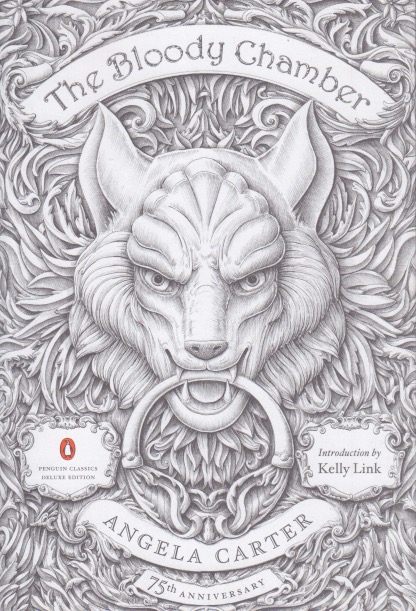
Angela Carter was a novelist whose best known work is her short story collection, The Bloody Chamber.  Often acclaimed as both gothic and feminist, these repurposed folktales and fairytales leave the reader in a thoughtful state.  I have to admit to having not known of Carter or her work until quite recently.  I’d seen a biography about her, but there are so many writers and my time seems always so limited.  Then I saw The Bloody Chamber mentioned on a list of best gothic fiction.  I had to find out what this was all about.  The stories are indeed unlike much of the feminist literature of the seventies.  The stories are focused on women, often young, and how they deal with being treated as the property of men.

The first, and lengthiest story, “The Bloody Chamber,” is a retelling of Bluebeard from the point of view of his last wife.  It’s an extended reflection on feeling owned and boxed in—literally trapped—by men’s economic rules of property.  Carter keeps readers on edge, even if they know the base story.  This isn’t a simple retelling.  Nor is it a lament about the natural, biological unfairness of sexuality.  There’s an ambivalence here, an enjoyment tinged with melancholy that gives the story a gothic sensibility.  The women in the different stories here prefigure more recent Disney heroines that take charge of their circumstances.  And there’s also ambivalence about the setting of the stories.  There are contemporary appurtenances but still castles and baronial mansions.  You’re lost in time.

The collection has some stories, such as beauty and the beast, retold twice and ends with three versions of werewolf stories that play, to an extent, on little red riding hood.  Some were tales with which I had no familiarity.  The effect of the whole is thoughtful contemplation of the human condition.  Much of the world, it seems, has been unduly influenced by a kind of literalism—a story, whether biblical or traditional, is supposed to go like this—that has not only robbed great texts of their depth, but has entrapped human beings in a stone-chiseled certainty.  A self-righteousness, if you will.  Even writing a text in stone doesn’t prevent others from interpreting it, however.  Since none of us have all the answers, we are each interpreters.  There was no historical Bluebeard.  There have, unfortunately, been many men who embody his attitude towards women.  Carter’s genius is to remind us that every story has at least two sides.  And the woman’s side may well be the truer of the two.


Fragmented

The existentialists, remember, used to put scenes in their plays to remind you that you were indeed watching a play.  In keeping with their philosophy, there was no reason to fool yourself.  Meanwhile, movies seldom break the fourth wall, immersing you in a story that, if done right, will keep your eyes firmly on the screen.  With home based media, however, we’ve all become existentialists.  (Of course, some of us had made that move before the internet even began.)  When we watch movies we always have that “pause” button nearby in case an important call, text, or tweet comes through.  We can always rejoin it later.  Life has become so fractured, so busy, that an unbroken two hours is a rarity.  I see the time-stamps on my boss’s emails.

While the existentialist side of me wants to nod approvingly, another part of me says we’ve lost something.  What does it mean to immerse ourselves into a story?  I know that when I put a book down it feels like unraveling threads at the site of a fresh tear in the fabric of consciousness.  Even the short story often has to be finished in pieces.  Poe, who knew much, wrote that short stories should be read in a single sitting.  All of mine have bookmarks tucked into them.  For a fiction-writer-wannabe like me, you need to feed the furnace.  To write short stories, you have to read short stories.  Novels must be spread over several weeks.  Some can take months.  I would like long novels again if time weren’t so short.  Presses are even encouraging authors to write short books.  Readers want things in snippets.

Perhaps all this fragmentation is why I enjoy jigsaw puzzles so much.  Part of the thrill is remembering several places in the picture simultaneously.  Being able to pick up where you left off.  I limit my puzzle work to the period of the holidays when I can take more than one day off work in a row and the lawn doesn’t require attention and those trees that you just can’t seem to get rid of don’t require monitoring.  But puzzles are designed for interruption.  Movies and short stories are intended to engage you for a limited, unbroken period.  The real problem is that we’ve allowed our time to become so fragmented.  A creative life will always leave several things undone by its very nature.  Other forces, mostly economic, will demand more and more time.  The best response, it seems to me, is to be existentialist about it.

Photo by Hans-Peter Gauster on Unsplash

Aleph, Borges

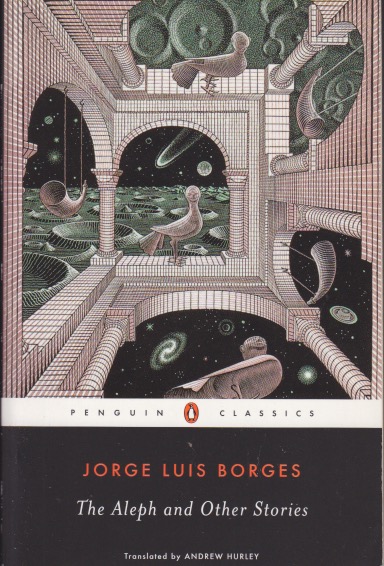
I’m never quite sure how I’m supposed to approach books of short stories.  Some of them are truly massive and contain only a handful of tales I wish to read.  Others are governed by a dedication to the author that compels me to read from cover to cover.  Some are by differing authors, among whom some appeal more than others.  I wasn’t sure where to begin with Jorge Luis Borges.  Not having been raised in a literary family, and having never formally studied literature, I found Borges through a friend and co-worker.  After my academic career crashed and burned, I started reading more literary writers and discovered Borges again and again.  I knew the basics of his story—he was perhaps the most famous Argentine writer, he had gone blind, and he had written probing, unusual stories.

I picked up this collection because of the title.  “The Aleph” is included here.  It was also the title of a collection of Borges’ stories, which make up the basis of this book.  To that collection are added some other pieces, and these last become a mix of poetry and philosophy more than a simple narrative.  Of course, Borges didn’t write simple narratives.  His stories are layered labyrinths.  A complex person doesn’t write simple stories.  Often they reflect on religion.  Some of them explicitly so.  They aren’t, however, religious stories.  Indeed, I was drawn to “The Aleph” because of my own experience of Hebrew and the sense that it is a sacred language.  Borges also puts this into the mix here.

So what kind of collection is this?  I’m still not certain.  This time I did read it cover to cover and at several places I became uncomfortable.  Borges doesn’t shy away from the harsh realities of life.  What people are capable of doing to each other, and what they in fact do.  Some of the pieces just under a page long stopped me in my metaphorical tracks.  Was I reading fiction or some kind of history?  Was philosophy secretly being fed to me by being left right out in the open?  This isn’t weird fiction, although it’s clear that some of it could be taken that way.  It is the work of a mind that operated on a plane different from that of many others.  There’s an uncertainty, a tentativeness here that is very becoming, and even beguiling.  Having read the book I’m not sure what it was.  It will, however, lead to yet more reading.  Of this I am certain.