
One of the memorable scenes from Men in Black is when the Arquillian takes Gentle Rosenburg to a restaurant for pierogi. One need not be an alien, or even Polish, to appreciate these dumplings, and a few weeks ago I found myself at a restaurant that offered pierogi on the menu, and I had to bring the leftovers home. When I was reheating them the next day an epiphany of sorts transpired. Now, when I prepare pierogi, I use the more healthy boiling method. The restaurant, however, fried them, leaving characteristic browning. As I flipped the reheating dumplings, a case of pareidolia occurred (prompting the title to this piece by both my wife and daughter, on separate occasions). A discussion of whose face this was ensued. Charles Darwin, Karl Marx, Abraham Lincoln, and Charles Dickens were all suggested, but those attuned to religious thinking know that when a face appears, it must be that of Jesus. Well, a man’s face with a beard, in any case. If it’s female, it must be Mary.
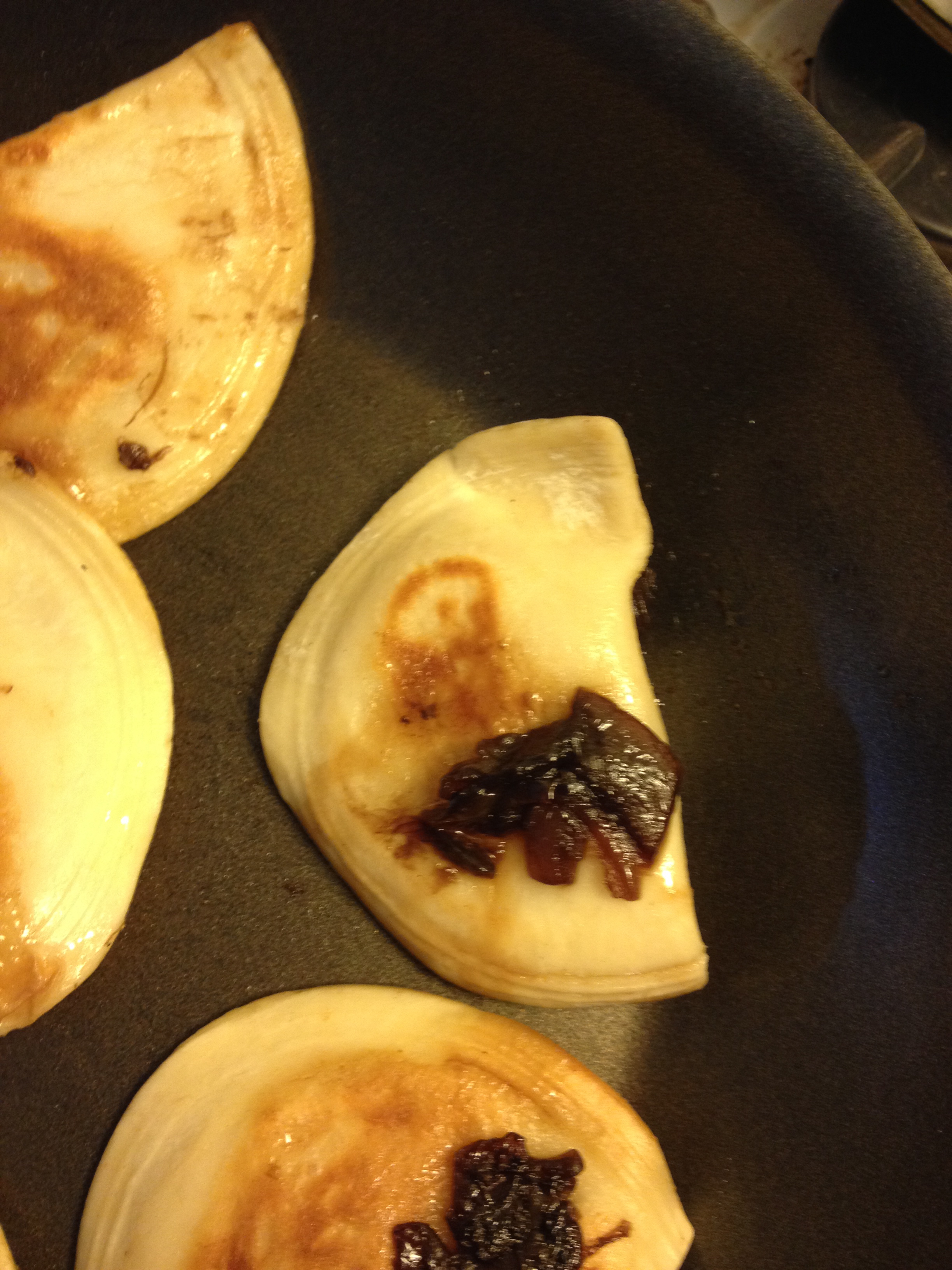
Pareidolia was always a winner with students, in my teaching days. Our brains are so attuned to finding faces that we actually design them into houses and cars and appliances. We like to see a friendly face. Now in my brain I know this is just fried dough, but my eyes are telling me this is a face on my dinner plate. The tendency is so closely tied to religious sensibilities that we can safely rule out any number of candidates. Of course, if I were to see this same phenomenon in a different culture, my referent would likely be completely different. Still, we seldom see news stories of Buddhists, say, finding Siddhartha Gautama’s image in foodstuffs. (Although, in all honesty I once found a water stain on a saucepan that looked very much like I imagine Confucius appearing.) Is there a deep-set need in our religious culture to find assurance in unlikely places? Are we that insecure?
Apart from the perennial favorites of breads (toast, tortillas, and now pierogi), images of “Jesus” show up in garden shrubs, water stains under highways, clouds, and even stingrays, prompting, a few years back, a website entitled “Stuff that Looks Like Jesus.” Now, I seriously doubt that some kind of transubstantiation has taken place on my dinner plate, but the appearance of a face on my food is always cause for reflection. Food is so essential to animal survival that it is perhaps strange that such images don’t occur more often. It is perhaps ironic that we hear most about it from a leisure-based culture with a cult of food fetishes. I don’t know who showed up on my pierogi, but the evidence is now long gone so it will have to remain a matter of faith.
 Steve A. Wiggins