Not All Vampires

Early film research owes great debt to YouTube.  Many historic and significant films cannot be purchased or watched anywhere else.  Even in this uber-greedy late capitalist era, few (if any) are willing to sell that for which many would pay.  This is brought on by my learning about Alice Ida Antoinette Guy-Blaché, also known as Alice Guy.  Guy was the first female film director.  She left a substantial body of work and is credited with being the maker of the first narrative-based film in history.  If you’ve not heard of her, you’re not alone.  Even during her lifetime she wondered why she was never recognized for her cinematographic achievements, incredible though they were.  She filmed one of the first adaptations of an Edgar Allan Poe story known, The Pit and the Pendulum (1913).  This one is partially lost—many early films are.
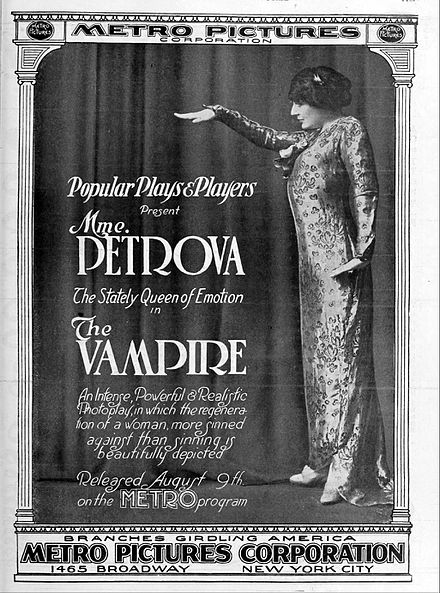
I wanted to see her 1915 film, The Vampire.  Given the date, you will have correctly guessed that it’s a silent movie.  It still survives and the only place it can apparently be found is on YouTube.  Before you run off and watch it, be aware that it’s not about a literal vampire, but rather “a woman of the vampire type.”  The current term is “vamp.”  The movie, which takes a feminist approach, is framed around Rudyard Kipling’s poem, “The Vampire.”  It runs for about an hour, which was pushing the envelope in those early days of cinema.  It tells the story of a happy, wealthy family broken apart by a “vamp.”  The husband receives a government appointment in Europe and his wife and daughter can’t follow for a month.  On the way over by ship, the vampire seduces him, after compelling her current love to shoot himself.  This isn’t a comedy.

The film doesn’t end happily—the statesman, aging prematurely, just can’t break the vampire’s hold on him.  Still, friends and family urge his wife to wait for him because divorce is wrong.  The film lingers on the suffering of the wife and on how much his young daughter misses her father.  The film quality is quite good for the time, although the YouTube version has been digitally restored.  So this isn’t a horror film, but watching it is a tribute to a woman who influenced filmmaking and then was summarily forgotten, largely because of her gender.  Alice Guy was the first woman to run her own movie studio.  Sadly, her husband left her and their children just three years after The Vampire.  Shortly after that Guy’s filmmaking career was over.  Fortunately for history, Guy has been rediscovered and has been receiving credit for her pioneering work.  Although The Vampire was about a dangerous woman, the reality is, and was, that patriarchy continues to ruin women’s lives.


Movie Ancestors

I’ve read quite a few Very Short Introductions, but this one struck me as particularly good.  Donna Kornhaber knows how to write for non-specialists, and she knows how to single out what’s interesting in the vast collective known as Silent Film.  As is the series trademark, this book is very brief, but it covers the essentials.  Kornhaber divides the silent film era, roughly 1895 to 1927, into three periods: early cinema, the transitional period, and the classic era.  During each of these, new developments demonstrated the sophistication of the industry and groundwork was laid for cinema as we know it today.  I learned quite a lot from this short treatment—so much that it’s difficult to know how to summarize it here.  Of course, it’s short so you can read it for yourself if you’d like to learn more. 

Perhaps what stood out to me the most was the correction of a misperception that, I hope, is not unique to me alone.  I’ve always thought of silent films as being grainy, poorly exposed, and choppy when showing people’s movements.  Kornhaber explains that most movies were of sound quality in their day, when projected properly.  Early film stock deteriorates, however, and not all stock was properly preserved.  This accounts for the graininess and the sometimes “overexposed” look of such films.  Even modern projectionists don’t use the proper speed and that leads to choppy motion.  In their own day, and with film handled by people who knew their business, early movie goers would have experienced realistic, well-rendered images.   These issues are our issues, not those of the original footage.

Another feature of the book is its focus on diversity in filmmaking.  Early silent film was dominated by France and the United States, but several other nations contributed to what we now think of as standard elements of cinema.  And the fact is that until sound was introduced many women played important roles in the development of what we expect from films.  Women directed.  Became business-savvy.  Ran their own studios.  Once the industry established itself as particularly lucrative, men began to edge women out.  The majority of early films—Kornhaber suggests around 80%—were lost as studios saw no reason to preserve them once “talkies” were the way to make money.  Consequently we’ve lost a good part of that early history.  We pretty much take movies for granted.  We can stream them any time, and we know what to expect (roughly, anyway).  What we don’t often consider is how much we owe to those who established what the movie-going experience should be, and did so before sound was added to the mix.


Sights of Silence

To an historian who cut his teeth on deep antiquity (if circumstances were different I would’ve ended up a Sumerologist), my current fascination with film feels manageable.  The form of communication we call “movies” really only began around 1895.  For those of us who find 1000 BCE a bit too modern, the nineteenth century seems strangely contemporary.  Simon Popple and Joe Kember offer a service, therefore, by giving us a Short Cuts on Early Cinema.  I’ve never formally studied cinematography, of course.  I have watched movies my entire life—grew up with them—and have learned to write about them (with some degree of intelligence, I hope!).  The history of the industry itself is fascinating.  Short Cuts are written for students, and this one covers the first twenty years of cinema, 1895–1914.  The cutoff coincides with the start of World War One, although not the introduction of sound, but it works nevertheless.

Although I learned a lot from this little book, the writing was sometimes verging on the technical.  Also, and this is a personal pet peeve, many of the paragraphs were too long.  This is an academic epidemic, not applying to this book only.  Look, I know the whole topic sentence and development thing, but paragraphs may be divided in different places, hopefully compelling the reader on.  When I see books intended for “general readers” with a wall of unbroken left margin, I shudder.  Give the eye a break.  This little digression shouldn’t be taken to imply that this book does it a lot, but there are some long paragraphs and they can make you lose your way.  In any case, there’s lots of good info here to balance out the occasional academic framing.

I especially found useful the year-by-year breakdown of major development in the early film industry.  Movies required quite a few breakthroughs, not the least of which was photography itself and also film stock that could be measured in hundreds of feet.  The machines to both film movement and project film.  Although not by 1914, syncing sound.  Color photography.  Movies are technical marvels.  And my approach to anything that is so gripping is to research its history.  In the case of cinema, it’s not a terribly long history.  Although 1895 is getting further away each passing second, it wasn’t even a century before I was born.  For those of us who look backwards, length does make a difference.  A lot was going on behind the scenes as movies went from one-minute side-show attractions to feature length productions where people went to specially designed theaters to view them.  This little book gives a walk through that world and what helped make cinema what it’s become.