
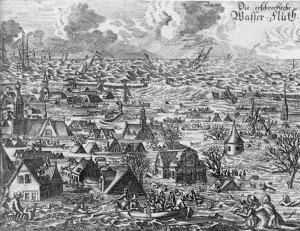
Floods are the stuff of legends. In fact, one of the most pervasive myths of all times is the world-wide flood. While some would see this as “evidence” that such an impossible flood actually occurred (some believing so fervently as to build replicas of imaginary arks), others recognize the flood as a basic human dilemma. We require water, and therefore we build our cities near a source of it. Rivers worldwide are prone to floods. While recently stuck in a holding pattern waiting for space for our flight to land at Newark, floodplains were more than evident from high above. My hometown regularly experienced floods when ice jammed the Allegheny River during the spring thaws. The floods of the Tigris and Euphrates rivers were, literally, epic-making. A piece in the Washington Post rather surprisingly reports “Legends say China began in a great flood. Scientists just found evidence that the flood was real.” The story by Sarah Kaplan demonstrates the universality of unruly water.
I know little of Chinese history and mythology. There’s no reason, however, to doubt that stories of ancient floods were as common there as elsewhere. The flood is, pardon the Christianization, the baptism of civilization. Things have to be washed clean before “civilization” can begin. In this case, according to the story, Yu, the founder of China’s first dynasty, tamed the flood. Now scientists are finding flood deposits from the Yellow River that match the 1900 BCE time-frame of this mythical founding. We can be certain that some will latch onto this date noting how Abraham was said to have emerged shortly after the flood (Genesis chronology says Noah was still alive when Abraham was born) and therefore this is proof of the Biblical flood. Even Sir Leonard Woolley advertised that he’d found the biblical flood in the river deposits of Mesopotamia. When it comes to literalism, any old flood will do.
No doubt many ancient flood stories go back to some historical event. The world was never completely covered with water in human times (before that nobody was here to see), but it’s easy to understand how people might have believed it could have happened. Our view tends to be local, often at the expense of universal costs. Consider global warming, for example. It’s difficult for us to see something that impacts us as such a distance. Taking care of the planet is so hard when we realize just how big it is. Our neglect, however, will definitely cause floods to come. Our denial makes myths for future generations. Headlines millennia down the road, if anyone’s left to read them, will, I’m sure announce with surprise that the devastating floods we’re creating now were indeed real.

 Steve A. Wiggins