Love for the Sky

People long for the sky.  We look at birds with envy and we have historically treated the weather, or the sky itself as divine.  To get oneself into the air is an expensive venture, no matter how it’s done.  One of the earliest forms of overcoming gravity was the hot air balloon.  The principle’s pretty simple: hot air rises.  Trap that hot air in a container large enough and it will lift a person, or people, to the sky.  Today ballooning remains popular, although not generally used for long-distance transit.  Still, to be in the sky is a consolation all its own.  Various hot air balloon festivals tour the country, but the Lehigh Valley Spooktacular Hot Air Balloon Festival was the first time I’d ever been close to an actual hot air balloon.  While not asking, I’m sure it is quite pricey to own and operate one.  Given the number of people there, it’s a safe bet that others are fascinated by the sky too.
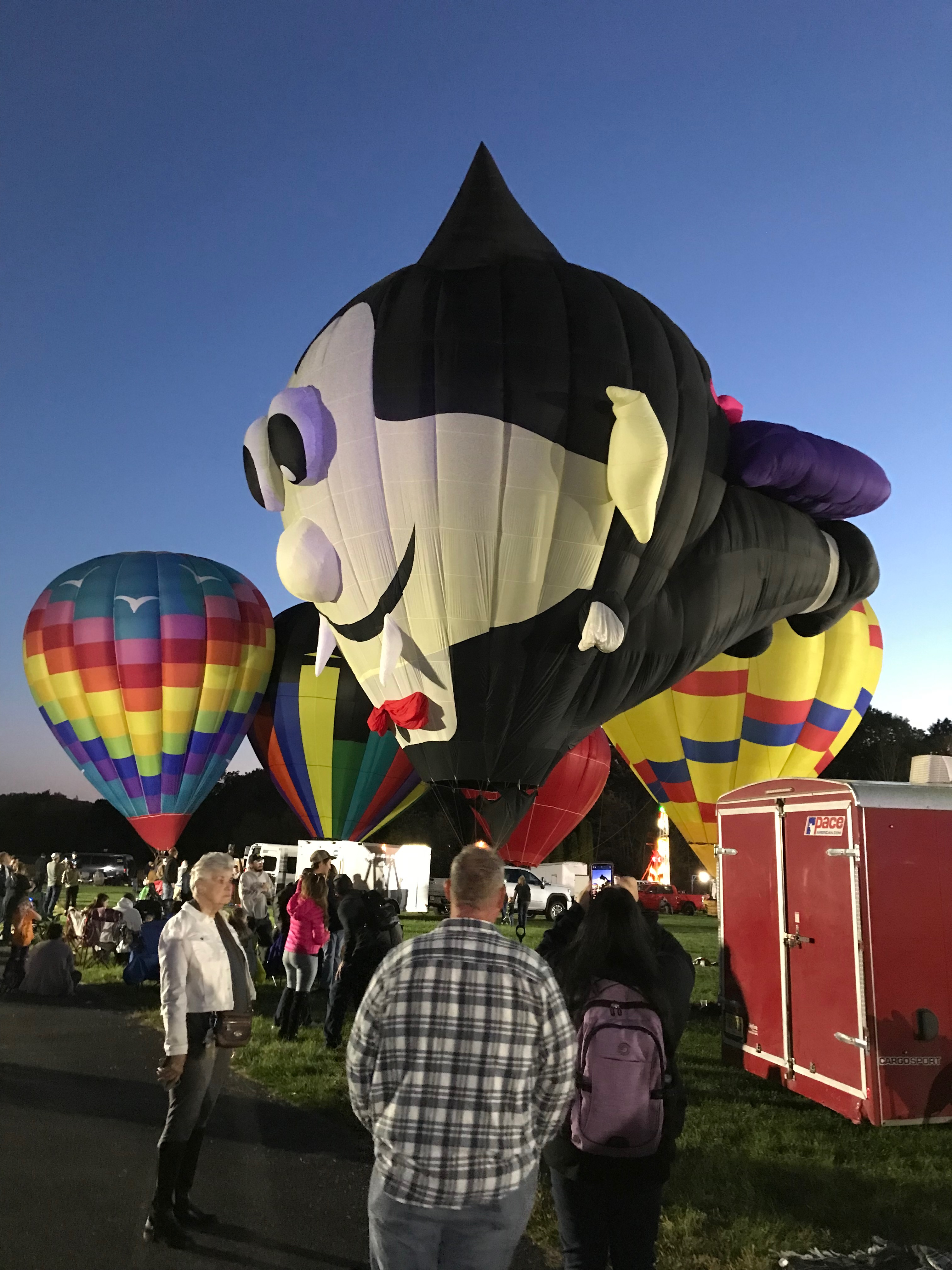
Apart from one vampire balloon, two things made this “Spooktacular.”  One was the fact that it’s midway through October, the month for scares.  The other was the vendors selling Halloween merchandise.  Options for disguises have come a long way since my childhood.  Blinking LED lights dangling from tentacles and battery-operated masks of black that show patterns in glowing colors on the faces of the wearers were both popular among attendees.  And not just with children.  Although the festival runs all day for Saturday and Sunday there are those of us who came for the evening finale—a mass inflation of balloons followed by a laser show and fireworks.

Such shows as this obviously require a ton of tech and a lot of set-up, but I couldn’t help but think as I watched that the sky, so eerily lit up at times, that in ancient times this would certainly have been considered as a theophany, an appearance of the gods.  Projected onto the sky itself, or penetrating that very sky, the lights could be made at times to dip, creating the impression of something large descending from above.  It was a show worth seeing.  As we drove home—it was past my bedtime and I had the passive role of passenger—I spotted a large bird winging through the night, dark against a low cloud.  Too dark to identify (although probably an owl), I thought how birds have a view that’s still rare among land-dwellers.  Theirs is the realm of the gods.

Sky Gods

One of the unspoken prompts for writing Weathering the Psalms was the unscientific idea that God is somehow associated with the sky. To my mind this has more to say about what religion is beyond the recognition that Anu, El, Nut, and kin were primordial deities of the celestial sphere. We’re all drawn to the sky. One of the earliest fictional pieces that I polished had to do with our desire for the sky—it’s something we deeply crave but cannot control. We dream of flying. Although flight seems almost casual these days, it is anything but. We still refer to satellite photos as being “God’s eye view” of the earth, knowing full well that the ancient cosmology of the three-tiered universe was simply a misconstrued view of how nature really works. Still, we want to embrace the sky.

Perhaps the cruelest aspect of work in the commercial sphere is the prevalence of “workstations” with no outside views. I’ve held two jobs since leaving academia where my “cubicle” was/is in a windowless room. Cut off from the sky, I’m supposed to focus on the glowing screen in front of me as if that could ever inspire me like a mountain sunrise or the silent crescent of the moon gracefully arcing across the sky. It could be night or day, snowing, raining, or brilliant sunshine, and for eight hours of each day I would never know. We call it efficiency. I think back to that story I wrote as a child about wanting the sky. If there are gods anywhere, it’s up there.

DSCN6374

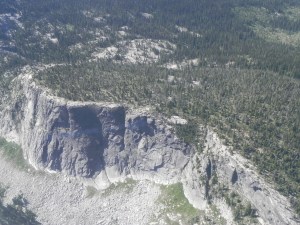
The perspective from above can change everything. On a small plane tour at 7000 feet, you can get a sense of what you’d never expect from the ground. Sharing the view of gods and angels, the land is laid out before you. “Distances,” our pilot says, “are very deceptive from up here.” Indeed, a few minutes aloft and it’s easy to forget what things looked like on the land. Pedestrian. Street-level. Quotidian life. Up here, isolated in a different way, I am seeing what the ancients could only imagine what the gods might see. For the moment I’m one with the sky. For the moment the world of everyday life is far away. That dark and gloomy cubicle no longer exists. In fact, from the sky I cannot see it in its windowless dungeon. We can’t own the sky. Being up here I start to suspect that neither can the gods.


Sky God Redux

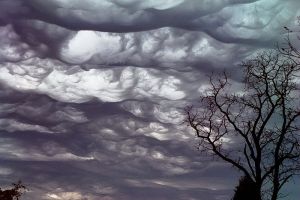
This week’s Time magazine includes the periodic feature of the 50 best inventions of the year. Flipping through the pages looking at techno-gadgets that leave me vacantly spinning in my office chair, I was surprised to see that invention number 49 is the work of our hypothetical sky gods. The undulates asperatus cloud has been receiving high profile attention of late, and now it is seeded on Time’s greatest inventions list! When I last posted on undulates asperatus, it had been written up in Wired. Prior to that I had seen a feature on the cloud in the New Jersey Star-Ledger some months back. Having written a(n unpublished) book on weather terminology in the Bible, I have had my head in the clouds for several years now. To find the humble collections of condensed humidity making the news is a strange but welcome validation of my work.

Undulatus_asperatus

Undulatus asperatus from Wikipedia, by Agathaman

Time resists bringing the divine into the description of the cloud, preferring the more neutral term “ominous” to describe undulates asperatus. After having spent several days under the blanket of a nor’easter here in New Jersey with its impenetrable gray clouds, I can appreciate how ominous thick clouds can be. The more I study ancient religions the more I am convinced that major gods primarily reflect the content of the sky. After all, gods were seldom seen in the fields and cities of antiquity, but the sky holds endless possibilities.

Perhaps some editor somewhere will stumble across my conviction that weather matters in the biblical world and will want to take a look at my book. If not, no worries. I’ll just be looking at the sky.