The Prom

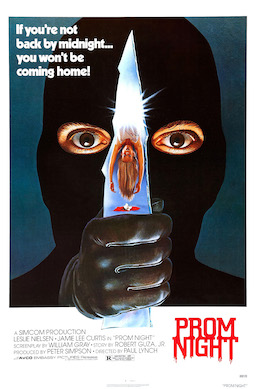
I had always assumed Prom Night was a knock-off of Carrie, and in some ways it is.  The story is significantly different, however, and the impetus to watch it came from Scream, where it’s referenced a few times.  In case you’re under the same delusion I was, here’s how it unfolds.  Jamie Lee Curtis, after starring in Halloween and The Fog, takes the role of Kim Hammond, older sister of a girl (Robin) accidentally killed at the start of the film.  A kids’ game at an abandoned building leads to the death, in which four children participated.  Six years later, it’s prom night.  The kids present at Robin’s death all receive mysterious phone warnings that they dismiss as crank calls.  Meanwhile, a Carrie-inspired sub-plot is introduced as Wendy, the leader of the killer kids, is outvoted as prom queen by Kim.  She gets a local thug, Lou, and his buddies, to plan a disruption to the crowning of the king and queen.  No pig’s blood, but this isn’t Stephen King.

Meanwhile, yet another subplot is introduced, riffing on Halloween, of an escaped psychopath as suspect.  The police are fearful after finding the body of a nurse he kidnapped at the site of Robin’s death.  He was falsely accused of Robin’s murder and was disfigured in a fire.  They fear he may be targeting the kids there that fateful day.  Nobody except the four kids know what really happened.  There’s a hint that someone saw the accident, however.  If you’re getting confused, apart from my faulty summary, it may be because the movie goes to great lengths to misdirect your suspicions of who the murderer may be.  Since the movie is over 45, there will be a spoiler in the next paragraph.  You are warned!

The killer is Robin’s twin brother, who is also Kim’s younger brother.  He witnessed Robin’s death and tries to murder those he holds responsible on prom night.  He succeeds in killing three of the four.  I’ll leave it at that.  This is one of those teen movies and a fairly early slasher.  The plot is too complex to hold up, however, with characters simply dropping out because the action shifts focus.  Too many false lead-ons and too much disco music make it less than stellar.  Of course, as a very religious kid shy around girls, I never attended my high school prom.  I guess I may have missed out on what was, by then, becoming a night of horror.  At least in the eyes of those exploring the emerging slasher genre.  


Louder

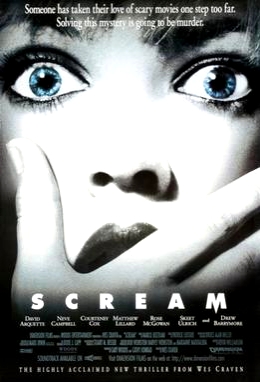
Scream is one of my old movies.  I saw it several years ago but the details had grown hazy so I dusted off the DVD to give it another go round.  I’m glad I did.  This Wes Craven classic was one of the first horror movies to rock the critics because it parodies so many other horror films while remaining a scary plot line.  And it’s intelligent.  I liked it so much that I’d watched Scream 2 as well, and the two had jumbled up in my mind.  In case you’re still in a Halloween mood, here’s the basic premise (I won’t spoil the ending): the opening sequence is so well-known that I’m tempted to skip it, but it sets the scene remarkably well.  A teenage girl home alone answers the phone to find a stranger on the line.  This stranger is watching her as he calls, eventually breaking into her house.  Using horror movie clichés, the ghost-faced intruder catches and kills her.

After that, Sidney Prescott is having trouble getting over her mother’s murder the previous year.  The recent murder triggers her.  When her father has to leave town on business, she decides to stay with a friend.  Ghostface attacks her, leading to the arrest of her boyfriend, who shows up after the slasher attack.  Along with her friends, of which the guys are all horror movie fans, she plays out various scenarios of who the killer might, or “should” be, according to the rules of the genre.  This is very effectively done, keeping the first-time viewer guessing who the killer might be.  When school is suspended because of the killings, the kids have a massive party (of course).  The killer’s there, however, for the most part following the rules.  But the instructions are subverted, making for a wild ride.

Clever and satirical, the movie strikes the right tone.  One thing I noticed the first time was that Ghostface is a little too fast for a psychotic killer.  He runs.  He’s also quite vulnerable, but then again, he’s not a supernatural villain.  After seeing Scream again, I realized that there are still some classics that I’ve missed.  One reason is that I’m not really a slasher fan.  Throughout the movie they avoid using the word “horror,” preferring “scary movie”—the original title for the film.  Scary Movie was picked up by a horror parody that I watched shortly after seeing Scream for the first time.  In many ways Scary Movie is a parody of a parody.  Horror is endlessly self-referential, of course.  And sometime an old movie is just what you need.


Not Alice’s

Sometimes I forget that movies are entertainment.  I mean, they’re big business and make some people obscene amounts of money.  In that respect they’re serious.  And also, they literally get into our heads and become part of our life’s experience.  Horror films, whatever that means, are often intelligent and thought-provoking.  I’ve been focusing on genre for a while now and when a friend recommended Willy’s Wonderland, and it was on one of my streaming services, I said “why not?”  This is entertainment, but the genre is all over the place.  Comedy, yes.  Fantasy, check.  Thriller, okay.  Action, definitely.  Horror, I’ll buy as well.  Nicolas Cage movie?  Well, he doesn’t look like he’s in his mid-fifties, and he doesn’t say a word in the whole thing.  The movie has possessed animatronic animals.  Satanists.  Small-town conspiracy.  Teens getting themselves killed.  And “one tough hombre.”

So what’s it about?  Hayesville has made a deal with the Devil.  A serial killer started an entertainment restaurant for kids’ birthdays, but along with his associates, began, well, killing.  Before the police could get them, they committed ritual suicide in a satanic pact, and they were permitted to inhabit the animatronic creatures.  When they weren’t fed, the machines started preying on townsfolk, so now they trap passersby and trick them into spending a night in Willy’s Wonderland so the machines can feed.  Cage’s unnamed character shows up and spends the night cleaning, killing machines, and playing pinball.  A young woman whose family had been killed tries to burn the place down, but, with her friends dead, and Cage leaving town after the carnage, she goes along for the ride.  It’s one of those movies that defies genre conventions.

As with many films released early in this pandemic, this one had a tough time at the box office.  I’d never even heard of it until the friend’s recommendation.  Lots of movies just disappear, but this one has at least the beginnings of a cult following.  It’s not difficult to see why.  If you can put up with the slasher aspect, it has quite a lot going for it.  Creepy kids’ stuff, children’s songs, and tawdry attractions are something we all experience in our own lives.  And a guy who goes around doing good—cleaning up other people’s messes, is something I think we tend to appreciate.  As a former janitor myself, I like the idea that the cleaning crew is the one who, well, cleans the clocks of the mechanical villains.  It’s a wonderland worth visiting.


Not a Peep

Time changes everything.  Peeping Tom, which has been on my list for some years, was castigated when it was released in 1960.  Now it’s considered a classic.  Indeed, it’s frequently discussed in books analyzing horror films, and it had a bit of influence on Alfred Hitchcock.  Films like this must be watched as period pieces, of course, but there’s so much psychology here to unpack that I wonder if it’s used in mental health courses.  Mark Lewis is a loner who inherited a spacious London house from his father.  He lets out the downstairs rooms but keeps to himself upstairs.  One of the reasons is that he realizes that he’s mentally unstable.  He’s a serial killer, in fact.  His young downstairs neighbor takes a shine to him and he reveals, via film, that his father tormented him as a child to film his fear reactions.

As an adult, Mark works in the film industry.  He also kills women while filming them to capture their fear reactions—taking his father’s work a step further.  Although shy, he is charming enough to others.  When he sees a fear reaction, however, he feels compelled to murder.  The neighbor downstairs doesn’t suspect him, but her ocularly challenged mother does.  Thinking back over it, many moments reminded me of a racier version of Hitch.  Racy because Mark picks up money on the side by taking boudoir photographs that the local news shop sells to certain customers.  This is a creepy film and perhaps the creepiest scene is where a local girl, well underage, comes into the news shop to buy a candy bar just after the owner sells an older man a pornography book.  We don’t like to admit that such things could happen.

There is so much going on in this movie that it’s clear, at least to me, why it has garnered such acclaim.  I spent the first twenty minutes or so wondering whether I should really be watching, but as I stayed with it I couldn’t look away (which is one of the very self-reflective issues that the film addresses).  The analyses I’ve read never really went into detail regarding the plot, so there were plenty of places where I wondered what would happen next.  The pacing is more in keeping with the turn of the sixties, but the mind work seems ahead of its time.  Some call it a precursor to slashers, but it doesn’t linger on the actual bloodshed (which is minimal, considering).  It does take its time to make you think while you watch.  And somehow it makes viewers complicit, it feels, with what they’ve seen.


Too Haunted

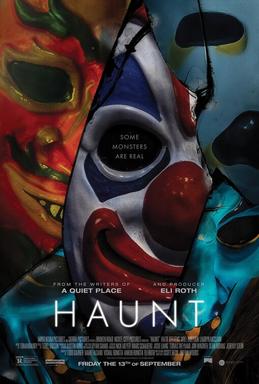
It’s past the season, I know.  But I have no control on when streaming services acquire new titles.  So it was winter by the time I saw Haunt.  Maybe it was the seasonal disconnect, or maybe I’m not all that fond of slashers—whatever the cause, I found it disturbing.  As a horror watcher, I really don’t like being afraid during movies.  And Haunt has those most troubling of characters—the unpredictable kind.  So let’s set this up properly.  Six young people—four women and two men—decide to visit a haunted house attraction on Halloween.  Although they take a random turn on a rural road outside Carbondale, Illinois, they end up at a haunted house attraction, with an illuminated road sign.  I’ll admit it; I don’t like fun houses.  They scare me too much.  So when the creepy clown at the entrance indicates, nonverbally, how they get in (taking no money) and puts their cell phones in a lockbox, I’d have told the others I’d wait in the car.

As we might expect, since this is horror, after a fakey plastic skeleton and some cheap props, it turns our that the terrors are real.  One by one, the young people are killed by a group that practices extreme body modification to make themselves look like real monsters.  For an unexplained reason, they kill everyone who comes to the attraction.  Sadism, one suspects, might be behind this.  In any case, it ends up with a final girl and final boy making it out alive and seeking medical attention.  The haunted house is burned down since Harper, said final girl, and her new boyfriend end up killing most of the killers.  The creepy clown, however, survives to try to hunt Harper down.

The film received pretty high ratings, but it seemed to me there wasn’t much beyond the terrors I normally experience at a fun house.  The body horror verges on torture porn, which is a sub-genre that I simply do not like.  In fact, I only watch it by accident.  My dilemma is that I don’t like to read summaries or watch trailers before seeing a movie.  I prefer to approach it fresh.  I suppose that’s why I keep a list of films that others have recommended, so I know they’re likely good.  I prefer intelligent horror rather than shock horror, although the two can overlap.  Movies that focus on the the pain humans can inflict on each other aren’t the kind I prefer.  Give me a garden-variety monster any day.  Even if it’s a winter weekend, and not Halloween.


Having X

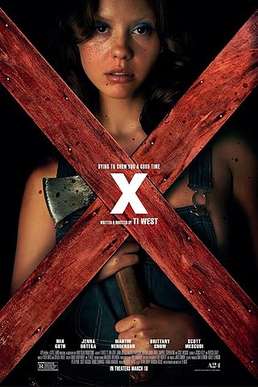
The final girl is such a classic horror trope that even horror novels can be titled after it.  You know the drill—teens hanging out, doing things that teens do, end up being killed off one-by-one by a monster or a disturbed person(s).  The one to survive is the virginal girl who doesn’t drink, use drugs, or whatever.  As a long-term horror watcher, I think the trope has been exaggerated, but it does occur enough times that there was clearly something to be noticed.  Enter X.  Released earlier this year, a slasher that rather obviously juxtaposes religion and horror, X features a “final girl” who is anything but virginal and sober.  The religion aspect is blatant from the beginning when the opening sequence involves a televangelist preaching to a viewership of the dead.

The title derives from the premise (which is a throw-back to the classic slasher era) that a would-be independent movie producer wants to shoot a pornographic movie.  Since this is strictly low-budget, he contacts an elderly gentleman on a remote Texas ranch who has a guest house.  With his one male and two female stars, a cameraman/director, and an assistant he drives to the isolated location.  They are all divided into couples, with each of the women having sex with the male star.  What makes this creepy from the beginning is that the old man, and his elderly wife, create a sinister presence.  She sneaks up on the young people, watching them through the window.  She misses her younger days when she was young and attractive.  As night falls the young people are killed off by the older couple one at a time.  What’s more, they’ve done this before.

X is a reflection on aging.  More than that, it’s a reflection on how religion leads to horror.  To say precisely how would involve giving away a spoiler, so I’ll leave the reader to watch the film to find out.  Suffice it to say, the televangelist is preaching about how sex leads to evil and the older couple kills because they’ve been listening to him preach.  X is not for the faint of heart.  I generally don’t like jump-startles and there were a couple of those that caught me off-guard.  (I try to anticipate them when watching slashers, or any horror, for that matter.)  But what of the final girl?  There is one, but it’s one who flies in the face of horror convention, if there is such a thing.