The Jonah Treatment

A kayak on the ocean might’ve seemed to be a safe place during a pandemic.  In November of 2020, however, two women ended up getting the Jonah treatment.  While it happened some time ago, the story appeared in Slate just in August, so the world is learning about it after a few years.  At least those of us who hadn’t seen the viral videos before.  Julie McSorley tells how she and a friend were paddling out to see some humpback whales along the California coast.  Then, like a scene from Finding Nemo, bubbles started to well up around them and they found themselves briefly in the whale’s mouth.  They escaped unharmed since humpbacks don’t eat mammals, being baleen whales.  Apart from the natural fascination of the story, what caught my attention was the reference to Jonah in the log line.  As Heather Schwedel notes, few people “outside of storybooks and the Bible” have actually been inside a whale.

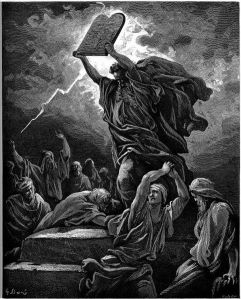
Image credit: Gustave Doré, Illustrations of Baron von Münchhausen, public domain via Wikimedia Commons

The typical biblical scholar response is generally somewhere along the lines of, “the Bible says ‘great fish,’ not whale.”  This may be true but we don’t possess a biblical glossary for the animals, real and imaginary, in the Good Book.  Ancient Israelites were neither great seafarers nor precise describers of nature.  There are many strange references to animals in the Bible with no certain referents in the world we know.  Not being oceanographically inclined, biblical authors wrote “great fish,” a term that was still used to describe whales up to Melville’s time.  But we now know there are other big fish as well.  Whale sharks, for example, and if you’ve ever watched River Monsters you’ve likely seen catfish large enough to send shivers down your spine. 

The funny thing about the book of Jonah is that the point of the story is often overlooked for the splashy action.  There’s a moral to the story.  It’s all about not judging others because they don’t belong to your group.  Jonah has already condemned the Ninevites as godless idolaters.  The book teaches that such judgment isn’t a human prerogative.  But we simply can’t get past that image of a whale, or great fish, swallowing a guy and digesting him for three days.  Like Jonah, Julie was spit back out by the whale.  It took only a matter of seconds since, despite what Pinocchio shows, the interior anatomy of most whales won’t allow living space for a long weekend away from home.  Julie McSorley and her friend emerged relatively unharmed.  McSorley even says it was a transformative experience.  One might even suggest it could be a spiritual one.

Fundamental Law

Last year I posted a piece on Fundamentalist Church of Jesus Christ of Latter-Day Saints fugitive Lyle Jeffs. The occasion for my venturing into this sect was that Jeffs’ lawyer, after Jeffs had escaped house arrest claimed the Rapture was responsible for his disappearance. Now that an unraptured Jeffs has been recaptured, I begin to wonder about the special immunity of lawyers. Surely Jeffs’ attorney knew that his client hadn’t been spirited to heaven in the fictional escapade we all know as the Rapture. Indeed, all criminal lawyers—or at least most—know the facts behind a case before they step into the courtroom. While their witnesses are guilty of perjury if they lie under oath, lawyers, through careful wording, are permitted to insinuate the opposite of the truth with no hint of wrong-doing. It’s just their job.

Legalism and religion go hand-in-hand. After an interesting preamble, the Bible begins by laying down the Torah. Among its stipulations is not bearing false witness. But then, that was before the modern legal system. Religions tend to serve as moral compasses—and that’s the phrase that’s frequently used. A compass helps to find direction, ensures that we go the right way. What exactly the right way is can be a matter of debate, however. It all depends on where it is we want to go. When religious law, such as polygamy among Fundamentalist Latter-Day Saints, and civil law (generally recognizing one spouse at a time) clash, lawyers debate with the comfort of knowing they need not be accountable for the truth.

I’m no legal expert—in fact, I wouldn’t even have known about this had not a friend sent me the piece by Ruth Graham on Slate—but the question does trouble me. Religion is often all about laws. Specialists in Islam are called jurists, and in Judaism rabbis know the Torah inside out. Religious laws sometimes—often, actually—conflicts with the laws of the land. Believers either accommodate the differences or get into trouble in the secular courts. It’s headline news when religious law becomes civil law in this modern day and age. Isn’t there something cynical, however, when a lawyer pleads the Rapture as probable cause for a disappearance? Knowing the law, they need not reveal the truth they know. And yet, if you personally implicate any wrongdoing in another you can be sued for liable or slander. Lyle Jeffs wasn’t in heaven. He was living out of his car, keeping off the grid. Of course, following religious law can be like that some times.


Creating Diversity

Informed opinion is a chimera. I write that as someone who has time to read only the news stories my wife or my friends pass on to me. Once in a while one of those stories makes me feel less bad about being uninformed. A recent piece by Slate author William Saletan looks at polls regarding Creationism. The piece, picked up in the New Jersey Star-Ledger on a recent Sunday, demonstrates that although the United States is a nation of Creationists, we don’t agree about what that means. What becomes clear to me when I read such stories is that people who believe in the Bible seldom read it. Or at least understand it. Creationism “is not a thing” in the Bible. Many accounts about how the world began are represented, and the main point seems to be that it’s important that it was the God of Israel who did it rather than the competition. The first couple of creation accounts are compelling with their insistence that people are special, and that we are in charge while the owner is away. In fact, however, creation is a minor point in the story. It just has to start somewhere.

Those who set out to read the Bible, I suspect, begin to stumble in parts of Exodus and generally give up once they reach Leviticus. Although the main point of the books of Moses is the rules, the modern Christian finds the story more engaging. And the creation accounts of early Genesis are among the stories people actually read. They do make for a great, if contradictory, tale. They have, however, little impact on what people are supposed to do. Ironically, those accounts have become failsafe political devices. We vote according to how old we think the earth might be. We are special, after all.

Saletan’s point in the article is that the finer we parse the questions, the more divergent opinion becomes. The Bible doesn’t say how old the earth is—it’s really not a point of any significance to the story—but if you’re going to take it literally, you can do the math. Few literalists truly take the Bible literally. Logic very quickly breaks down as Genesis 2 follows Genesis 1. Americans are told that the Bible is literally true, but such a view literally makes no sense. We are committed to it, however, as we somehow equate believing in stories to be more important than understanding what those tales are trying to say. The polls, according to the article, make the point abundantly clear. When it comes to understanding the Bible Americans are very committed, if very confused.

Just one Creationist museum.  Photo credit: Creashin, Wikimedia Commons

Just one Creationist museum. Photo credit: Creashin, Wikimedia Commons


What You Pay for

Over four to one. It’s a sad statistic. A friend sent me a story in Slate exposing, once again, the (some would say) criminal inequality of university administration to the “talent.” Turning our eyes to Canada, the piece by Rebecca Schuman narrates how when administrator Indira Samarasekera of the University of Alberta announced that she was leaving, her position was applied for by four faculty members of Dalhousie University as a group. Intended as a pointed joke, the faculty members, led by Kathleen Cawsey, noted that if all four were hired the salary of Samarasekera would cover all of their salaries with a substantial raise. Universities continue to insist that administrators should pull down corporate salaries for what, to the eyes of everyone else, is a job with no point. Long before even a Dean had been born, faculty taught because that’s what they do. As perennial overachievers they require very little managing to do their jobs. The more corporate universities have become the more pronounced faculty abuses of they system have grown. Coincidence?

In my current ancillary job to the calling of my life (the classroom), I spend a lot of time on college, university, and seminary websites. One of the interesting dynamics I’ve noticed over the last few years is that when you want to find faculty (the only ones likely to write a truly academic book) you have to wade past tabs announcing trustees, administrators, and other dead weight. Almost as if institutions of higher education find the subject experts to be an embarrassing afterthought. When we send our children off to take the SATs and have them sign up for honors courses and college-placement classes in high school, we’re probably not thinking about what trustees they will be emulating or administrators they will be ignoring. There was a time when people associated universities with the faculty talent they could draw. And the subsequent benefit to paying students.

How the times have changed...

How the times have changed…

Samarasekera’s $400,000 salary will be, undoubtedly, claimed by another faceless administrator. Universities across the United States and Canada will help to recoup their costs by hiring more adjunct faculty and slashing permanent positions. And parents will weep all the way to the bank’s loan officer. Our children are being taught “business ethics” in real time. Tuition will go endlessly up to make sure we can afford the best paid deans of this or that, and the most comfortably paid coaches whether or not their teams win or lose, because, we all know in advance who the losers are. One thing is for certain, they will not be the administrators or coaches. They will, however, be the ones paying to sit in the classroom.