Dental Dawn

Someone knowing my interest in religion and horror recommended Teeth.  A comedy horror film based on the concept of vagina dentata—an idea I first encountered in Neal Stephenson’s Snow Crash—it begins with a purity event.  Dawn, a teen leader in the abstinence movement, addresses other adolescents about the importance of maintaining, well, purity.  They all wear purity rings and vow themselves to chastity until marriage.  As might be expected, not all of them are able to uphold their pledges.  Being inexperienced, when Dawn finds herself in a compromised position with her boyfriend she learns she has, um, teeth.  Other guys, even when warned, can’t resist an opportunity and they too pay the price.  The point of the film seems to be female empowerment, but it’s also pretty funny.

After boyfriend number one has disappeared, Dawn again addresses the purity group only to have them quote Genesis 3 at her, clearly intimating that sin is the fault of women.  The Bible is there by implication and the sermonizing of the adult leader after Dawn has to leave the stage again takes up the religious outlook.  The underlying concept of purity movements is distinctly Christian.  While all religions have something to say about sex, generally the most negative about it is Christianity.  That’s not because other religions lack for spirituality, but Christianity tends to denigrate the body, and in the process tends to make natural things sinful.  This gives plenty of fuel to a movie like this where a woman has to make her own way in a man’s world.

What’s really interesting here is that no punches are pulled when it comes to the origins of patriarchy.  The Bible clearly views males as the standard of humanity and females as an adjunct.  That idea has had a death-grip on western society, particularly in America, from the beginning.  Teeth was written and directed by a man.  I suspect that the presumably well-intentioned use of an old mythical idea that makes females into monsters may not appeal to women writers or directors, empowering as it may be.  Nevertheless, if taken with the fun obviously intended from the opening playful music to the comically terrified responses of Dawn’s adolescent victims, the movie can still convey a positive message to women who might watch it.  Horror is often a repository of social commentary.  Not taken seriously by the mainstream, it nevertheless puts good messages out there.  And sometimes it bares its teeth.

Word of the Year

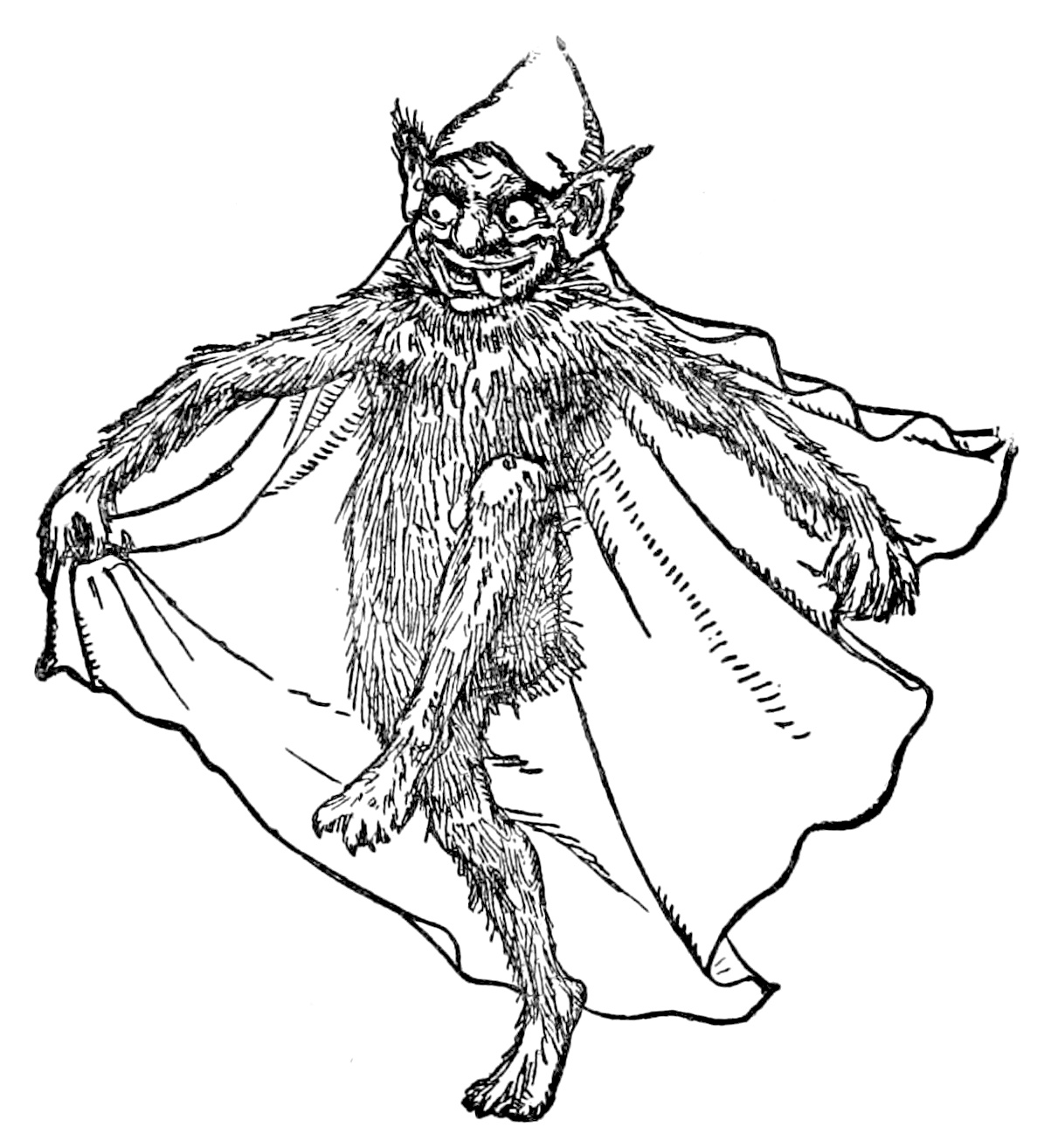
I still have to look up “goblin mode” each time I read it.  I’ve been reading it quite a bit because it was Oxford University Press’ word of the year for 2022.  Throwing voting open to the public for the first time, goblin mode was overwhelmingly chosen, edging out my personal favorite, “metaverse.”  (It’s not every day that a word your brother-in-law invented gets that kind of accolade!)  But goblin mode is in the Zeitgeist.  It means to live an unkempt existence, perhaps hedonistically, without caring what others think.  It is, of course one of the offspring of the Covid-19 pandemic and its lock-downs.  Like social distancing, it’s something some of us had done before we knew what it was called.  But only partially.  I have a mental self-image that I don’t allow myself to show because I don’t like being judged.  I’d be safer in the metaverse, perhaps.

Image credit: Goblin illustration by John D. Batten from “English Fairy Tales” via Wikimedia Commons

Somewhat a natural hermit, I do crave human company and, like most people, I worry about what others think of me.  The thing is, people are natural actors.  We keep our goblins well hidden, usually.  Social life is quite different from the moments we spend alone.  Goblins are, of course, a type of monster.  Somewhat undefined and malleable, they can be compared to demons or fairies.  They do tend to be associated with households, which may make their use with this phrase appropriate.  Goblins tend to be thought of as ugly, thus goblin mode is letting your “ugliness” take over, no matter who may see.  You could be in permanent goblin mode in the metaverse, though.

I have to admit that such things make me feel my age.  The lessons of conformity, even though I was born in the sixties, were pretty deeply impressed.  “Do you want other people to see you like that?”  I wonder if we’re not all insecure at some level—it’s our primate inheritance.  Going into goblin mode, then, is striking back at the natural human acting ability.  It comes at a time when the message of not judging is also prevalent.  In the metaverse, as it was first used in Snow Crash, you chose an avatar that could look like anything you wanted.  I suppose that’s a form of goblin mode too.  We are natural actors.  Watch people in a crowd sometime.  Or at the office.  Or even at home, if they’re not alone.  If other eyes are watching the question always remains “do you want others to see you like that?”  And what we see is probably not authentic.


Degrees of Separation

For some reason lost in the fog of weblandia, I get The New York Times, “The Morning” delivered to my email.  By carefully not clicking the links I can get my day’s worth of fear and paranoia for free.  Not all the news is bad, of course, and I’d be glad to pay if circumstances had been different.  After giving all the sorrow that’s fit to print, “The Morning” ends with an Arts and Ideas section.  By then I’m usually cradling my head in my hands but I look up to see the positive side of humanity.  The other day the article on the Metaverse included this line: “In its simplest form, the term — coined by Neal Stephenson in his 1992 novel ‘Snow Crash’ — describes an online universe that people can share together…” and I realized probably the closest I’ll ever get to the Gray Lady.

I am, as many of my regular readers know, Neal’s brother-in-law.  He mentions me in the acknowledgements to Snow Crash, something that was discovered by someone at work fairly recently, and which probably did more for my stature than my many long hours daily.  When it comes to degrees of separation, fate, I suppose, plays a role worthy of the Joker.  Neal hadn’t written Snow Crash yet when I met his sister.  Her somewhat unlikely friendship with me eventually led to our marriage and it was in the context of a family gathering that the conversation Neal mentions in Snow Crash took place.  Outside publishing, and in particular academic publishing, acknowledgements are seldom read.  I always read them, though, looking for unusual connections.  I’m often rewarded for doing so.

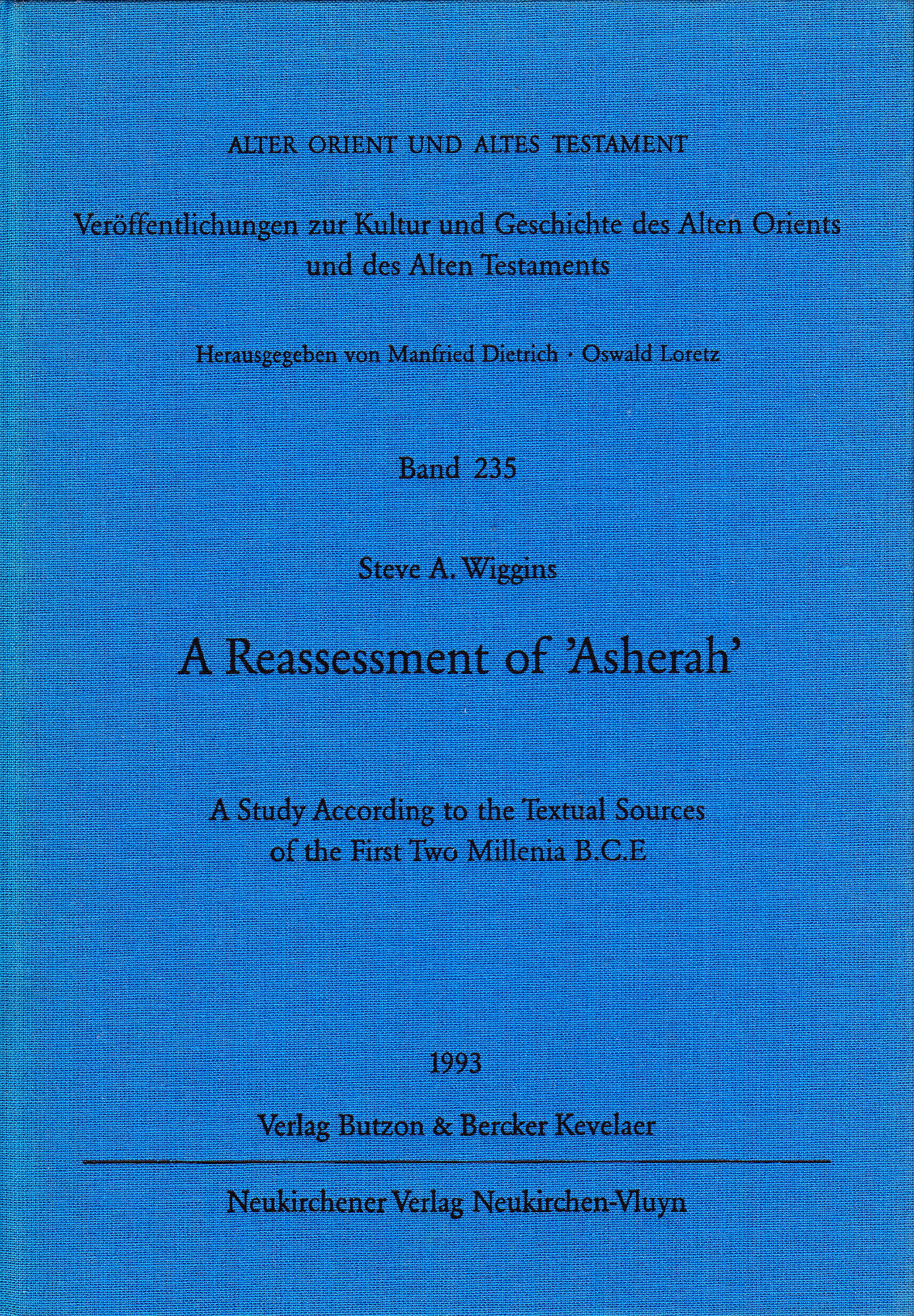
Asherah was, unbeknownst to me at the time, undergoing a resurgence of interest.  My Edinburgh dissertation was published the same year as a more prominent one by Cambridge University Press.  Just a year later, another came out.  Then another.  The internet was really an infant in those days and we learned of such things through printed resources and printed resources are always in arrears by months, if not years.  Of the many Asherah books mine had the distinction of being the most expensive.  Some things never change, I guess.  Suffice it to say, Asherah was on my mind as Neal and I drove to the store to pick up some baby supplies.  I had nothing to do with his coining the word or idea “Metaverse”—he’d already worked that out.  It was Asherah that ended up in the novel.  I was on my way to a short-lived romance with academia at the time.  Family, however, is so much more than degrees of separation.


Stand-in Line

Pop culture borrows from religion without knowing it.  Or maybe it’s just that religion has become so irrelevant that people no longer care.  Whichever may be the case, those who contribute to pop culture have a rich treasury from which to take withdrawals.  This occurred to me while waiting for a bus into New York.  Many people don’t want to stand in line (who does, really?).  In the Park-n-Ride subculture, you may leave an avatar in your place.  It’s probably not called an avatar, but since there’s nobody here to ask, I’m going to use the pop culture name.  You put your bag on the pavement, marking your place and then go sit in your car.  Since I’m going to be sitting in a big car for the next two hours, I prefer to stand outside.

The idea of an avatar is mediated to most people through either computer language or the movie.  I first encountered the term in the former sense in Neal Stephenson’s Snow Crash.  I was an internet neophyte and had trouble conceiving a virtual world in those days.  Some time later came the latter.  James Cameron’s film embodied the idea—linked through software, the tired hardware of physical bodies could be given new life.  In some senses it was an even better life.  Now everyone knows what an avatar is.  Perhaps except that the idea is native to Hinduism.

Hinduism was never an organized, intentional religion such as Christianity.  It is rather a wide array of traditional beliefs that, in the light of missionary activity, had to be given a name.  There are many gods in Hinduism, and when a deity descends to earth s/he appears in a form recognizable to humans—an avatar.  Not being an Indologist, my understanding of the concept is very basic, but it’s enough to know that this religious idea found a role in pop culture first through computer representations of human beings.  We had flattered ourselves with being gods, since we had created a virtual world.  A world we couldn’t physically enter.  Avatars were, therefore, how we wanted others to experience us.  Snow Crash is peopled with all kinds of representations.  The internet today, nearly 30 years on, has many more.  After all, there are many gods.

I glance at my watch.  The bus should be here any minute now.  When it enters the lot I’ll see the deities behind these canvas and leather avatars.  They’ll be less impressive than I’ve imagined them, I’m sure.  And although we’ve created virtual reality, I still have to get on a physical bus to go to virtual work.


Animal Ways

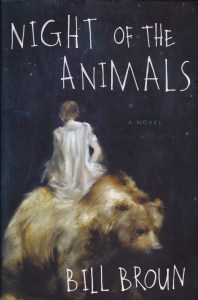
nightofanimalsNoah’s Ark has a way of showing up in many literary forms. Familiar to many from Genesis, it actually predates the Good Book by hundreds of years. On the backside, it keeps recurring in literature as diverse as Neal Stephenson’s Snow Crash, Jonathan Carroll’s The Ghost in Love, and Margaret Atwood’s MaddAddam trilogy. It also shows up in Bill Broun’s debut novel Night of the Animals. Set in a future that’s becoming present faster than Broun likely anticipated, the story revolves around an addict who hears animal voices. The story stubbornly refuses to let you get any grip on a slippery reality, so the reader’s left guessing even at the end. In the 2050s Britain is under a fascist regime that seeks to keep the wealthy happy and everyone else servile. (Keep reminding yourself this was written before 11/9.)

Cuthbert, the protagonist, believes the animals—most of which are extinct in the wild—are calling him to release them from the London zoo. As an addict his perception of reality is constantly in question. His sense of mission, however, is not. One of the stranger elements in the tale (and that’s saying something!) is the revival of Heaven’s Gate. This cult, instead of wiping itself out, has gone international. The approach of a comet sets the Neuters (as they’re called) on a mission to wipe out earth’s remaining animals. Many of them are in the London zoo, which brings Heaven’s Gate into direct conflict with Cuthbert, who is busy trying to release as many talking animals as possible. London literally becomes a zoo and Heaven’s Gate openly attempts a coup.

All of this sounds wild and fantasy-prone, but like 1984, fiction sometimes peers deeper into reality than science. Is it science fiction? It’s set in the future, but it’s difficult to say. What has all this to do with Noah’s Ark? The novel itself draws the parallel—the zoo that preserves the last of their kind is, by default, an ark. The Ark. Floating on a world-ocean of irrational turmoil where might (read wealth) makes right after all. Religious imagery interlards the story. Cuthbert becomes St. Cuthbert. His possible granddaughter (the reader is never sure) manifests as the Christ of the Otters. There’s even a kind of Second Coming. This is a novel that feels like altered reality. That illusion is given the lie when you close the book and turn on the news.


Virtually Divine

So I decided to try virtual reality for a while. I have been reading about the influence technology has on religion, so I thought a trip to Wikitude would be instructive. Now I don’t want to sling lingo like I’m some sort of real techie, but Wikitude is an app that shows the artificial worlds of virtual reality in your immediate environment. Many of us live our day-to-day lives without realizing that we are surrounded by powerful, invisible beings who can only be seen through electronic eyes. We have given our physical world an imaginary overlay that may turn out to be more real than reality itself. So I clicked on Wikitude and took a peek around my office on Third Avenue. Wikitude shows those things that I would have called “dialogue boxes” as a kid, but that now stand in for overlays against any mapped reality. In Manhattan there are many, many of them. I clicked on the one nearest my finger. It read, “A monster is destroying the city.” Like it read my mind.

In some ways I never got over the naïve realism I grew up believing. I first read about avatars in Neal Stephenson’s Snow Crash. Back then the idea of virtual worlds was still pretty new, and although Norman Spinrad and William Gibson had played with the idea earlier, the Snow Crash version is what stayed in my head. Avatars, I knew from my research on ancient religions, came from very early Indian belief. In what we now casually call “Hinduism,” some believed that gods came down and walked among us as avatars. Christians would later call this “incarnation.” In virtual reality, we are the gods and we descend into the world of human making as embodied electronic versions of ourselves. The idea, however, goes back to one of the most ancient religions in the world.

I’m not sure I feel safe in this virtual world I’ve discovered. I was relieved when I clicked on Wikitude the next day to find the menacing monster nowhere in sight. But is it really gone? The physical world has no shortage of ways to frighten the very sensibilities out of us. Many of them go by the name of religion. In this world, I can’t just click off the screen and be safe. It used to be that our simple, domed world had a divine bowl above it with a loving, if often very stern, parent watching over us. Now we have become that god, creating monsters and worlds to house them. Maybe that is the best answer to theodicy yet. When we create virtual worlds, we always include evil in the picture. Perhaps it has always been thus with the gods.

Reality or not?