First World Religion

H. P. Lovecraft’s contemporary, and sometimes inspiration, Algernon Blackwood has recently come to my attention. Like Lovecraft, Blackwood was an early twentieth-century writer of supernatural tales. Raised with a father of “appallingly narrow religious ideas” Blackwood came to write stories involving strange religious characters and occult themes. I recently read his famous story, “The Willows,” for the first time. The entire premise is built around a sacrifice required by strange gods on an isolated island in the Danube River. Much of Lovecraft’s literature, as is readily apparent, builds on the Old Gods. Lovecraft was an unflinching atheist, but he knew that the divine had the ability to frighten in a way that the purely material often does not.

The early twentieth century exerted an enormous influence on the religious landscape of the modern world. Although my historical specialization is much earlier, it is clear that the events of the First World War forever changed the way that religion was viewed. Historically, those not involved in the fighting of wars had often been insulated from them. With the advent of technology that allowed military devastations to be photographed and swiftly disseminated, people around the world realized what an atrocity war actually is. Not glorious. Not triumphant. And despite the abundance of piety in foxholes, no deities evident anywhere. It is well known that horror of war at least partly led William Jennings Bryan to advocate a more fundamental brand of Christianity to counterbalance the “evils” of evolution that led to such nasty ideas as eugenics and social Darwinism. It is no accident that the Fundamentalist movement began to take hold with the revelations of the First World War.

GermanInfantry1914

Ironically, today many use creationism as the excuse to challenge all religion as a misguided set of antiquated principles that have no place in an enlightened world. The sad truth is that those who immediately dismiss religion out of hand don’t realize that the creationist concern arose precisely for the same reason: the horrors that science was unleashing upon regular, simple religious believers. The two viewpoints, however, can live together. Although many of the writers of the early twentieth century had no room for faith in their accounting of reality, they did believe in its effectiveness in creating fiction that had to be taken seriously. Atheists, perhaps, but not angry ones. Perhaps the angry ought to spend some time amid the willows to evaluate more fairly the ambiguous role that religion play has played and continues to play in an uncertain world.

Being Human

Within the first three pages, if you’re not mortally offended or inexplicably happy, you’re probably not an American.

Growing up with pets, I had a hard time understanding the hard and fast line drawn between animals and people. The failsafe fact used back then is that only people used tools. When we looked closer at animals we found that wasn’t quite true. Well then, only people have language. A large question mark has grown from that assertion too. The final fallback, the sine qua non was souls: only people have souls. It is also the safest of assertions, since it can be tested for neither people nor animals.

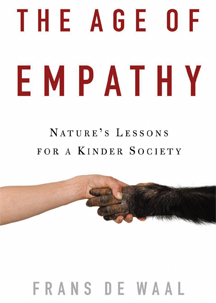
This way of thinking, according to Frans de Waal’s The Age of Empathy, arises from the western religious tradition—a religious tradition that grew up in relative isolation from other primates. Many world religions do not feel the necessity of making people absolutely different from our animal cousins. In Christianity at least, heaven itself rides on it. What are we so afraid of?

I posted, a couple years back, on Frans de Waal’s Our Inner Ape. Having just finished The Age of Empathy, I have reaffirmed my earlier accolades—he is one of the most sensible and important writers alive. Step by slow, evolutionary, cautious step, de Waal illustrates that one of the taboos of science—that animals don’t have emotion—is patently wrong. Not only do they experience emotion, but apes, cetaceans, and dogs at least, know empathy. Even scientists don’t like to admit this because science grew up in the shadow of the Judeo-Christian-Muslim worldview of human superiority.

But there’s even more at stake. As de Waal makes perfectly clear, the unbridled capitalism of the United States goes against nature. The unlimited acquisition of the vast majority of the resources by the few sets our primate sensibilities on end. Empathy, the ability to feel for another and take their perspective, is not only part of animals’ experience of the world, it is also a mandate of our religions. In order for society to survive, we must come to know this truth. Falsely applying Social Darwinism as factual, biological Darwinism, the few have taken more than either biology or religion permits.

The Age of Empathy should be on every school’s mandatory reading list and corporate climbers should learn that even selfishness has a very steep price tag. Not only for themselves, but for all of us.


Biblical Science Fiction

1950s science fiction films are perhaps the most parsimonious celluloid genre. Standard Saturday afternoon fare in my childhood, I still have a soft spot for the unapologetic self-confidence of these movies with their painted backdrops and hokey effects. The messages are frequently self righteous and often biblical. So yesterday as I treated myself to a viewing of The Mole People, I went on instant alert as the biblical references began right away for an audience that would have known the Bible well enough to take it all in. Set in “Asia,” the archaeologists are digging for Sumerian artifacts when then discover a stone tablet “below the great flood level.” That makes it at least 5,000 years old, the assembled academics declare. A diffident Dr. Roger Bentley tells his fellow excavators, “in archaeology all things are possible!” When a young boy of the indigenous population discovers an oil lamp shaped like a boat, the archaeologists note, “the flood’s been proven to be a historical fact.” The boat is a model of Noah’s ark, the Sumerian version. The scene of the expedition climbing Mount Kuitara includes footage from the 1955 Fernand Navarra trek up Mount Ararat during which a wooden beam was found, reputedly from Noah’s ark.

If you can stomach the bogus Sumerian you’ll learn that ancient Mesopotamians also survived the flood, a kind of “children of Cain” motif. These Ishtar-worshiping pagans are practitioners of a kind of social Darwinism, killing off their own kind when resources in their underground world become strained. Their great underground civilization parallels that of ancient heathenism while more advanced civilization on the surface of the globe has the benefit of an enlightened Christian worldview. Even the Sumerians whipping the actual mole-men is reminiscent of the Egyptians whipping the Hebrews in the Ten Commandments (released the same year).

Fast forward fifty years. We now live in a technologically advanced civilization where the myths of ancient people have little place. Science provides logical explanations for most of what we encounter in the world around us. Yet there are still otherwise intelligent people seeking Noah’s ark on Mount Ararat. The past is impossible to escape. The Sumerians in the film (whose walls are inexplicably decorated by Egyptian artwork and hieroglyphics) represent those who hold onto a confused religion that has become a form of terrorism in the eyes of the more advanced archaeologists. Perhaps the paradigm has shifted, and those who use religion today to gain political power and personal gain have become the self-righteous Sumerians of The Mole People.