Professionalism

We’re all tightly packed together here on the internet.  Social media is a fuzzy category and now includes such platforms as LinkedIn, which I think of mainly as a place to hang your shingle while looking for a job.  I chose, many years ago, to make myself available online.  This sometimes leads to a strange familiarity.  It isn’t unusual for me to have an author hopeful to contact me through my personal email or through LinkedIn, especially, to try to push their project.  (Such people have not read this blog deeply.)  One thing acquisitions editors crave most highly is professionalism.  Being accosted on LinkedIn, or in your personal email, is not the way to win an editor’s favor.  Some of us have lives outside of work.  Some of us write books of our own and don’t blast them out to all of our contacts on LinkedIn.  Professionalism.

It’s tough, I know.  You want to promote your book.  (I certainly do.)  It seems strange to say that blogging is old-fashioned, but it is.  (Things change so fast around here.)  But you could start a blog.  Or better yet, a podcast.  Or a YouTube channel.  You can blast all you want through X, Bluesky, Facebook, Tumblr, or Instagram.  I admit to being old fashioned, but LinkedIn is for professional networking, not doing quotidian business.  It may surprise some denizens of this web world that some publishers don’t permit official business through social media.  Email (I know, the dark ages!) is still the medium preferred.  Work email, not personal accounts.  Some authors (believe it or not) still try to snail mail things in.  Publishing is odd in that many people, and I count my younger self among them, suppose you can just do it without learning how it works.  Most editors, I suspect, would be glad to say a word or two about professionalism.

Photo by Ben Rosett on Unsplash

Professionalism is what makes a commute to the office on a crowded NYC subway train possible.  We all know what’s permissible in this crowded situation.  We know to wait until someone checks in at work before asking them about a project we have in mind.  (If you’re friends with an editor that’s different, but you need to get to know us first.)  When I started this blog I was “making a living” as an adjunct professor.  I was hanging out my shingle.  I also started a LinkedIn account.  Then I started writing nonfiction books again.  Since those days I’ve been trying to figure out the best way to promote them.  Professionally done, if at all possible.


Remaining in Shadow

Some people want to be found.  Others don’t.  Those of us who are curious shade into those who are frustrated when we can’t find someone.  People have been around for a relatively long time now, and we’ve been giving each other names because “hey you” only goes so far.  Even so, unique names are rare since, it seems, the majority of European-derived folk had something to do with smithies.  Nevertheless, the internet offers to help us find people.  I was searching for someone the other day but that person, despite publishing nearly daily on the interwebs, has a very common name.  And he styles himself without even a middle initial.  (He may not have one, I know.)  The point is, perhaps he doesn’t want to be found.  I run into authors like this—they assume their high-level monograph is sufficient fame.  You can’t find them online.

I recently joined Bluesky.  I’d like to leave Twitter, but I still have a large number of followers there (for me), although they seldom interact.  Publishers look at things like the number of X followers you have, so until Bluesky surpasses Twit, I’ll need to keep both going.  On Bluesky more people introduce themselves to you.  At least when you’re new.  Not a few are looking for relationships, sometimes of the sexual kind.  (I find that occasionally on what is called X, but mostly in the account under my fiction-writing pseudonym.)  These are people who want to be found.  The internet, strangely enough, has driven us further apart.

America has always been a polarized place, but the web has sharpened the border.  Indeed, it has militarized it.  I remember the days when meeting people actually meant going outside and stopping somewhere else.  Society had rules then.  Two topics of forbidden discussion were religion and politics.  It was easier to make friends with those rules in place.  Since I’ve chosen to put myself out there on the web, my choice of field of study does tend to come out.  And it’s one of those two forbidden topics.  Since my career goal has occasionally been ministry (still is from time to time), putting religion into the equation is inevitable, for those who really want to get to know me.  Social media is a strange country, however.  I tell new conversationalists on Bluesky that I have a blog, but it doesn’t seem to lead many people to my dusty corner of the interweb.  And it still gets me no closer to finding that guy with the tragically common sobriquet.  He may not want to be found. 

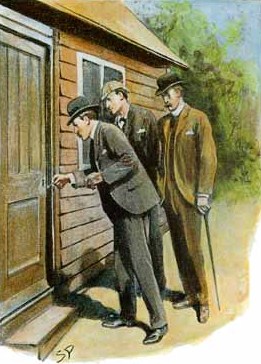
Sherlock Holmes seeks someone without the internet. Image credit: Sidney Paget (1860 – 1908), Strand Magazine, public domain, via Wikimedia Commons

Not Friendly

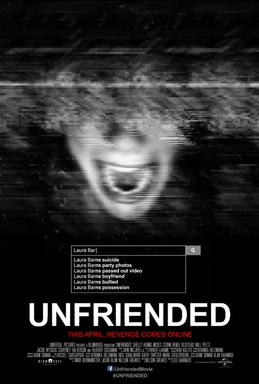
A ghost-revenge story, online.  Unfriended is one of those low-budget horror films that manages to be remarkably effective through the acting and its overall verisimilitude.  It’s also a kind of parable about the dangers of living our lives online.  The only problem is that technology is moving so fast that a ten-year old movie looks outdated.  The scary thing is many people are online even more, especially since the pandemic that came a few years after the movie was released.  Six high-schoolers are chatting on Skype (see what I mean?).  A friend in the group died by suicide a year ago because of an embarrassing video posted of her on YouTube.  Even a mature viewer like me can easily recall how deeply peer pressure cut in high school.  It’s a difficult time for all of us.  In any case, an unidentified person has joined the call and makes threatening comments via chat.

Of course, there are multiple apps (we called them programs long ago) running and nearly the entire movie is on the screen of one of the kids’ laptops.  In real life I was waiting for my low battery warning to come on, because I was watching it on a laptop, and all the notices that appeared on the upper right-hand corner made the thing look real.  Naturally enough, the kids start getting killed off.  Since this is horror their deaths are shown, if briefly, on screen and mostly they’re bizarre.  Hovering in the background is a webpage that warns against opening and answering messages from the dead.  As Blaire (whose screen we’re seeing) comes to realize that the unknown person is the girl who died by suicide, Laura (the dead friend) forces them to play a game of Never Have I Ever.  This leads to dissension and fighting as confessions come out and friends begin dying.

There’s a heavy moral element involved—the teens are being “punished” for typical teen behaviors.  Interestingly, toward the end I noticed that Blaire had a crucifix on her bedroom wall.  The kids don’t talk about religion at all (something I did do as a teen) but they all have a moral sense of what they did wrong.  The webpage about not answering online messages from the dead suggests confessing your sins, if you do open such a message.  Blaire tries to confess, but she has a secret that’s kept until the very end, so I can’t say what it is here.  I wouldn’t want to be unfriended for providing a spoiler.


Scrolling Along

I’ve got a condition.  “Oh, we know!” I hear you say.  But I mean a specific one.  Fast moving images make me nauseous.  It can be debilitating.  I can lose an entire day because I’m stopped at a railroad crossing while boxcars speed past my eyes.  Or because some found-footage filmmaker can’t hold the camera still.  As the old moralizing children’s song goes, “Be careful little eyes what you see.”  The internet has thus cast me into a kind of personal Hell.  You see, it has to do with scrolling.  To find things you have to scroll.  And scrolling, if I’m not careful, can make me quite ill.  When I try to find an old post on this blog, where the keywords are too common, scrolling through old posts can make me ill.  “Ah,” I hear you say, “turnabout is fair play.”

But seriously, scrolling can really be an accessibility issue.  An unrecognized one, for sure, but still an issue.  I have very long lists.  Books I need to read.  Movies I need to see.  Stories I haven’t finished writing.  And to find things, I must scroll.  It’s worse with pictures.  With pure text you can sort of avert your eyes.  Of course, you might miss what you’re seeking.  A small price to pay for not spending the rest of the day with your head between your knees.  If you’ve been to this blog a time or two, you know that I consider myself a neo-Luddite.  I use technology but I am ambivalent about it.  It sure makes navigation easier (until you lose the signal, then you curse yourself for not having a paper map).  It helps physicians and makes book buying much quicker.  But it can also make you sick.

It is possible to create this kind of nausea on the printed page.  It’s also easier to catch the early eye-strain that warns an episode is coming and close the book.  Besides, most books don’t cause this to happen.  Increasingly, scrolling is triggering it.  Looking for an image in the thousands of posts I’ve published here to reuse to illustrate a point.  Trying to find that book I know I saw on my endless Amazon wish list.  And just how many movies do they have on Netflix anyway?  Merrily we scroll along.  It’s just that some of us have to pull over to the side of the road awhile, get out of the car, and breathe deeply for a bit.  Don’t worry about us.  Just speed on by.  There are places to go, and me, well, I’ve got a condition.

More my speed. Image credit: “Boekrol Esther 18de eeuw uit een sefardische synagoge in Sevilla” public domain via Wikimedia Commons

Publishing Deportment

I don’t know if anybody reads this blog for publishing advice (editors are easily edited out, I know!).  But still, here goes.  It pays, in many ways, to research your targeted publisher.  And no matter which publisher you decide to approach, do it professionally.  “Friending” an editor on social media and then asking her/him to consider your book on said media is not professional.  Many publishers don’t allow any kind of business to take place through social media.  Be smart about it—go to a publisher’s website and follow their instructions.  Or email an editor.  At their work email.  Again, many publishers do not allow business to be conducted through private emails.  I may be an outlier editor for trying to build a social platform, but if you want to talk business, please use my work address.

More books are being published now than ever before.  Even small presses are closing submission windows because too many people keep trying to get published.  As someone who’s published a few books, I would urge you to ask yourself: why do I want to publish this?  Is it just because you wrote it?  Then look for a press that publishes that kind of thing.  Be prepared to face some frustration, but homework is never easy.  Is it because you think publishing a book will lead to fame?  Adjust your frame of reference.  The vast majority of authors are, and remain, obscure.  It is possible to make some money in publishing, but most of the time it’s not very much.  If it’s money you’re after, you need to get an agent.  It might seem as difficult to get an agent as it is to get published.  That should tell you something about the possibility of making money from books.

I’m no publishing guru.  Editing’s my day job.  One thing I’ve learned, however, is that publishers like to see that you’ve taken their guidelines seriously.  A quick social media introduction isn’t the same thing as an email that shows someone at least looked you up at work.  And most publishers have descriptions of what they want to receive on their websites.  This applies both to fiction and non.  I get it.  I remember being a kid in high school dreading all that homework—all those books I’d have to haul home day after day.  But that’s the tried and true way to learn something new.  And if you want to get published you do need to learn how to do it.  And just like in high school, deportment counts.


Mind the Gap

One of the general rules for writers is not to engage in too many platforms on social media.  There are a few reasons for this advice, the largest one being time.  Social media can easily become a time sink.  And time on social media is time not spent in writing.  Another reason, also related to time, is that becoming proficient in various platforms takes time.  And again, time spent on social media…  This has been on my mind because when people find me on various media they sometimes (not often) want to engage in discussion.  They often don’t use email.  They want me to join their favorite app or platform, and that’s where conversation breaks down.  I don’t use many platforms.  Those that I do use I do sparingly.  I’m still on Twitter, but I’m trying to move that following to Bluesky.  (I’m glad for followers/friends there!)  And I’m on Facebook, but I only check it once a day.

I don’t do this to be difficult.  I work 9-2-5 and after that I’m too exhausted to learn new platforms.  The first hours of the day (and it starts early for me) are spent writing.  There’s simply no more time for additional platforms.  The largest culprit is Academia.edu.  I suppose that’s because much of my pre-horror work is posted there.  People want to discuss it, but on their terms.  The thing about producing content—whether for this blog or for YouTube—is that it takes time.  And I’m just a working slob.  Those folks you see doing this professionally (there are professional bloggers and vloggers and podcasters) are paid for what they do.  Some of us rely on a full-time job for that.

Most of the people who reach out want me on a chat platform.  I prefer not to chat.  Or text.  Long-form writing has less opportunity for creating misunderstandings.  If you can’t take the time to say what you really mean, thoughtfully, doesn’t that open the door to hastily scrawled, easily misunderstood comments?  Communication breaks down.  I’m very flattered people are discovering my work.  I’ve been at this for decades now.  Like anyone who researches and writes, I’m very happy to learn someone, anyone is interested.  I’ll respond briefly on Facebook, and more fully to a comment on this actual blog.  Email is probably the best way to converse without devolving into mere chat.  I seldom use my phone, so all I humbly request is to meet me where I am.  I’ll get back to you, but I prefer long-form.  Tell me what’s on your mind.

Photo by LUM3N on Unsplash

Doing Without

I’m a creature of habit.  Although I’m no internet junkie (I still read books made of paper), I’ve come to rely on it for how I start my day.  I get up early and do my writing and reading before work.  I generally check my email first thing, and that’s where something went wrong.  No internet.  We’ve been going through one of those popular heat waves, and a band of thunderstorms (tried to check on their progress so I could see if it’s okay to open the windows, but wait—I need the internet to do that) had rolled through three hours ago, at about midnight.  Maybe they’d knocked out power?  The phone was out too so I had to call our provider on my cell.  The robovoice cheerily told me there was a service outage and that for updates I could check their website.  Hmmm.

I can read and write without the internet.  I’m on Facebook for, literally, less than two minutes a day.  I stop long enough to post my blog entry and check my notices.  I hit what used to be Twitter a few times a day, but since people tend to communicate (if they do) via email, that’s how the day begins.  This morning I had no internet and I wondered how tech giants would live without it.  I’m no fan of AI.  I use technology and I believe it has many good points, but mistaking it for human—or thinking that human brains are biological computers—flies in the face of all the evidence.  Our brains evolved to help our biological bodies survive.  And more.  The older I get the more I’m certain that there’s a soul tucked in there somewhere too.  Call it a mind, a psyche, a spirit, a personality, or consciousness itself, it’s there.  And it’s not a computer.

Our brains rely on emotion as well as rationality.  How we feel affects our reality.  Our perspective can change a bad situation into a good one.  So I’m sitting here in my study, sweating since, well, heat wave.  It was storming just a few hours ago and I can’t check the radar to see if the system has cleared out or not.  What to do?  Open the windows.  I’ll feel better at any rate.  And in case the coffee hasn’t kicked in yet, “open the windows” is a metaphor as well as a literal act on my part.  And I don’t think AI gets metaphors.  At least not without being told directly.  And they call it “intelligence.”

Photo by Chris Barbalis on Unsplash

Tech Warning

My moon roof is open.  That’s what the late-night alert says.  Thing is, I don’t have a moon roof.  Maybe I should go out to the garage and check, just to be sure.  You see, these new cars, which are as much computer as they are a means of conveyance, are subject to glitches just like the computers at work always seem to be.  And if this is true of a massive and lucrative company like Toyota, how can the rest of us really trust what our devices tell us?  After all, mainly they exist to sell us more stuff.  So whenever we take the Prius out, after it’s put away I get some kind of warning on my phone.  Nearly every single time.  If somebody’s been sitting in the back seat—or even if a bag was resting there—I’m cheerfully reminded to check the back seat once I get into the house.  I appreciate its concern and when I grow even more forgetful I may need it.  But that moon roof…

I use and appreciate technology.  I believe in the science behind it.  It makes life simpler, in some ways.  Much more complex in others.  I confess that I miss paper maps.  Do you remember the thrill of driving into an unknown city and having to figure out how to get to an address with no GPS?  Now that seems like an adventure movie.  Our cars practically—sometimes literally—drive themselves.  I’m no motor-head, not by a long shot.  I do remember my first car that didn’t have power steering or power brakes.  It had a stick-shift and you had to wrassle it at times.  Show it who was in charge.  With technology we’ve all become the serfs.  It breaks down and you have to take it to an expert.  Not quite the same as changing a tire.

I worry about the larger implications of this.  As a writer I worry that my largest output is only electronic.  Publishers don’t seem to realize that those of us who write do it as a way of surviving death.  We have something to say and we want it etched in stone.  Or at least printed on paper.  Tucked away in some Library of Congress stacks in the hopes that it will remain there for good.  I often think of dystopias.  The stories unfold and ancient documents—our documents—are found.  But unless they get the grid up and running, and have Silicon Valley to help them, our electronic words are gone.  It’s as if you left the moon roof open, even though you don’t have one.


Intimate Thoughts

Although I haven’t had much time to devote to my fiction writing—I’m finishing yet another nonfiction title—I do have a Twitter account for my pseudonym.  I’ve always found it ironic that that Twitter account, which gets very little attention from me, has gained well over twice as many followers as the account in my real name.  On both accounts I follow back, but few notice the account where I post more often.  Strange.  Lately I’ve noticed that my pseudonym account has been getting attention from what seem to be cyber-prostitutes.  I’m not sure if that’s the proper name, but these users purport to be young women and they direct message you with solicitous intent (at least online).  Needless to say, I don’t respond.  It does make me wonder if that’s why Twitter is now known as X.

Social media has given new license to strangers, of course.  For a while there I accepted any invites I received on Facebook (publishers look at how many “followers” or “friends” you have on social media).  Many of these people I don’t know.  One, in particular, happens to be online quite early in the morning and has tried to video call me a few times on Facebook.  Those who do actually know me are aware that I spend less than five minutes a day on Facebook.  I post my post, check my notifications, and move on to other things.  In other words, anyone who knows me would never try to video call me through Facebook.  There are other ways to reach me.  I do have a blog, you know.  Social media has mediated a level of intimacy that I’m not ready to engage.

What am I doing here?

For all my daily shooting off at the fingers, I’m a pretty private person, really.  I’m shy—who knows? Maybe even on the spectrum—but also social.  Working in publishing I know that those who have the power to promote your book (and price it so mere mortals can afford it) want you to have internet exposure.  I guess that means some people will take it as an invitation to try to get sexy with you, or to call you at what is, in reality, the middle of the night.  I want people to get to know me first.  As much time as I spend writing, it’s a mere fraction of how I spend my days.  Intimacy should be reserved for friends.  At least I believe so.  Those who know me well know my pseudonym and its real-life counterpart.  For when I have time for that sort of thing.


Who Are We?

I wonder who I am.  Beyond my usual existential angst, I tried to access some online learning modules at work only to have so many barriers thrown up that I couldn’t log in.  Largely it’s because I have an online presence (be it ever so humble) outside of work.  Verification software wants to send codes to my personal email and my company has a policy against running personal emails on work computers.  Then they want to send a phone verification, but I don’t have a work cell.  I don’t need one and I have no desire to carry around two all the time because I barely use the one I have.  By the way, my cell does seem to recognize me most of the time, so maybe I should ask it who I am.

Frustrated at the learning module, I remembered that we’d been asked to explore ChatGPT for possible work applications.  I’d never used it before so I had to sign up.  I shortly ran into the very same issue.  I can’t verify through my personal phone and I found myself in the ironic position of having an artificial intelligence asking me to verify that I was human!  I know ChatGPT is not, but I do suspect it might be a politician, given all the red tape it so liberally used to get me to sign in.  Not that I plan to use it much—I was simply trying to do what a higher-up at work had asked me to do.  So now my work computer seems to doubt my identity.  I don’t doubt its—I can recognize the feel of its keyboard even in the dark.  And the way my right hand gets too hot from the battery on sweltering summer days.  It’s an unequal relationship.

My personal computer, which isn’t as paranoid as the work computer, seems to accept me for who I say I am.  I try to keep passwords secure and complex.  I have regular habits—at least most days.  I should be a compatible user.  I don’t want ChatGPT on my personal space, however, since I’m not sure I trust it.  I did try to log into the learning module on my laptop but it couldn’t be verified by the work server (because the computer’s mine, I expect).  Oh well, I didn’t really feel like chatting anyway.  But I did end the day with a computer-induced identity crisis.  If you know who I am, please let me know in the comments.  (You’ll have to authenticate with WordPress first, however.)


Shepherding Books

One of the truths of publishing books—unless you make it to one of the big five, and even then it can’t hurt—is that you have to promote your own books.  Almost no publisher can afford to get word out that you’ve published your incredibly interesting tome with them.  So when I received an invitation from Shepherd to put together a list with one of my books on their site, naturally I said yes.  The way it works is your book page features a category of books, anchored by your own, and followed by five recommendations.  The idea is that people attracted to your subject will find this list and your book and, perhaps, just perhaps, buy a copy.  Since Nightmares with the Bible still hasn’t come out in paperback, I started my list with Holy Horror.  You can check it out here.

Authors often have no sense of scale.  Thousands of new books (perhaps up to two million) are published each year.  Think about that for a second.  Even the big five publishers can’t promote every single book, not at that rate.  There is a real satisfaction in having written and published a book, and many authors take that as a kind of entitlement.  “I’ve done my work, now somebody else should do the advertising.”  That may be fine if you have tenure somewhere and your prestige is assured.  If you’re a mere mortal like the rest of us, however, that means using social media.  Make a webpage.  Start a blog.  Get a Twitter and Facebook account.  The fact is, unless you do these things people won’t be able to find you.  They don’t spend their weekends at the local library browsing the shelves for new books.

Photo by Tanner Yould on Unsplash

Shepherd is a free service to authors.  I know many people who write (most of whom don’t read this blog) but if you know of anyone who does, point them to Shepherd.  The homepage has a convenient “Contact Us” link at the bottom.  Some websites will promote your work for a fee.  For me, I’m still waiting for royalties to come anything near what I have to spend to write my books—so far it’s been a money-losing venture.  I’m optimistic, however, that some day my books will be published in the affordable range—not just the big five do this, but most publishers have to be persuaded, through social media presence, that you can help find readers.  Shepherd is a good place to start.


The Importance of Sharing

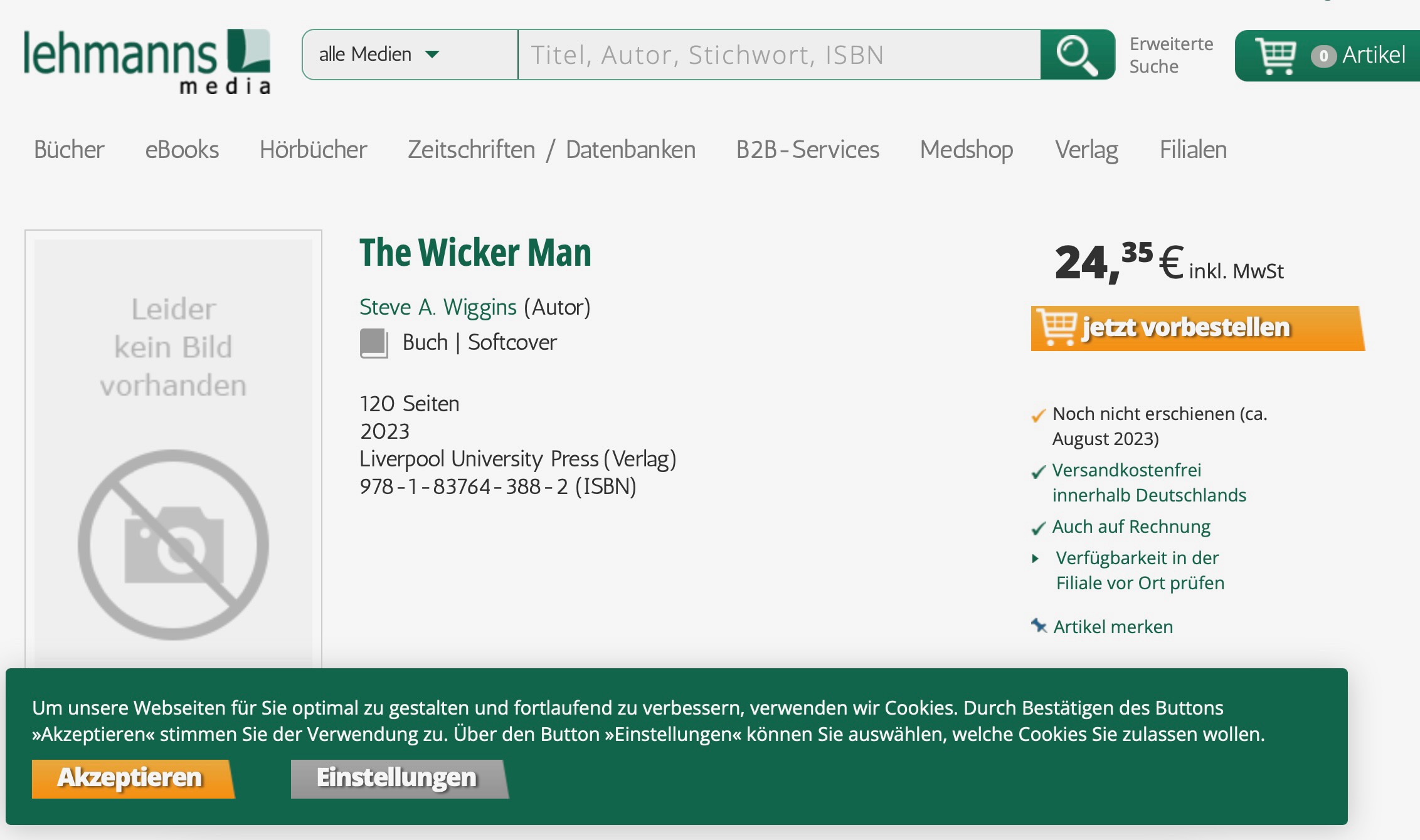
Growing up with siblings, I remember it well—my mother instilling the message of sharing.  If something good came my way, I could count on hearing “Share that with your brothers!”  These days sharing is easy and it only costs you a click.  And it’s very important.  Especially to those of us with soft voices.  You see, there is another new Wicker Man book coming out this year.  This is the 50th anniversary of the movie and there’s a lot of interest.  The other book is getting quite a bit of free press because the publisher knows the importance of sharing the information.  Click that share button!  Meanwhile I’m watching what we in the biz call the NBA (New Book Announcement) creep very slowly out of its box.

A couple days ago I wrote about how Amazon isn’t aware of the book, and Google can’t seem to find it.  In the intervening days it has now shown up on Lehmann’s bookselling shop in Germany.  You here, reading this, are the only people in the United States (if you are) who know about this book.  My voice isn’t very loud.  I don’t get retweeted and I don’t even have a cover image to share yet.  I’m still waiting for it to appear on the publisher’s website.  (This is one of the reasons I’m (hopefully) moving on from publishing with academic presses—they tend to be a touch slow.)  What can you do to help?  Share this post.  It’ll only take you a second.  Look down below this post and you’ll see this:

Of course, I can accept that you don’t like what I’m saying.  But if you’re on Reddit, Facebook, Twitter, or Pinterest, you can share the misery.  All it costs is a click.  The thing about the internet is that little things can add up to a lot.  That’s the whole idea behind websites that take a small cut to get the item you want out to you.  Life by a thousand cuts.  If enough people share, even those with a “Yop” to utter can save all Whos, right Ted?  I used to think all those YouTubers were a bit gauche with reminders in each and every video to click the “like” and “subscribe” buttons.  Now I’m coming to understand that that’s the way life on the internet is lived.  And May Day is just around the corner. Notice for my book will continue to creep out slowly.  Meanwhile I’ll look at Lehmann’s website and hope for the best.


Take the Tour

If you read my blog posts on Facebook, Twitter, or Goodreads (Hi, y’all!), you may not be aware of my actual website.  Now I have no kind of fame, no matter how modest, but the website does contain more than my blog posts.  I’ve been working on it lately to try to update the place a little.  There are separate pages for all my books, for example.  And links to the various interviews I’ve had, as well as links to my YouTube videos (thank you to my original 14 followers!).  If you know me personally you know that I’m not the self-promoting type.  I have a monster-sized inferiority complex (so it’s good that I don’t run for political office), and I’m a champion introvert.  I spend a lot of time by myself.  So why do I do all this web-based stuff?

Good question.  You see, I work in publishing and one of the things I hear constantly is marketing and publicity folks talking about an author’s platform (or lack thereof).  Believe it or not, my humble efforts here outstrip many authors—I do have a website and I tweet and book-face, no matter how infrequently.  In other words I do this to write. Call it being a modern writer.  The days are long gone when you wrote a manuscript and mailed it in and let the publisher do their thing.  To be a writer is to have to promote yourself, no matter how inferior or introverted you may feel or be.  If you’re a regular reader you know I miss the old way of doing things.

Photo by Rodion Kutsaiev on Unsplash

We learn lessons when we’re young.  Those lessons are difficult to unlearn.  I didn’t really know what it meant to be a writer—I grew up among laborers in a blue collar family—but I knew whatever my job might be it would involve writing.  As it turns out I’ve had more success (such as it is) in getting published as a nonfiction writer.  A great deal of that is due to learning how the system works—being in publishing helps—and figuring out how to place a book.  I wasn’t an English or even publishing major.  It didn’t seem to be rocket science back then, but it has become a more technological industry today.  Of course, time for doing this extra stuff is limited.  Indeed, if you work 925 you know that time to do anything outside of work is already rare enough.  If all of this looks like an amateur built it, it’s because that’s true.  The urge to write is, however, elemental.  Some of us are willing to work for words.


Forgot Again?

I’ve noticed a pattern.  I’ve been posting daily on this blog for over thirteen years now.  During the past two of those, several days (including the day before yesterday) have gone without a post.  It’s not that they haven’t been written—no, I have a surplus of ideas—it’s because of the pattern I mention.  I know that early morning is a bad time to be active on social media.  Few others are awake and by the time they are many, many more posts come on top of my meager efforts.  So in my reptilian brain, I think, “Maybe I should wait until about 6:30 to post—you know, when people are awake.”  My reptilian brain tends to rise between three and four (sometimes earlier) and so I really do believe people are shaking off sleep at around 6:30.  I think this although my family repeatedly assures me it’s just not true.

In any case, I load up my daily post on WordPress before starting work, which I also do early.  The pattern for the days I forget to post is this: something sets off my early morning schedule and I forget to click “publish” before getting engrossed with work.  I guess I need a blog posting alarm clock.  For example, two days ago I had an early author call from someone in Europe.  I don’t mind early calls,  as long as they’re pre-arranged, but that meant I had to jog early so that I could get dressed in time—I don’t like meeting someone for business for the first time wearing sweats.  By the time I’d jogged, changed, and wolfed down breakfast, I’d forgotten to click “publish” for the post already loaded up and ready to go.  Any interruption to my schedule can do this.  Just last month I forgot because election results were coming in.  I need that alarm clock.

Posting daily is a happy part of my routine.  I’ve done in when I have a flight out of the country later in the day.  Or when I’m overseas, I make sure to post ultra early Eastern Time (presuming I’m flying east) to make sure I get one post in each day.  If I fly west I post ultra early local time so that I can keep it about the same time as usual, or else I post later than usual—time zones flummox me.  (So far those western flights haven’t been out of the country, I would note.)  When I forget to post, however, I’m home and something disrupts my morning schedule.  Those who live by the clock, I’m told, die by the clock.  And when that happens, I’ll probably have a post loaded but I hope I’ll be forgiven if I forget to click “publish,” even if my alarm clock does go off.


Tone Deafness

Tone deafness isn’t just for music any more.  Perhaps because of the incessant torrent of the internet, we might think we understand something better than we do.  Or this may be what comes after years of what Linda Stone has called “continuous partial attention.”  We’re all so busy that we don’t have time to think things through.  I’ve run into several instances of tone deafness lately, where the sound comes not from music, but from a lack of considering the society.  For example, Black Lives Matter.  When I sometimes feel pressed upon by the fact that the mongrel peoples who came together to eventually deliver me benefitted from slavery I feel helpless.  I can’t understand how Black folks feel, as much as I want to help.  This can lead to tone deafness when I think I’m actually able to explain.

Photo by saeed karimi on Unsplash

This also applies to other aspects of our lives.  If someone we know is too busy, asking them to fit us into their schedule may be tone deafness.  Unless we pick up on the many hints that “not this day, but that day might work” conveys, we tend to miss the point.  I’m always amazed just how many people don’t pick up on the stress conveyed in such situations.  Even professional service folk.  You can almost hear them looking at their screens instead of the distressed look on your face.  When we’re all too busy, ironically, the way to address this is to spend a little more time listening.  Paying attention to someone else.  The world won’t end if we do.

Short emails may show tone deafness as well.  Those who send one or two word emails probably don’t realize how rude it seems on the receiving end.  Perhaps they think it’s the same as texting.  There’s a reason I don’t text.  If someone is important enough for me to contact, I feel that I need to give them the required time.  Look at them, not the screen.  Try to hear the pitch they sing in, the cadence they use.  People make beautiful music.  Lives are symphonies.  Do we really want to approach their performance preoccupied by what’s next on our agendas?  I remember getting dressed up and going to a formal concert hall to listen to live music.  I also remember sitting across a table or desk from someone with no devices, being listened to carefully.  Even if it was a viva it was a wonderful feeling that someone was actually listening.  Now what was it you were saying?