Academic Politics

Being the curious sort, I followed up on the post I dropped the day before Valentines.  I had written about Scholars Press and how details were hard to find.  I kept digging after that post.  I learned some things.  The Society of Biblical Literature (SBL) used to meet regularly with the American Schools of Oriental Research (ASOR).  ASOR was all about archaeology.  Then, in the year 1969 SBL and the American Academy of Religion (AAR), formed the Council for the Study of Religion.  The next year they began holding their conferences together.  ASOR was still part of it.  In fact, the three societies, along with Brown University, formed Scholars Press.  (For those in the know, this is why SBL now publishes Brown Judaic Studies.)  Scholars Press churned along, but ASOR was increasingly being shunted aside.  The conference started being called AAR/SBL, with no ASOR.  In 1997 (I remember this personally) ASOR started holding separate conferences.

Two years later, in 1999, Scholars Press dissolved.  SBL, the oldest of the societies, began publishing as Society of Biblical Literature.  AAR partnered with Oxford University Press to do their publishing.  (By the by, AAR started out as Association of Biblical Instructors in American Colleges and Secondary Schools).  ASOR went its own way, and Brown settled on SBL to continue its religious studies publishing.  As a young scholar, I was a member of all three societies.  (I didn’t attend Brown, though.  But I did go to a graduation there once, if that counts.)  I wondered why they couldn’t get along.  In a word, it was because of politics.
Those who know me personally likely know that I have tried to pursue the ordination track in three different denominations.  What they may not know is that the reason I never got through the process was, you guessed it, politics.  I started to learn, when in college, just how many power plays were involved in covens of ministers.  When dealing with the ultimate power, I guess, everyone wants to get the upper hand.  That bothered me as a seminarian.  The second and third denominations both showed their politics up front, and those sharp, flashing teeth made me realize that I’d never be free of politicking had I moved ahead.  I suppose I could go be a hermit and live in the desert—I might escape it that way, but whenever two or three are gathered, the politics start to show.  ASOR, SBL, and AAR have quite a lot in common.  All are under threat as part of the dreaded “humanities” category, and yet that’s not enough to make them want to pull together.  Politics just go that way.


Scholarly Publishing

So here’s the thing about innocuous names—they don’t work well with the internet.  Search engines throw a rod trying to find something so insipid that it might mean anything.  I’m driven to this topic by the fact that “Scholars Press” or something like it, is used by a number of organizations, some apparently predatory.  If you’re a scholar of religion you know to what I’m referring when I say “Scholars Press.”  You know the neat, trim little monographs that you consumed like popcorn while writing your dissertation.  Try to find a history of the press online.  I’ll wait.

So finally I heaved myself out of my chair and got an actual book (imagine that!) off the shelf.  It is a volume I purchased when the American Academy of Religion and Society of Biblical Literature met in Orlando.  A conference to remember.  So, along with Woody and Buzz Lightyear, we were gathered to learn about religion and I finally shelled out for Ernest W. Saunders’ Searching the Scriptures: A History of the Society of Biblical Literature 1880–1980.  There I found what Google couldn’t: Scholars Press dates from 1974, a joint venture of the two societies.  Originally it published books from the University of Montana at Missoula, and later moved to Chico, California.  Finally it settled in Atlanta and eventually split into two as AAR and SBL took on the publishing of their own books.  I saved myself several minutes of probably fruitless scrolling.  It seems nobody else is really interested in this.  I am an historian of religion, but an historian none the less.  I wanted to know the sequence of events.

I am curious when the two decided to break up this venture.  There was a divorce, or temporary separation, between the societies some years back—I can’t recall when it was—that seems a logical time for them to think about taking on their individual publishing programs, but then again, they may have started before then.  In other words, I don’t have the date when Scholars Press dissolved.  Religious studies, I realize, is a small discipline.  For many colleagues it’s their entire world.  Some of them write histories about various aspects of it—I saw a book that I want to read about the murder of a religion professor Ioan Culianu back in 1991—but compared to history or English, we’re minuscule.  And we don’t seem very curious about ourselves.  We’re an odd lot, that’s for sure.  And we don’t always pick the best names.


The Gift

Each day, each hour is a gift.  With my mother’s passing two months ago, I’ve been struck by the sheer number of colleagues that have died this year.  Not all of them older than me.  I wrote some months back about Michael S. Heiser, a blogging buddy from days past.  An email about a potential author just yesterday sent me back to the Society of Biblical Literature necrology.  This author had died unexpectedly the day before.  Glancing over the top of the list, I saw that three people with whom I’d worked died in November.  This was quite a shock since two of them were younger than me and the other not much older.  The thing about professors is that you kind of expect them to grow old.  To be old.  Life is a gift, and it’s sometimes easy to forget that.

Both tenacious and tenuous, life is a mystery.  Perhaps it’s perverse, but this makes Shirley Jackson’s “The Lottery” seem like a metaphor.  In fact, those of us who read and watch horror generally do so with a purpose, consciously or not.  It helps us face difficult things.  Five colleagues in one year sounds like a lot.  Someone in my family, younger than me, had six funerals to attend this year.  Life can feel difficult at such times.  Horror can be a coping mechanism.  At least for some of us.  It can be profoundly hopeful.  The meaning of life can be elusive, which is why, the existentialists conclude, we must make our own.  Existence precedes essence, as they say.

Carlos Schwabe, Death of the Undertaker; Wikimedia Commons

Other than profession, one of the few things these five fallen colleagues had in common was my perspective on them.  I don’t think they knew each other.  Had I not been an editor I likely wouldn’t have known three of them at all.  We live in a web of interconnection.  And I don’t mean the world-wide web (does anyone even use that term any more?).  Lives are gifts and gifts cross paths with other gifts.  Such information, all at once, can be difficult to process.  It makes me wonder why we allow wars.  Why we don’t think of consequences before we vote autocrats to power.  Instead, if we focus on that ephemeral gift we have, and how we might share it with others, appreciation rather than hatred grows.  To this lonely existentialist who watches horror for meaning, that just makes sense.


Final (not) Thoughts

One thing I’ve noticed as I’ve aged is that I pay attention to necrologies a lot more.  Few people from my college and seminary days stay in touch, and the same is true of my teaching days.  People are busy, I know, but I always look at alumni magazines memorial pages.  Whenever I get on the Society of Biblical Literature website a morbid curiosity draws me to the list of departed members.  I’ve known several of them in past years.  Still, it was a shock to see Michael S. Heiser on the list recently.  For one thing, Michael was younger than me, and for another, I knew him for a long time.  Theologically we were pretty far apart, but that never stopped us from being friends.  We both lived in Wisconsin and we both ended up in academic-adjacent jobs.  We shared an interest in unusual things and we were even blog buddies for awhile.  Michael died back in February.

I hadn’t heard because SBL moved its recently deceased list off the home page (I suspect that’s not the best marketing), so you have to click through.  But when I did I was saddened to see Michael there.  Then I notice two colleagues even younger who’d died in the last few months.  It gives you pause.  There are no guarantees in life, I know.  Those who manage to make it to my age are fortunate, but can generally expect to have a few more years.  That’s not a promise, however.  Having watched a lot (possibly too much) television in my life, it brought to mind a Frasier episode where a colleague the famous psychologist’s age died, sending Frasier into a search for reasons why.  That’s something those older than me tell me that I’d better get used to.

We tend not to want to think about it, but I’ve had both a parent and parent-in-law say how strange it is to find yourself old while still thinking like a young person.  It is bewildering.  And it’s one of the reasons I write so frenetically.  It was after I finished my third book, I think, that I realized I didn’t have all the time in the world left.  I have lots of books I want to write, many of them already started and slumbering on my hard drive.  Michael was also a prolific writer, and a more successful one than I have become.  His blog had more followers.  And it seems like only yesterday that I ran into him at an SBL meeting and he did an impromptu interview with me.  Life’s too short not to stay in better touch.


Outside In

Work duties necessitate my attendance at the American Academy of Religion and Society of Biblical Literature annual meeting, starting Friday, in Denver.  Given the state of the pandemic I can’t say that I’m thrilled to be attending, but work is work.  What really prompts this post, however, is the travel arrangements.  The agency I used is based overseas.  They customarily send a fact sheet about the country to which you’re traveling—in this case, my own.  It was fascinating to read how the rest of the world rates the United States.  Overall we receive a pretty good score, but there are a few items of concern.  One is that mass shootings are not uncommon.  The guide laconically states “Due to the wide availability and proliferation of arms across the United States, high-profile shootings occur.”  This is not wrong.

It goes on to note that if you can avoid being shot, crime rates are overall low in the US.  Disease, apart from Covid-19, is well under control.  While organized crime and gang problems are mentioned, it notes that open conflict between states does not exist.  It seems that, despite the rhetoric of certain politicians who like to use hatred to get their way, we do tend to cooperate pretty well.  We have plenty of micro-cultures here, and I know that I’m only comfortable living in a northern one.  I like four distinct seasons, and I don’t mind shoveling snow, but I’m getting away from my guide.  Hurricanes are a risk on the east coast through November and wildfires are possible in the west, also largely through November.  Earthquakes are localized and infrequent.  We live with a heightened risk of terrorism, but our medical care is good.  If expensive.  We have good dental.  

While I didn’t really learn anything about the United States per se, I did learn a little about how others view us.  We are a nation with tremendous resources and great potential.  Our melting pot nature is, I believe, the source of our cooperative strength.  We are still, after two centuries, suffering growing pains because there are some who want things the way they used to be in spite of the incessant, almost daily, changes that take place.  There is no turning back.  After the apple has been eaten you can’t unlearn that knowledge.  The recent elections spoke pretty clearly: we believe in democracy and we support women’s rights.  That’s how we see ourselves.  How the world sees us, however, may be quite a different interpretation.


All About Merch

Although I’d heard of it uncomprehendingly when I was in seminary, I first joined the Society of Biblical Literature in 1991, while a doctoral student.  I religiously *ahem* attended the annual meetings until I lost my job and my ability to afford it.  When I landed in publishing I started attending again, and over all these years I’ve started to notice a lot of swag creeping in.  Publishers sell bauble headed theologians (aren’t they all?), playful knick-knacks, and even socks bearing the cover design of established commentary series.  It’s as if we want to tell the world that studying the Bible is cool.  (Why not purchase some nice warm socks?)  So I wasn’t really surprised when the society itself, fondly known as SBL, started selling its own merch.

On most SBL electronic newsletters there’s a link to the vendor that produces shirts and mugs with jokes that only other biblical scholars will get.  (I never found this a very humor-laden community, being under duress, as it is, and as deeply conflicted as the country that hosts it.)  Eventually I grew curious and clicked on the link to the novelty tee-shirts and mugs.  It took me to a company called Redbubble.  SBL Press has its own page there with a strange header photo, apparently of a G. I. Joe and G. I. Jane reading some of SBL’s books.  Weird marketing is fine, of course.  Some of us have almost a connoisseur sensitivity to the bizarre.  As for the merch itself, it includes limited designs since, I suspect, most professors aren’t novelty tee-shirt fans.  What caught my attention was the button at the bottom that said “Mature content: hidden.”

Did the Society have some top shelf items?  The Bible certainly has quite a bit of mature content itself.  Questionable stuff as well as scenes that are, well, let’s just say scenes that are left out of children’s Bibles.  Of course I clicked the link.  It took me off the SBL Press page, naturally.  Redbubble has, I’m sure, many clients.  SBL’s demographics are slowly changing but the field is one still dominated, in numbers at least, by white men.  They’re the ones who benefit the most, I suspect, from a society that bases itself on the biblical outlook of the world.  At least as far as how it’s been applied in northern Europe and its colonial enterprises.  SBL tries to attract younger scholars, of course.  And everyone like knick-knacks and inside jokes. 


Missing Markers

Something truly remarkable happened this week.  The Society of Biblical Literature, which, along with the American Academy of Religion, meets annually in November, has canceled its in-person meeting.  I’ve been attending this conference since 1991 (with a few years off for good behavior).  It always meets the weekend before Thanksgiving, stretching to the Tuesday prior.  Some academics use the meeting to have an exotic Thanksgiving break with their families, particularly when it congregates someplace warm.  (It was scheduled for Boston this year.)  So I’m ruminating what this will mean for a year of missing markers.  Some of you may recall I missed two years ago, electing to stay in Newark Airport instead, but this is different.  We’re all being changed by this virus.

Missing markers.  That’s what my wife calls it.  March 12 was the day that Covid-19 became a crisis.  In my extended family that’s in the middle of birthday season.  Travel plans had to be altered.  Trips to see loved ones had to be delayed.  Then cancelled.  Memorial Day came and went.  It was a long weekend, but for most of us it was a long weekend at home.  Our usual summer trip to the lake was also a victim.  A remote lake may be the safest place to be, but you have to get there.  Flying doesn’t seem safe and we don’t have enough vacation days to drive all the way out and back.  Here we are halfway through the summer and each day feels pretty much like the one before, even if it’s a day off work.  Time seems out of whack.  Back in April it was hard to believe it was still 2020, now it’s difficult to comprehend that the year’s more than half over and there will be no AAR/SBL in November.

Growing tired of the phrase “unprecedented times,” I prefer “missing markers.”  Yes, the weather’s still doing its time-keeping job.  This summer has been quite hot around here, for the most part.  I remember shivering in my study sometime not so long ago, bundled up in layers and thinking that when summer rolled around this coronavirus would be a bad memory.  If only there were something governments could do to keep people safe.  If only there were people in the White House who cared.  I had visions of professors, hundreds and hundreds of them, wearing masks with their tweed.  It was a vision of wonder.  They’d walk up to you, extending an elbow to bump, but you’d back off.  That’s actually too close.  And lecturing spreads germs very effectively.  Over time 2020 itself will become a marker.  I’m not sure anyone will miss it, however.


Bunny or No?

Since we’re in the midst of a smaller holiday season (capitalistic societies can only get away with one major holiday season because the workers must work) many people are wondering whether they should go to church for Easter tomorrow.  I’ll confess I woke up from a nightmare this morning where I accidentally forgot about COVID-19 and went to church.  I stepped inside and the building was full.  I tried to find an empty pew to socially distance myself from all but the Divine, and there was no room.  I felt infected as others started to cough around me.  In real life I’d just read from the World Health Organization’s situation report (number 80, located here, in case you want to see) that we’ve just reached day 100 since WHO received its first notification of this new disease.  The report has guidance for those who feel compelled to gather for religious services.  It makes for very interesting reading.

WHO, like certain political parties, knows that people will listen to their religious leaders rather than reason.  (And still our universities cut positions in their religion departments since, apparently, it is best not to know about such things.)  Recognizing that a secular, science-based organization simply can’t compete, WHO urges religious leaders to spread the word about evidence-based responses to the outbreak.  Don’t gather large Easter-day crowds (they also mention Passover and Ramadan), but, interestingly, do keep the services going.  WHO recognizes the psychological (you can’t say “spiritual”) value of religious belief.  It gives people hope and comfort.  It keeps them going in difficult times.  Call it mental health, but the World Health Organization has wellbeing right there in its title.

Photo credit: ItsLassieTime, via Wikimedia Commons

Ironically, the same day I saw an email from the other acronym in my life, SBL (the Society of Biblical Literature).  They were releasing their annual report showing the dismal job market figures for the discipline over the last year.  These jobs are fading and although WHO recognizes billions of people are motivated by religion our smartest institutions are shifting their money away from understanding it.  The COVID-19 outbreak puts us in this strange place where disjunctures become focal points.  If you look at a field of uniform gray long enough you’ll stop seeing anything at all.  You need contrast for vision to work.  WHO recognizes that religious observance constitutes a major challenge for the effort to keep people isolated.  Universities now in isolation, continue to see no reason to study this.  I’m waiting to awake from this nightmare.


All Been Ready

As the pandemic stretches on and getting things in stores—or even from Amazon—isn’t assured, my thoughts go back to Larry Norman.  Specifically to his song “I Wish We’d All Been Ready.”  Made famous for many by its use in the 1972 rapture film A Thief in the Night, the song recounts the state of those “left behind” when a piece of bread could be exchanged for a bag of gold.  The lyrics are haunting in their sincerity.  Here in Pennsylvania, as in neighboring New York, non-essential businesses have closed, per order of the governors.  Periodic forays to the grocery store show the empty shelves of panic buying.  Norman’s song rings in my ears.  Only this isn’t a biblical plague.  We’re just acting like it.

No doubt technology has been of great use in keeping us aware.  I do wonder, however, at how panics seem to come more quickly now.  Slowing down manufacturing will have a knock-on effect for things down the road, of course.  Right now we’re all wondering how we’re going to get through yet another day just sitting in the house.  Meanwhile the lawn is beginning to grow and I’m going to have to get out there with the push mower soon.  I’d been planning on shopping for a better one this year, but plans seem to have suddenly pooled at my feet.  What is essential travel anyway?  Does it count a trip to the big box hardware store to buy a reel mower?  Should I even bother about the lawn when there’s no toilet paper within a fifty-mile radius?  I wish we’d all been ready.

The funny thing about all this is how it makes us focus on the here and now.  While we’re waiting for things to “get back to normal” we’re being told nobody knows how long this might last and we should plan to hunker down for some time.  The International Meeting of the Society of Biblical Literature (being held in Australia this year) was cancelled.  Many of us in the discipline have had our lives revolving around the Annual Meeting in November for all of our adulthood.  If that meeting’s cancelled how will we even know when Thanksgiving comes?  Can it even come without the crowds at the Macy’s parade?  Best not to look too far ahead, I guess.  The rapture is a fictional construct, but the effects of a pandemic are eerily similar.  I do wish all of us had been ready.


Merch

I recall the time I first heard the word “merch” used as a verb.  I was with some wonderful ladies on the second annual Women’s March, in New York City.  We had to leave fairly early to get there from Jersey and as we made our way to the march route, we saw the goods.  Vendors had all kinds of things on sale, from the ubiquitous tee-shirt to refrigerator magnets.  One of the women in the group said, “I guess you can merch anything.”  And so you can.  People will buy all kinds of identifying marks.  It’s a craze I personally don’t get into.  I buy plain clothes, having more of an Amish aesthetic.  Still, I was a little surprised to notice that the Society of Biblical Literature is now merching itself.

Now, who can blame a non-profit for trying to score a little on the side?  We all know what that’s like.  What I find myself most curious about is who would want to advertise that they’re working on a degree that will, in all likelihood, find them on the breadline when it’s all over?  I’ve known many who’re proud to be nerds—they’ve got employment to give them creds.  Those of us tormented by the meaning of it all, not so much.  My decision to go to grad school was accompanied by the blessed assurance that there’d be plenty of opportunities, but there was no merch.  Indeed, I was two years into my doctorate before  I even found out what the SBL was—the great connector whence came jobs.  At least in theory.  I found my post at Nashotah House because a friend told me about it.  I still have some of their merch.

Knowing what I do now, would I have done it any differently?  It’s difficult to say.  Who can recall the frame of mind of his younger self with such clarity as to know his choices?  Having studied Bible I was curious whence it came—to turn back even further the pages of history.  As I sit here in the early morning I have on my last two remaining pieces of Edinburgh merch.  My moth-eaten woolen divinity scarf and my blue alma mater sweatshirt.  I try hard not to think how close to three decades ago it was.  I was so sure I’d find a job with that rare Scottish degree, imprint of John Knox’s breeches still fresh upon my head.  Instead the merch of my current employer—a coffee mug—stands before me, reminding me that work alone awaits.


Reentry

Image credit: NASA/ISS Expedition 28, public domain from Wikimedia Commons

They call it reentry, I suspect, because of the perils and stress experienced by astronauts reentering the earth’s atmosphere.  If the calculations are off, you either burn up or bounce back into the void.  Neither is a pleasant prospect.  It is also the feeling many of us experience at returning to work after the holidays.  We’ve had a taste of life without gravity, then suddenly you’re back into the thick of things.  It didn’t help that among my accumulated emails (I do not check work emails during my few allotted vacation days or holidays) was the notice of the sudden death of fellow scholar Gary Knoppers.  Gary’s interest early on included Ugaritic, before shifting to Second Temple Studies.  I once asked him over breakfast if he recalled the question I posed as a grad student when he presented an Ugaritic paper back in Kansas City.  Of course he didn’t; I don’t recall any questions I was ever asked either.  (With one exception.)

Gary died prematurely, just back before Christmas.  The usual venues for finding out such news, like the Society of Biblical Literature portal, were also on vacation.  It is maybe best that I didn’t learn about it until reentry.  Still, it didn’t make it any easier.  I can’t claim to have known Gary very well, but the suddenness with which someone you know dies can lead to shock.  Not so much the fact of death itself, but that it has claimed someone you knew.  I was working with him on a book idea for my employer.  We had traded health complaints about not being young men anymore.  It’s all so very human.

On Ash Wednesday a couple years back one of my colleagues asked if I was going to get ashes.  I replied that I thought about death every day and that I didn’t need ashes to remind me.  She thought it was a funny response, but it is actually true.  One benefit of my religious upbringing is that it early took away the fear of dying.  Since all people have to face mortality, it never made sense to me to fear it.  That doesn’t mean the same thing as wanting to die, but the price to pay is frequent visits to the valley of the shadow in my mind.  I was merely being honest that Ash Wednesday; my interest in horror is, by the way, related to that constant awareness.  Gary was a productive scholar and a kindly man.  Learning of his death so soon after the holidays became its own kind of reentry.  And a reminder that January looks both forward and back.


Extra Baggage

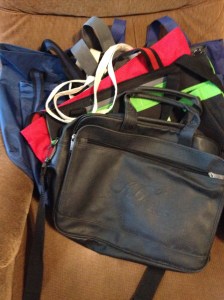
So, I’m packing.  Have been, on and off, since January.  One of the most dreaded moments of packing is the closets.  You know how in horror movies the villain often hides in closets?  We have no danger of that.  Any monster foolish enough to try it would be suffocated under tons of stuff.  Some houses may have walk-in closets, but I am inclined to call a mining company whenever I need to find anything in ours.  Our closets have led full lives.  It’s almost 100 degrees outside and I’m excavating.  We’re at that stage of “absolutely need to keep?” instead of “do we want this?”  Then I came upon it.  The layer of SBL tote bags.  Like a paleontologist of ancient academia.

If you’ve been a member of the Society of Biblical Literature you know what I mean.  Every year the Society wants you to realize value for your money, and they give you a tote-bag to help you haul home the books you’re going to buy.  Long-time attendees know to pack an empty suitcase inside their regular one just to accommodate the books.  (That could also account for about ninety percent of my packing—we have more books than a small town public library.)  But it’s not the books that are the problem today, it’s the bags.  I’ve been attending SBL since 1991.  Do the math.  I seem to recall that they didn’t do tote bags back in Kansas City, but soon after they became part of the agenda.  And I have an impressive pile of them in my closet.

Too small for groceries—especially in the early editions, back when we could meet in smaller venues—and too impractical for anything other than books, they multiply in our closets.  What professor doesn’t have his or her iconic briefcase already?  Reduce, reuse, recycle they say.  At least half of my totes have never been reused.  Zippers?  Who thought of that?  Pulling handfuls out of the closet, I marvel at their colors.  I can’t remember everyone walking around with a red bag—what year was that?  (San Francisco, 2011.)  The black leather edition—remember that one?  (SBL, n.d.)  The bags aren’t really useful for packing, on a movers’ scale.  You can imagine the burly guys outside their truck scratching their heads at this impractical conveyance.  Like so much else in life they’ve become mere souvenirs.  From the French word for something like “remembrance,” souvenirs are meant to take us back to the place in vivid detail.  I fear that many past meetings have run together into a blend of biblical arcana.  I’m sure that’s just me.  Still, I’m responsible for this new discovery.  I’d I’ll need shortly to decide whether these totes go into the museum or back into the landfill that moving inevitably creates in a throw-away world.


Museum Piece

So the Museum of the Bible is now open in Washington, DC. It actually opened while a quorum or more of biblical scholars were busy making their way to Boston for the annual meeting of the Society of Biblical Literature. Many of the guild realize that the museum’s a conservative, evangelical venture, but it brings some attention to the beleaguered field and so it’s strangely welcome. This shows itself in the rather surprising names on museum publications. Renowned scholars don’t seem to think through the implications of supporting such places with the star appeal of their names. Indeed, many in the professorate are starved for attention—I’m not judging; I implicate myself even by making such a suggestion. When such an institution opens, it validates those it implicitly condemns.

A Bible museum?

Scholars can be woefully naive. Visiting places such as the Museum of the Bible, or the Creation Museum, or the Ark Encounter, pumps money into the already very well-funded Christian right. Such believers are extremely political and seek to get candidates like Trump elected. By slaking our puerile curiosity, we’re funding those who’d have us stripped of our very freedom to believe as we do. The paper trail’s there for any who wish to follow it. Supporting such ventures in any way will lead to headaches in the future. Sure, I’d love to see dioramas of dinosaurs on the ark so that I could feel superior for a little while. There’s a price for such vanity, however, and that price is the loss of freedom itself. We see it at work in our government at this very moment.

Museums are places for artifacts that are outdated. This is an ironic statement to make concerning the Bible. Especially by those who believe it is the final word. Why put that word into a museum? The irony’s worth it if enough paying customers arrive. Scholars meanwhile try to find ways to analyze this. Articles and books are appearing, stating what we already essentially know. The Green family, motivated to repressive political action because of their Bible belief, have spent money to build an elaborate museum, money that could’ve been used to help the poor. The book that appears in that museum suggests that the poor should be our concern. And although it actually does say that idols shouldn’t be worshiped, it has the great potential to become one itself. All you have to do is pay the admission price to find out.


Sacred Places

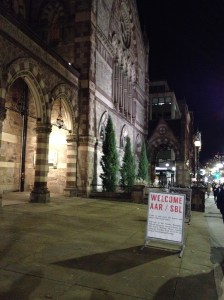
Boston Brahmins, lock up your doctrines—AAR/SBL’s come to town. Boston always has special associations for me. My first home away from home. Where I met my wife. Where I learned what you can only learn at seminary. Coming back is like coming home. Of course, I’m here to work. As I was getting ready for this trip I recalled that the conference met in Boston when I was studying for my Master’s degree at Boston University. Unlike many graduate schools these days, no overtures were made for students to attend. In fact, I didn’t know what all the in-joking among the faculty was all about. I relearned the existence of the conference as a grad student in Edinburgh a few years later. Few traveled across the Atlantic for it, at that point. In fact, none of the Edinburgh faculty who’d eventually become regulars had ever considered going. My first meeting was in Kansas City.

The meeting has grown since those days. Now regularly expecting about 10,000 scholars (can one help but think of 10,000 maniacs?) a year, the venues are limited. Atlanta, Boston, San Antonio, San Diego. Chicago and Denver once in a while. Personally, I’m glad it’s close enough for a train ride. New York City and Boston, two peas in a pod. My only regret is that I won’t be able to get out to my old stomping grounds. Some colleagues (few read this blog) contact me at the last minute asking if we can get together. My schedule’s booked from breakfast through supper each day. Those who attend as participant-observers have no idea. These are the longest working days of my entire year. Still, they’re in Boston.

I often muse about place on this blog. We’re attached to the place where we’re born—it’s our personal sacred space. In life we grow attached to other places, whether we can settle there permanently or not. I wanted to live in Boston. I did so for a year after attending seminary here, making a living doing this and that. Having a master’s degree in religion doesn’t get you far in life. In those heady days of sleeping on the floor and finding out what life was really like for the unconnected, I learned an awful lot. And when the woman I wanted to marry came back for a visit, I proposed. I’ve only ever visited Boston since. But whenever I manage to do so, even if it’s just for work, it’s like coming home.


Some Bible Lovers

I’m on a train heading to Boston. If you notice a dearth of religion scholars in your neighborhood this weekend, it’s because it’s time for the American Academy of Religion and Society of Biblical Literature annual meeting. If a religious emergency comes up, take two of your favorite scripture and call the office next week. Viewed from the outside, this must be one of the stranger scholarly gatherings. A few thousand people get together in posh hotels and convention centers to exchange ideas about which the larger world cares very little. Ironically, the vast majority of people in the world are religious, but as a society if we know enough about the Bible to get us through the most recent indiscretion, so we’re good. Let the scholars have their fun.

This year there’ll be a session on monsters and monster theory that I helped to organize. That doesn’t mean I’ll get to attend it—the conference is a very different beast for those on the exhibit hall floor—but I’ll have the satisfaction of knowing that it’s happening. Years ago I discovered that many of my colleagues who are teaching shared an interest in monsters. Many of us weren’t aware of the others because this isn’t the kind of thing you talk about in polite company. One thing an editor may be is a vector. We hear what widely separated people are working on. Every great once in a while we’re able to put the pieces together. So it was with monsters. There seemed to be a critical mass, and two or three colleagues took the idea and ran with it. Or ran from it, whichever you do with monsters.

For me Boston will be a series of meetings that will blend into one another until I’ll have to consult my notes to remember anything at all. If I could feel this wanted outside the conference I’d never have to dream of being a rock star. You see, editors are the gatekeepers of academic publication. For those lucky enough to have teaching jobs, it’s publish or perish, so the editor is a vital link. The rest of the year we fall into the background. Emails go ignored. Reminders are forgotten. Requests unanswered. But here, out on that carpeted concrete, we’re the ones they’ve come to see. What we do in the conference matters very little to the world at large. But we do it anyway. We gather together just before Thanksgiving, thankful to be reminded that there are others like us.