AAR/SBL Chicago

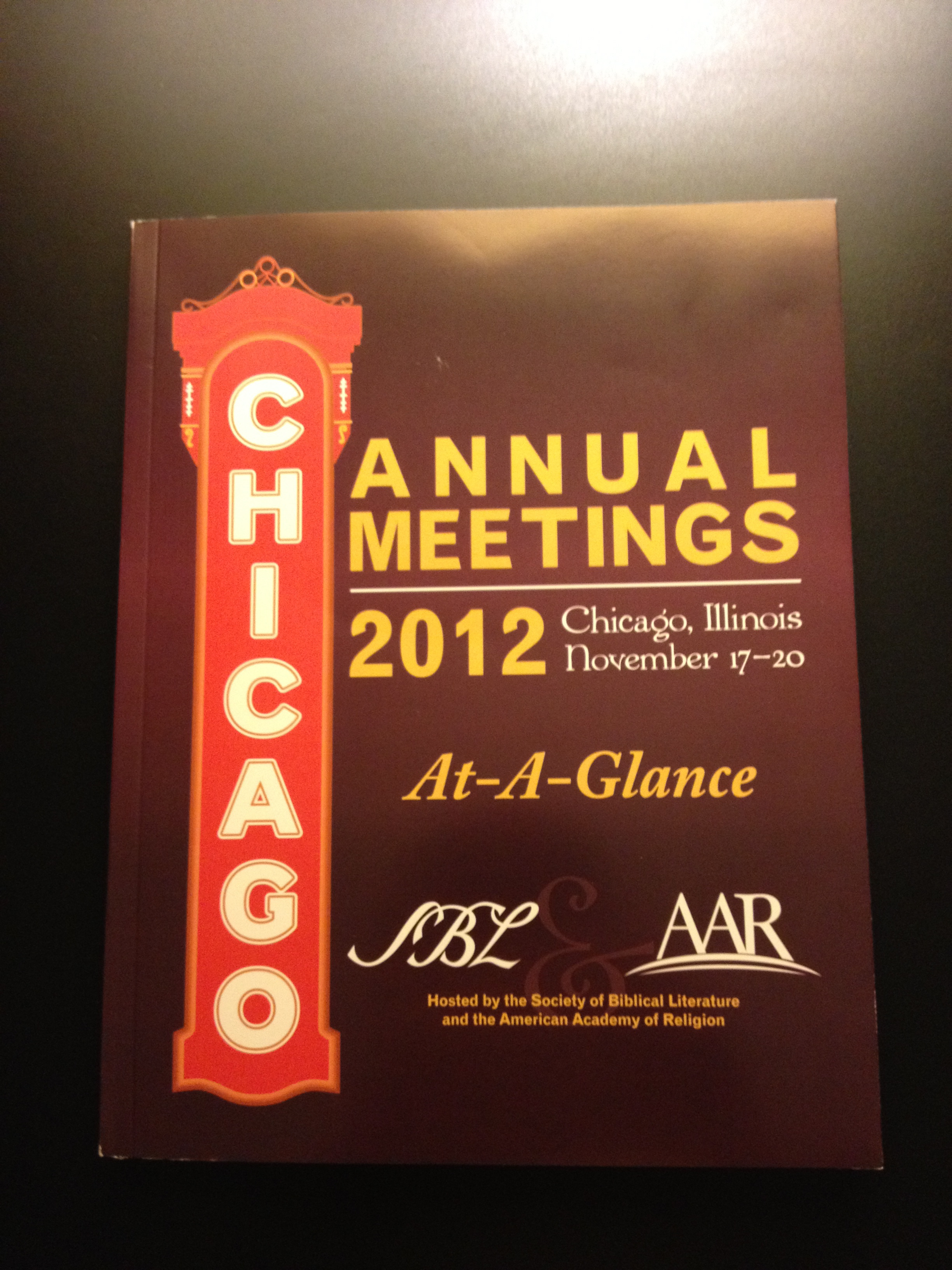
On just about any playground you’ll spot the kid who’s watching from the side, instead of playing with the others. That’s me. I don’t suspect that anyone starts life wanting to be left out, but some of us—attuned to the subtler messages of life—become aware that we’re not really invited or welcome. That sensation bathed me in its eldritch light once again while waiting for my flight to Chicago for the American Academy of Religion and Society of Biblical Literature annual meeting. I’ve often wondered what it must be like for those innocent aeronauts not clued in that the Friday before Black Friday (the real holiday, I’m led to believe) that flights to a specified city will be choked with crusty professors of religion. Sitting in Newark Airport and hearing the word “Ugaritic” from the seat behind me, I knew it had begun. I turned around. No flash of recognition. If was as if I hadn’t spent years learning that obscure language and publishing in the main journals. The invisible man.

The airport before the AAR/SBL annual meeting is a theological locker room where the guys gather to compare the size of their, um, theses. It’s pretty hard not to overhear, once you’re tuned in to your specialization, as colleagues lay out their publications, invited papers, international travel plans. I’ll admit to being jealous. They’re living the life for which I trained. I had taught for nearly twenty years and was never really invited to play. Now here I sit, knowing what Ugaritic is among the perplexed business travelers, but I’m not one of the big boys.

I realize that outside the rarified world of higher education Ugaritic matters even less than the homeless unfortunates shivering in the streets of Manhattan or Chicago. Back in the brief days when I tried to be a player, I remember attending an Ugaritic conference here in Illinois. Crowded into an elevator with renowned colleagues, one of them joked, “If this elevator falls, the field of Ugaritic studies may never recover.” An exaggeration, but not by much. Present company excepted. Of that august group, only one was asked to step off into the void. His exit was barely noticed. Ugaritic studies thrives. The poor beg for alms. And one kid, even though he now understands the rules of the game, still watches from outside.
National Fear

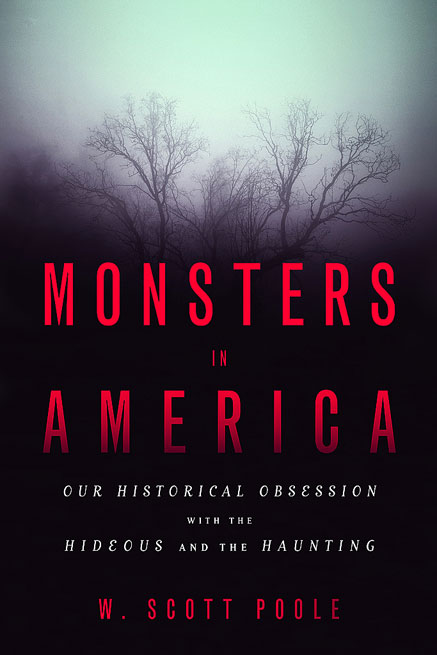
Back in my full-time teaching days, the American Academy of Religion and Society of Biblical Literature annual meeting was an excuse to buy books. Not that we were flush with money, but the prices were so good (we’re talking academic books here) that they simply couldn’t be passed up. Those days are long gone. This year I limited myself to a single book: W. Scott Poole’s Monsters in America: Our Historical Obsession with the Hideous and the Haunting. I was not disappointed. Poole gives us a smart study with considerable insight into American culture. Not only that, but it also proved an excellent source of self-understanding. I had never come across the phrase “monster kids” for those of us born in the blue light of the television when the Universal monster movies were released for television viewing in the 1960s and 70s. Poole classifies himself in that camp, and it is clear that we share this “guilty pleasure.”

Categorizing our monsters into types that fit various aspects of the American self-image, we find our national phobias reflected in our fictional fears. Throughout the book the uneasy sense of uncertainty towards sexuality, science, and death, like the revenants described, keep arising from the ground. Although Poole is a historian, it very soon becomes clear that one of the main driving forces behind both identifying and challenging these monsters is religion. It is a view Poole shares with Douglas Cowan and Stephen Asma and other analysts who take seriously the origins of our fears. Monsters creep out of the same mental space as gods. That which is not real is no less scary for its non-existence.

Particularly insightful was Poole’s analysis of the subversive nature of monsters. They challenge convention, forcing a cultural catharsis. The notable exception, Stephanie Meyer’s Twilight series, also has a religious rationale. Meyer, a conservative Mormon, effectively extracts the fangs of the vampire to make it a safe, if not Christian, monster. Monsters make establishment believers uncomfortable, for they remind us of the darkness that always follows the light. Humanity responds with efforts, religious and scientific, to banish the dark. But at the end of even the longest day, night will come. When it does, I would recommend curling up with Poole for an evening of cultural self-understanding. Followed by a bowl of popcorn and a movie from his filmography.


The Self-Importance of Nothingness

Not that I’m aspiring to Sartre, but being in the presence of so many academics brings out the natural existentialist in me. Religion is a funny field to engage in higher education. We are studying an intangible. Many would say an illusion. If we are too bold about what we find, no shaking hand will deign to sign the paycheck, and so we carry on, innocuous, unperturbed, self-assured. At conferences like this I sometimes sit back and watch others walk by. Having entered the academic world from humble, uneducated beginnings, I have no pretensions about what I do. Or where I might go. Yet I hear idolatrous whispers following those who’ve made a name for themselves. God-struck grad students with that theophanic gaze leveled at the man (sometimes woman) whose name graces the cover of so many books. God’s very representative here on earth. Incarnate in this very room.

I entered religious studies because I arrived at college knowing nothing. An exasperated freshman advisor finally insisted I chose a major. I said I didn’t know. “But what are you interested in?” To me religion wasn’t as much an interest as an imperative. Some churches raise their young to believe that all else is vanity. Every moment should be spent seeking that elusive deity, the one whose very words the clergy speak. I fell into religious studies. I fell far. Reading the Bible multiple times as a teen, classes weren’t that challenging. Ideas were. There comes a time, undefined so as not to be pinpointed, when an invisible line is crossed. Then, when you look back, everything has changed. A dark secret has been planted deep in your psyche and you realize that you are a religion scholar. There is no turning back.

No Einsteins exist in the world of the academic study of religion, but gods abound. Watching colleagues who’ve achieved the dream, who’ve been tenured and pampered and paid well to deign to share their lofty thoughts with the rest of us, I feel like I’m watching shadow puppets against a blank wall. When will they get God into the laboratory and switch on their fancy, humming machines, and the one that goes “ping,” to uncover the truth of the universe? How much lower can we mere mortals stoop? It often feels like I missed that crucial first day of school. Having peered long over the ledge, however, I realize that we are all in this together. Has anyone ever bothered to count the homeless in San Francisco? Has anyone ever bothered to look into their eyes? And that guy with high name recognition? I’ll ask him to write a book. And I will fawn and coo. Why? Because I know the hand that signs the check, and I know the price of idolatry.


I Left my Bible in San Francisco

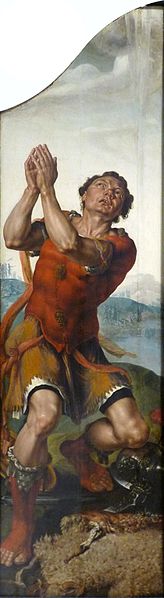
Gideon prays for a Bible

I’m staying at the Hilton, Union Square in San Francisco. Surrounding me are over 10,000 (is that a proper myriad?) religion and Bible scholars gathered for the American Academy of Religion and Society of Biblical Literature annual meeting. I travel light. Having left my Bible behind I went to look up something in the Gideon general issue. It is not here. The world’s largest academic conference focusing on the Bible, four hundred years after the King James Version hit the shelves, and I am Bible-less in my hotel room. Of course, once I get to work I will be surrounded by Bibles, some of them walking, talking resources who have the whole book memorized. Yes, the Society is that kind of place. The Gideon hotel Bible is an American institution. It feels like a constitutional right. When my daughter was very young and we stayed in a hotel, she found the Gideon Bible and asked what it was. We explained that the Gideons leave a Bible in hotel rooms all across the country. “That’s just weird,” she said with all the conviction of a pre-teen.

There are current movements to remove Gideon Bibles from hotels. They do, after all, represent a privileged position to Christianity in a nation founded on religious freedom. No one is forcing you to read that Bible, but it is there, like a tell-tale heart, in your bedside table drawer. Thumping incessantly. To read or not to read? What’s on the TV?

My favorite discussions at conferences like this are with scholars who find the privileging of one religion distressing. Our culture is so grown up in so many ways; we are more enlightened about sexuality and gender and race, and yet, and yet… We still like to have that Gideon Bible nearby. We like our political candidates Christian. Preferably Protestant, although a Catholic will do if he (inevitably he) is on the right side of the right issues. We are vaguely and implicitly afraid of those who don’t share our convictions.

In a moment of levity near closing time yesterday, a customer stopped by to say Routledge should have more gimmicks. Many publishers have giveaways, and some have little games that bearded, bespectacled professors sometimes even play. The customer suggest darts, or even a little shooting range. I said, “Guns and theology are sure to lead to trouble.” Although he laughed, I was serious. Few things in this world can be justified as easily as religiously motivated slayings, at least in the minds of the perpetrators. And to borrow a phrase from a budding genius, “That’s just weird.”


Saints and Angels

From Wikipedia Commons

San Francisco. As I take a look down the coast I see Santa Barbara, Los Angeles, San Diego. So many saints and angels. And, of course, San Luis Obispo. I’m here in the city of Saint Francis (an odd choice for a rustic saint) for the American Academy of Religion and Society of Biblical Literature annual meeting. Before I began this blog, I attended this conference every year, and then the societies decided that they didn’t like each other any more and had a trial separation. Unwittingly, they were following religion, American style. If we don’t like you, even if you’re in the same tradition, we’ll take our marbles (presuming we have any) and go form our own denomination. This easy divorce of dogma is very American.

For such a religious nation, the United States is remarkably prone to hatred. Even scholars of religion can’t get along. We call each other names like “liberal,” “conservative,” “evangelical,” “secular,” “atheist.” Each a swear word. Long ago it was recognized that these two academies have more in common than not. I mean, come on! Dowdy professors studying utterly impractical, arcane beliefs bridging magic and modernity? Who do we think we’re kidding? I used to give papers here based on one single word of the Bible! So in the city of Saint Francis we are together again. American Academy of Religion, meet Society of Biblical Literature. In the same hotel, but maybe not yet ready to share the same bed.

We reflect the society we inhabit. Christianity in America has a venerable tradition of splitting and reuniting. Evangelical United Brethren, United Methodist, United Church of Christ, anybody but the Unification Church. We come together and soon learn that some molecule of doctrine is out of place—time for an atomic reaction. We are the scholars of religion, and we can’t stand each other. So we’re leading the way, America—we’re reconciling! We’re trying to get together for awhile. Next time let’s make it in a Protestant city.


Jesus? No News

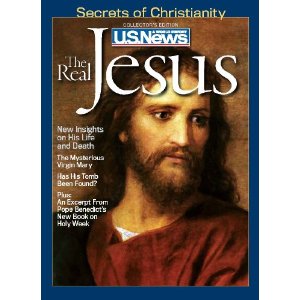
Stepping into the Port Authority Terminal in New York City may be the last place I expected to see Jesus. But there he was, at Hudson News, his beneficent face forming a repeating mosaic before the hurried and harried commuters rushing to get to work. U.S. New & World Report’s special issue features Jesus. Obviously. Racking my half-asleep brain, I couldn’t think of any reason for this sudden popular epiphany; it seems out of sync for Christmas and Easter, and no big news discoveries in the archaeological world had been recently announced. Perhaps the editors know the American Academy of Religion and Society of Biblical Literature annual meeting is coming up next week. Getting 10,000 scholars of religion together in one location is enough to make even the most hardened skeptic pray for a miracle. So, what are these “Secrets of Christianity” that call for a special edition?

The sidebar taunts: “New Insights on His Life and Death,” “The Mysterious Virgin Mary” and “Has His Tomb Been Found?” I am curious about what makes Mary mysterious; she is a minor character in the Gospels who rose to a mysterious prominence only with Catholic hagiography. Well, the sidebar does also state that the special edition has “An Excerpt From Pope Benedict’s New Book on Holy Week.” Spoiler alert! Please keep in mind that Holy Week is months away yet. Perhaps it is in response to the overly religious tussle that is going on with Republican presidential candidates. What was once a forbidden topic of discussion is now headline news, and the average person might feel the need to brush up on Christianity 101. Problem is, apart from the Gospels—and their brief is not always historical—we have very little in the way of evidence about Jesus. In the first century he was just another radical rabbi, not likely to have garnered much public notice until after his martyrdom. That means that the smallest nuggets become huge in a world where we simply don’t know.

The cycling and recycling of Jesus into the public consciousness is big business in America. With the frenetic faith claims of political candidates lacing the headlines, it is almost like a high school locker room with each contender claiming to have the bigger God. Cracking open the magazine on my lunch hour confirmed my suspicions—there’s nothing here that scholars haven’t known for years. Problem is, scholars don’t speak on a level that most people can hear. I don’t recall the last time I saw a professor taking a bus or hanging out in a bus terminal. That’s the thing about Jesus, you can always find him hanging out with the common folk. If religious specialists would learn to speak in plain language there wouldn’t be so many “Secrets of Christianity.”


Wasting our Breath

The internet is alive with the sounds of musings about the appropriateness of various types of scholars doing biblical research. The discussion revolves around a recent article by Ronald Hendel in Biblical Archaeological Review, a useful, if sometimes overeager, magazine. In it Hendel laments the policy of the Society of Biblical Literature, a professional group to which I have belonged for nearly two decades, of accepting overtures from evangelical groups in return for money they are able to bring in. The Society’s web page has a rebuttal and has invited discussion. I prefer to give my views on my blog – a place that I consider neutral territory.

I am not privy to the inner workings of the SBL. I have served as a chair of one of the program units in the annual meeting for several years, but I do not pretend to know the politics behind the scenes. I joined the society, like most young scholars, to find a job. Since that has never happened I have not become more deeply involved since I have no institutional base. It is clear, however, that over the past years conservatively motivated groups have felt an assonance with the Society, given that it is the gateway to academic respectability. The problem is that conservative/evangelical groups approach the Bible with doctrinal shackles firmly locked in place. Fearful of angering their image of God, there are questions they simply can’t ask. Secular or unaffiliated scholars are free to go wherever they believe the evidence leads. In the job market, the evangelicals are better placed to find work. In the wider academic world, however, their work is suspect.

Little did I realize as I laboriously worked away on my dissertation that many evangelical scholars flock to the field of ancient Near Eastern studies, providing, as it does, a way to avoid critical interaction with the Bible. They may thus become “Bible scholars” while leaving the confessional virgin Holy Writ intact. I entered ancient Near Eastern studies to get to the bottom of it all – to explore the origins of the Bible itself. All of us end up interviewing for the same jobs.

At the end of the day what it comes down to is an issue I’ve addressed before: who has the right to interpret the Bible? The answer often distresses scholars. It does not require a Ph.D. to read and interpret the Bible. Most times an advanced degree is a decided liability. A friend has recently pointed out that scholars write for scholars, intent on demonstrating their erudition while losing all public credibility. I’m not sure where the debate will end, but when it’s over not a ripple will be felt among the general public. The Bible will continue its reign in American society unchallenged.


In the Morning

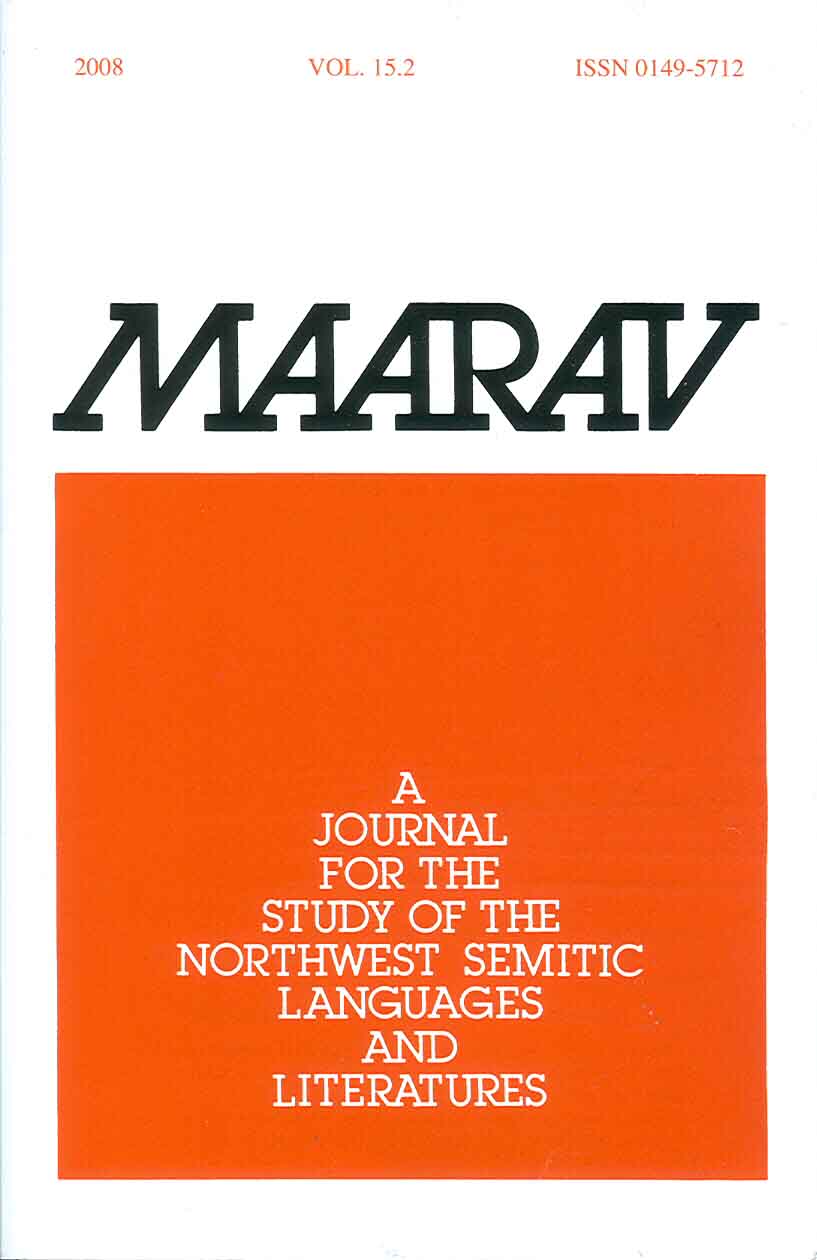
The arrival of the most recent issue of MAARAV (15.2) was a poignant blend of joy and melancholy. Joy in that my article about the odd Hebrew word galgal was finally published, and melancholy in that this will likely be my last academic article. I began publishing academic pieces back in the early 90’s and kept a steady stream going until being abruptly dismissed from Nashotah House. Research requires a regular, steady employment situation with access to obscure materials and a somewhat predictable teaching load. Since being cast into the outer darkness of the adjuncts’ world, well, it’s awfully dim out here to try to devote the scant free time to in-depth study. Such is the world of academics.

This article was a spin-off of a much larger project – a book that was completely written and rejected by a noteworthy publisher and lies dormant on a hard-drive somewhere – on the weather terminology in the Psalms. Several publishers expressed minimal interest, and this article was an effort to demonstrate how weather language has been sublimated due to faulty methodology. The unusual word galgal likely derives from a root with connotations of circularity. Nineteenth-century travelers in the Levant associated the word with tumbleweeds, and this association has stuck ever since. In my article I sort through the lexical information seeking some kind of consensus in the West Semitic language family for a more solid understanding of this troublesome lexeme. To the unbiased observer, the earlier favored translation of “whirlwind” still holds a considerable amount of evidence.

This particular paper holds an enduring place in my memory. I first read it at the Society of Biblical Literature Annual Meeting in 2001 in Denver. Well, I started to read it. The morning of my paper I’d visited the Denver Museum of Nature and Science to see the famed dinosaur and mineral exhibits. While in the museum I became violently ill and had to take a taxi back to my hotel. When I tried to read the fated paper that afternoon, nausea swept over me and I couldn’t finish it. Somehow, returning to a project that had made me physically ill held little appeal, no matter what its academic merits. The paper sat, forgotten, until I thought to submit it to MAARAV a couple years back. Now it awaits the criticism of others while I move on to other things. I do hope that this humble contribution to Hebrew lexicography might be taken seriously since like Denver’s dinosaurs, it is the last of its kind.


God and the Boss

I seldom gush, nor am I given to great displays of emotion. Although I appreciate great accomplishments in others, I have never considered a living person a hero. Only Bruce Springsteen. An article in the newspaper yesterday described the first academic conference on the Boss’s music, held right where it all began — New Jersey. Unfortunately unable to attend, I relish the fact that others see in Springsteen what must be something like I see.

Last year at the Society of Biblical Literature Annual Meeting in Boston, I picked up a copy of a new book, The Gospel according to Bruce Springsteen, by Jeffrey Symynkywicz (Westminster John Knox, 2008). I am not a fan of “Gospel according to —” books, but there is a trenchant depth of struggle with religion embedded in Bruce’s songs that transfixes me almost as much as Melville’s Moby Dick. Now, this is deeply personal with me. I don’t discuss my amazement that borders on worship of Springsteen with anyone. Coming from a decidedly blue-collar background, and having wrestled against circumstance for everything I’ve earned, including my degrees, I hear resonances of empathy throbbing through what Bruce sings. He is not an icon; he is an authentic human being. And his music is a gospel.

Boss

I haven’t read Symynkywicz’s book yet. Whenever I’ve tried to read the popular bios of the Boss I soon become frustrated at how trite they all make it sound. Having survived (barely) the Reagan-Bush era with its utter lack of sympathy for the condition of most Americans, sometimes I just need to crawl into the corner alone, slip on the headphones, and listen to Nebraska over and over again.