
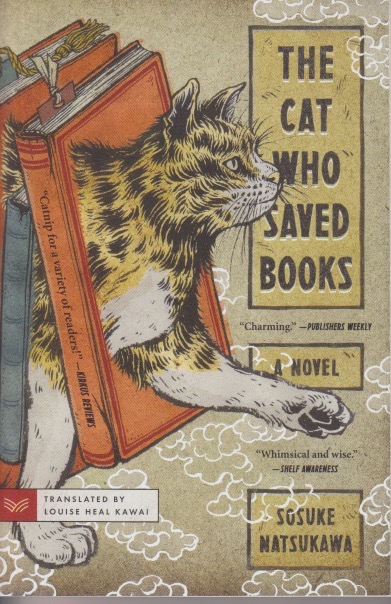
Sometimes I go into an independent bookstore and just look what’s on the shelf. Often this ends up being an attempt to find a book that isn’t monstrous in length. Much of what’s currently on offer is long, but I grew up reading 128-page paperbacks (not great literature, granted) that set my expectations. Now, I do read long books. Since books and movies are staple topics for discussion on this blog, however, I need to keep things moving in both kinds. All of which is to say that I picked up Sosuke Natsukawa’s The Cat Who Saved Books because it was short. This particular bookstore was one where I know and trust the owner’s taste. I’d bought Haruki Murakami’s works there before. I really didn’t know what I was getting into this time, though. I like cats. I like short books. I like the Japanese authors I’ve read. So.
The BISAC code on the back of this one didn’t state that it was fantasy. I like some fantasy fiction, but my tolerance is limited. The fault is mine entirely; I own that. I enjoy speculative fiction and a book with a talking cat felt like it might fit that niche. I thought the story of The Cat Who Saved Books was good, and the message was sound. But it felt a bit trite. The previous Japanese author I’d read was Murakami, and he’s pretty incredible. I can give you a taste of this book, however, and raise a question about it. A teenage boy is left taking care of his grandfather’s bookshop after his guardian dies. A talking cat appears and leads him to four labyrinths where the boy has to rescue books that are being misused. His arguments to save them don’t seem profound, but something might’ve been lost in translation.
The question is that one of the characters claims to be a book almost two-thousand years old that has had more influence than any other book. Was this the Bible? Interestingly, nearly every book mentioned in this novel is from the “western canon.” I have to wonder if this particular book, which is a rather severe character, is the Good Book. I don’t suspect there’s any way to find out, really. Still, it seems to fit the sense that Natsukawa uses. This is an innocent enough fantasy novel. I guess I prefer my fantasy to have solid rules laid down so that I have an idea what to expect. But then again, my perspective is that of a primarily western reader, and one who craves short books now and again. I’m open to learn.
 Steve A. Wiggins