Geography Quiz

With my daughter’s encouragement, I’ve taken an interest in geography.  While not exactly an isolationist, I’ve often thought that America trying to impose its will on foreign nations is generally wrong-headed.  Still, when I read histories of the early United States, it appears that the desire to own and organize everything from Atlantic to Pacific makes sense to a particular outlook.  Taking the land from its rightful owners was clearly wrong.  It seems that wherever there are borders people fight.  I’ve been quizzing myself on geography and I’m getting fairly decent at identifying countries (not all of them, and not always correctly).  Doing so has led to some learning opportunities.  Africa was, of course, heavily colonized even into my own lifetime.  Only recently have we begun to realize that people should have the right to independence—sounds familiar, right America?

There are lots of quiz games available on the internet that help making these identifications fun.  I’ve learned that the newest country recognized is South Sudan, in Africa.  It became independent just twelve years ago, breaking away from Sudan.  South Sudan is one of the least developed nations in the world—I suspect that some of these conditions contributed to the desire for independence.  Another thing that becomes evident in learning geography is just how much disputed territory there is.  Thousands, probably millions, of lives are lost over border disputes.  This seems like such a testosterone-driven form of politics that patriarchy ought to be thoroughly ashamed of itself.  The United States still plays these games as well, backing our favorites, despite the will of the people.

One nation that consistently shows up in these quizzes is Western Sahara.  Apparently this is still a disputed territory, colonized by Spain but released from its control in 1975.  Immediately fighting broke out between Morocco and Mauritania, its neighbors.  Both wanted control of the region.  The territory is one of the most sparsely populated in the world, being mostly Sahara, but even so it’s worth fighting over, in the strange geography of the human psyche.  I often ponder our apparently insatiable urge to fight and control.  As if we can really control anything.  All it takes is a thunderstorm to park over an area for four hours and any house will begin to feel the damage.  Nobody’s really in control, as you’d think events in Russia might underscore.  It seems unbelievable to me that a world so connected—entangled even—with the internet would still insist on disputing who owns this rock or that.  Just think how much we could accomplish if we’d even allow for a little leeway in our geography.

Remember this?

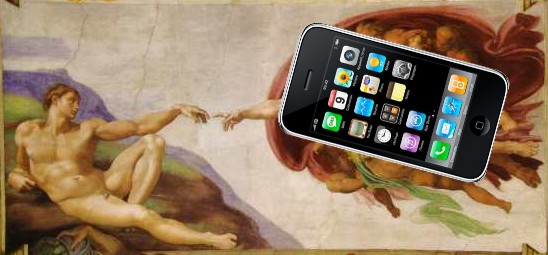
Church of Siliconism

Some of us have been dragged into the electronic age kicking and screaming. Our apartment at home is full of books, and they are made of paper, not plastic. In college, some of my friends and I vowed we would never use computers—harbingers of a cold, new age. It was a vow I kept until working on my doctorate (pretty much). Despite keeping this blog, I really have very little native intelligence about the world of circuit-board, integrated circuit, and chip. I would probably be the last person to have thought to ask for an iPhone—I frequently forget to take my cell phone with me, and when I do, I sometimes neglect to turn it on. So I was stunned to find an iPhone with my name on it yesterday. I looked at it like an alien baby, wondering what it might eat. As the day wore on, however, I started to see some of what it might offer.

Siri, the software personal assistant for iOS, responds in a friendly voice to questions asked. “She” (and you can’t help personifying her) is like a personal portal to the mind of the Internet. You want a pizza? Siri knows the location of all the places in your neighborhood that deliver. You wonder what the most recent nation in the world is? Siri will look that up for you. (South Sudan, as of yesterday, according to her sources.) My brother-in-law, intrepid with electronics, and knowing my background, asked Siri about God. She replied, “Humans believe in spiritualism. I believe in siliconism.” Someone at Apple clearly has a sense of humor, but the more I began to parse this statement, the more I realized Siri could use a personal assistant in the religion field.

Spiritualism is not the same as spirituality; the former is the belief in ghosts and the religions that accompany that belief, such as Theosophy. Clearly in an American market, any product that denied belief in God, even by implication, would become the product of a witchhunt. The sad image of heaps of iPhones being melted as leering evangelicals look on is disturbing but unfortunately easy to conjure. Best to program Siri to deflect any potential ire with humor. The second component of her pithy reply is siliconism. As a religion, it is clearly underway all ready. Who reading this blog can imagine life without electronic media? Be honest! What does a computer believe? Do androids dream of electric sheep? Does Siri say her prayers as she’s being shut down for the night? What does it mean to believe? So now I have an iPhone. The day before yesterday I couldn’t find my app with both hands. Now I have a personal religion consultant. I suspect I’ll be starting a new religion by the end of the day—the First Church of Christ, Programmer. Its headquarters will be wherever a true believer is located at the moment, as long as s/he has an iPhone. Blackberry users will, of course, be considered heretics.